John Wesley’s Evangelistic Forerunners: The Puritans

John Wesley (d. 1791)For more on the Puritans’ influence on John Wesley’s thought and preaching, see Robert Monk’s John Wesley, His Puritan Heritage: A Study of the Christian Life (1966); John Newton’s Susanna Wesley and the Puritan Tradition in Methodism (2003); Roland Burrows’ John Wesley in the Reformation Tradition: The Protestant and Puritan Nature of Methodism Rediscovered (2008).

It is a well-known fact among historians of revival that John Wesley stands out as the first great revivalist in the Evangelical tradition. Honestly, this is debatable, because Jonathan Edwards’ revival in Northampton, Massachusetts came before Wesley’s revival. But the revivals of Edwards were short lived and not long lasting; the same went for the powerful revivals of George Whitefield, who was influenced by Wesley. But Wesley had a long lasting revival impact on the Methodist Bible study groups, and so he has the tendency to shine out above all other revivalists as the first GREAT revivalist. (The second great revivalist being Charles Finney.) When I speak of “revival,” I am referring to the original meaning of the word, as it was used during the first Great Awakening. It is a PURITAN and EARLY METHODIST renewal of GOSPEL PREACHING and PRACTICAL HOLINESS in the daily lives of Christians. That is revival. It is rooted, grounded, and maintained in conversion experiences brought about by powerful Gospel preaching, by men called either “evangelists” or “revivalists.”

In addition to being a great Gospel preacher, Wesley was an avid reader and an Oxford scholar. He edited a 30 volume work called “A Christian Library.” The subtitle says: “Extracts From and Abridgments of Choicest Pieces of Practical Divinity.” It is good to have access to this work of Wesley’s, because it shows us who his theological influences were–that is, who he looked up to, his favorite preachers. To save you the time and research, let me tell you as simply as I can: most of them are PURITANS. In addition to all the Puritan works he included, he also has some Pietist (Johann Arndt, August Hermann Francke), Quietist (Fenelon, Miguel de Molinos), and Cambridge Platonist (John Smith) material in there as well.

I sifted through his “Christian Library” a few times, and out of all the Puritan names he includes in his anthology, the following stand out to me as probably strong influences on Wesley so far as his (1) Gospel Preaching and (2) Open Air Preaching were concerned.

Robert Bolton (d. 1631) left us The Four Last Things: Death, Judgment, Hell, Heaven.

Joseph Alleine (d. 1668) wrote An Alarm to Unconverted Sinners, (also called A Sure Guide to Heaven), and many other similar things.

John Bunyan (d. 1688) left Some Gospel Truths Opened, The Doctrine of the Law and Grace Unfolded, and many other convicting Puritan material that he preached in the open air. It seems Bunyan was the only well-known open air Puritan preacher.

John Flavel (d. 1691) wrote The Method of Grace in Gospel Redemption.

Richard Baxter (d. 1691) wrote A Call to the Unconverted, What We Must Do To Be Saved, and many other convicting things about the Gospel and practical holiness.

Jonathan Edwards (d. 1758) left us “Sinners in the Hands of an Angry God,” and many other fire and brimstone sermons; and was Wesley’s contemporary along with George Whitefield.

The Puritans Were Evangelistic Calvinists

It is worth noting that all of these preachers were “Calvinists,” but I use quotes because they were not your usual dead, speculative, inactive Calvinists. They were Puritans, and that meant they were EVANGELICAL CALVINISTS–that is, they believed in preaching the Gospel to get people saved. After James Arminius died in 1609, Puritan theology was in constant dialogue with the concepts of Calvinism and Arminianism all the way up till the Great Awakening in the 1730s. (And so it is today.) This Calvinism-Arminianism dialogue even led Richard Baxter to take a mediating view of four point Calvinism, instead of the classic five point TULIP. Following suit with the established position of the Church of England at the time, John Wesley chose to reject all Calvinism, which gave the early Methodists a distinct Arminian approach to their Gospel preaching. He expressed his Arminian views most clearly in his book Predestination Calmly Considered. Wesley had open air preaching in common with the Puritans of old, but had Arminianism in common with the spiritually dry clergy of the Church of England. Thus, Wesley combined what he felt were the best of both worlds, and formed the Methodist Gospel approach: EVANGELICAL ARMINIANISM. Francis Asbury, Adam Clarke, and other Methodist preachers followed suit. J. I. Packer, in his chapter 18 of “Puritan Evangelism” in A Quest for Godliness, also mentions other Puritan evangelists and their theology: Hugh Clark, John Cotton, Westminster Confession, Westminster Shorter Catechism, John Owen, Thomas Watson, Thomas Goodwin, etc.

Puritan Evangelism Was Mainly Confined to the Church Building

The only downside of the Puritan approach to evangelism, at least according to Packer’s overview, is that it seemed to downplay street preaching. The normal way was to preach Gospel sermons during church services, because it was done in the view of Calvinism: that God would elect people in the world, according to His grace and predestination, and would draw them by His Spirit sovereignly to a Puritan church service. Then, at the Puritan church service, the church attendee would hear the pastor preaching about justification, regeneration, repentance, faith, sanctification, and election, and other soteriological subjects–this would get the people permanently and lastingly saved, bearing goodness and holiness in their lives. So the Puritan’s church building was viewed as an evangelistic center, not as a missions sending base for street preachers. The church was the place to preach, the pastor was the one to do the preaching of the Gospel, and it was God’s responsibility to draw people to the church and get saved. There was not much evangelism or active outreach to the public in the streets or elsewhere. Unless, of course, you were John Bunyan (d. 1688)–but we know that led him to prison. We should also be aware that the Church of England, which had full legal control over the British government at the time, was persecuting the Puritans: so they were really in hiding.

Modern Calvinists Give Finney a Bum Rap,
And Discourage Preaching About Immediate Repentance

Another thing I did not like about Packer’s evaluation, is that he discredits the evangelistic method of Charles Finney (d. 1875). (Like most Calvinists.) Packer is right in that he labels Finney as a Pelagian (one who believes it is possible for all men to obey God’s law with natural human ability). That was one of Finney’s greatest theological errors; but, at other times in his writings, he comes to express things that could be shown to be Arminian or synergist in nature, explaining that the influence of the Holy Spirit is necessary to bring men to repentance, faith, and a life of holiness. Oh well, Finney was not trained as a theologian, but as a lawyer. And, it was just that kind of background that God used to make him one of the most powerful Gospel preachers of all time. Finney is widely regarded today as the primary revivalist of the Second Great Awakening. He was so experienced in starting revivals in upstate New York, that he wrote a manual on how to start revivals, called Lectures on Revivals of Religion. One of the aspects of Finney’s approach to evangelism, that of the so-called “New School Calvinism” theology, was unlike the passive view of some Puritans. Finney took hold of a “I have to go out there at get ‘em now” approach. True, God draws men to Christ, but Christians also have a responsibility to obey the voice of Christ: “Go out to the roads and country lanes and make them come in, so that my house will be full” and “go into all the world and preach the Gospel to every creature” (Luke 14:23; Mark 16:15, NKJV).

Packer says the following in critique of Finney’s pro-active “go get ‘em” approach. He compares the old way of Puritan in-church evangelism with the approach of Finney, which was to go out and hold evangelistic meetings, and persuade his hearers to “REPENT RIGHT NOW.” This is how Packer handled Finney’s preaching. In other words, says Packer, if you want to be a Puritan-style evangelist, then don’t be like Finney:

Preachers are to declare God’s mind as set forth in the texts they expound, to show the way of salvation, to exhort the unconverted to learn the law, to meditate on the Word, to humble themselves, to pray that God will show them their sins, and enable them to come to Christ. They are to hold Christ forth as a perfect Saviour from sin to all who heartily desire to be saved from sin, and to invite such (the weary and burdened souls whom Christ Himself invites, Mt. 11:28) to come to the Saviour who waits to receive them. But they are not to do as Finney did, and demand immediate repentance and faith of all and sundry. They are sent to tell all men that they must repent and believe to be saved, but it is no part of the word and message of God if they go further and tell all the unconverted that they ought to “decide for Christ” (to use a common modern phrase) on the spot…Bullying for “decisions” thus in fact impedes and thwarts the work of the Holy Spirit in the heart. Man takes it on himself to try to bring that work to a precipitate conclusion, to pick the fruit before it is ripe; and the result is “false conversions,” hypocrisy and hardening.

Why?! With all due respect to Packer as a theologian and a serious man of God, wouldn’t this sort of reasoning be convenient for a lukewarm and man-pleasing pastor? Is Packer just being unloving, apathetic, and unconcerned for the lost on their way to an eternal Hell?! I doubt that. But his logic against preaching immediate repentance doesn’t seem to mesh well with a desire to seek and save the lost. How could anyone, with a clear conscience, ever tell evangelists to preach the Gospel as abstract doctrines of salvation, but not in such a way as to make it clear that the hearers are in great need of repenting, believing, and giving their lives to God immediately? They could die immediately and go to Hell immediately if they die in their sins! Why not preach they need to apply the blood of Christ and repent as soon as possible? Now! Maybe Packer believes the grace of God forces men to repent against their sinful will, so there is no point in pressing the issue now. But THERE IS A PROBLEM WITH THIS! How many thousands of people, hearing a gospel preached in such a passive manner, will think to themselves, “Oh, well then, God is loving and gracious. I don’t have to repent right now and live by the Ten Commandments right now. I’ll wait until I’m on my death bed, then I’ll repent.” Then, after the church services, they get in car crashes, die, and go to Hell—and they can’t get out. Trapped in Hell, burning forever and ever. All because some gentle pastor didn’t want to “bully” his congregation (his source of income), with harsh and pressuring sermons, about the need to escape the judgment of an everlasting fire in Hell; all because of this kind of thinking. I reply to this respected scholar of Puritanism with quotes from the renowned Puritan evangelist, Joseph Alleine (d. 1668), so we can share in his spirit of urgency:

“There is no entering into Heaven but by the strait passage of the second birth; without holiness you shall never see God (Heb. 12:14). Therefore GIVE YOURSELVES UNTO THE LORD NOW.” (A Sure Guide to Heaven, p. 16).

“There is every reason in the world that YOU SHOULD IMMEDIATELY TURN AND REPENT.” (A Sure Guide to Heaven, p. 67).

Arminianism Is Perfectly Biblical and Logical When Applied Evangelistically

John Wesley, George Whitefield, and the early Methodist circuit riders did lots of open air preaching along these lines. And Finney too would have fit in quite well with the early Methodists. Arminianism does that to Gospel preachers: TAKE ACTION! DO SOMETHING RIGHT NOW! REPENT! REPENT! BELIEVE THE GOSPEL! NOW!! Whether God opens the hearts of the elect as you preach, or after, is none of the preacher’s business. There is no way the preacher can know that until after the fact. The preacher must preach repentance; that’s his responsibility before God. And, I think it is obvious in the Bible, that the style through which it is presented by John the Baptist, Jesus, and the apostles: repentance is always supposed to be preached in a “please do it right now—I’m warning you in love” kind of way!

Posted in Uncategorized | Leave a comment

Books for Hell Fire Preachers

UPDATED BIBLIOGRAPHY: 7/1/12

Puritan, Methodist, and Evangelical Books on Hell

Clearly the greatest Hell fire preacher in all of church history was, and still is, Jonathan Edwards (d. 1758); the man who preached the sermon “Sinners in the Hands of an Angry God.” Any evangelist, or Gospel preacher, should turn to Edwards’ writings if preaching on Hell is to be taken seriously. However, Edwards was not the first Hell fire preacher. He was the last preacher in the Puritan tradition: a tradition in which there were many other preachers, who graphically displayed Hell fire and brimstone:–the literal Biblical view of eternal damnation: the doctrine of eternal punishment. Christopher Love’s Hell’s Terror (1653), John Bunyan’s A Few Sighs from Hell (1658), and Thomas Vincent’s Fire and Brimstone (1670) were well known Puritan classics on the subject. Avoiding artistic license, and preaching strictly from the Bible, and dreams and visions, these preachers were not like the Puritan poet John Milton, who authored Paradise Lost (1674), an imaginary, fictional poem about Hell: what Dante’s Inferno was in the Middle Ages. The Puritans were serious Hell fire preachers. They took theology seriously, the Christian life seriously, and the doctrine of eternal punishment seriously. Their whole purpose in ministry was to ensure the salvation of themselves and their listeners from eternal damnation in Hell. The modern Fundamentalist and Evangelical establishment has descended from the Puritans; and we would be wise to remember these old paths (Jeremiah 6:16).

As noted previously, Edwards has been considered the “last Puritan,” and died in 1758. Coincidentally, that is exactly 100 years after Bunyan’s book on Hell was published; perhaps, then, it would be right to say that 1658-1758 was a Golden Age of Puritan Hell Fire Preaching. But the life and ministry of Jonathan Edwards gave rise to a new expression of Christianity called Evangelical Revival. Edwards was, at the same time the “last Puritan” and the “first Revivalist”; the others who continued the new Revivalist tradition were John Wesley (d. 1791) and George Whitefield (d. 1770), the founders of Methodism. Because Wesley was an Arminian “Puritan”, and Whitefield a Calvinist “Puritan”, they eventually parted ways, on polite terms. Wesley went on to lead the Methodist Church and Whitefield the Calvinistic Methodists; both of them were hard working evangelists; however, Wesley preached on free will, and Whitefield on predestination (adopting Edwards’ Calvinistic Puritan tradition). Wesley drew his inspiration from Arminian Puritans like John Goodwin and Richard Baxter; and other Anglican preachers. Nevertheless, both Wesley and Whitefield, pushing their own versions of Methodist Revivalism—were definitely Hell fire preachers, as well as preachers of righteousness.

Before liberal theology entered the Methodist Episcopal Church: their preachers were committed to preaching on Hell (eternal punishment), as well as Baptists, Presbyterians, and others who inherited the Puritan tradition. But, it seems, that during the early nineteenth century with Charles Finney (d. 1875) (though not necessarily because of him): Hell fire preaching declined; and morality and ethics became the main focus of the Christian life for Evangelicals. This seems to have given rise to Universalism and Humanism; and no doubt, because of the Enlightenment focus on science, skepticism, reason, and a general loss of faith in the existence of the spirit world.

Rare Puritan books on Hell can be found either on amazon.com or heritagebooks.org. Also, publishers worth noting, who are publishing Puritan books on Hell, and other classics, are: International Outreach (intoutreach.org), Soli Deo Gloria Publications, The Northampton Press, Old Paths Gospel Press, and Diggory Press. Hell fire preachers would do well to pay special attention to the following authors (in this order): George Whitefield, Jonathan Edwards, Thomas Vincent, Robert Peterson, John Bunyan, Isaac Watts, Thomas Boston, Christopher Love, Solomon Stoddard, A. W. Pink, William G. T. Shedd, Thomas Doolittle, and Harry Buis.

Probably the best old-time theologians who have written about Hell:
Jonathan Edwards, Thomas Vincent, John Bunyan, Thomas Boston, Christopher Love

Probably the best modern theologians who have written about Hell:
Edward Donnelly, Robert Peterson, William G. T. Shedd, R. L. Dabney, and John Walvoord

Allison, Gregg. Historical Theology: An Introduction to Christian Doctrine. Grand Rapids, MI: Zondervan, 2011. Chapter 32: “The Final Judgment and Eternal Punishment.” Heavy reliance on the church fathers.

Bartlett, Samuel. Life and Death Eternal: A Refutation of the Theory of Annihilation. Boston: American Tract Society, 1866. 390 pages.

Baxter, Mary K. A Divine Revelation of Hell. New Kensington, PA: Whitaker House, 1993. A Pentecostal prayer warrior explains her 40 day out-of-body experience in Hell; as she is guided by the Lord Jesus.

Blanchard, John. Whatever Happened to Hell? Darlington, UK: Evangelical Press, 2003. Foreword by J. I. Packer.

Boston, Thomas. Hell. London: Diggory Press, 2007. A Scottish Presbyterian with a Puritan leaning; died in 1732. 96 pages.

Buis, Harry. The Doctrine of Eternal Punishment. Philadelphia: Presbyterian and Reformed, 1957. 148 pages.

Bunyan, John. Sighs from Hell: The Groans of a Damned Soul. Edited by Don Kistler. Orlando, FL: The Northampton Press, 2011. 160 pages.

_________. Groans of a Lost Soul. Old Paths Gospel Press. 144 pages.

Byun, Seung Woo. Christians Going to Hell. Lake Mary, FL: Charisma House, 2006. A South Korean preacher lays out the Gospel in a hard-hitting attack on Hell-bound hypocrites and churchgoers.

Clarke, Adam. Clarke’s Christian Theology. Salem, OH: Schmul Publishing, 1990. Chapter 33: “Hell.” 438 pages.

Dabney, R. L. Systematic Theology. Edinburgh, UK: The Banner of Truth Trust, 1985. Chapter 46: “Nature and Duration of Hell Torments.” 903 pages.

Doolittle, Thomas. Rebukes for Sin by the Flames of Hell: A Terrifying Look at Eternity. Ames, IA: International Outreach, 2011. 105 pages.

Donnelly, Edward. Biblical Teaching on the Doctrines of Heaven and Hell. Edinburgh, UK: The Banner of Truth Trust, 2001. Chapters 1-4. 144 pages.

Edwards, Jonathan. The Torments of Hell: Jonathan Edwards on Eternal Damnation. Edited by William Nichols. Ames, IA: International Outreach, 2006. 18 fire and brimstone sermons by Jonathan Edwards. 334 pages.

Erickson, Millard. Christian Theology. Grand Rapids, MI: Baker Books, 1998. Chapter 60: “Final States.”

Finney, Charles. “The Loss When a Soul is Lost.” The Oberlin Evangelist. July 2, 1851.

Geisler, Norman. Systematic Theology: In One Volume. Minneapolis, MN: Bethany House Publishers, 2011. Chapter 79: “The Final State of the Lost (Hell).”

Gerstner, John. Jonathan Edwards on Heaven and Hell. Grand Rapids, MI: Baker Book House, 1980. 93 pages.

_________. Repent or Perish. Morgan, PA: Soli Deo Gloria, 1990. A traditionalist’s response to Edward Fudge’s Annihilationism; Gerstner is like Robert Peterson and John Walvoord in this regard.

Grudem, Wayne. Systematic Theology. Grand Rapids, MI: Zondervan, 1994. Chapter 56: “The Final Judgment and Eternal Punishment.”

Hodge, Charles. Systematic Theology. Vol. 3. Peabody, MS: Hendrickson Publishers, 1999. Part IV. Chapter 4.6: “Future Punishment.”

Ingebretsen, Edward. Maps of Heaven, Maps of Hell: Religious Terror as Memory from the Puritans to Stephen King. M E Sharpe, 1996.

Love, Christopher. Hell’s Terror, or, A Treatise of the Torments of the Damned as a Preservative Against Security. EEBO, 2011. Love (d. 1651) was one of Puritanism’s most renowned Hell fire preachers before Edwards. 140 pages.

Lutzer, Erwin. One Minute After You Die. Chicago, IL: Moody Publishers, 1997. Chapters 2 and 6.

Merrill, S. M. The New Testament Idea of Hell. London: Richard D. Dickinson, 1879. Old-school Methodist bishop and preacher who had very strong views of Wesleyan soteriology; provides arguments against Universalism.

Morgan, Chris. Jonathan Edwards and Hell. Fearn, Scotland: Mentor, 2004. 176 pages.

_________, and Robert Peterson, eds. Hell Under Fire: Modern Scholarship Reinvents Eternal Punishment. Grand Rapids, MI: Zondervan, 2007. 256 pages.

_________, and Robert Peterson. What is Hell? Phillipsburg, NJ: P&R Publishing, 2010. 40 pages.

_________, and Robert Peterson, eds. Is Hell for Real or Does Everyone Go to Heaven? Grand Rapids, MI: Zondervan, 2011. 96 pages.

Peterson, Robert. Hell on Trial: The Case for Eternal Punishment. Phillipsburg, NJ: P&R Publishing, 1995. 258 pages.

_________. “Part Two: The Case for Traditionalism” in Two Views of Hell. Downers Grove, IL: InterVarsity Press, 2000.

Pink, A. W. Eternal Punishment. Bottom of the Hill Publishing, 2011. Recommended by International Outreach.

Pusey, Edward. What is of Faith as to Everlasting Punishment? Nabu Press, 2012. Deals extensively with the writings of the pseudepigrapha, the Talmud, church fathers, martyrs of the early church, and the Desert Fathers, and their affirmation of Hell as a literal place of eternal punishment.

Shedd, William G. T. The Doctrine of Endless Punishment. Solid Ground Christian Books, 2008. 220 pages.

Stoddard, Solomon. The Fear of Hell Restrains Men from Sin. Morgan, PA: Soli Deo Gloria, 2003. Timeless Hell fire sermon by the grandfather of Jonathan Edwards. 20 Pages.

Strachan, Owen, and Doug Sweeney. Jonathan Edwards on Heaven and Hell. Chicago, IL: Moody Publishers, 2010.

Turner, Alice. The History of Hell. Orlando, FL: Harcourt Brace & Co., 1993. Although written by an unbeliever, this book can provide a historical resource for major works on Hell, particularly from the 1600s and on, from the Puritan and Evangelical traditions.

Vincent, Thomas. Fire and Brimstone. Morgan, PA: Soli Deo Gloria, 1999. 250 pages.

_________. Fire and Brimstone in Hell. Ames, IA: International Outreach, 1994.

Walls, Jerry. Hell: The Logic of Damnation. Notre Dame, IN: University of Notre Dame Press, 1992.

Walvoord, John. “The Literal View” in Four Views on Hell. Edited by Williams Crockett. Grand Rapids, MI: Zondervan, 1996.

Watts, Isaac. The World to Come. Morgan, PA: Soli Deo Gloria, 2003. 431 pages. A Great Awakening preacher argues convincingly for the Biblical view of Heaven and Hell.

Wesley, John. “Of Hell” in The Works of John Wesley, vol. 3, Sermon #73. Edited by Albert Outler. Nashville, TN: Abingdon, 1986.

Whitefield, George. The Eternity of Hell Torments. Gale ECCO, 2010. 36 pages.

Wiese, Bill. 23 Minutes in Hell. Lake Mary, FL: Charisma House, 2006. A conservative Christian shares his out-of-body experience in Hell; and backs it up with Biblical theology.

_________. Hell: Separate Truth from Fiction and Get Your Toughest Questions Answered. Lake Mary, FL: Charisma House, 2006. 368 pages.

OLD BIBLIOGRAPHY: 12/27/11

Arendzen, J. P. Eternal Punishment, 1928. (old Catholic)
Brine, John. A Vindication of Divine Justice, 1754. (TULIP Calvinist).
Donnelly, Edward. Heaven and Hell, 2002. (Reformed).
Edwards, Jonathan. “Of Endless Punishment” and “The Eternity of Hell Torments,” 1700s (Congregational).
Goulburn, Edward. Everlasting Punishment, 1880.
Gulliver, John. Law and Penalty Endless, 1873. (Congregational)
Lee, Luther. Universalism Examined and Refuted; And the Doctrine of Endless Punishment Established. (Puritan). 1700s.
Peterson, Robert. Hell on Trial: The Case for Eternal Punishment, 1995. (Reformed).
———- and Christopher Morgan, Hell Under Fire, 2004. (Reformed).
———- and Christopher Morgan, What is Hell?, 2010 (Reformed).
Pink, A. W. Eternal Punishment. (Calvinist).
Randles, Marshall. For Ever: An Essay on Eternal Punishment, 1878.
Shedd, William. The Doctrine of Endless Punishment, 1885. (Calvinist).
Stoddard, Solomon. The Fear of Hell Restrains Men from Sin, 1700s. (Puritan).
Walvoord, John. “Literal View” in Four Views on Hell, 1997. (Reformed).
Wesley, John. “Of Hell” (Sermon 73). (Wesleyan Arminian).
Wiese, Bill. 23 Minutes in Hell, 2006. (Reformed Charismatic).
——–. Hell: Separate Truth From Fiction, 2008.

Posted in Uncategorized | Leave a comment

Inviting Strangers Into Your Home for Bible Study

“I was a stranger and you invited me in.” –Matthew 25:35

Recently, I believe the Lord Jesus graciously gave me a revelation of how to start a house church in an apostolic way, within the 21st century context. And that entails:

1. Open Air Preaching–On State Universities.

2. Open Air Preaching–The Gospel, Being Guided by John Wesley.

3. Using a Stand Alone Sign–Beside Me As I Preach, That Says: “Join Us for Home Bible Study.” And, on this sign, we will have attached to it, a card holder with “True Life Ministries” cards containing our e-mail address. At the bottom of the sign, TRUE LIFE MINISTRIES printed; and under it: wesleygospel.com.

4. Invite Those Who E-Mail Us to Home Bible Study.

I put this idea across my wife and she is in full agreement. But I put it across another loved one, and she disagreed. Why this is I don’t really know. Probably because it doesn’t fit her understanding of going to traditional church on Sunday morning.

The Short “Screening Process” Before Letting Strangers in Your Home

Her main objection was, “Well maybe you should first have a Bible study in a coffee house or some public place to get to know them. Then, after you know them, invite them to your house.” This was really kind of a half-approving statement. And, at first it seemed reasonable to me, but when I rethought it, I realized it does not line up with the New Testament. Jesus said, “I was a stranger and you invited me in” (Matthew 25:35). He was referring to Christians reaching out to strangers in Christ’s name, as a service to Christ Himself. I think the whole philosophy of “first we’ll meet in a public place and talk, then we’ll meet in our home” is a cloaked kind of unbelief, lack of trust, and lack of faith in Christ’s Word. If you feel compelled to obey Christ’s commandment to invite a stranger into your house, then you should have the faith to believe that He will honor that, and help you do it. But this doesn’t mean there is no “screening process” at all. We’ve made it work before, where we communicate through e-mail with a stranger interested in house church, talk on the phone for half an hour or more, to see what we both believe, what we’re like, see if we’ll get along, etc. By the end of the phone conversation, you pretty much have a feel for what kind of person you’re dealing with. No, you haven’t seen their face yet. But you’ve talked to him or her; and you know where they’re coming from. That should be enough. Anything less than that would be a total lack of faith, in my opinion. Agree on a Bible study time, and then give them your address.

Why Are You Worried About Inviting Strangers Into Your Home?

Where do you draw the line? With the whole public-to-home meeting transition–how many meetings does it take to say, “Oh, I know this person. Now, they are allowed into my house?” Faith is required eventually. Risks must be taken. Are you paranoid, fearful, and worrying all the time that burglars are going to come in unawares, and steal from you? Or sexual offenders or murderers? Then don’t. Take Jesus’ advice, and don’t be so attached to your possessions: “Do not store up for yourselves treasures on earth, where moth and rust destroy, and where thieves break in and steal” (Matthew 6:19). Which is more important to you? Reaching out to strangers, impacting them with the Gospel, and ushering them into the kingdom of God? OR–being so obsessively worried that somebody’s going to steal something when you’re not looking? Are PEOPLE more important to you than THINGS? Or is it the other way around? If you’re gonna do the house church Bible study thing–then at some point, you’re going to have to make PEOPLE your priority. Stop worrying about your STUFF. Get people saved! Make Christian friends out of those strangers! You won’t be strangers for long if you study the Word together. Discernment and discretion are always advised, but FAITH and RISK-TAKING are also advisable. Especially since the Bible says things like, “Do not neglect to show hospitality to strangers, for by this some have entertained angels without knowing it” and “‘Go out to the roads and country lanes and make them come in, so that my house will be full” (Hebrews 13:2, NASB; Luke 14:23).

Posted in Uncategorized | Leave a comment

The Pursuit of Prophetic Accuracy

Each of these books deal with the much needed area of “prophetic accuracy.” They should include some very reliable pointers to avoid “missing God.”

1. Bill Hamon’s Prophets Pitfalls and Principles
2. John Tetsola’s Developing Prophetic Accuracy
3. Cindy Jacobs’ The Voice of God
4. Greg Haslam’s Moving in the Prophetic
5. Leonard Ravenhill’s America is Too Young to Die
6. Sam Storms’ The Beginner’s Guide to Spiritual Gifts

Posted in Uncategorized | Leave a comment

Good Locations for Open Air Preaching

1. Downtown City Parks. Every city has its own “central park” just like Manhattan. Raleigh, NC has its Moore Square. And many other towns have places like this. Target audience: homeless, beggars, sick, poor people. Sometimes you will find elderly people walking through the park or families.

2. Courthouses. Great environment, especially during the lunch hour, for preaching a “justice of God” type of Gospel message. Justification and repentance makes very much sense in front of a courthouse where criminals are charged and tried before a judge. Somehow Judgment Day just makes more sense in front of a courthouse. Target audience: middle aged lawyers that need to be broken, criminals of all ages–especially the “thugs” and “gangstas”; as well as homeless, beggars, and other inner city employees.

3. State Universities. This is an ideal place to preach the Gospel. Universities are intellectual centers, and a perfect place to spread Christian teachings. Young inquisitive minds of college students, mostly in their early 20s, are trying to find out the meaning of life. At such a time, preaching repentance and conversion through a born again experience, is very ripe. Target audience: college students mainly in their 20s, professors, middle aged commuters, and campus employees. Need some apologetics preparation in the areas of higher Biblical criticism, atheism, Darwinism, and universalism. Josh McDowell’s Evidence That Demands a Verdict and Handbook of Today’s Religions are good; Fritz Ridenour’s So, What’s the Difference?; and Ron Rhodes’ Answering the Objections of Atheists, Agnostics, and Skeptics. Although state universities are public places just like city parks and courthouses, you will need to schedule a time and place for preaching on campus with the Student Activities office, and get a temporary permit from them. Otherwise, the campus police will kick you off campus.

4. Doctor’s Offices or Hospitals. It was recently suggested to me that healing evangelism, at least on a one-to-one basis, might be possible if done in front of a doctor’s office. Provided that you are standing on a public sidewalk, you should have no conflict with the police. Gathering a crowd? I don’t know if that would be possible. Perhaps. I met an old Pentecostal man who regularly prayed for the sick at nursing homes, and he preached, and sung Gospel songs as well. The Gospels and the Book of Acts do not mention doctor’s offices, hospitals, or infirmaries of any kind. This is because they were a Greco-Roman invention. The Jews did not have them, so far as I know. The Jews had doctors, and they used the “balm of Gilead.” But they did not have any hospitals. But as Christianity spread throughout the Roman Empire, churches and monasteries adopted hospitals into their buildings, and the Catholic saints prayed for the sick, as well as provided medical treatments. (So says the Wikipedia article on “Hospital.”) Perhaps we need to seek and save the sick, in the same way we seek and save the lost. Target audience: sick, crippled, and even hopelessly “incurable” people. The focus would be divine healing prayer, with a Gospel message mixed in.

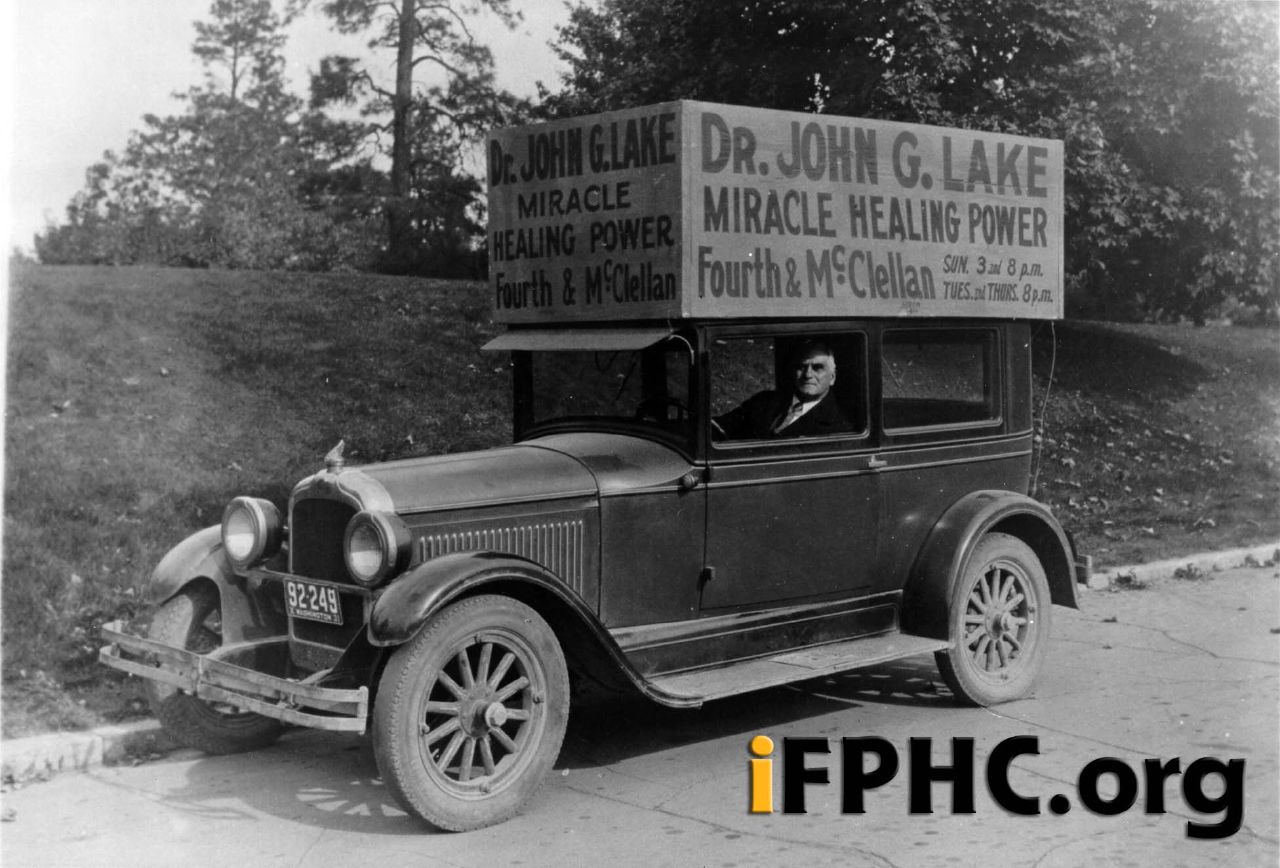
5. Free Open Air Divine Healing Crusades. This is a new concept I just thought about. It dawned on me today that throughout the history of the church, most occasions of miraculous healing in answer to the prayer for the sick, have been performed in church buildings, hospitals, or tent revivals (healing revivals). In the 1400s, St. Vincent Ferrer healed a man on a platform that he was preaching on in the open air; that would be the equivalent to an outdoor “healing crusade.” My goal is I want to publicize the power of God with signs, wonders, and miracles. Cloistered healings within the confines of a hospital or church building may result in nothing more than “preaching to the choir.” But what about showing miracles to a lost and skeptical world? I don’t think it would be a bad idea to preach and teach on divine healing with a portable microphone on college campuses; in addition to this, have signs and banners propped up that say things like: “Dr. John G. Lake, Miracle Healing Power,” “MIRACLE CRUSADE,” or “Receive God’s Miracle.” Basically, the healing crusade model is probably the best for what I’m trying to do: make a public display of divine healing, glorifying the Gospel of Jesus Christ in the open air to the non-Christian. I can think of no other place better to do free healing crusades than at state universities! No tents would be needed for this. However, that’s always an option.

Posted in Uncategorized | Leave a comment

He Wondered At Their Unbelief

“Jesus said to them, ‘A prophet is not without honor except in his hometown and among his own relatives and in his own household.’ And He could do no miracle there except that He laid His hands on a few sick people and healed them. And He wondered at their unbelief” (Mark 6:4-6, NASB).

I Get Prepared for Healing Evangelism on the Streets

For the past week or so, I have been getting my faith excited to go into all the world and preach the Gospel to every creature. To heal the sick, cleanse the lepers, and cast out demons. To preach the Gospel with signs following–ON THE STREETS like Jesus and the apostles. So, finally the opportunity came. I took a shower, dressed up semi-casual, worshiped to a CD, got into the presence of God, read James 1-5, and a little bit of Andrew Murray’s Divine Healing. We did all we could to get our healing-faith heightened for power evangelism on the streets, and to preach the Gospel in the open air. This would be a first for us, for up until now, we had only preached. No prayer for the sick or anything. But I am a Charismatic Christian, I figured, and I need to start acting like it. What advantage do I have over the non-Charismatic? I believe I can work miracles of healing, signs, and wonders, through faith in Jesus, by the laying on of hands! Faith without works is dead, so I figured now was as good a time as any to put this Charismatic faith of mine into practice. I was so excited! I was expecting a healing or two to draw a crowd of 50 to 100 people–and then I would proceed to preach the Gospel of Christ, like John Wesley, and the Great Awakeners: justification by faith, regeneration by the Spirit, and progressive sanctification by obedience to the moral commandments of Christ.

I Preach a Bold Offer of Miracles,
But I Only Get Non-Response and a Beggar Wanting My Money 

So we went down to Moore Square in Raleigh, NC where we live. It was totally an embarrassing disappointment.  After mustering up enough boldness, I shouted, and preached to a group of about 20 people:

“JESUS CHRIST SENT US INTO THE WORLD TO WORK MIRACLES. TO PRAY FOR SIGNS AND WONDERS, AND PRAY FOR THE HEALING OF THE SICK! WE WILL PRAY FOR SIGNS AND WONDERS RIGHT NOW! WE WILL PRAY FOR HEALING!”

I waited for about 15 seconds or so, and a poor homeless lady on the park bench called me over. “Hello. Do you have a sickness I can pray for?” I said. She replied, “Well, I’ve got this cast on my wrist, but it’s alright for now. I was wondering if you might have some spare change?” I said, “No ma’am. Silver and gold I do not have. But I do have healing for you.” She said, “Oh, nevermind. I’ll be alright.” I walked away totally frustrated. Already I was surprised at the lack of curiosity; and the lack of interest among these people. Nobody even seemed remotely interested, in the fact that I was saying MIRACLES could happen right before their eyes! No interest at all. I gave up on that group.

More Unbelief, Non-Response, a Satanist, and a Discourager

And then I walked to the other end of the park square, where there was another group of poor, destitute looking people. I shouted and preached:

“FREE PRAYER FOR MIRACLES OF HEALING IN JESUS’ NAME! YOU DON’T NEED MEDICAL BILLS TO RECEIVE PRAYER FOR HEALING. WHO WILL COME? WHO WILL COME TO RECEIVE THE PRAYER OF FAITH FOR HEALING?! WHO WILL COME TO RECEIVE SIGNS AND WONDERS?! NO CHARGE. NO MONEY NEEDED. JUST FAITH. NO FEE. NO RIP-OFFS. JUST FAITH IN JESUS CHRIST. THERE’S GOT TO BE SOMEBODY. THERE’S GOT TO BE SOMEBODY TO RECEIVE PRAYER FOR HEALING.”

In the midst of my baby crying and interrupting, a black man in his thirties, with a walking stick, and a goatee approached me. He totally just questioned, and challenged everything I was doing, trying to discourage me. I said, “Sir. Do you have any sickness you need prayer for?” “No.” “We’re here to pray for the sick,” I said. “Man, everybody here is sick, man what are you talking about?” I tried to explain—but he interjected—“You walk around this park—everybody’s got problems.” I said, “I’m praying that somebody will come and receive some prayer.” Then he said, “Why are you here? Nobody is coming up to you.” He made me angry, and I said some things not worth repeating. (I didn’t cuss. But let’s just say, I was too zealous in my response, and could have got punched in the face.) He left and said, “Don’t be like your forefathers man, don’t be like your forefathers.” Another guy walked by and shouted, “Hail satan!” right in front of my wife and daughter.

WICKED AND PERVERTED GENERATION! I WONDER AT THEIR UNBELIEF!
We have shaken the dust off our feet against Raleigh (Matthew 10:14).
We will go to other cities to preach and heal (Matthew 10:23).

There Still Remains Hope

After being totally embarassed, discouraged, and just defeated–I encouraged myself by watching some of the videos of John Duncan. I want to be like this guy. He is an open air preacher that sometimes includes healing commands in his preaching. I was blessed to have a phone conversation with him a little while back. He is definitely a man of God. I understand his main influences in the area of divine healing are Curry Blake’s Divine Healing Technician Training Manual and John Wimber’s Power Evangelism and Power Healing.

Posted in Uncategorized | Leave a comment

The Commandments of Christ (Part 2)

See also: The Moral Laws of Leviticus 18-19

In light of my last article on this subject, let me call to memory that “the law is good if one uses it properly” (1 Timothy 1:8). An improper use of God’s law would be: (1) To teach Christians to keep the ceremonial law of Moses–such as kosher foods, Jewish festivals, the Sabbath Day, circumcision, Jewish manners of dress, etc (Colossians 2:16; Galatians 5:6). (2) To teach Christians to keep the moral law of Christ as a means of earning God’s forgiveness of sins (Romans 3:20; Galatians 5:4). (3) To teach Christians that God is so inflexible and intolerant, that His saving graces will instantly depart from them, and He will cast them into Hell, if they break the smallest of God’s commandments–especially if they are unclear about a certain ethical issue (Romans 14). To call these three things “improper uses” of the law, no doubt, John Wesley would be in full agreement (“The Law Established Through Faith, I,” 3.2).

But, as for the proper use of God’s law, let it suffice to say that it is still good for: (1) Convicting Christians of sins that they are not aware of (Romans 3:20; 7:7). (2) Showing Christians their sinfulness, their spiritual inadequacy, and their need for God’s grace found by faith in Christ crucified (Romans 5:20; Galatians 3:24). (3) To define the love of God, which is the fulfillment of all the law and the prophets, so that a living and saving faith may be experienced as that which produces the fruit of good works (Matthew 22:36-40; Galatians 5:6; James 2:26). (4) Training Christians how to live a holy and saintly life, developing purity, love, humility, obedience to God, self-control, a knowledge of God’s likes and dislikes, personality traits, and character–so that we may “become mature, attaining to the whole measure of the fullness of Christ” (Ephesians 4:13; cp. 1 Corinthians 7:19; 9:21; Hebrews 8:10; Revelation 12:17).

Christ’s Commandments in the Gospel of Matthew

1. Do not live on bread alone, but on every word from the mouth of God (4:4).
2. Do not put the Lord your God to the test (4:7).
3. Worship the Lord your God, and serve Him only (4:10).
4. Repent, for the Kingdom of Heaven is at hand (4:17).
5. Follow Me, and I will make you fishers of men (4:19).

The Sermon on the Mount

6. Be poor in spirit, and yours will be the Kingdom of Heaven (5:3).
7. Mourn, and you will be comforted (5:4).
8. Be gentle, and you will inherit the Earth (5:5).
9. Hunger and thirst for righteousness, and you will be satisfied (5:6).
10. Be merciful, and you will receive mercy (5:7).
11. Be pure in heart, and you will see God (5:8).
12. Be a peacemaker, and you will be called a son of God (5:9).
13. Be persecuted for righteousness, and yours will be the Kingdom of Heaven (5:10).
14. Rejoice when you are persecuted for your faith in Christ, because you are being treated the same way the prophets were treated, and you will have a great reward in Heaven (5:11-12).
15. Do good works, in such a way, that will make other people glorify your Father in Heaven (5:16).
16. Do not think that I came to abolish the law and the prophets; I did not come to abolish but to fulfill (5:17).
17. Live by and teach all of My commandments to others, and you will be called great in the Kingdom of Heaven (5:19).
18. Live more righteously than the scribes and Pharisees, or you will not enter the Kingdom of Heaven (5:20).
19. Do not be hatefully angry with your brother, or you will be guilty before the court (5:22).
20. Do not say, “You dummy!” to your brother, or you will be guilty before the supreme court (5:22).
21. Do not say, “You idiot!” to your brother, or you will be guilty enough to go to Hell fire (5:22).
22. If you are in church, and you remember that your brother has something against you, leave church and go get right with your brother, and then you can go back to church (5:23-24).
23. Make friends with your legal opponent, so you won’t get thrown into jail (5:25).
24. Do not look lustfully at a woman–that is adultery of the heart (5:28).
25. Do not divorce your wife, unless she has committed adultery against you (5:32). Note: Paul added that the circumstance of desertion also justifies a divorce (1 Cor. 7:15).
26. Do not marry a divorced woman–that is adultery (5:32).
27. Do not swear by any oaths–simply say “Yes” or “No” when questioned (5:33-37).
28. Do not resist those who insult you (5:39).
29. If anyone slaps you on the right cheek, turn to him the other cheek (5:39).
30. If anyone wants to take your shirt, give him your coat also (5:40).
31. If anyone forces you to walk one mile, be willing to walk two miles (5:41).
32. Give to those who ask from you (5:42).
33. Do not turn away from those who want to borrow from you (5:42).
34. Love your enemies (5:44).
35. Pray for those who persecute you (5:44).
36. Be perfect, as your Heavenly Father is perfect (5:48).
37. When you give to the poor, do it secretly (6:1-4).
38. When you pray, do not do it publicly to be seen by people (6:5).
39. When you pray, go into your room alone secretly, and close the door (6:6).
40. When you pray, do not keep on talking like the pagans (6:7).
41. Pray like this (6:9-13):

Our Father in Heaven,
Hallowed be Your Name,
Your Kingdom come,
Your will be done,
On Earth as it is in Heaven.
Give us today our daily bread.
And forgive us our debts,
As we also have forgiven our debtors.
And lead us not into temptation,
But deliver us from the evil one.

42. Forgive other people when they sin against you, and Your Heavenly Father will forgive your sins (6:14-15).
43. When you fast, do not look depressed or wasted away, like when a religious hypocrite tries to show other people that he is fasting (6:16).
44. When you fast, be sure to wash yourself, so people won’t know you’re fasting (6:17-18).
45. Do not store up for yourself treasures on Earth, but in Heaven (6:19-20).
46. Have generous eyes, then your whole body will be full of light (6:22).
47. Do not be stingy, or you will be full of darkness, and enslaved to money (6:23-24).
48. Do not worry about your life–what you will eat or drink or wear (6:25).
49. Seek first the Kingdom of God and His righteousness–and all the food, drink, and clothing you need will be given to you (6:33).
50. Do not worry about tomorrow (6:34).
51. Do not be nitpicky, or people will find fault with you (7:1).
52. Do not preach to anti-Christians, or they will mock you, and hurt you (7:6).
53. Pray for God to give you the Holy Spirit’s presence, fruit, and spiritual gifts (7:7-11).
54. Treat people the way you want to be treated: with God’s righteous love (7:12).
55. If you want to make it to Heaven, then live your life by faith in Christ, and obedience to His commandments (7:13-14).
56. Beware of false prophets; they are the people who prophesy and work miracles in Jesus’ Name, but do not live by His commandments (7:15-23).
57. If you live by Christ’s commandments, then you will be wise, and your faith will endure the trials and tribulations of life (7:24-27).

Commandments for Heavenly-Mindedness

58. Follow Christ, and let the spiritually dead worry about earthly things (8:22). Note: the “spiritually dead” to the ancient Jews were “sinners”; or people who did not live by God’s commandments.
59. The disciples will fast when Christ is in the grave for three days (9:15). Note: Adam Clarke comments that the early Christians mourned the death and burial of Christ every Easter with a forty hour fast. This is probably what is meant by Christ’s saying, “The days will come when the Bridegroom is taken from them, and then they will fast.”
60. Pray for God to send out true healing evangelists into the world, who will preach the Gospel with signs following, and work hard for the salvation of souls (9:35-38).

Commandments for Apostolic Ministry

61. As you go, preach, “The Kingdom of Heaven is near” (10:7).
62. Do not charge money when you heal the sick, raise the dead, cleanse the lepers, and cast out demons–because you received these spiritual gifts for free from God (10:8).
63. On your journey, do not bring any money with you, or any extra clothes; also, don’t bring any shoes, or a walking stick: because God will provide people to support you (10:9-10).
64. Whatever city you enter, find someone who lives for God, and stay at his house until you leave the city (10:11).
65. As you enter the house, give it your greeting, and bless it saying, “Peace be to this house”; but if it turns out the family does not live for God, then take back your blessing of peace (10:12-13).
66. Whoever does not receive you, or listen to your words, as you leave that house or city: shake the dust off your feet (10:14).
67. Be wise as serpents, and harmless as doves (10:16). John Gill comments: “The serpent is a very sharp sighted, cunning creature, and uses various arts and stratagems for its own preservation, and especially of its head; and is so far to be imitated by the followers of Christ, as to make use of all proper methods to preserve themselves from the insults and rage of men, and not expose themselves to unnecessary dangers: and, as much as in them lies, they should be careful to give no just occasion of offence, or irritate, and provoke them to use them ill, and to avoid all snares and traps that are laid for them; and, at the same time, maintain the innocence and harmlessness of the dove, being free from all wicked cunning and craftiness, without rancour, malice, and wrath; not meditating and seeking revenge, but meek and humble in their deportment, leading inoffensive lives, and proceeding in the course of their calling, though liable to many insults, and much oppression.”
68. Beware of men, because they will hand you over to courts of law, scourge you in their religious buildings, and bring you before governors and kings for the sake of the Gospel (10:17-18).
69. When such men hand you over to the authorities, do not worry about what you will say to them, because the Holy Spirit will give you revelation about what to say (10:19-20).
70. The Christian who endures persecution until the end of his life, and holds to his faith in Christ, and keeps His commandments with a clear conscience, will be saved from the eternal punishment of Hell (10:22).
71. If people persecute you in one city, then flee to the next (10:23).

Posted in Uncategorized | Leave a comment

The Commandments of Christ (Part 1)

In John Wesley’s sermon “The Law Established Through Faith, I”, he masterfully explains how a Christian is supposed to apply the law of God to his life. This is a crucially important thing, not only for maintaining the true faith that saves from Hell, but for growing in Christian holiness by the Spirit of God. Matthew 7 teaches that only those who do the will of God will make it to Heaven, and this will is expressed in the commandments of Christ. 1 John says over and over that Christians are not saved at all, nor in love, nor in saving faith, unless they consciously keep the commandments of Christ in their lives. This is a dreadfully convicting thing to think about. He explains that Christians must avoid the error of the Pharisees–which was the belief that they could earn their salvation by keeping God’s commandments, even the ceremonial laws of Moses, like circumcisions, and Sabbath days. Christians are also cautioned to avoid the error of the Antinomians–which is the belief (very commonly taught by heretics today) that a simple faith in Christ’s death on the cross for our sins, by which God forgives us, somehow frees us from the obligation to keep God’s commandments, even from the obligation to obey Christ’s commandments! This is taken from certain things that the apostle Paul wrote, such as, “Sin shall not be your master, because you are not under law, but under grace” (Romans 6:14), “Christ is the end of the law so that there may be righteousness for everyone who believes” (Romans 10:4), and “Before this faith came, we were held prisoners by the law, locked up until faith should be revealed. So the law was put in charge to lead us to Christ that we might be justified by faith. Now that faith has come, we are no longer under the supervision of the law” (Galatians 3:23-25).

But Wesley shows that Antinomians are all in error, and they don’t interpret correctly what Paul meant by the “law” in these verses. He shows plainly, and I agree with him, that Paul was speaking of the Old Testament concept of salvation, which was similar to the Hindu law of karma (except reincarnation). Under the Old Testament law of Moses, men were saved, and forgiven of their sins, by trying to keep God’s commandments to the best of their ability. If they did not keep God’s commandments, then God would punish them, and Hell would swallow them up. Samuel said, “To obey is better than sacrifice” (1 Sam. 15:22). Keeping God’s commandments was better than atoning for sin by animal sacrifices.

But in the New Testament, especially in Hebrews, it shows that animal sacrifices cannot take away the condemnation of a guilty conscience weighed down by sins. Hence salvation by the Old Testament law was a schoolmaster to point us to the guilt-free sacrifice of Christ on the cross–the Lamb of God who takes away the sins of the world. He who repents of his sins, and intends to live imperfectly by Christ’s commandments for the rest of his life, has continual need to apply by faith the once-for-all sacrifice of Christ for the forgiveness of his sins. If I try to obey Christ’s commandments every day, then it is inevitable I will sin by accident, because I am not perfect, as Romans 7 says. When I sin by accident, I immediately turn my eyes of faith to Christ crucified, and understand by faith that my sin has been atoned for, and when I repent through faith in this, God will forgive my sins, and His wrath will be turned away from me, as far as the East is from the West. Hence, a proper faith in Christ crucified, should not lead a Christian to think that he is “free from the law,” in the sense that God does not expect him to live by Christ’s commandments! Paul said, “Shall we go on sinning so that grace may increase? By no means!” (Romans 6:1-2). The reason why Jesus died on the cross for our sins, was so that God could forgive us quicker, we can have peace of mind, and as Christ said, “Go and sin no more” (John 8:11, NKJV). This is the New Testament concept of salvation, and if anyone thinks otherwise, then he should expect an intense wrath of God and Hell fire upon the time of his death! Never was Christ’s death on the cross for the forgiveness of our sins, ever intended to “change the grace of our God into a license for immorality” (Jude 1:4).

Christians will never be perfect, but are urged by Paul to “aim for perfection” (2 Corinthians 13:11). What is the perfect standard? The moral law of God. “The law of the Lord is perfect, reviving the soul” (Psalm 19:7). But there has been a change of the law since the New Testament was instituted (Hebrews 7:12). It should be obvious in the plain reading of the New Testament, that the ceremonial law of Moses has been done away with, and that Christians are only bound to keep the moral law, which has been perfectly defined by the commandments of Christ. Empowered by the indwelling of the Holy Spirit in our hearts through God’s love, Christians are supernaturally enabled by this grace to live by “the righteous requirements of the law” (Romans 8:4). All the Old Testament kosher foods, and ceremonies, are of no concern to the Christian–even keeping the Sabbath Day does not matter (Colossians 2:16). All that matters is living righteously by the commandments of Christ. This should utterly define a true Christian’s life.

Posted in Uncategorized | Leave a comment

Soul Eradication

God created the first man, Adam, a psycho-physical fusion—a wholistic duality of mind and body (Genesis 2:7).  With humankind, God’s “breath of life” (Hebrew: neshama) also brought about another uniqueness, a self-consciousness, sentient, and sapient being reflecting personality attributes similar to God’s own.  In God’s Creation, Adam (mind and body) was said to be a living being (Hebrew: nefesh khayyah)—often translated soul.

Soul eradication is the error that the unique dimensions of personhood: intellect, emotions, sexuality, volition, etc., which are conjoined with the animating life force inherited from the fallen First Adam, are in sum total: “flesh.”  Thus according to soul eradicationists, the goal of Christian living is to transcend and dwell exclusively “in the spirit,” entirely separated from the “soulish” realm. Accordingly, their interpretation of spiritual growth via the truths of Romans 6-8 leads progressively toward a spirituality that is: anti-intellectual, emotionless, asexual, and passive (“let go, and let God”).  One will often hear that the realm of the senses are “carnal” and that the believer’s “soulishness” must be crucified!

The origin of this erroneous teaching is hard to identify.  The view is held and promoted by a number of individuals and groups (past and present) within the “Christian deeper life” movement—and even some individuals who share an appreciation for the works of Miles J. Stanford.  The error seemed to gain traction with Christian teachers who engage in highly-speculative forms of tripartite anthropology(1)—e.g., Watchman Nee, Col. Bob Thieme, etc.  For example, the official website for Nee states the following:

The Tripartite Man – In the early years of his Christian life, Watchman Nee came to see that man is composed of three parts: spirit, soul, and body (1 Thess. 5:23). He came to see that the soul is the personality of man; the body is the outward part of man for contacting the physical world; and the spirit is the inmost part of man for contacting the spiritual world. Since God is Spirit, we must worship and serve Him in our spirit (Rom. 1:9; John 4:24). Believers are regenerated by the Spirit of God in their spirit, the Spirit of God witnesses with their spirit (Rom. 8:16), the Lord Jesus is with their spirit (2 Tim. 4:22), and they are one spirit with the Lord (1 Cor. 6:17). The spirit must be divided from the soul (Heb. 4:12) so that believers can walk, live, and work in their spirit (Gal. 5:16, 25) and be spiritual men (1 Cor. 2:14-15).

So in the view of Nee and his followers, regeneration occurs exclusively in the realm of spirit, a realm separate from soul (human personality).  The ontological wholism evident throughout both OT and NT is missing.  This spirit/soul dichotomy bears an uncomfortable similarity to the spirit/matter antithesis of the ancient Gnostics, who considered the spirit good and matter to be evil, the soul/body distinction of Platonism, or the philosophical idealism found in pantheisitic monism.  Was this a case of West-meets-East in a worst sense of the term?  In short, these views are at odds with the various authors of the NT.(2) For Nee, it is highly likely his view were assimilated while under the ministry of T. Austin-Sparks, just prior to the release of Spark’s 1939 polemic on tripartite anthropology, What Is Man?  In the Preface to that book, Sparks makes this startling admission on page 7:

No claim is made to any expert knowledge.  The contents represent more the result of observation and experience amongst Christian people over a wide area during a good number of years, than of study of the subject itself.

And again on page 20:

But may we repeat, before commencing a new chapter, that ours is no academic or technical undertaking.  For this we have neither ability nor inclination.

For any Bible-believing Christian with an appreciation for the veracity of the Written Word of God, Spark’s statements should immediately raise warning flags.  While the tripartite theory of the human being warrants serious consideration, it necessitates scholarly evaluation and grounding in the original Greek texts, not anecdotal speculation based on observation, experience, or both. Disturbingly, trichotomists who claim to have experienced “crucifixion of their soul-life,” often cast a condescending eye or judgmental comment toward those “carnal” brethren whose expressions of intellect, emotions, sexuality, will, etc. differ from their own.  Their claim to “super-spirituality” seems to often result in a highly-sectarian spirit, legalistic attitudes, and division amongst those who love the Lord.  There is something seriously amiss here. Christian growth author, Miles Stanford attempted to counter this erroneous ‘soul-eradication’ view.  In chapter Seven of Position To Person, he wrote:

Your Essential Identity – Your Father, in eternity past, formed you positionally as an individual in His mind. He formed you actually (condition), as a later date, in your mother’s womb. The Fall did not unmake you as that particular person; neither did your new birth unmake you as that same person. What is intrinsic to your personhood you never lose; your identity is eternally the same.

Whatever alteration you pass through in your new birth as to soul and spirit, whatever change awaits your body at the Rapture, you will never lose your essential identity in which your Father conceived you prior to the foundation of the world. 

Further, in Chapter 39 of The Complete Green Letters, he gave this summation:

The following quotation from a message by Norman F. Douty seems to sum up what we have been seeking to share.

When we say that Christ’s life has come into us to displace ours, what do we mean?  We do not mean that this life of the Lord Jesus has come in to displace our personality.  When I speak of our fallen life, I do not mean the human personality as such.  I mean the poison which permeates our personality, the poison of sin which has degraded and defiled and distorted our humanity.

It is not that this new life of the Lord Jesus comes in to take the place of our personality, to take the place of our faculties created by God, but it comes in to take the place of the sinful life which is operating in our personality and employing our faculties.  The vessel is the same, but the contents are different–the same vessel, the same person, the same faculties, but the contents different.  No longer this sinful element, but the very holy nature of the Lord Jesus Christ filling, interpenetrating, permeating.

Our Father is not seeking to abolish us as human beings and have the Lord Jesus replace us.  He is seeking to restore us as human personalities so that we may be the vehicle through which Christ will express Himself.  Therefore you find that whenever God gets hold of a man (or woman), instead of abolishing his personality, He makes it what He intended it to be. Redemption is the recovery of the man, not the destruction of the man.  And when the Lord Jesus in us is brought to the place He is aiming for, there will not be an atom of the old life left, but the man will be left–glorified in union with the Lord Jesus Christ. When it comes to personal tastes (e.g. music, art, food, etc.) or cultural preferences, which do not directly or indirectly violate moral precept, there can be danger in standing in judgment on other believers.  J. B. Stoney wisely wrote:

We as members of the Body of Christ are made for heaven, we are heavenly; not of the earth, though on it.  When this truth first came out, we tried to carry it out in the wrong way, turning away from this thing and that thing in order to be heavenly.  That is legality  (Ministry II:246).

—

(1)  Dichotomist anthropology generally sees soul and spirit as synonyms.  A careful study of the dichotomy vs. trichotomy view warrants familiarity with the literary forms of: synecdoche, parallelism, and synonymity.

(2)  Body, Soul & Life Everlasting: Biblical Anthropology and the Monism-Dualism Debate, John W. Cooper, Eerdmans Publishing, Second Edition, 2000.  Using knowledge of the original languages, Professor Cooper engages in sound argumentation and draws logical conclusions.  The author demonstrates intellectual integrity in approaching the subject.  However, this reference does not represent a ‘blanket’ endorsement for all views of the author.

http://withchrist.org/souleradication.htm

Posted in Uncategorized | Leave a comment

God is Punishing the Nations for Their Sins!

Dream of Tornado with Graduation Ceremony and Flags of Nations

A few nights ago, I dreamed that my dad and I were sitting at a graduation ceremony. I think it was supposed to be a flashback to my 2008 college graduation. But it was not identical. I saw over the stage there were lines that spanned across the entire crowd. On these lines were flags of the nations. They were big flags, but the odd thing was, is the flags were all scrunched up, and you couldn’t see them. I was kind of irritated about this, and wished a big gust of wind might come by, and blow the flags open so I could see them. Something to pass the time; something to look at. But then, more than a mere gust of wind came through.

At first the sky became stormy and foreboding.
Then a powerful stream of wind blew through the open air, causing the flags to open up, and flap furiously.
Then, over top my dad and I, an enormous tornado appeared–a tornado so large and so dream-like, that the “eye of the tornado” was large enough to engulf us all.
End of dream.

Interpretation: Since 2008, God Has Been Punishing the Nations!

This is not my first tornado dream. In the past 3 or 4 years I think I’ve had about 5-6 dreams about tornadoes. And 2 or 3 of those dreams have been of tornadoes that are supernaturally large–tornadoes so large they could only be seen in a dream. 4 years ago, I even remember a dream where I saw tornado so large it reached from Heaven to Earth, or from the ground, to the height of Earth’s blue atmosphere!

But in this particular tornado dream, something was specifically communicated to me: God is punishing the nations for their sins! I looked at the Bible dictionaries about tornadoes, and they directed me to articles on the “whirlwind.” It is a symbol of the judgment of God for sins. But “judgment” is such a vague and undescriptive word–the sense I get is one of PUNISHMENT. Yes, God is a Judge; but as the Judge of the nations, He has revealed to me that since 2008–through the economic recession–God has been PUNISHING the nations for their sins. And AMERICA is first and foremost, because it was the first flag I saw when the winds started to blow. All the nations are economically dependent upon America, and are thus partakers of her sins. GOD IS PUNISHING AMERICA FOR HER SINS. I am also being punished for my sins, and so is my dad, because we were underneath the tornado. The fathers have failed to raise their sons in the nurture and admonition of the Lord. The nations have gone their own way and lived like atheists. Now God is punishing them for rejecting His laws and His presence; and by His grace, some will bow the knee to Jesus Christ. Pray for the nations to repent!

GOD PUNISH AMERICA,
Land that I love.
Stand beside her, and guide her
TO REPENT with a light from above.
From the mountains, to the prairies,
To the oceans, FULL OF SINS
GOD PUNISH AMERICA, My home sweet home
GOD PUNISH AMERICA, My home sweet home.

11/5/11: I just realized after re-reading this article, that the Todd Bentley divorce affair also went down during the 2008 Lakeland healing revival. So also the 2008 onslaught of the economic recession we are currently living in. Among the many sins in America that God is punishing us for–could it be that He is especially punishing the morally lax standards of DIVORCE AND REMARRIAGE in the American church? The manifest adultery and godless narcissism? I think so! For my position on divorce and remarriage, which allows for Christian remarriage only under the circumstances of the death of a spouse, the adultery of a spouse, or the desertion of a spouse, see my short e-book Divorce and Remarriage. My view of the issue is basically in agreement with William Heth’s “Remarriage for Adultery or Desertion” in Remarriage After Divorce in Today’s Church: 3 Views. Other than death, adultery, or desertion–I would maintain that there are no other circumstances, that would be Biblically legitimate, for a real Christian to divorce his spouse. So, in other words: if the marriage is rocky, and the husband-wife relationship is strained–it would be THE SIN OF ADULTERY for them to get divorced, simply because they can’t “get along.” What they need in such a circumstance, is to receive Bible-based Christian marriage counseling, and learn how to get along with Biblical guidance.

Posted in Uncategorized | Leave a comment