Revival Books to Enflame You for Street Preaching

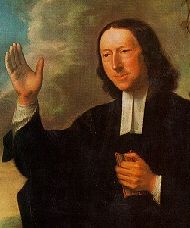
JOHN WESLEY (Wesleyan Revival Preacher, from 1738 to 1741)

1. Albert Outler’s John Wesley’s Sermons – I will list the sermons Wesley was writing in his study, and preaching from his heart without notes on the streets, during the Wesleyan revival of 1738-1741. According to Timothy L. Smith’s dates.

1738 – Salvation by Faith (Sermon 1)
1739 – The Spirit of Bondage and of Adoption (Sermon 9)
1739 – Free Grace (Sermon 128)
1739-1740 – Upon Our Lord’s Sermon on the Mount, 1-6 (Sermons 21-26)
1739 – The Great Privilege of Those That Are Born of God (Sermon 19)
1739 – Justification by Faith (Sermon 5)
1739 – Christian Perfection (Sermon 40)
1739 – The Means of Grace (Sermon 16)
1741 – The Marks of the New Birth (Sermon 18)
1741 – True Christianity (Sermon 134)
1741 – The Law Established Through Faith, 1 (Sermon 35)
1741 – The Almost Christian (Sermon 2)
1741 – The Righteousness of Faith (Sermon 6)

2. Steve Harper’s The Way to Heaven
3. Steve Harper’s “Wesleyan Arminianism” in Four Views on Eternal Security
4. Thomas C. Oden’s John Wesley’s Scriptural Christianity, Chapters 6-10
5. Albert Outler’s John Wesley
6. Harald Lindstrom’s Wesley and Sanctification
7. Mildred Wynkoop’s A Theology of Love
8. Mildred Wynkoop’s Foundations of Wesleyan-Arminian Theology
9. Adam Clarke’s Clarke’s Christian Theology (Schmul, Chapters 7-13)
10. Samuel Wakefield’s Wakefield’s Christian Theology (Schmul, Book 4, Chapters 8-12; Book 5, Chapters 1-4, 7-8)
11. Kenneth Kinghorn’s John Wesley on Christian Beliefs: The Standard Sermons in Modern English – This excellent compilation of Wesley’s sermons rivals Albert Outler’s, because a lot of them are about the Gospel and sanctification–but they are IN MODERN ENGLISH!

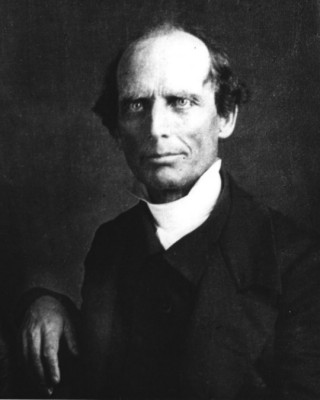
CHARLES FINNEY (Second Great Awakening Preacher, from 1824 to 1831)

Some of the most powerfully anointed revelations into the Gospel of Jesus Christ are found in these pages. Powerful and lawyerly arguments against atheism and other anti-Christian objections are found as well. Learn how to preach what Finney preached during the Second Great Awakening (1824-1831). These books were written by him after his experience of those revivals.

I do want to warn you though: Finney was not a perfect theologian. Among the things that Finney maintained, were: (1) Revival is not a miracle. It is simply the effect of men choosing to repent and live obediently before God. Most would disagree with Finney on this point, and respond that the Holy Spirit is some way influencing the minds and hearts of those saved in a revival. (2) His moral government view of the atonement. Finney maintained that Jesus’ death on the cross was to set a moral example of self-sacrifice to us. Some say that he denied the penal substitutionary view of the atonement: that Jesus died on the cross for our sins. But I don’t think that is an accurate interpretation of Finney. It might be a straw-man argument to say that he denied substitutionary atonement; it seems that he merely had multiple views of the atonement at the same time. (3) Pelagianism. This truly was an error committed by Finney; and his critics are not misinterpreting him. He gives most expressive voice to this doctrine in the latter half of his Systematic Theology. This was probably Finney’s greatest theological failure. He rejected the Arminian view that the Holy Spirit helps Christians to repent, believe, and obey God’s commandments. He affirmed that all of this is possible by mere human ability and strength, especially the obedience to God’s commandments. This is denied emphatically by the apostle Paul in very many ways, in both Romans and Galatians. (4) His denial of Christ’s imputed righteousness to the Christian. This is also an erroneous doctrine of Finney. The apostle Paul taught the perfect righteousness of Christ is legally imputed to the criminal record of Christians (in Romans). Finney explained this away as a Calvinistic invention; a mere excuse for Antinomians to live unholy lives, and simply profess “once saved, always saved.” But I don’t think he understood that imputation is a matter of justification, not of regeneration or sanctification.

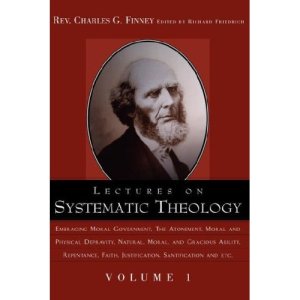
For books by Finney, I recommend Lectures on Revivals of Religion and Lectures on Systematic Theology edited by Richard Friedrich of Alethea in Heart Ministries. And anything by Finney from Bethany House Publishers. Anything else by Finney can be found on Amazon.com from other publishers.

Also, I want to add, that there is a lot of revival material from the publishing house called: Dr. Larry Martin‘s River of Revival Ministries or Christian Life Books. Stuff about the theology and history of the Great Awakenings, the Welsh Revival, Azusa Street, the Brownsville Revival, D. L. Moody, Leonard Ravenhill, Pentecostal Pioneers, Billy Sunday, Winkie Pratney, etc.

1. Charles Finney’s Lectures on Revivals of Religion (1835)
2. Charles Finney’s Sermons on Important Subjects (1836)
3. Charles Finney’s Lectures to Professing Christians (1837)
4. Charles Finney’s Lectures on Systematic Theology (1851, 2 vols)
5. Charles Finney’s Sermons on Gospel Themes (1876) – Contains some powerful arguments against Universalism; and has many other good preachings.

Posted in Uncategorized | Leave a comment

There is a Way That Seems Right to a Man

As I reflected on the various kinds of atheism and agnosticism–both secular and religious–I went to bed sort of disturbed in my mind. I prayed in tongues and felt God’s presence, and then fell asleep. After several hours of sleep, I had a dream.

I dreamed that I was high up on a porch that was thousands of feet above the ground. I wanted to get down from it. I went to walk to the edge of the porch where there was a tremendously long ladder which went down into oblivion. As I approached the ladder, a bullying boy, began to taunt me and push me aside, because he wanted to use the ladder. Initially I was repulsed at his bullying, but when I saw that he was shoving me so near to this cliff, I backed up and let him have the ladder. It then turned nighttime. I walked down the walkway quite a bit to be in a safe area. As the bully climbed down the ladder, he fell, and got caught in some ropes hanging from the side. He strangled and died.

Then I turned around. Up on a curb there was a guy I remembered from high school. His name was Nathan. He was a nice guy, but he was not a born again saved Christian. He was a Jew, a good Jew, who lived by the Torah, but had not accepted Jesus as his Messiah. I was trying to tell Nathan what happened to the bully, but he was so engaged in thought he wasn’t hearing me. He dived as if into a pool, but went face down on the wooden floor! He died on impact! When I saw this, I looked to the ground and wept, and saw a tear come from my face and fall on a nail on the floor. And I heard the music of a worship song, speaking about how we need Jesus’ presence in our lives.

“There is a way that seems right to a man, but in the end it leads to death” (Proverbs 14:12).

The bully was an atheist. The Jew was a religious agnostic or practical atheist. The one was mean, the other was nice. But both of their ways led to death, because neither went the way of Christ.

Posted in Uncategorized | Leave a comment

Three Great Moves of the Devil Today

The devil is very active these days. From what I see in the Bible, in my theology studies, my dreams and visions, street preaching, and my daily experiences–I’m going to draw some conclusions here. But I think that they are far from being comprehensive conclusions. At best, they are general conclusions.

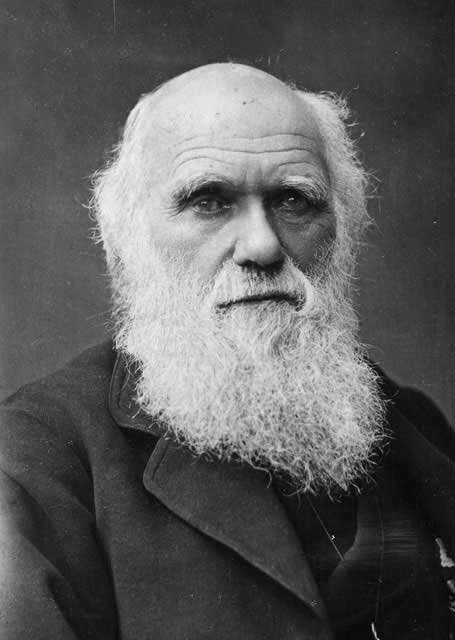
1. Atheism. The devil is moving immensely in the area of atheism these days. This may come as a shock to some; or as simply “stating the obvious” to others. Not only does my experience with hecklers on the streets prove this, but so do statistics: in American and Australian case studies, only 50-60% of my generation–Generation Y–born around 1985–believe in the mere existence of God or gods! The other 40-50% is either ATHEIST or AGNOSTIC altogether! That is alarming! And those who do believe in a Creator–that’s about as far as they go. There are no deep theological views about who that Creator is, or what the Bible is for, or what God’s will for humans is. The commandments and laws of God have been completely forgotten! With such an enormous amount of people born around 1985 believing like this, it follows that many of my generation who ever “go to church” are really just atheists in their hearts. They don’t really know that God is REAL. They simply “go-to-church” because of family tradition. Who is to blame for all of this atheism? Charles Darwin, and atheist evolution concepts being taught in our public school science classes. Our nations have been indoctrinated like Communists!
There is an article in the International Standard Bible Encyclopedia (1915) on “Atheism“: it explains that there are four different kinds of atheism. (1) Classical Atheism is the denial of the existence of pagan mythology gods like Zeus, Hades, and Hercules; the early Christians were often accused of this by the Greeks and Romans. (2) Philosophical Atheism is the pantheistic concept from Hinduism that there is no “God” or “gods,” but merely a mysterious force that brought the world into being, perhaps by natural and evolutionary means. This concept is in Star Wars. It denies that any real God exists, or speaks to people; and is especially anti-Christian; and rejects the existence of the God of the Bible. (3) Dogmatic Atheism is the absolute denial of the existence of God. The strong atheism of conviction. This kind of view: “There is no God! I’m sure of it!” It is often backed up by many anti-Christian arguments, skeptical reasonings, and logical “proofs” for why God probably does not exist. Richard Dawkins, Sam Harris, and Bertrand Russell would fall into this category. It is because of this movement that atheism has entered the colleges, schools, and churches. It is responsible for the now popular concept, “The Bible is full of contradictions and can’t be trusted; and God didn’t create us–we all came from monkeys and evolution millions of years ago.” (4) Practical Atheism is not the denial of God’s existence outright, but is “to live as if there is no God.” The writer of the article, Jacob Kapp expresses this elegantly accurate:

“It takes the form often of complete indifference to the claims of the Divine Being or again of outbroken and defiant wickedness (Psalms 14:1). That this form of atheism is widely prevalent is well known. It is accompanied in many cases with some form of unbelief or prejudice or false opinion of the church or Christianity. Dogmatic atheism is no longer a menace or even a hindrance to the progress of Christianity, but practical atheism is widespread in its influence and a dangerous element in our modern life (compare Isaiah 31:1; Jeremiah 2:13,17,18; 18:13-15). Whatever the form, whether it be that of religious agnosticism, denying that we can know that God exists, or critical atheism, denying that the evidence to prove His existence is sufficient, or dogmatic, or practical atheism, it is always a system of negation and as such tears down and destroys. It destroys the faith upon which all human relations are built. Since there is no God, there is no right nor wrong, and human action is neither good nor bad, but convenient or inconvenient. It leaves human society without a basis for order and human government without foundation (Romans 1:10-32). All is hopeless, all is wretchedness, all is tending to the grave and the grave ends all.”

This last kind of atheism–the practical atheism–is TO LIVE YOUR LIFE AS IF GOD DOES NOT EXIST. The Bible is irrelevent, the commandments of the Bible have no bearing upon the way you think, or feel, or behave, or talk, or relate to people. God is not really known consciously as a Living Being in your life. MANY PEOPLE IN THE CHURCH ARE PRACTICAL ATHEISTS. Or, as Mr. Kapp put it, “religious agnostics”: they don’t really KNOW for sure that there is a God. But they keep on going to church and saying their prayers, as if to a “God” billions of miles away up in Heaven. They have no EXPERIENCE of God. He is no more real to them than Santa Claus! But hey! At least they go to church and say their prayers–right? No, that leads them all to Hell. “Without faith it is impossible to please God, because anyone who comes to Him must believe that He exists” (Hebrews 11:6). There is a book that recently came out in 2011, which drives into this issue way more deeper than I have: The Christian Atheist: Believing in God but Living as if He Doesn’t Exist by Craig Groeschel.

2. Occultism. A great number, it seems–sorry I don’t have the statistics–are increasing in Universalist ideas about God (if they do believe in a God). That He is the Father of all children, of all faiths. This is the diplomat’s god–a convenient and political god that doesn’t offend anyone. The god of the United Nations and Unitarian-Universalists. It’s in the Catholic Church, the United Methodist Church, and many of what you may call the popular “mainline” denominations. These are not churches that hunger after THE TRUTH OF THE BIBLE, but who are decieved by the POPULAR LIES OF SATAN. Behind this “world religions” movement of non-judgmental love, acceptance, and tolerance, is a PSYCHIC movement inspired by yoga and Far Eastern meditation. Those who really get into this CO-EXIST thing, are called NEW AGERS–and they are all over the churches! This has been going on since the 1960s and before. Except, to a very limited extent, in those churches which claim to uphold Fundamentalist and Conservatve Evangelical orthodox Biblical viewpoints. But even those lines are becoming more and more blurry.

3. Marianism. In the last 150 years since the Marian apparitions at Lourdes, there has been a dramatic increase in the Marian movement in the Catholic Church, which is the most popular denomination in the world. Throughout church history, Catholics have acknowledged Mary as the mother of Christ, with other saints. Only occasionally were there some “cults” that had higher and more exalted views of her. But now, there have been multitudes of visions and apparitions all over the world, claiming that Mary is the Queen of Heaven, and the only way to salvation! These things have not been officially accepted by the entire Roman Catholic Church, but the movement is increasing in its influence. Many bishops and cardinals are approving these demonic messages, and the last Pope John Paul II approved them. This actually goes against the traditional Catholic view that Jesus Christ is the only mediator between God and man (1 Timothy 2:5). But this is changing more and more because of these fallen “angels of light” (2 Cor. 11:14). The documentary movie Messages from Heaven (2000) goes into detail about this.

What’s a Christian to Do?
The Bible tells us: “Submit yourselves, then, to God. Resist the devil, and he will flee from you” (James 4:7). Submission to God is living your life for Jesus Christ. Loving God with all your heart, soul, mind, and strength, and your neighbor as yourself (Matt. 22:37-40). He who loves Jesus Christ, must keep His commandments (John 14:15). Keep your faith in Jesus’ death on the cross for your sins strong, and guard it with all your heart. Be sure to “cast down arguments and every high thing that exalts itself against the knowledge of God, and bring every thought into captivity to the obedience of Christ” (2 Corinthians 10:5, NKJV).
There is no doubt in my mind: as a Christian, as a thinker, and as a human being–that the devil exists, and that these are the things he and his demons are up to in the world. Resist these things in your hearts and minds. These subtle evil things of satan and evil spirits. Use the Name of Jesus in prayer. Think against these things. Feel against these things. Pray against these things. Speak against these things. Write against these things. They are drawing multitudes to Hell and sinking sand. Do not compromise what you think or feel for the sake of “not offending” someone, or being diplomatic. Light and darkness cannot co-exist. There must be a separation of the two. GUARD YOUR FAITH! STAND UP FOR JESUS! BE STRONG TILL THE END OF YOUR LIFE! FINISH STRONG! Remember:

“We do not wrestle against flesh and blood, but against principalities, against powers, against the rulers of the darkness of this age, against spiritual hosts of wickedness in the heavenly places” (Ephesians 6:12, NKJV).

Put on the full armor of God, and be a soldier for Jesus Christ! Amen.


Posted in Uncategorized | Leave a comment

A Prophet’s Decree

By the grace of God:
I will uphold sound doctrine, love God and man, and live a righteous life.
I will repent when I fall, plead the blood of Jesus, and preach the Gospel to every creature.
I will put God before my family, and my family before my ministry.
I will not tolerate heresy, nor hate anyone, nor be wicked.
I will not abuse the grace of God, and will not resist dreams, visions, and God’s voice.
I will practice contemplative prayer, write my visions, and walk the old paths.

Posted in Uncategorized | Leave a comment

A Response to Erik Raymond’s Article: “What I meant by ‘Evangelical Mystic’” (Part 3)

In the comments one person mentioned Edwards as a guy who may have followed this type of thinking. I disagree. And perhaps the comment was not directed at what I am referring to here. In my reading of Edwards he seems to have been staunchly opposed to this type of practice, even calling such folks who practice this subjectivism “incorrigible”:

1. Erik is preparing to quote Jonathan Edwards. I have a lot of respect for Edwards, as one of the key preachers during the Great Awakening. But he was also on the extreme Calvinistic side of the revival spectrum. John Wesley, just as powerful a preacher, was on the other side–a pure Arminian. So, already as Erik quotes Edwards, let’s keep in mind that Edwards is not the only authority on revival. He’s just simply the authority that Reformed revivalists prefer to refer to, because of his Calvinist views.

2. Erik said: “In the comments one person mentioned Edwards as a guy who may have followed this type of thinking. I disagree.” This demonstrates that there are conflicting views about Jonathan Edwards as a Charismatic. Although Edwards did not speak in tongues, there is evidence that he certainly felt God’s presence, and supported the physical manifestations of the Holy Spirit that he saw in his revivals: shaking, fainting, and even ecstatic holy laughter. Dr. Guy Chevreau demonstrated this about Edwards in an extensive and scholarly way in his work, Catch the Fire (1995). Edwards was also a supporter of dreams and visions of Christ and Heaven, but he was extremely skeptical of them. He relied on 1 John 4 to “test the spirits to see whether they are from God,” in his Distinguishing Marks of a Work of the Spirit of God (1741). He was only open to revelations that were plainly about salvation and sanctification topics already revealed in the Bible. He rejected futuristic prophecies and mind-reading words of knowledge (which I would disagree with him about). See: Jonathan Edwards’ Rules for Spiritual Discernment. So, at least in 1741, Edwards was a limited and very skeptical Charismatic Christian.

“Many godly persons have undoubtedly in this and other ages, exposed themselves to woeful delusions, by an aptness to lay too much weight on impulses and impressions, as if they were immediate revelations from God, to signify something future, or to direct them where to go, and what to do.”

1. Erik quotes Edwards: “Many godly persons have undoubtedly in this and other ages, exposed themselves to woeful delusions…” He may be referring to the Quakers of his own day, and Catholic saints of the past. Calling their revelations “woeful delusions” or tragic deceptions of satan and self, not of the Holy Spirit.

2. Erik quotes Edwards: “…by an aptness to lay too much weight on impulses and impressions, as if they were immediate revelations from God…” This is an important issue worth noting. When Charismatics begin to lay too much emphasis on what are called “prophetic impressions” or nudges, feelings, emotional intuitions, or know-that-you-knows, deception is indeed heightened to an absurd extent! Dr. Jack Deere’s The Beginner’s Guide to the Gift of Prophecy (2008) goes so far as to refer to impressions as “flimsy” or unreliable experiences. In my experience, impressions, impulses, intuitions–whatever you want to call them–are the most PROPHETICALLY INACCURATE experiences you can possibly have as a Charismatic! It is better to take Numbers 12:6 as your guide for prophetic accuracy: “When a prophet of the Lord is among you, I reveal Myself to him in visions, I speak to him in dreams.”

3. Erik quotes Edwards: “…to signify something future, or to direct them where to go, and what to do.” This would be an example of hyper-prophetic Quietism, in my opinion. Besides, I don’t know of any example in the Bible where any prophet or apostle prophesied the future, or received prophetic direction without either a dream, vision, or voice from God. Impressions had little or nothing to do with it!

“I would therefore entreat the people of God to be very cautious how they give heed to such things. I have seen them fail in very many instances, and know by experience that impressions being made with great power, and upon the mind…are no sure sign of their being revelations from Heaven.”

1. Erik quotes Edwards: “I would therefore entreat the people of God to be very cautious how they give heed to such things.” Notice that Edwards was what today people would call an open-but-cautious Charismatic Christian. He was not a closed-and-resistant Cessationist. And he is right to be cautious. Everyone should be cautious. But caution should never lead to the extreme of rationalism, theological idolatry, intellectual speculation alone, and an overall resistance to the works of the Holy Spirit–just like the Pharisees. Edwards was wise enough to avoid this Phariseeism.

2. Erik quotes Edwards: “I have seen them fail in very many instances…” So have I! Too many Charismatics in the prophetic movement have such a loosey-goosey attitude about “missing God” with regard to prophesying the future or to words of knowledge. Perfectionism is not the answer, but neither is this concept that developing spiritual gifts is unnecessary. Paul said, “Since you are eager to have spiritual gifts, try to excel in gifts that build up the church” (1 Cor. 14:12).

3. Erik quotes Edwards: “…and know by experience that impressions being made with great power, and upon the mind…are no sure sign of their being revelations from Heaven.” Edwards rightfully observed, that when people become so deceived as to think that IMPRESSIONS and IMPULSES are God’s voice, or the Spirit’s messages, they fail over and over again at predicting the future, or reading minds by those emotions and feelings. They would do better to go by dreams and visions only (Num. 12:6), and forget impressions altogether! Provided that the dreams and visions are Biblical in nature.

“Why cannot we be contented with the divine oracles, that holy, pure Word of God, which we have in such abundance and clearness, now since the canon of Scripture is completed? Why should we desire to have any thing added to them by impulses from above? Why should we not rest in that standing rule that God has given to his church, which the apostles teaches us, is surer than a voice from heaven? And why should we desire to make the Scripture speak more to us than it does?”

In a series of rhetorical questions, Edwards expresses his frustration with the prophetically inaccurate Charismatics of his day. I have to admit, this sounds very Cessationist. It may have been that at this point in 1743 (two years after his more Charismatic leaning), Edwards had felt like giving up on the prophetic altogether, and just sticking to the old Reformed idea of sola Scriptura or “Bible only” thinking.

1. Erik quotes Edwards: “Why cannot we be contented with the divine oracles, that holy, pure Word of God, which we have in such abundance and clearness, now since the canon of Scripture is completed?” From a Charismatic viewpoint, I will say that I cannot be contented merely with the Bible, because God is not. The gift of prophecy has obviously continued throughout the history of the church, especially among some of the Catholic saints. Paul gives Christians guidelines on the prophetic in 1 Corinthians 14. The Bible is authoritative, because it contains the most significant revelations of the prophets and apostles of the past. But God is still in the business of confirming His Word with signs following (Mark 16:20). He does this to confirm, affirm, and strengthen people’s faith in the Bible. This is especially true in an increasingly rationalistic and agnostic age like ours.

2. Erik quotes Edwards: “Why should we desire to have any thing added to them by impulses from above?” I take issue with his use of the expression “to have any thing added to them”–because again: this is that same kind of Cessationist straw man argument, that maintains Charismatics are seeking rhema words from God, so they can go and write their own cult scriptures and Books of Mormon. This is not the case! We are only seeking validation of the Bible’s truth–confirmation of the Word with signs following (Mark 16:20). This is not only necessary for the conversion of the heathen during evangelism, but for the progressive deliverance of Christians from our heathenish hearts in cloudy skepticism and doubt. Faith is based on the Gospel of Christ in the Bible, but is certainly strengthened by dreams, visions, God’s voice, and miracles. Edwards said, “Impulses from above”–again, who in their right mind thinks that God inspired the Bible through mere emotions and impulses? (Apparently some in Edwards’ day.) I think it is evident when you study the Old Testament prophets, and such, that you are reading vision and dream experiences: either interpreted into poetry, prose, or otherwise.

3. Erik quotes Edwards: “Why should we not rest in that standing rule that God has given to His church, which the apostles teaches us, is surer than a voice from Heaven?” I encountered this argument once in a conversation with a Southern Baptist Cessationist seminary student. The argument is, why put your faith in these impressions (and even audible voices from Heaven), when now we have the Bible–God’s rule for the Body of Christ? There is no need for rhemas. Only the Bible, says Edwards. We can trust the Bible, he says, but not supposed revelation experiences. I respond: but that’s just the thing. God appears to be still speaking with a voice from Heaven! Why else would Peter have dealt with the issue? Because he experienced it! Peter wrote that Christ “received honor and glory from God the Father when the voice came to Him from the Majestic Glory, saying, ‘This is My Son, whom I love; with Him I am well pleased.’ We ourselves heard this voice that came from Heaven when we were with Him on the sacred mountain. And we have the word of the prophets made more certain, and you will do well to pay attention to it, as to a light shining in a dark place” (2 Peter 1:17-19). A plain reading of the text leads me to see that when Peter said, “And we have the word of the prophets made more certain, and you will do well to pay attention to it”–he meant to say: the Old Testament prophets’ words about Christ being the Son of God, are now more certain to us, because they have been so powerfully confirmed by our experience with the voice from Heaven on the Mount of Transfiguration.

If ever the apostle Peter had doubted that the Old Testament prophets were speaking of Jesus, his doubts were annihilated, and his faith in Jesus was made more certain because of His experience of God’s voice saying, “This is My Son, whom I love; with Him I am well pleased.” This is what Peter meant, in my view. THE VOICE OF GOD he experienced on the mount with Christ, made more certain to him that Jesus was indeed the Christ, the Messiah, prophesied by the Old Testament prophets! Peter was saying that HIS EXPERIENCE CONFIRMED THE WORD! (Mark 16:20). Adam Clarke agrees. And this had made this interpretation of Scripture more certain to Peter: that Jesus is the Christ spoken of by the Old Testament prophets. Peter no longer needs to have any doubts about Him. But unfortunately, Cessationists do not see it that way. They think Peter had so doubted the voice he heard on the mount, that in effect, he was saying, “But the Scriptures are more certain than what I experienced on the mount.” This is accusing the apostle Peter of doubting his experience on the mount! All the while, that was probably the most powerful revelation experience he had in his life! Oh, the persistent skepticism of Cessationists! Woe to this doubtful viewpoint! By the way, just verses before this disputed text in 2 Peter 1:17-19, he writes that Jesus had just recently spoken to him in a subjective revelation that he was going to die very soon: “I think it is right to refresh your memory as long as I live in the tent of this body, because I know that I will soon put it aside, as our Lord Jesus Christ has made clear to me” (2 Peter 1:13-14). Who made it clear to him that he was going to die very soon? The Lord Jesus Christ Himself! Through a dream, vision, or some other kind of revelation! MORE CLEAR! THROUGH A SUBJECTIVE REVELATION! Do you see how wrong the Cessationist view of this text is? It is totally wrong.

4. Erik quotes Edwards: “Why should we desire to make the Scripture speak more to us than it does?” My Charismatic answer is: the Scripture is Scripture, but God is a Spirit. Now, it is true that the Spirit of God inspired the Scriptures through the prophets and apostles. But what has been said in them is what has been said in them. After that, there is nothing more that can rightfully come under the category of “Scripture.” So, all the visions and revelations of the saints of the ages: of St. Antony, of St. Patrick, Hildegard of Bingen’s Scivias, of St. Dominic, of St. Francis of Assisi, of St. Ignatius of Loyola, St. Teresa of Avila, St. John of the Cross, John Bunyan, John Wesley, Rebecca Springer, David Wilkerson, Mary K. Baxter, etc–all these Christian saints who ever had visions or revelations directly from God–none of their revelations can ever be categorized as “Scripture.” They are private revelations that come out of their experience of spiritual gifts. Christians at large in the Body of Christ, are free to doubt them as they please, if something in them seems to contradict what is written in the Bible. Why should Christians desire these things to be so? Because obviously God wills it! Otherwise He would not reveal these things to Christians. Paul said, “Follow the way of love and eagerly desire spiritual gifts, especially the gift of prophecy” (1 Cor. 14:1). The apostle Paul commands all Christians to DESIRE ESPECIALLY THE GIFT OF PROPHECY!

Posted in Uncategorized | Leave a comment

A Response to Erik Raymond’s Article: “What I meant by ‘Evangelical Mystic’” (Part 2)

My emphasis is upon what has become so common today in evangelicalism. What I am referring to is this constant reference to God communicating with people through what seems like every way imaginable with the exception of the Scripture. Often times folks speak of being ‘led’ to do this or that or that God has ‘told’ them not to do this or that. I have been told by well meaning evangelicals that I have to listen to the “still-small voice” of God.

1. Erik said: “What I am referring to is this constant reference to God communicating with people through what seems like every way imaginable with the exception of the Scripture.” That is, he is against these “every way imaginables” because they are leading people away from Bible study. What are they? Impressions, dreams, God’s voice, and circumstances in life. But these are still valid ways for God try and speak to you! Are you going to turn a deaf ear to His communications in these areas? Will you muffle your spirit’s ears, and only read the Bible? However, I have to sympathize somewhat with Erik. Too many Charismatic Christians do turn away from Bible study after they get into dreams, visions, and the voice of God. That is not only dangerous, deceiving, and foolish, but it is also sinful, since we need to remind ourselves to keep Christ’s commandments (John 14:15). Charismatics must continue to study their Bibles. I recommend the NIV Study Bible.

2. Erik said: “Often times folks speak of being ‘led’ to do this or that or that God has ‘told’ them not to do this or that. I have been told by well meaning evangelicals that I have to listen to the ‘still-small voice’ of God.” This is Reformed Cessationist talk. I’ve heard this anti-Charismatic kind of rhetoric before. I’m not saying that Charismatics are free from anti-Cessationist rhetoric, but I think the opposition is stronger from Cessationists, because they are more educated and literary most of the time. There is nothing illegal, illegitimate, sinful, or anti-Biblical about a Christian feeling led by God to do something, or being convinced that God has told them to do something. The entire Book of Acts is full of prophetic experiences; and the lives of saints throughout church history as well (see Jeff Doles’ Miracles and Manifestations of the Holy Spirit in the History of the Church). And, those well meaning Evangelicals who told Erik to listen to the still small voice of God, were referring to a Bible verse: “After the earthquake a fire; but the Lord was not in the fire: and after the fire a still small voice” (1 Kings 19:12, KJV). And as far as being led by God to do something: “Those who are led by the Spirit of God are sons of God” (Romans 8:14).

The problem with this is that the Scriptures never command me to look inward for direction but rather to look to the revealed Word of God. Believers are given the Scripture to be equipped and instructed for every good work (2 Timothy 3:16-17); we are told to meditate upon it (Psalm 1) so that we me have knowledge, wisdom and understanding cultivated (Proverbs 3:3-5; 4:5-8).

1. Erik said: “The Scriptures never command me to look inward for direction but rather to look to the revealed Word of God.” This is half true. He’s right about the Scriptures commanding him to look to the revealed Word of God: the Scriptures themselves. Every Christian is bound to look to the Bible for direction. But when he said, “the Scriptures never command me to look inward for direction”–he is mistaken: “Were not our hearts burning within us while He talked with us on the road and opened the Scriptures to us?” (Luke 24:32); “The kingdom of God is within you” (Luke 17:21); “The Lord opened her heart to respond to Paul’s message” (Acts 16:14); “A man is a Jew if he is one inwardly; and circumcision is circumcision of the heart, by the Spirit, not by the written code” (Romans 2:29); “It is with your heart that you believe and are justified, and it is with your mouth that you confess and are saved” (Romans 10:10); “Do you not know that your body is a temple of the Holy Spirit, who is in you, whom you have received from God?” (1 Corinthians 6:19); “Inwardly we are being renewed day by day” (2 Corinthians 4:16); “I thank God, who put into the heart of Titus the same concern I have for you” (2 Corinthians 8:16); “I pray also that the eyes of your heart may be enlightened in order that you may know” (Ephesians 1:18); “Because you are sons, God sent the Spirit of His Son into our hearts, the Spirit who calls out, ‘Abba, Father’” (Galatians 4:6); “The goal of this command is love, which comes from a pure heart and a good conscience and a sincere faith” (1 Timothy 1:5); “See to it, brothers, that none of you has a sinful, unbelieving heart that turns away from the living God” (Hebrews 3:12); “Anyone who believes in the Son of God has this testimony in his heart” (1 John 5:10).

2. Erik said: “Believers are given the Scripture to be equipped and instructed for every good work (2 Timothy 3:16-17); we are told to meditate upon it (Psalm 1) so that we me have knowledge, wisdom and understanding cultivated (Proverbs 3:3-5; 4:5-8).” Amen! I agree with this 100%. I just don’t think that Bible study should replace inward leadings of the Holy Spirit.

Ironically, a new breed of self-appointed prophets has arisen. These religious quacks tout their own dreams and visions with a different phrase, ‘The Lord told me.’ That is mysticism, and it preys on people looking for some secret truth that will add to the simplicity of God’s all-sufficient, once-for-all delivered Word” (MacArthur, Our Sufficiency in Christ).

1. Erik is quoting from John MacArthur, the leading Reformed Cessationist theologian of today–author of Charismatic Chaos. MacArthur said: “A new breed of self-appointed prophets has arisen.” Just what he means by “self-appointed,” I don’t know. I’m assuming that he’s implying they are not God-appointed, but self-appointed. That modern-day prophets don’t see God’s visions, but their own visions; they don’t hear God’s voice, but their own voice. Or, he may look at it like this: they presume to appoint themselves to the high status of prophets and apostles in the modern church, when God has made no such public announcement of this to the church at large–hence these prophets are merely given to delusions of grandeur. But my response to both of these notions would be: it is completely in keeping with Protestant Christianity to believe that God can directly speak to every Christian, because Peter said, “You are a chosen people, a royal priesthood, a holy nation, a people belonging to God, that you may declare the praises of Him who called you out of darkness into His wonderful light” (1 Peter 2:9). It seems to me that MacArthur is contradicting the Protestant conviction in both the priesthood and prophethood of all believers. The same apostle Peter who wrote that all Christians are priests, also said, “In the last days, God says, I will pour out My Spirit on all people. Your sons and daughters will prophesy, your young men will see visions, your old men will dream dreams” (Acts 2:17).

2. Erik quotes MacArthur: “These religious quacks tout their own dreams and visions with a different phrase, ‘The Lord told me.’” Modern apostles and prophets are “religious quacks,” to Erik and MacArthur’s mind, simply because they don’t think God speaks in dreams and visions anymore, like He did in the Bible times. So, in their worldview, all modern day dreams and visions, and all dreams and visions ever experienced throughout the 1,900 year history of the church, were not from God or angels. They’re either from self or satan. I don’t think that is likely. But Erik and MacArthur are free to believe what they believe–even if they have no reason to believe it! Although there are a great many pretenders to dreams and visions, and liars, and false prophets–this does not mean true prophets do not exist.

3. Erik quotes MacArthur: “That is mysticism…” MacArthur is correct to say that believing in modern-day prophets, dreams, and visions is mysticism; he is absolutely right about that–it is Christian mysticism in fact; and there is nothing wrong with it if guided by good theology. But do you see what MacArthur is trying to do here? Rhetoric. He’s trying to use his literary skill to insult modern prophets by stigmatizing them with the label of mysticism. Much like how Bible-believers are often stigmatized as “Fundamentalists.” Most of the time when people think of the word “mysticism,” they don’t think about Moses, Elijah, Jesus, and the apostles. No! Americans and other Westerners use the word “mysticism” almost exclusively in application to gypsies, psychics, fortune tellers, witches, wizards, Hindu gurus, and Buddhist monks. Hence, this is slanted rhetoric.

4. Erik quotes MacArthur: “…and it preys on people looking for some secret truth that will add to the simplicity of God’s all-sufficient, once-for-all delivered Word.” Notice how he uses the expression: “and it preys on people…” This is total rhetoric. He is treating God’s gifts of dreams and visions as if they were PREDATORS! I don’t know about you, but to me, that comes pretty close to blasphemy against the Holy Spirit (Luke 12:10), which is the attitude the Pharisees had to Jesus’ powers. But how can such a learned and educated Bible scholar like MacArthur make such a confident judgment against modern dreams and visions? How? Because, he is persuaded in the Reformed interpretation of 1 Corinthians 13:8-10: he genuinely does not believe prophecy is for today. And for that, I think he is deceived at least; or at the very worst, an unbeliever pretending to be a Christian! MacArthur also said: “people looking for some secret truth that will add to the simplicity of God’s all-sufficient, once-for-all delivered Word.” Is that really what these people are looking for? That sounds pretty far-fetched. I am one of “these people”: and I can speak for others like me. While most of us accept the Holy Bible as the supremely authoritative and inspired Word of God, and the theological Scriptural canon rule for testing and learning all things about God–we still maintain that God has never quit directly speaking to Christians through dreams, visions, voices, etc. It’s just that most Christians ignore His revelatory speech. And that God’s voice in dreams and visions becomes especially helpful, when He shows us clearer interpretations of the Bible, confirms us in a theological position, or directs us in our lives in a specific ways that the Bible cannot do, because its revelations are general in nature. But what MacArthur seems to imply by his rhetoric is that Charismatic Christians are seeking out “secret truths,” so they can write their own bibles, their own cult scriptures, and presume to have as much AUTHORITY as the apostles of the New Testament. No! We’re not seeking to be like the Mormon founder Joseph Smith, who presumed to write: The Book of Mormon: Another Testament of Jesus Christ (1830)! That is pure heresy and blasphemy! It qualifies as CULTISM! But I put some of my own dreams, visions, and revelations into my Book of Dreams, yet was careful to explain in the introduction that people are free to doubt my revelations, and never even come close to putting them on the same level of authority as the Bible! Never in their LIFE! MacArthur gets the wrong idea about Charismatic Christians, if he thinks we’re all on our way to writing our own kind of “Books of Mormon.”

The reason for the mysticism label is because that is precisely what this is. B. B. Warfield used to distinguish Christianity from all pagan religions in that it was a religion that was revealed from the outside in, whereas, pagan mysticism is revealed from the inside out. Bible believers understand that their hearts are “more deceitful than all else and is desperately sick” (Jeremiah 17:9) and unable to be understood. As a result not only the source of the ‘revelation’ is to be questioned but also the interpretation.

1. Erik is reiterating his former statement against “inward direction.” It was his second statement that I commented on above in this article, when he said, “The Scriptures never command me to look inward for direction but rather to look to the revealed Word of God.” He maintains that Christians cannot have inner leadings from the Holy Spirit. Only the Bible is to be our source of knowledge and direction from God. To him, the heart has virtually nothing to do with it. BUT–hopefully my ample Bible references above to the inner “heart” dimension of Christian life have demonstrated that Erik is wrong about this, and so was B. B. Warfield. While it is true that pagans experience inner leadings from the gods and devils they follow, it is also true that Christians experience inner leadings from the God of the Bible.

Posted in Uncategorized | Leave a comment

Against Bullying

Posted in Uncategorized | Leave a comment

Semi-Quiet Open Air Preaching – Courthouse (Raleigh, NC)

Outline of Extempore Street Sermon (After Preaching It)

1. Atonement and Judgment Day – 00:00 – 4:12
2. Deathbed Confession vs. Living for God – 4:12 – 5:32
3. Atheism vs. Living by Faith in Christ – 5:34 – 6:33
4. Intelligent Design is More Reasonable Than Atheistic Evolution – 6:34 – 7:28
5. The Folly of Atheistic Evolution in Light of the Deathbed, a Call to Immediate Repentance, Living for God, Based on Pascal’s Wager–the Big “What If” Hell Exists – 7:30 – 8:55
6. City People Tend to Be Atheists–Separated from God’s Creation or Nature – 9:00 – 10:15 – “I think that I shall never see; a poem lovely as a tree…poems are made by fools like me, but only God can make a tree.” – Joyce Kilmer
7. John 14:6 vs. Universalism – 10:18 – 12:30
8. Prevenient Grace and Conditional Election – 12:32 – 13:34
9. Growing in Grace, Progressive Sanctification, and Discipleship – 13:35 – 15:46
10. God’s Love for Man and Man’s Love for God – 15:47 – 16:23
11. Against Positive Thinking (Joel Osteen) – 16:25 – 17:20
12. Another Call for Immediate Repentance – 17:30 – 18:41
13. John 14:6 vs. False Salvation Ideas (Churchgoing, Baptism) – 18:42 – 19:47
14. A Call for Americans to Return to Their Puritan Roots – 19:48 – 24:50
15. If You Love Christ, Then Keep His Commandments – 24:51 – 27:44
16. Invitation to House Church or Cell Group – 27:45 – 29:44
17. Not All Christians Are Hypocrites – 29:46 – 30:53
18. Open Your Hearts to Christ, Stop It Atheists!, It’s So Obvious There Is a God (Romans 1:18-19; Psalm 14:1) – 31:00 – 33:35
19. If People Lived for God, Then Our Society Would Be More Righteous – 33:35 – 35:08
20. Dinosaur Fossils Don’t Prove We Came From Monkeys! – 35:09 – 35:59
21. Preaching the Gospel Helps God’s Government and Man’s Government – 36:00 – 37:00
22. HELL FIRE awaits those who don’t keep Christ’s commandments – 37:10 – 46:07
23. The Tragic Downfall of the Methodists (Evolution and Biblical Criticism–Josephus, Antiquities Bk. 18) – 46:08 – 52:20
24. No Excuses on Judgment Day – 52:21 – 53:16
25. Repent! Repent! Repent! – 53:17 – 54:28

Posted in Uncategorized | Leave a comment

Semi-Quiet Open Air Preaching – Moore Square (Raleigh, NC)

30 minutes of quiet open air street preaching–and one interested person at the end who might meet us for house church! Praise God! At 25:35, this Gospel fisherman got a bite!

Mark 16:15, NKJV: “Go into all the world and preach the Gospel to every creature.”

Luke 14:23, NKJV: “Go out into the highways and hedges, and compel them to come in, that my house may be filled.”

Mark 1:17, NKJV: “‘Follow Me, and I will make you become fishers of men.'”

It’s a Lot Like Going Fishing

On this last note, it is worth considering, that when you go fishing, you need to cast your hook, line, and sinker into a patch of foliage where the schools of fish group together. It is the same with this style of evangelism. Find groups of people. Imagine they are a school of fish. Then, cast your line in their general vicinity. Perhaps someone will bite your bait and get hooked on Jesus! Don’t think that the people weren’t listening or hearing me. The lady at 25:35 got up from the far end of the group of people, because she saw me preaching, and she approached us conversationally! I’m convinced that this is the way the apostles preached the Gospel, mostly. It is also worth considering, that when you go fishing, if you make too much noise, you will scare the fish away! LOUD, SCREAMING, OLD TESTAMENT STREET PREACHING WILL PROBABLY SCARE THE PEOPLE AWAY, mostly. Unless, of course, they are hecklers, and just want to incite a riot, and discredit Christians.

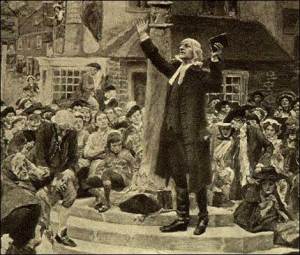
John Wesley, the Greatest Open Air Preacher Ever, Preached This Way

John Wesley’s “Open-Air Preaching” from (Ray Comfort’s World’s Greatest Preachers): “It must be the Gospel, and it must be preached in a manner worth the hearing, for mere noisemaking is an evil rather than a benefit…I know a family almost driven out of their senses by the hideous shouting of monotonous exhortations…It will be very desirable to speak so as to be heard, but there is no use in incessant yelling.”

I would like to add that most of Charles Spurgeon’s remarks on “Open-Air Preaching” in Lectures to My Students, are a very long quote from what John Wesley had to say on the subject.

Things I Would Change – 11/30/11

1. Bring “business cards” with me that had our ministry, contact info, phone number, and email on it. So, if we ever get a “bite” again from interested listeners, we can give them our info, so they can go to church with us if they want.

2. Pray for the sick. We need to preach the Gospel and heal the sick with signs following. For advice on this, I would consult John Wimber’s Power Evangelism and Power Healing, Faith Cure books, and Gordon Lindsay’s The Voice of Healing magazines.

3. Read Revivalist Gospel Sermons Before Street Preaching. This kind of meditating on Gospel doctrines from revivalists of the past can stir up the gift of evangelism from the Holy Spirit. I would, at least at this point, turn to Albert Outler’s John Wesley’s Sermons, Kenneth Kinghorn’s John Wesley on Christian Beliefs, and Charles Finney’s Sermons on Important Subjects.

Posted in Uncategorized | Leave a comment

Revival Soteriology in a Nutshell

These four books provide a quick route to understanding the Gospel according to the four great revivalists of the Great Awakenings: Jonathan Edwards, John Wesley, George Whitefield, and Charles Finney. These are powerful weapons for open air preaching. But I would be careful of Calvinism in Edwards and Whitefield, sinless perfectionism in Wesley and Finney, and Pelagianism in Finney (denial of man’s sinful nature). They were not theologically perfect, but all of them were successful at getting people into the kingdom of God, and preaching the Gospel (justification and sanctification). And getting Christians to live for God.


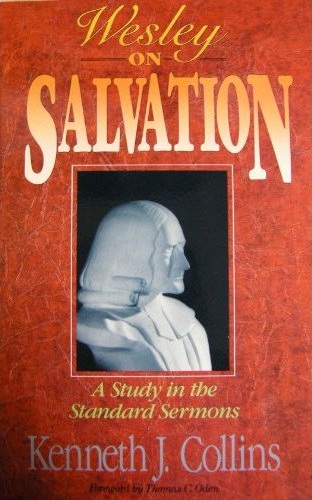
Kenneth Collins' "Wesley on Salvation"

John Gerstner's "Jonathan Edwards: A Mini-Theology"

Posted in Uncategorized | Leave a comment