
-
-

-
LATEST POSTS
RECENT VIEWS
- Old Testament Visions of Hell
- The Christian’s Love for His Neighbor
- The Torment of Sisyphus in “Dante’s Inferno” (1935)
- Soteriology for Open Air Preachers
- An Arminian Response to Charles Spurgeon’s “A Defense of Calvinism”
- Gospel Bibliography
- Review of John Wesley’s “The Use of Money” (1760)
- David Wilkerson: Pentecostal Evangelist and Pastor
- Four Reasons Hell Is Offensive - Bill Wiese
- Books for Hell Fire Preachers
MONTHLY ARCHIVES
- September 2026 (66)
- August 2026 (90)
- July 2026 (101)
- June 2026 (89)
- May 2026 (94)
- April 2026 (100)
- March 2026 (114)
- February 2026 (104)
- January 2026 (177)
- December 2025 (208)
- November 2025 (231)
- October 2025 (148)
- September 2025 (113)
- August 2025 (95)
- July 2025 (89)
- June 2025 (69)
- May 2025 (82)
- April 2025 (136)
- March 2025 (139)
- February 2025 (116)
- January 2025 (130)
- December 2024 (87)
- November 2024 (129)
- October 2024 (125)
- September 2024 (76)
- August 2024 (79)
- July 2024 (101)
- June 2024 (92)
- May 2024 (58)
- April 2024 (54)
- March 2024 (34)
- February 2024 (95)
- January 2024 (61)
- December 2023 (6)
- November 2023 (34)
- October 2023 (22)
- September 2023 (7)
- August 2023 (1)
- July 2023 (2)
- June 2023 (3)
- May 2023 (2)
- April 2023 (7)
- March 2023 (2)
- January 2023 (2)
- December 2022 (1)
- October 2022 (4)
- September 2022 (1)
- August 2022 (3)
- July 2022 (2)
- June 2022 (1)
- May 2022 (2)
- April 2022 (6)
- March 2022 (4)
- February 2022 (2)
- January 2022 (4)
- December 2021 (6)
- November 2021 (5)
- September 2021 (1)
- August 2021 (1)
- July 2021 (2)
- June 2021 (1)
- May 2021 (2)
- March 2021 (3)
- February 2021 (2)
- December 2020 (1)
- October 2020 (1)
- November 2019 (1)
- October 2019 (2)
- September 2019 (1)
- August 2019 (1)
- July 2019 (7)
- June 2019 (4)
- May 2019 (4)
- April 2019 (18)
- March 2019 (7)
- February 2019 (4)
- January 2019 (6)
- December 2018 (3)
- November 2018 (2)
- October 2018 (4)
- September 2018 (5)
- August 2018 (3)
- July 2018 (2)
- June 2018 (1)
- May 2018 (3)
- April 2018 (8)
- January 2018 (1)
- December 2017 (5)
- November 2017 (1)
- October 2017 (8)
- September 2017 (4)
- August 2017 (6)
- July 2017 (6)
- June 2017 (6)
- May 2017 (10)
- April 2017 (20)
- March 2017 (15)
- February 2017 (10)
- January 2017 (10)
- December 2016 (8)
- November 2016 (10)
- October 2016 (19)
- September 2016 (15)
- August 2016 (4)
- July 2016 (8)
- June 2016 (3)
- May 2016 (7)
- April 2016 (3)
- March 2016 (9)
- February 2016 (3)
- January 2016 (9)
- December 2015 (7)
- November 2015 (9)
- October 2015 (7)
- September 2015 (4)
- August 2015 (13)
- July 2015 (9)
- June 2015 (2)
- May 2015 (6)
- April 2015 (38)
- March 2015 (26)
- February 2015 (28)
- January 2015 (28)
- December 2014 (19)
- November 2014 (12)
- October 2014 (5)
- September 2014 (9)
- August 2014 (16)
- July 2014 (30)
- June 2014 (16)
- May 2014 (17)
- April 2014 (16)
- March 2014 (6)
- February 2014 (8)
- January 2014 (8)
- December 2013 (2)
- November 2013 (2)
- October 2013 (3)
- September 2013 (2)
- August 2013 (2)
- June 2013 (2)
- May 2013 (7)
- April 2013 (7)
- March 2013 (5)
- February 2013 (3)
- January 2013 (5)
- December 2012 (2)
- November 2012 (2)
- October 2012 (4)
- September 2012 (6)
- August 2012 (3)
- July 2012 (7)
- June 2012 (1)
- May 2012 (3)
- April 2012 (5)
- March 2012 (2)
- February 2012 (3)
- January 2012 (1)
- December 2011 (5)
- November 2011 (4)
- October 2011 (9)
- September 2011 (2)
- August 2011 (3)
- July 2011 (2)
- June 2011 (4)
- May 2011 (4)
- April 2011 (4)
- March 2011 (6)
- February 2011 (4)
- January 2011 (1)
- December 2010 (5)
- November 2010 (5)
- October 2010 (9)
- September 2010 (3)
-
Would John the Baptist Like Your Church? – Family Room Media
Posted in Uncategorized
Leave a comment
Romans 10: Unlimited Atonement for All of Mankind
Paul demonstrates that Christ died for the sins of all mankind, and that everyone and anyone who repents and believes, can be saved (vv. 11-13). Continuing the theme from ch 9, God shows no saving favoritism to either the Jews or Gentiles:–all He requires is that individuals meet His conditions for salvation: repentance and faith in Christ. There is no salvation through Judaism, that is for sure (vv. 3-4).
Posted in Uncategorized
Leave a comment
Keeping Your Faith Strong In Times of Testing
 Those on the rock are the ones who receive the Word with joy when they hear it, but they have no root. They believe for a while, but in the time of testing they fall away. –Luke 8:13
What is faith? My view is that it is two things:
1. It is a spiritual impression of the reality of the Biblical worldview, and especially of salvation from Hell, through the cross of Christ.
2. It is also a resolute, determined, hanging on to Christ; and a human choice to persevere, and remain “faithful,” or continually committed to trusting in Christ, regardless of what may happen to you.
When the Son of Man returns, will He find faith on the Earth? (Luke 18:8). I hope that He will find faith in me; I care too much for my soul to go to Hell.
Why is it that we observe so many Christians–friends, family, acquaintances–falling away from the faith? (2 Thessalonians 2:3). Or, at least, stop fellowshipping with you, or reject you, just because you’re trying to be holy, as your Father in Heaven is holy? (Matthew 5:48). Why is it that so many of these Christian church friends pull away, fall away, or reject your friendship, once they get a handle on the idea that you are striving for holiness? This is apostasy! Defection from the faith: which calls us to holiness and righteousness all the days of our lives (Luke 1:75). If Christians think that this life we’re supposed to live does not lead to or require immediate moral and ethical growth, development, and transformation–then I have a very hard time reconciling that view with the teachings of Jesus and the rest of the New Testament.
From top to bottom, churches that were once founded on holiness principles and ideas, are now so soiled by the worldliness of Hollywood, the sexual immorality of women’s fashion, and endless anti-Biblical entertainments. It makes me wonder why God has not given a lot of these denominations over to total bankruptcy, or caused other calamities to come, so to destroy their headquarters off the face of the earth forever. It makes me wonder. The Lord is patient, in waiting for the children of earth to come to repentance (2 Peter 3:9). But when the Son of Man returns, WILL HE FIND FAITH AND HOLINESS ON THE EARTH!? IN THE CHURCH!? Will He?
—–
Sometimes I feel that I am a castaway. Not a castaway from God, as Paul feared (1 Corinthians 9:27); but a castaway from secular society and the evangelical church. I feel often that my kindred spirits are scattered all over the world; and are on that large imaginary thing called the Internet Church. Sure, I believe large amounts of the body of Christ are out there; who also happen to use the internet. But when it actually comes to meeting with people, it is so rarely that you find a physical, church building, with holiness being taught and practiced in a balanced and godly manner. So rare. Everyone in these evangelical churches are so morally lax. The supervisors, administrators, the bishops, the pastors, the church boards, the church members, the youth pastors, everyone. THEY’RE DEAD! Dead in trespasses and sins! (Ephesians 2:1). Not regenerated. I doubt that 90% of them know what the word “regeneration” means; and still less who experience the reality of a regenerated life.
Things in the evangelical churches are very, very bad right now. For this reason, I am writing this “jeremiad,” so to speak. If God’s judgment is coming to the evangelical churches in America and British countries, then it will be because they have ceased to preach LORDSHIP SALVATION and ceased to stress every-day PRACTICAL HOLINESS being lived out in the lives of their congregations. Once our Christian bookstores start carrying more books by The Banner of Truth Trust, Soli Deo Gloria Publications, Francis Asbury Press, Schmul Publishing, Puritans, and old-time Wesleyans–so much of what is now falsely called “the ministry” will be found to be a human conceit; and all these seeker-senstive pastors will die off, as God judges their lives, and the times of refreshing come from the Lord (Acts 3:19). But now is not that time. Today is a desert of the Spirit. Today is a famine of the hearing of the word of the Lord (Amos 8:11). Today the true saints and prophets are in hiding; are on the internet sometimes; or are so off the popular radar, because nobody wants to publish or broadcast their words. These are times of great apostasy and rebellion against the Lord God. These are vexing, saddening times for the righteous; even as the righteous soul of Lot was vexed in the city of Sodom (2 Peter 2:8).
Oh how many times Christ has called to these evangelical churches, by sending prophets and wise men, but they were not willing to listen! (Matthew 23:34, 37). Their hearts are hard, and stubborn, and reprobate; many are beyond the hope of repentance, so long have they grieved the Spirit of God (Hebrews 6:4-6). What is a godly man to do in such conditions?
1. Acknowledge that there is a GREAT APOSTASY going on in the evangelical churches; and don’t pretend it’s not there.
2. REMEMBER HELL; and be thankful that you are not in Hell; and that through the death of Christ, by holding on to your faith in it, you are in the forgiveness of God; and you will try to live right until your dying breath, no matter what the people around you are doing, thinking, and saying. CLING TO CHRIST!
3. Worship God in truly concentrated praise and worship, pray in tongues in the Spirit, spend time in silent prayer, and acquire the presence of God. You must have the witness of the Holy Spirit! YOU MUST FEEL THE HOLY SPIRIT in these times! You need it!
Posted in Uncategorized
Leave a comment
Review of Gary North’s “Puritan Economic Experiments”
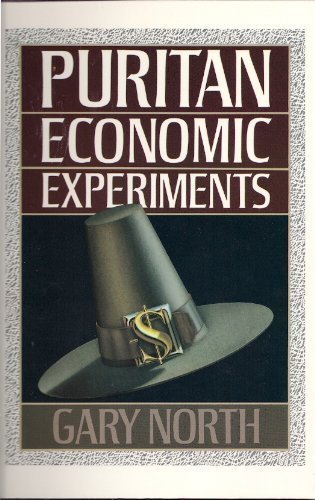 This was an interesting book. As a husband and father, and as a preacher trying to follow the Holy Spirit’s leading into independent pastoral ministry, it becomes necessary to strategize and plan in a faith-based way how to pursue economic growth without becoming a pagan. Gary North is my primary source in this regard. His book Puritan Economic Experiments (1988) helped me to clarify and refine some of my thoughts about this.
He takes a look at two Puritan groups: the Pilgrims of the Plymouth Colony; and the more economically successful Puritans of the Massachusetts Bay Colony, both of the 1600s. In the early days of the Pilgrims, the primary concern of these Puritans was escaping from persecution in England, so they could practice their Calvinistic Westminster Confession of Faith without being imprisoned, tortured, or killed. There was a Company who owned land in the Plymouth area who allowed the Pilgrims to live there if they would till the land. The only trap of that situation was a common storehouse: everyone had to eat from the same bucket, so to speak; it was communism, and led to a plague, nearly exterminating all the Pilgrims. Also, it made the young men lazy, not seeking employment; all they did was help women prepare food. So, the Pilgrim governor, William Bradford, he changed things. He made it mandatory for every Pilgrim family to have a family farm. Thus began the American dream of private property. Bradford labeled communism as a “conceit of Plato” (p. 5). The more money families had, the better quality of houses they could live in. More money, better houses.
In the context of the family farm, it came to be seen that “private ownership of the means of production…was most efficient…and economically profitable” (p. 20). To me, this would carry over into our times in the form of a family farm, family business, or FlexJobs.com, where you work a job from home on the internet–the means of production being your PC and the internet site of your internet employer and the direct deposit to your bank account.
In the Massachusetts Bay Colony, for decades, the Puritan governors tinkered with the idea of a minimum wage or a “just wage,” which they found nearly impossible to regulate. The reason why, is because towns and cities have a different economic culture than each other; and hence the bidding prices would have to fluctuate from town to town, or else business simply could not function. Therefore, the most settled idea, which is still with us today in the United States, is that minimum wage is determined by the local governors or mayors of towns and cities. This can be illustrated by McDonald’s, which always pays “minimum wage.” In Dunn, North Carolina, you get $7.25/hour for working at McDonald’s; in Atlanta, Georgia, you get $10/hour; in New York City, you get $8/hour; but in Minot, North Dakota, you get an amazing $11/hour! Minimum wage is based on your geographical location. Being underpaid, also termed “wage oppression,” was something the Puritans tried to steer clear of as much as possible. But the final conclusion was free market capitalism: allowing people to move to whatever town or city that would turn out the most profit for them: and usually, this meant the Boston area.
Because the Puritans were so strict and law-abiding, it accidentally produced wealth and economic growth. The preachers warned against pride, ambition, and seeking to wear the clothing styles of the upper class. They saw these things, in keeping with the Westminster Larger Catechism, answers 124 and 126, as not “honoring father and mother”:–which considered the upper class as the ‘fathers and mothers’ and the poor as the ‘children’ of society. This totally un-Biblical idea was a carryover from medieval English feudalism:–kings, princes, dukes, servants, blacksmiths, peasants; and upper, middle, and lower classes. People who sought economic growth and success were discouraged to do so by the Puritan preachers. Predestination, they taught, implied the rich are born to be rich and the poor are born to be poor; this was similar to the Hindu caste system. Fate dominated their minds; even economic fate. But in the 1680s, the second generation of Puritans rebelled against this idea. Economic success was the result, but so was apostasy. Economic growth became such a big focus:–that spirituality was laid aside. For this reason, God sent the Great Awakening through Jonathan Edwards in 1730s. Thank God for that! After that, “individual saints saved, planned, and built for the future” (p. 61).
Posted in Uncategorized
Leave a comment
Independent Holiness-Pentecostal Churches
I’ve entered a new level of awareness that I’m an independent holiness-Pentecostal; and it is among these types of Christians that is really my most kindred spirit and audience. As I pursue this level of self-discovery, I find a general openness to (1) Lordship Salvation (Wesleyan), (2) Pentecostal Worship in the Presence of God, and (3) Prophecy, Healing, and Deliverance. For further research on independent (non-denominational) holiness-Pentecostalism, see:
Burgess, Stanley. The New International Dictionary of Pentecostal and Charismatic Movements.
DuPree, Sherry. African-American Holiness Pentecostal Movement.
McCauley, Deborah. Appalachian Mountain Religion: A History.
Olson, Roger. “Holiness-Pentecostalism and Evangelical Theology” in The Westminster Handbook to Evangelical Theology.
Robinson, James. Divine Healing: The Holiness-Pentecostal Transition Years, 1890-1906.
Sanders, Cheryl. Saints In Exile: The Holiness-Pentecostal Experience in African American Religion and Culture.
Stephens, Randall. The Fire Spreads: Holiness and Pentecostalism in the American South.
Synan, Vinson. The Holiness-Pentecostal Tradition.
Turner, William. The United Holy Church of America: A Study in Black Holiness-Pentecostalism.
Posted in Uncategorized
Leave a comment
Vanity and Pride: The Desire to Be Famous
I say to everyone among you not to think of himself more highly than he ought to think. –Romans 12:3
Do not be haughty, but associate with the lowly.
–Romans 12:16
It is not the one who commends himself who is approved, but the one whom the Lord commends.
–2 Corinthians 10:18
It is better to be of a lowly spirit with the poor than to divide the spoil with the proud.
–Proverbs 16:19
Woe to you Pharisees! For you love the best seat in the synagogues and greetings in the marketplaces.
–Luke 11:43
 Ever since I was in fifth grade (1998), I wanted to be a famous rock star. I’ve never really thought of that until now, but its sadly true…the famous aspect of it. I know that it was about that time that I got interested in music:–especially grunge and alternative rock and heavy metal. Bands like Nirvana, The Smashing Pumpkins, and harder bands like Metallica. I really liked the music. Then my mom got me an electric guitar: a red Ibanez GRX40. I didn’t really play it that much for several years, because the guitar lessons guy just taught me to pick “Ode to Joy,” and it was very boring and simple stuff. I really wanted to play the kind of music I liked, such as Green Day or something. I really just liked listening to my albums or the radio, but sometimes I would goof around with my guitar.
By the time I was in 9th grade, I had just become a Christian, and was now getting into secular nu metal bands like Soulfly, Korn, Coal Chamber, Limp Bizkit, etc–sadly, it took me years to stop listening to the ungodly and profane lyrics of these bands. Only sometimes do I still listen to Soulfly, only the songs that don’t cuss, and mainly its for the guitar aspect. Max Cavalera–a totally unsaved heathen–and the frontman for Sepultura and Soulfly–became my guitar hero in high school and college. At the same time, I was a growing Christian and trying to follow Jesus Christ. Max Cavalera and Jesus Christ were my two biggest influences in high school. One represented the flesh, I suppose, and the other the Spirit. I developed my ability to play Max’s songs with what were called “guitar tabs”:–this was not learning to play guitar in the classical sense, but just for fun, just for metal…it was all power chords, based on mashing the top two strings all along the fret board, with a special tuning called “Drop D.” I listened to Christian rock and metal bands too, such as P.O.D. and Living Sacrifice, but to me, they were not as good as Max’s stuff musically; I even got a black Warlock guitar with EMG pickups for a strong metal sustain sound…just like Max. So, in high school, I really developed a love for metal. Just the sound of the music got into my soul and helped me express my frustrations: much like blues music helps down-and-out black people express their frustrations. My family didn’t understand it, especially the screaming aspect; and they thought it was annoying. But it really was an outlet for me: and I think that was healthy.
Somewhere in the background, however, I had this picture in my mind of me performing in front of thousands of people with my metal band: and being famous. It’s not a thought that I would have too much; sometimes when I would be practicing in my room; or maybe when I was laying down to go to sleep…I would imagine myself standing on a stage in front of a crowd, and everyone cheering me on. My interest in metal and Cavalera’s songs was strictly musical; I was entertained and occupied with it; I locked myself in my room for hours playing it; imitating it; and making my own kind of metal songs like that. Really, I just liked playing the music. But…in the background of my passion for that music, I admit, there was this ungodly idea: wow…what if I made it big? What if became a famous musician? Wouldn’t that be cool? I could become a famous rock musician for Christ, like Living Sacrifice at Cornerstone, or like P.O.D., and be a real witness for Christ. Now I know how to label that thought: VANITY.
When I was a junior in high school, a guy in my computer class named R. J. recruited me for his band. He was a drummer; and we would play together after school at his house. We practiced Soulfly’s song “Tribe” a lot; and got pretty good at it, and some girls came by to listen to us once; we tried recruiting a bassist, and there were a few takers, but nobody permanent. Then the issue of lyrics came up. I wanted to write metal songs about the Christian life; but R. J. labeled himself as more of a “Deist”; and I was disheartened by this, because I never thought it through this far. I was doing a sort of “friendship evangelism” thing on him, but I realized at that point, that I would have to compromise my standards if I continued with this. Then R. J. told me that he just had sex for the first time with some girl, and I knew this was all wrong; so, I told him thanks for the opportunity, but I had to step out. He was sad to see me go, but he understood. If I had continued with R. J. long enough, I think we could have become a local metal band based around NC State University, but I would have totally lost my witness for Christ through compromise of my newfound Biblical morals. Afterwards, I advertised for members of a Christian metal band, but had no success in finding anybody. I found one drummer, but he was too committed to the Norma Jean-style (around 2002) to want to play my Cavalera-style music. It was the fear of Hell that kept me from going back to R. J. and pursuing my personal dream of having a metal band.
—–
In the midst of this, people at church would tell me occasionally that God was calling me to be a pastor; and I came to believe it, because as I read the Bible and as I listened to my pastor on Sundays, I developed a feeling of wanting to preach. But the subject matter I wanted to preach on would be salvation from Hell, the Day of Judgment, and other such things impressed on my mind by the Holy Spirit as I read the Scriptures. What I later discovered was called “holiness preaching” in college, and demonstrated by Leonard Ravenhill on sermonindex.net. Ravenhill confirmed the calling of God in my heart to be a preacher of righteousness ever before I knew what it looked like. I would read Colossians 3:5-10, and I knew I wanted to be a pastor or preacher when I grew up: “Put to death, therefore, whatever belongs to your earthly nature: sexual immorality, impurity, lust, evil desires and greed, which is idolatry. Because of these, the wrath of God is coming. You used to walk in these ways, in the life you once lived. But now you must also rid yourselves of all such things as these: anger, rage, malice, slander, and filthy language from your lips. Do not lie to each other, since you have taken off your old self with its practices and have put on the new self, which is being renewed in knowledge in the image of its Creator.” In the latter 2 years of my time at UNC Pembroke, 2006-2008, I sadly discovered that many pastors treat “holiness preaching” in much the same way that R. J. treated my lyrics: with disdain. This is due to a carnal trend in ministry called the Seeker-Sensitive Movement, which has been going on since the 1980s.
Thanks be to God that He gave me a fiancé, Rebekah (now my wife), who had the foresight about the corrupt and morally compromising practices of denominational church leaders, because of a bad experience she just had at her former college. I was given a glimpse at the carnal and ungodly inner workings of suave, yet unrighteous men, and how they run things when confronted by a preacher of righteousness: they fire him. The past seven years have been a real test of my integrity. And, so far, by the grace of God, I have been passing the test. At times I have wanted to give up, but I know by faith that someday I will be a pastor, and be able to preach things like Colossians 3:5-10 and not get fired for it.
The first time I was tempted with vanity, or the desire to be famous, it was with the secular metal band in high school.
The second time I was tempted with vanity, was in 2009, when Mark Virkler endorsed my e-book How to Experience God, and Destiny Image Publishers wanted to publish it–a Christian “vanity publisher,” on the condition that I travel from church to church selling my book, and letting it be sold in the churches, their bookstores, etc; and that I pay them $3,000 for printing.
The third time I was tempted with vanity, was recently with a Youth Pastor job where I could have had the praises of men, but I would not have been allowed to preach on Hell, repentance, or holiness.
When you are tempted with vanity–the desire to be famous–know that it will always cost you something moral; your conscience will be compromised somewhere, and God will frown on it. But if you stay on the straight and narrow path, then you can rest in the promise of Scripture: “Those who are wise will shine like the brightness of the heavens, and those who lead many to righteousness, like the stars for ever and ever” (Daniel 12:3). Rather than be a rock star, I want to be a righteous star: a saint.
Years I spent in vanity and pride,
Caring not my Lord was crucified,
Knowing not it was for me He died
On Calvary.
Mercy there was great, and grace was free;
Pardon there was multiplied to me;
There my burdened soul found liberty
At Calvary.
By God’s Word at last my sin I learned;
Then I trembled at the Law I’d spurned,
Till my guilty soul imploring turned
To Calvary.
–“At Calvary,” by William Newell
Posted in Uncategorized
Leave a comment
A Rare Vision, and Precious to Behold
 The man of God appeared
In the eyes of my mind;
It was power, and it was good
And it showed me what to be.
A rare vision, and precious to behold
To see in spirit, what it was, and who;
The stuff of saints and prophets
Of Elijah, Elisha, and the Baptist.
The material of the Spirit
The Man of men;
The man of God that teaches
All men true manliness.
In Christ, the true Christ–
All is restored;
The creation, the might, the wind;
The power, the mind of wisdom.
I saw in spirit what it means
To be a man;
In a flash, in a moment:
A rare vision, and precious to see.
To understand by that light
Which enlightens all men in Christ;
By the Spirit, enlivening by feeling
And the power that brings life.
And, I saw the arm of power
Not by physical, but by might of the Spirit;
Creating, and reforming, and renewing;
Protecting, and providing, and establishing.
Posted in Uncategorized
Leave a comment
John Wesley: Portrait of a Revival Preacher – Leonard Ravenhill
Originally from here.
 Remember the tale of the four blind Ethiopians who overtook an elephant? The groping men started to explain what they had encountered:
“Oh!” said the first. “We are on the brink of a well. I have caught the rope hanging over the rim of it.” Thus spake the man who held onto the tail of the monster.
“Nonsense,” said the enlightened commentator at the other end of the beast. “We are at the peril of a great snake. He has just moved his slimy head across my legs.” So much for the trunk of the beast.
“You are both wrong,” declared the third witness. “We are in a low cave. I have just reached up and touched the low roof.” It happened he was tickling the wrinkled abdomen of the mammoth.
“Fools!” cried the last man as he held his arms around the leg of the animal. “We are in a forest. I have my arms around a tree.”
It seems to me that the critics down the ages have been almost as confused in their evaluation of John Wesley as were the blind Ethiopians with their elephant.
Dr. Maximinim Piette, the Roman Catholic professor at Brussels, Belgium, terminating his classic work on John Wesley, says Wesley has been compared to:
“Saint Benedict as regards his liturgical sense of piety; Saint Dominic for his apostolic zeal; Saint Francis of Assisi for his love of Christ and for his detachment from the world; Ignatius of Loyola for his genius as an organizer.”
The distinguished political leader and man of letters Augustine Birrel does not hesitate to call John Wesley “the greatest force of the eighteenth century.”
Canon J. Overton, the Anglican historian, might be charged with being a little biased in his view of his fellow Anglican, but he rates Wesley as “the busiest, and in some respects, the most important life in that century.”
Dr. T. R. Glover, the Public Orator Emeritus of Cambridge University, England, places Wesley with Paul, Augustine, and Luther, thus ranking him with the greats of the evangelical succession.
As I see it, Wesley might have been the Prime Minister of England had he turned his genius into political channels. He might have forestalled many of the later inventors had he applied himself to the tricks of science. His bank balance at death might have been like that of a Rothschild had he devoted his gifts to the unrighteous mammon.
Peep for a moment at the antecedents to John Wesley’s conversion. His diary gives these illuminating facts:
“In the year 1725, being in the 23rd year of my age, I met with Bishop Taylor’s Rules and Exercises of Holy Living and Dying. I was exceedingly affected. I resolved to dedicate my life to God. A year or two after Mr. Law’s Christian Perfection was put into my hands. This convinced me more than ever of the impossibility of being half Christian. And I am determined, through His grace (the absolute necessity of which I was deeply sensible) to be all devoted to God – to give Him all my soul, my body and my substance.”
Despite this startling word from his own pen, plus the fact that this good soul rose at four a.m. to pray, besides giving alms and devotedly caring for the poor – yet he owns to having no witness of the Spirit that he was born of God.
About midnight on the 24th of August, 1709, while he was not yet six years of age, John Wesley was dramatically saved from his burning home. On the 24th of May, 1738, mature, educated, self-disciplined, and virtuous by any standard, Wesley was saved again. About a quarter to nine on that memorable night, John Wesley’s heart was strangely warmed, and because of that, the world has been warmer ever since.
As a brand plucked from the burning (Zechariah 3:2), Wesley went forth to pluck other brands from eternal burnings. The dignified, dapper Oxford don saddled his mare and with eager pity sought the “erring children, lost and lone.”
Darkness covered England and gross darkness her people when Wesley, along with Whitefield, picked up the torch of Biblical REGENERATION to light her thickest gloom.
Bishops Butler and Berkley have been called the best churchmen of their day; nevertheless Butler forbade Wesley and Whitefield to preach in his diocese although it was thronged with some of the most degraded folk in the kingdom.
There were ministers with hearts aflame in other parts of England at the time, notably Grimshaw of Haworth. William Law was Wesley’s contemporary theologian at the same time that Charles Wesley, Phillip Dodderidge, and Isaac Watts were putting divine fire into music and setting spiritual truth to song.
It amazes me that the Lord took the tender and scholarly Wesley to the outcasts of men and then took Whitefield from the tavern atmosphere where he was raised to evangelize the elite in their silks and satins.
Wesley as a preacher is described in a paragraph I often read from the pen of an unknown author:
“Take thy liberty; occupy thy commission, wound and heal; break down and build up again. Be fettered by no times; accommodate no man’s conveniency; spare no man’s prejudice; yield to no man’s inclinations though thou scatter all thy friends and rejoice all thine enemies. Preach the Gospel: not the gospel of the last age or of this age, but the everlasting Gospel.”
I believe that this is just what Wesley did.
Wesley probably lacked both the oratory and some of the fire of Whitefield, but no one has ever seriously questioned his anointing. Wesley had power, and under his preaching men were slain of the Lord. Even the boisterous Whitefield was alarmed at this, but he was more alarmed when within days, the same phenomena attended his own meetings.
John Wesley preached with revelation. “His spiritual insight was hardly less than terrible. He seemed to see into men’s souls, to put his finger upon the hidden sin, the unconfessed fear.”
In the main, the unchurched people loved to hear him. In nine months he delivered at least five hundred sermons, and only six of them were in churches.
Mr. Wesley did preach second-blessing holiness. Hear him in writing to Joseph Benson: “With all zeal and diligence confirm the brethren (1) in holding fast that whereto they have attained – namely, remission of all their sins by faith in the bleeding Lord, and (2) in expecting a second change, whereby they shall be saved from all sin and perfected in love.”
To Sarah Rutter he writes: “Gradual sanctification may increase from the time you are justified, but full deliverance from sin, I believe, is always instantaneous – at least, I never knew an exception.”
Space forbids more about this flaming apostle. Let me conclude with Dr. W. H. Fitchett‘s words on this God-possessed soul:
“He seemed to live many lives in one, and each life was of an amazing fulness. He preached more sermons, traveled more miles, published more books, wrote more letters [without a secretary], built more churches, waged more controversies, and influenced more lives than any other man in English history. And through it all, as he himself in a humorous paradox puts it, he had not time to be in a hurry” [Wesley and His Century, 1906].
John Wesley was “a good man, full of faith and of the Holy Ghost” (Acts 11:24).
Posted in Uncategorized
Leave a comment
Jonathan Edwards: Portrait of a Revival Preacher – Leonard Ravenhill
Originally from here.
 Jonathan Edwards, 1703 – 1758, achieved greatness as an American preacher-evangelist, principal of a college, mystic, and revivalist.
“Jonathan Edwards is not only the greatest of all American theologians and philosophers but the greatest of our pre-19th century writers as well.” So writes Randall Stewart in his book American Literature and Christian Doctrine.
Here is a concise summary of the life of Edwards from the able pen of Perry Miller: “Jonathan Edwards was one of America’s five or six major artists–who happened to work with ideas instead of with poems or novels. He was much more of a psychologist and poet than a logician. Though he devoted his genius to topics derived from the body of divinity (the will, virtue, sin), he traced them in the manner of the very finest spectator” [Jonathan Edwards, 1949].
For us to see Jonathan Edwards ascend his pulpit today, a candle in one hand and his sermon manuscript in the other, would cause a titter in the congregation. From our modern foam-cushioned church seats, with carpeted aisles and soothing background music, we can scarcely capture the old-time dignity of the unpretentious church where Edwards and others held captive the hearts and minds of their hearers.
When Jonathan Edwards “uttered” in the Spirit, the expressionless face, the sonorous voice, the sober clothing were forgotten. He was neither a dullard nor a sluggard. His was a devoted heart intent on rightly dividing the Word of Truth. But in doing it, Edwards flamed. Yet to him, sensationalism was anathema. To make an impression was never the thought behind any of his preaching. Scholarship on fire for God is to my mind the eighth wonder of the world. Edwards had it.
The tongue of Edwards must have been like a sharp two-edged sword to his attentive hearers. His words must have been as painful to their hearts and consciences as burning metal on flesh. Nevertheless, men gave heed, repented, and were saved.
“Knowing the terror of the Lord” (a thing seemingly forgotten in our day both by pulpit and pew), Edwards smoldered with holy wrath. Impervious to any consequences of such severity, he thundered these words from his pulpit:
“The bow of God’s wrath is bent, and His arrows made ready upon the string. Justice points the arrow at your heart and strings the bow. It is nothing but the mere pleasure of God (and that of an angry God without any promise or obligation at all) that keeps the arrow one moment from being made drunk with your blood.”
To utter truth like that with tears and tenderness takes an anointed and therefore fearless and compassionate man.
But in the hearts and minds of the hearers there must also have been some prevenient grace at work. Apart from this, men would have rebelled at this stern sweep of power on their souls. As it was, before Edwards’ spiritual hurricane, the crowd collapsed. Some fell to the earth as if pole-axed. Others, with heads bowed, clung onto the posts of the temple as if afraid of falling into the nethermost depths of Hell.
Edwards wept as he preached. In this he was a kinsman in soul of the mighty Brownlow North (d. 1875) of the revival that occurred years later in Ireland in 1859. The divine law of Psalm 126:6 never has nor ever can be abrogated: “He that goeth forth and weepeth, bearing precious seed, shall doubtless come again with rejoicing, bringing his sheaves with him.”
As pastor of one of New England’s largest, wealthiest, and most socially-conscious congregations, Edwards had a rare perception of the needs of his flock. He also had a heart of great tenderness for their spiritual health.
Let’s go to the woods where Edwards is alone with his God. Let’s creep up behind that old gnarled tree and listen to his broken prayer:
“I feel an ardency of soul to be…emptied and annihilated, to lie in the dust and be full of Christ alone, to love Him with a holy and pure love, to trust in Him, to live on Him, and to be perfectly sanctified and made pure with a divine and heavenly purity.”
Edwards was also a soul kinsman of George Whitefield, his contemporary. Was the mighty American, Jonathan Edwards, sparked by the English apostle, Whitefield? Did the thunderings from the vibrant soul of Whitefield, then storming through New England, disturb and challenge the normality of Edwards’ preaching life? This is not a rhetorical question. It cannot be answered fully, but it contains more than a grain of truth. We do know that after meeting young George Whitefield, Jonathan Edwards changed his style of sermon notes.
It pleased the Lord to sideline Edwards to a small pastorate at Stockbridge, Massachusetts. This banishment came because of his difference with a Solomon Stoddard (his grandfather and former pastor), who had administered the Lord’s Supper to some who had not made public confession of their faith in Jesus Christ as their personal Saviour. But in his seclusion, Edwards’ brilliant mind took wings. His long incubated thinking came to the birth. Thus he might have said to Mr. Stoddard what Joseph said to his brethren: “Ye meant evil against me; but God meant it for good.” The Lord again turned the wrath of man to praise Him, for at this time Edwards’ soul got the measure of “words.” From his pen flowed the best of his writings. Edwards sleeps, but his message still speaks.
When the voice of Milton had long been silenced by death, Wordsworth cried,
Milton, thou should’st be
living at this hour:
England hath need of thee;
She is a fen of stagnant
waters.
We could paraphrase those words thus:
Edwards, thou should’st be
living at this hour:
America hath need of thee:
She is a fen (spiritually)
of stagnant waters.
A thin crust, a very thin crust of morality, it seems to me, keeps America from complete collapse. In this perilous hour we need a whole generation of preachers like Edwards.
“O Lord of hosts, turn us again; cause Thy face to shine upon us, and we shall be saved” (Psalm 80:19).
Contrast this great man of God with his contemporary. I quote from Al Sanders in Crisis in Morality!
“Max Jukes, the atheist, lived a godless life. He married an ungodly girl, and from the union there were 310 who died as paupers, 150 were criminals, 7 were murderers, 100 were drunkards, and more than half of the women were prostitutes. His 540 descendants cost the State one and a quarter million dollars.
“But, praise the Lord, it works both ways! There is a record of a great American man of God, Jonathan Edwards. He lived at the same time as Max Jukes, but he married a godly girl. An investigation was made of 1,394 known descendants of Jonathan Edwards of which 13 became college presidents, 65 college professors, 3 United States senators, 30 judges, 100 lawyers, 60 physicians, 75 army and navy officers, 100 preachers and missionaries, 60 authors of prominence, one a vice-president of the United States, 80 became public officials in other capacities, 295 college graduates, among whom were governors of states and ministers to foreign countries. His descendants did not cost the state a single penny. ‘The memory of the just is blessed’ (Proverbs 10:7).”
To us this is the conclusion of the whole matter.
Posted in Uncategorized
Leave a comment

