False Prophets and the Seeker-Sensitive Church

I had a dream in 2007 that was a prophetic warning against me being involved in ministry in any church showing signs of the Seeker-Sensitive Movement (which I now understand is the majority). It has taken me a while to come to this interpretation; but now I know its true. For a while I thought Frank Viola’s interpretation was right–that it would be about “the institutional church” (all non-house churches). But now I see more clearly, through historical reformational and revivalistic soteriology eyes–that this was really a prophetic dream against the Seeker-Sensitive Movement and how its ashamed of the Gospel. (See Gary Gilley’s This Little Church Went to Market and John MacArthur’s Ashamed of the Gospel.)

—–

My Friend and I Wake Up in an Underground Cave

God gave me a dream last night about false prophets. It goes like this. I had a dream that me and an old Christian friend were at some type of youth gathering again—like a church camp. But it was the night of the last day, and we were trying to get some precious sleep. So, at about 2:30 A.M. or so, we got into our beds. I couldn’t fall asleep, and my friend had headphones that just blaringly turned on and woke him out of a restless sleep. The strange thing was that our beds were located in a giant room where the pool was; the pool of the resort we were at for the youth gathering. The pool room was underground like a cave. Well, as I saw my friend wake up, the lights in this giant pool room turned on. And a young man, a lifeguard, was sitting next to the pool. “What!” I said, “It’s way too late for this!” It was very absurd and irritating. Then a few kids started pouring in the room, and they began swimming.

A Boy Nearly Drowns in the Pool

Then, there was a little boy that wanted to dive off one of the big diving boards. But off the diving board, there was a “Tarzan rope” for swinging into the water. By this time, the kids’ parents were at the pool side, getting ready to pick them up. Just like at a church camp. As the little boy wanted to use the diving board rope, the lead lifeguard—(there was another too, a young man)—showed the boy how to safely use the Tarzan rope, in front of all of the parents. “Well,” I thought, “There’s no use trying to sleep now.” So I tried to find some weights that I might exercise with in the pool. As everyone else was doing their stuff, I worked out with some weights in the shallow water. But they weren’t very effective. Then the boy jumped into the water. I swam to the pool’s edge to put the weights there. No one noticed me. I got out of the pool, and stood on the side with everyone else. Most everyone was watching the boy in the water. I noticed the young lead lifeguard standing on the weights I put on the pool’s edge, as he was watching the boy. The boy began to drown under the water. And some random young man from the crowd jumped in to save him. The lifeguard still watching. The boy was rescued.

A Carnal Lifeguard Boastfully Preaches a Sermon

Prideful PastorThen the lifeguard started to give a speech to everyone about how he is a preacher, and about how God talks to him. A peculiar feature though, the lifeguard was completely naked! This represents shame and carnality. Then there appeared some sweatpants on him to somewhat cover his nakedness. But they were on too loosely, and would still show some of his nakedness. Still representing carnality or sexual immorality. So, the young lifeguard who didn’t save the boy–was a carnal preacher. As all of the parents were listening to him, he essentially said, “I used to be a mountain boy from a rough Communist country. And I used to preach to people saying, ‘You need to repent of your sins, and fear your God, lest His wrath continue to burn hot against you.’” “But then,” he said, “God talked to me, saying, ‘Don’t preach like that, because I am a gentle god.’” (After he said “God” told him that, I intuitively knew that was a demon speaking a half-truth to him. God wants us to preach repentance, the fear of the Lord, and divine wrath, but in light of God’s mercy.) As the carnal lifeguard preacher kept on speaking, I remember him saying this: “God also saw fit to speak to me one time through a vision. I saw a train, and it was weeping. O, I thought, how wonderful it is for God to give me such a marvelous vision.”

The Carnal Preacher Doesn’t Understand His Vision

I discerned that the true God had really spoken to him that time. The train represents the continually working church. The fact that the train was weeping, represents how this carnal preacher was hindering the work of God in the church. (Or, in his church particularly.) And the church was sad, that this carnal preacher had done so much damage. But the meaning of the vision was hidden from this prideful young man, just as Nebuchadnezzar’s dream interpretation was hidden from him. And as I saw the young man speaking more (which I believe, represents his “preaching”), I saw the other young man who had saved the young boy’s life.

The Carnal Preacher is Jealous

And the young boy, himself now grown into a young man, came and hugged the young man that saved his life. And the grown boy, hugging him, was weeping and saying thank you. This was in front of all of the parents, the pool, and the prideful carnal lifeguard preacher. Then I saw the carnal lifeguard preacher say something to the young man that was hugged, something about immodestly dressed women—he was to speak! Then the young man that saved the boy’s life started saying some rebuking things to the carnal lifeguard preacher. “Way to speak out of turn!” the carnal preacher said back. Then I heard the voice of an old man, welcome the good young man who saved the boy’s life, to his house. “My wife will be happy to meet you,” he said. But then he said, “Oh no. O Lord, O Lord, my wife died 10 years ago.”

Interpretation

God’s young prophets are being awakened from their spiritual slumber. They want to sleep, but God is not letting them; He is disciplining them. Some of God’s young prophets are being foolish, rebellious, and disobedient to His voice. However, God says, “Enough of this. I’m calling you to put an end to this foolishness.” Alongside of God’s young prophets, there are young false prophets. Some of them have enormous megachurches (signified by the large pool), but they are wicked churches, and their sin has been concealed from me until now. These are those pastors and churches influenced by Rick Warren and the Seeker-Sensitive Movement; who refuse to preach repentance and the true lordship salvation Gospel. God is going to be revealing the sin in some of these megachurches with all of their false prophets. The false prophets of these churches are leading their church members into sin. The sin is destroying, killing, and causing them to be unsaved.

Independent evangelists and Christians not swayed by seeker-sensitive ideas will try to rescue their lost relatives from these evil churches. These friends and relatives will mainly be part of the older generation, but there will be part of the younger generation mixed in there too. However, the false prophets will try to deceive these friends and families into thinking that “all is safe.”

Some of God’s young prophets are going to try to do ministry work in these wicked, mostly large institutional churches. They will hope to change the churches from the inside out. But God will show them that it will be no use. And any good influences of God’s prophets on these churches will only scratch the surface. So the true prophets will leave the carnal seeker-sensitive churches, because they will realize it’s no use. After these prophets leave the carnal churches, the false prophet church leaders will reclaim their place of influence; and will regain total dominance over their churches.

But not all of the people in these churches are going to Hell. There will be a small number that will desire to be saved (a remnant). But because they won’t know what to do, it will take godly friends and relatives to convert them; and possibly preachers from other godly churches in private conversation. And by this, a small number of people in the seeker-sensitive churches will be saved from the religious control of their “pastors.” And with tears, they will thank the messengers of God that showed them the truth. The false prophets will continue to puff themselves up with pride.[1] Loving to be seen and heard by men, they will boast to everyone about how “God talks to them.” They will continue to preach and preach their empty meaningless words. And these preachers will bear the fruits of carnality, moral laxity, and hypocrisy.

Some false prophets will boast of having hard, difficult childhoods. And they will say, because of this, “We used to preach the fear of the Lord, repentance, and the wrath of God. But since then, God has told us that He is a gentle God, and therefore commands us not to preach on such things.” This half-truth will deceive many people; they preach soft messages, so that they can have many church members, and pay the bills for their church buildings and programs. As the true preacher is to preach with gentleness, he is also to call people to repentance, the fear of the Lord, and to warn people to flee the wrath to come.

And because of all the damage that these false prophets caused, it will cause their churches to weep, because their false prophets had deceived them; and because their false prophets hindered the work of God (revival) in their churches. God will even try to speak to some false prophets through open visions. The false prophets will rejoice over the fact that they have received supernatural experiences from God, and they will brag to people about it. But, because of their pride, like King Nebuchadnezzar, the meanings of their visions will be hidden from them. And they will not realize that their visions were spoken against them as judgments and punishments. Years will pass, and the false prophets will continue to preach their empty, humanly-devised messages.

And some of the godly outsiders that rescued the drowning in the seeker-sensitive churches, will be thanked and honored by those that got saved—right in front of the eyes of some of these false prophets. And when the godly outsiders are in the presence of the false prophets, the false prophets will pretend to be godly. But secretly, the false prophets hate the godly outsiders that rescued people from their seeker-sensitive churches. And some of the godly rescuers will rebuke the false prophets. But because the false prophets are foolish, they despise correction (Proverbs 12:1; 15:10). They will accuse the godly outsiders of “speaking out of turn”—that is, preaching without a denominational preacher’s license. Some of the older Jesus freaks from the Jesus Movement and the house church movement will give places for the young prophets to speak in their house churches or small groups; it will be their responsibility to carry the true lordship salvation Gospel into the next generation, because the older Jesus freaks are dying of old age and losing their memory. May I be counted among the new Jesus generation of lordship salvation prophets!

—–

[1] 6/27/14: I now understand the false prophets to be seeker-sensitive pastors who domineer over their church members, and puff themselves up with pride. This is not to say that all pastors are false prophets, but only a general trend among them.


Posted in Uncategorized | Leave a comment

Biblical Idealists vs Pragmatists

Recently a loved one labeled me an “idealist”: I think he intended it as a rebuke–as something I should be ashamed of, and change. But I am happy to accept this label, because it is Biblical to be an idealist. Let me explain why.

i·de·al·ist

1. a person who cherishes or pursues high or noble principles, purposes, goals, etc. Synonyms: optimist, perfectionist, reformer, visionary, utopianist. Antonyms: pragmatist, skeptic, cynic.

2. a visionary or impractical person. Synonyms: romantic, romanticist, dreamer, stargazer. Antonyms: realist, materialist.

3. a person who represents things as they might or should be rather than as they are: “My friend is an idealist, who somehow thinks that we always agree.”

4. a writer or artist who treats subjects imaginatively.

5. a person who accepts the doctrines of philosophical idealism, as by representing things in an ideal form, or as they might or should be rather than as they are.

Obviously, there are bad forms of idealism: being overly optimistic, failing to account for negative realities; being impractical with regard to economic, social, and domestic responsibilities, etc.

But I want to identify with Biblical idealism, especially when it comes to the Christian life and ministry (theology; especially practical theology–what we DO with our lives). Like Jesus, who said, “Be perfect, even as your Father in Heaven is perfect” (Matthew 5:48), I seek to strive for perfection of spiritual life, morally, Biblically, economically, domestically, socially, evangelistically, and ministerially. I want to LIVE BY THE BIBLE as much as I can. That’s the ideal. That’s the reform I feel responsible to before God my Father and my Judge. This is very idealistic, I admit; but I refuse to succumb to the less-than-ideal for the sake of an easy, convenient American church religion; or an American economic dream life. This is why, at the age of 29, I am so bent toward Christian spirituality or mysticism. I am pursuing sainthood, because the Bible says, “Follow peace with all men, and holiness, without which no man shall see the Lord” (Hebrews 12:14). How can I not be an idealist? Why should I compromise with the less-than-ideal vision of the Christian life that seeker-sensitive pastors would have me buy into? Or the antinomians, universalists, and friendship evangelists? I have to LIVE BY THE BIBLE:–that is my upward calling; that is my idealism. Biblical Christian idealists practice self-perfection; they try to improve themselves by means of Biblical obedience, or progressive sanctification.

Pragmatists, on the other hand, skip over the self-improvement idea; and just default to whatever option is the most reasonable and easy for their immediate benefit or pleasure. The opposite view of Biblical idealism would be that of the common stock American pragmatist.

prag·ma·tist

1. a person who is oriented toward the success or failure of a particular line of action, thought, etc.; a practical person.

2. action or policy dictated by consideration of the immediate practical consequences rather than by theory or dogma.

Pragmatism is not of faith; it is practical rationalism; it is of “immediate” gratification, and not “by dogma” or theology, or Scripture, or the wisdom of the Christian tradition. It is earthly-minded decision making, and not faith-based. It does not pray; it does not rely on the guidance of the Holy Spirit. It only asks, “What is the most logical and easiest way for me to solve this economic or physical problem?” It draws conclusions and takes action on that thought alone. There is no prayer; no faith; no God to follow, mind you—in the pragmatic lifestyle. All is your own mind guiding your actions; all is for the American Dream, and coveting, and greed, and feeling a sense of security. There are no radical steps of faith in Christ (for that would be too “idealistic”). Pragmatists don’t understand religious idealists, Christian or otherwise. All they understand is what works for them, to make life easy. And if life is not easy, then they get depressed (or even suicidal, as in the Great Depression). Pragmatists only go with what is logically CONVENIENT; and ECONOMICALLY and SOCIALLY EASY. They do not have the patience to wait for deliverance by God’s hand; THEY DO NOT LIVE BY FAITH IN GOD; and they are usually LOVERS OF MONEY. They succumb to the evils of the world system and do not stand up against those evils. They are easy prey for ill-gotten gain; in their mind, THE END ALWAYS JUSTIFIES THE MEANS–AND MIGHT ALWAYS MAKES RIGHT. They are (sometimes) put to shame by the idealists, because all too often they’ve had to make moral compromises (sins) for the sake of their pragmatism–to get into their physically comforting, yet spiritually and morally destitute condition.

Biblical Idealists I Intend to Imitate for the Rest of My Life

Abraham – follows God’s Spirit instead of pragmatically settling in a prosperous city like Sodom.

Moses – follows God’s Spirit instead of pragmatically settling for an easy life in Egypt.

Elijah – Old Testament prophet; follows God’s Spirit and confronts the king’s prophets of Baal in a time of widespread apostasy, risking his life.

John the Baptist – confronts the hypocrisy, adultery, and worldliness of Herod and the Pharisees, risking his life, costing him his head.

Jesus – the same; the reason why they crucified Him.

Francis of Assisi – Catholic saint; seeks a life of Christlike perfection in a time of moral compromise among the clergy.

Martin Luther – Protestant reformer; remains faithful to Scripture regarding the doctrines of salvation–even though all the clergy said different; and were mostly corrupt.

Richard Baxter – ejected Puritan; the same.

John Wesley – revivalist; the same.

Charles Finney – revivalist; the same.

Leonard Ravenhill – revivalist; the same.

Posted in Uncategorized | Leave a comment

Romans 3: Initial Justification: By the Cross, Not the Law

The Apostle Paul makes the distinction between cheap grace antinomianism (3:5-8) and Jewish ‘law-salvation’ (3:20-21, 28) from his Gospel, which brings wretched, depraved sinners into a right relationship with God on the basis of faith alone in the blood of Jesus (3:25). Far from reaching a lawless antinomian outcome, Paul says this faith in the blood of Christ leads Christians to “uphold the law” by holy living (3:31).

Correction

15:38 – A glitch in the video makes my voice sound unnaturally deep, like Darth Vader! Sorry. Turns out it highlighted an important point I was trying to make! To God be the glory! “No one will be declared righteous in His sight by the works of the law“ (Romans 3:20a).

Posted in Uncategorized | Leave a comment

Where Did the Conservative Holiness Movement Come From? – ConservativeHoliness.org

Further Reading on the
History of the Conservative Holiness Movement

Black, Brian. The Holiness Heritage.

Thornton, Wallace. The Conservative Holiness Movement: A Historical Appraisal.
—–. Radical Righteousness.

Sidwell, Mark. “The Conservative Holiness Movement” –
http://lgdata.s3-website-us-east-
1.amazonaws.com/docs/474/231458/SidwellMarkConservativeHoliness.pdf

Snider, William. “The History of the Holiness Movement” –   http://www.classicholinesssermons.com/?cat=49

Posted in Uncategorized | Leave a comment

Romans 2: Hypocritical Judging and the Judaizers

The Apostle Paul judges the hypocritical judging of the Judaizers, at the church of Rome, because they were evil.

Posted in Uncategorized | Leave a comment

God of Elijah – Disciple

Bring on the show down
How long will you waver between two opinions
If the Lord is God, follow Him
But if Baal is god, follow him.

There are 450 prophets of Baal and just one of me
So it should be no problem to get his attention
And show everyone here today
If he’s the real god
He’ll have to send fire down.

So they began to shout, run around, cut themselves
Baal made no reply, so Elijah cried,
“Well maybe he’s sleeping, or busy, or traveling
Or using the bathroom, or deeply thinking.”

God of Elijah, send Your fire!
Let it burn up inside me, melt me down!

God of Elijah!

So Elijah took twelve stones
Representin’ the twelve tribes
And built an altar of sacrifice
And dug up a trench and cut up a bull
And placed it on the wood
And poured four jars of water all around
He said do it again and then do it a third time
Until the whole sacrifice had been soaked down
Water rolled out of the trenches, and Elijah prayed,

“Lord God of Israel let it be known today
That You are God and I pray You answer
And turn their hearts back to You again
Let the fire fall and burn it all—
Let it rain down!”

God of Elijah, send Your fire!
Let it burn up inside me, melt me down!

God of Elijah! God of Elijah!

Lord God of Elijah let it be known today
That You are God; I pray You answer
And turn our hearts back to You again
Let the fire fall and burn it all—
Let it rain down!

Posted in Uncategorized | Leave a comment

Romans 1: Lordship Salvation and God’s Wrath

The Apostle Paul introduces his letter to the Romans, with two major themes of salvation: holiness and the wrath of God:–“holiness or Hell.” The first section speaks of Gospel holiness (1:1-17); the second section speaks of the wrath of God against the wicked (1:18-32).

Corrections
At 18:00 – I say Romans 5:5, but meant to say Romans 5:9 speaks of being “saved from God’s wrath.”

At 46:26 – I say, “As the Word says,” but meant to say “as the hymn says.”

Posted in Uncategorized | Leave a comment

Antinomianism: Reformed Theology’s Unwelcome Guest? – Dr. Mark Jones

—–

Description originally from here.

Antinomianism - Mark Jonesan·ti·no·mi·an noun [an-ti-ˈnō-mē-ən] One who holds that under the Gospel dispensation of grace the moral law is of no use or obligation because faith alone is necessary to salvation. —Merriam-Webster’s dictionary

Hotly debated since the sixteenth century in the Reformed theological tradition, and still a burning issue today, antinomianism has a long and complicated story.

This book is the first to examine antinomianism from a historical, exegetical, and systematic perspective. More than that, in it Mark Jones offers a key—a robust Reformed Christology with a strong emphasis on the Holy Spirit—and chapter by chapter uses it to unlock nine questions raised by the debates.

Table of Contents

1. Lessons from History
2.
The Imitation of Christ
3.
The Law
4.
The Law and the Gospel
5.
Good Works and Rewards
6.
Amor, Amor
7.
Assurance
8.
Rhetoric
9.
Toward a Definition and a Solution

Author Mark Jones (PhD, Leiden University) is Senior Minister at Faith Vancouver Presbyterian Church (PCA) and Research Associate at the University of the Free State in Bloemfontein, South Africa. He has written and edited several books and most recently coauthored A Puritan Theology: Doctrine for Life.

Endorsements  “Mark Jones’s monograph is the work of a Puritan-minded scholar and theologian who understands these things well, has researched historic antinomianism with thoroughness, and has many illuminating things to say about it. His book is a pioneering overview that I commend most warmly, particularly to pastors. Why to them? Start reading it, and you will soon see.” – J. I. Packer

“The problem of antinomianism is a hardy perennial for the church. There is a mischievous movement afoot at the moment whose soaring rhetoric about grace is matched by an equally casual presumption on the same. Mark Jones’s book is thus to be welcomed: it is Biblically grounded, historically sensitive, and above all timely. In addition, through his careful attention to the role of Christ in Scripture and in historical Reformed confessional treatments of sanctification, Jones provides a significant supplement to other recent books pleading for a Biblical emphasis on personal piety.” — Carl R. Trueman, Paul Woolley Professor of Church History, Westminster Theological Seminary, PA; Pastor of Cornerstone Presbyterian Church (OPC) Ambler, PA

“We are living in a deeply encouraging day when the sovereignty of God’s grace is being rediscovered far and wide. But, as has happened in the past, when such times of Biblical ressourcement have occurred, the error of antinomianism has made its appearance. This new work by Mark Jones is thus a timely tract for the times. It is rich in Scriptural argument, illustrations from church history, and vigorous application. May it have a wide reading and even wider heeding!” — Michael A. G. Haykin, Professor of Church History and Biblical Spirituality, The Southern Baptist Theological Seminary, Louisville, KY

“Though in the popular imagination antinomianism is often simply identified with a denial of the positive role of God’s moral law in the Christian life, Jones demonstrates that it includes a number of additional elements—a belittling of Christ’s example of holiness as a pattern for the Christian life (imitatio Christi); a diminishment of the law of God as a true means of sanctification; an unbalanced conception of the relationship between Law and Gospel; a reluctance to acknowledge the Biblical emphasis upon rewards as a legitimate motive for Christian obedience; and a failure to recognize the role of good works as a secondary ground for the believer’s assurance of salvation. However, the principal strength of Jones’s argument against antinomianism resides in his emphasis upon the fullness of Christ’s person and saving work. Jones shows how a proper understanding of the work of Christ includes both the Gospel benefits of free justification and progressive sanctification. In doing so, Jones nicely exposes one of the ironies of antinomianism—in the name of preserving the Gospel, antinomianism typically truncates it.” — Cornelis P. Venema, President, Professor of Doctrinal Studies, Mid-America Reformed Seminary

“What does a seventeenth century theological controversy have to do with Christian living in the twenty-first century? Everything. With the acumen of an historian and the heart of a pastor, Mark Jones deftly guides readers through one of the most tangled and most important set of issues facing the Reformed church. If you want to preach the Gospel with greater Biblical clarity, or learn how better to apply the Gospel to your daily life, pick up this book and begin reading.” — Guy Prentiss Waters, Ph.D., Professor of New Testament, Reformed Theological Seminary

“Church history records that the doctrinal pendulum often swings from one dangerous extreme to the other. This present day is no exception. The legalistic abuses of recent decades are now being replaced with a hyper-grace license to sin. Sad to say, portions of the Reformed community have given shelter to this new Antinomianism, claiming that personal obedience to the Law of Christ is merely optional. Often trendy with ‘the young, restless, and Reformed,’ [THE NEW CALVINISTS; JOHN PIPER, etc] this toxic message is poisonous to the soul. In this excellent work, Mark Jones exercises considerable skill in exposing the fatal flaws of this anti-law, cheap-grace easy-believism. Throughout these pages you will find the theological clarity needed to reject the twisted errors of legalism and license and to embrace a true, grace-inspired, Spirit-empowered obedience to the Scripture.” — Dr. Steven J. Lawson, Senior Pastor of Christ Fellowship Baptist Church, Mobile, AL

Posted in Uncategorized | Leave a comment

The Seeker-Sensitive Movement: A Bibliography

Willow Creek PerformanceAll the books in this bibliography are from an anti-seeker-sensitive viewpoint; the viewpoint I heartily agree with! Because the Seeker-Sensitive Movement is SUCH AN ABOMINATION!

DeWaay, Bob. Redefining Christianity: Understanding the Purpose Driven Movement. Springfield, MO: 21st Century Press, 2006. A rebuttal of Rick Warren’s teachings.

Gilley, Gary. This Little Church Went to Market: The Church in the Age of Entertainment. Darlington, England: Evangelical Press, 2005. #1 RANKING.

Houdmann, S. Michael. “Should a Church Be Seeker Sensitive?” GotQuestions.org.

Hutchings, Noah. The Dark Side of the Purpose Driven Church: Expanded Edition. Bethany, OK: Bible Belt Publishing, 2007. Written by a traditional pastor who’s church was hijacked and supplanted by a new seeker-sensitive pastor.

Klenck, Bob. “Diaprax and the Church–Manipulating the Church into Globalism.” Video. This M.D. gives a highly educated and critical evaluation of the Seeker-Sensitive Movement. 2 hours and 43 minutes.

MacArthur, John. Ashamed of the Gospel: When the Church Becomes Like the World. 3rd ed. Wheaton, IL: Crossway Books, 2010. #2 RANKING.

Pritchard, G. A. Willow Creek Seeker Services: Evaluating a New Way of Doing Church. Grand Rapids, MI: Baker Book, 1996. #3 RANKING.

Smith, Warren. Deceived On Purpose: The New Age Implications of the Purpose-Driven Church. Magalia, CA: Mountain Stream Press, 2004.

Sundquist, James. Who’s Driving the Purpose Driven Church? Bethany, OK: Bible Belt Publishing, 2004. A thorough rebuttal of Rick Warren’s teachings.

Posted in Uncategorized | Leave a comment

The Gospel According to Martin Luther

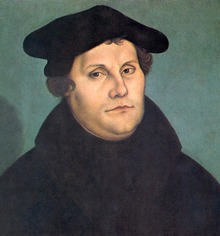
Martin LutherThe following are extracts from The Smalcald Articles, contained in the Lutheran Book of Concord. All of this was written by Martin Luther in 1537. Read it; and preach the Gospel to every creature! (Mark 16:15).


Of Sin. – Part III, Article I.

1] Here we must confess, as Paul says in Rom. 5:12, that sin originated [and entered the world] from one man Adam, by whose disobedience all men were made sinners, [and] subject to death and the devil. This is called original or capital sin.

2] The fruits of this sin are afterwards the evil deeds which are forbidden in THE TEN COMMANDMENTS, such as [distrust] unbelief, false faith, idolatry, to be without the fear of God, presumption [recklessness], despair, blindness [or complete loss of sight], and, in short not to know or regard God; furthermore to lie, to swear by [to abuse] God’s name [to swear falsely], not to pray, not to call upon God, not to regard [to despise or neglect] God’s Word, to be disobedient to parents, to murder, to be unchaste, to steal, to deceive, etc.

3] This hereditary sin is so deep [and horrible] a CORRUPTION OF NATURE that no reason can understand it, but it must be [learned and] believed from the revelation of Scriptures, Ps. 51:5; Rom. 6:12ff ; Ex. 33:3; Gen. 3:7ff…

Of the Law. – Part III, Article II.

1] Here we hold that the Law was given by God, first, to restrain sin by threats and THE DREAD OF PUNISHMENT [HELL], and by the promise and offer of grace and benefit. But all this miscarried on account of the wickedness which sin has wrought in man. 2] For thereby a part [some] were rendered worse, those, namely, who are hostile to [hate] the Law, because it forbids what they like to do, and enjoins what they do not like to do. Therefore, wherever they can escape [if they were not restrained by] punishment, they [would] do more against the Law than before. These, then, are the rude and wicked [unbridled and secure] men, who do evil wherever they [notice that they] have the opportunity.

3] The rest become blind and arrogant [are smitten with arrogance and blindness], and [insolently] conceive the opinion that they observe and can observe the Law by their own powers, as has been said above concerning the scholastic theologians; thence come the hypocrites and [self-righteous or] false saints.

4] But the chief office or force of the Law is that it reveal original sin with all its fruits, and show man how very low his nature has fallen, and has become [fundamentally and] utterly corrupted; as the Law must tell man that he has no God nor regards [cares for] God, and worships other gods, a matter which before and without the Law he would not have believed. In this way he becomes terrified, is humbled, desponds, despairs, and anxiously desires aid, but sees no escape; he begins to be an enemy of [enraged at] God, and to murmur, etc. 5] This is what Paul says, Rom. 4:15: The Law worketh wrath. And Rom. 5:20: Sin is increased by the Law. [The Law entered that the offense might abound.]

Of Repentance. – Part III, Article III.

1] This office [of the Law] the New Testament retains and urges, as St. Paul, Rom. 1:18 does, saying: The wrath of God is revealed from Heaven against all ungodliness and unrighteousness of men. Again, Rom 3:19: All the world is guilty before God. No man is righteous before Him. And Christ says, John 16:8: The Holy Ghost will reprove the world of sin.

2] This, then, is the thunderbolt of God by which He strikes in a heap [hurls to the ground] both manifest sinners and false saints [hypocrites], and suffers no one to be in the right [declares no one righteous], but drives them all together to terror and despair. This is the hammer, as Jeremiah 23:29 says: Is not My Word like a hammer that breaketh the rock in pieces? This is not activa contritio or manufactured repentance, but passiva contritio [torture of CONSCIENCE], true sorrow of heart, suffering and sensation of death.

3] This, then, is what it means to begin true repentance; and here man must hear such a sentence as this: You are all of no account, whether you be manifest sinners or saints [in your own opinion]; you all must become different and do otherwise than you now are and are doing [no matter what sort of people you are], whether you are as great, wise, powerful, and holy as you may. Here no one is [righteous, holy], godly, etc.

4] But to this office the New Testament immediately adds the consolatory promise of grace through the Gospel, which must be believed, as Christ declares, Mark 1:15: Repent and believe the Gospel, i.e., BECOME DIFFERENT and do otherwise, and BELIEVE My promise. And John, preceding Him, is called a preacher of repentance, however, for the remission of sins, i.e., John was to accuse all, and convict them of being sinners, that they might know what they were before God, and might acknowledge that they were lost men, and might thus be prepared for the Lord, to receive grace, and to expect and accept from Him the remission of sins. Thus also Christ Himself says, Luke 24:47: 6] REPENTANCE and [FORGIVENESS] OF SINS must be preached in My name among all nations.

7] But whenever the Law alone, without the Gospel being added exercises this its office there is [nothing else than] death and Hell, and man must despair, like Saul and Judas; as St. Paul, Rom. 7:10, says: Through sin the Law killeth. 8] On the other hand, the Gospel brings consolation and remission not only in one way, but through the Word and Sacraments, and the like, as we shall hear afterward in order that [thus] there is with the Lord plenteous redemption, as Ps. 130:7 says against the dreadful captivity of sin…

Of the Gospel. – Part III, Article IV.

We will now return to the Gospel, which not merely in one way gives us counsel and aid against sin; for God is superabundantly rich [and liberal] in His grace [and goodness]. First, through the spoken Word by which THE FORGIVENESS OF SINS is preached [He commands to be preached] in the whole world; which is the peculiar office of the Gospel. Secondly, through Baptism. Thirdly, through the holy Sacrament of the Altar. Fourthly, through the power of the keys, and also through the mutual conversation and consolation of brethren, Matt. 18:20: Where two or three are gathered together, etc.

How One is Justified before God, and of Good Works. – Part III, Article XIII.

1] What I have hitherto and constantly taught concerning this I know not how to change in the least, namely, that BY FAITH, as St. Peter says, we acquire A NEW AND CLEAN HEART, and God will and does account us entirely righteous and holy for the sake of Christ, our Mediator. And although sin in the flesh has not yet been altogether removed or become dead, yet He will not punish or remember it.

2] And such faith, renewal, and forgiveness of sins is followed by GOOD WORKS. And what there is still sinful or imperfect also in them shall not be accounted as sin or defect, even [and that, too] for Christ’s sake; but the entire man, both as to his person and his works, is to be called and to be righteous and holy from pure grace and mercy, shed upon us [unfolded] and spread over us in Christ. 3] Therefore we cannot boast of many merits and works, if they are viewed apart from grace and mercy, but as it is written, 1 Cor. 1:31: He that glorieth, let him glory in the Lord, namely, that he has a gracious God. For thus all is well. 4] We say, besides, that if good works do not follow, faith is false and not true.

Posted in Uncategorized | Leave a comment