Review of A. D. Belden’s “George Whitefield: A Heritage Biography” (1961)

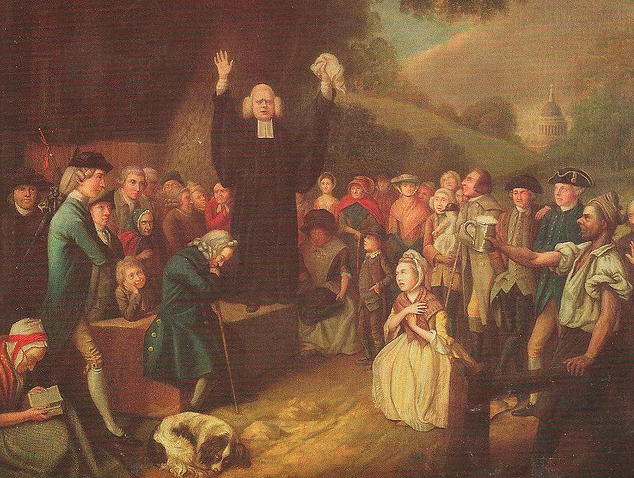
George Whitefield Open Air Preaching 5This 20 page booklet by Independent Press Ltd, is a short biography of George Whitefield by the renowned biographer A. D. Belden, author of the larger work George Whitefield: The Awakener (1930). I did a research paper based on that book in college, and it had a profound impact on me around 2006. This bio booklet is broken up into four sections. Below I will briefly summarize these sections, which will provide a sketch of the life of this exemplary saint:

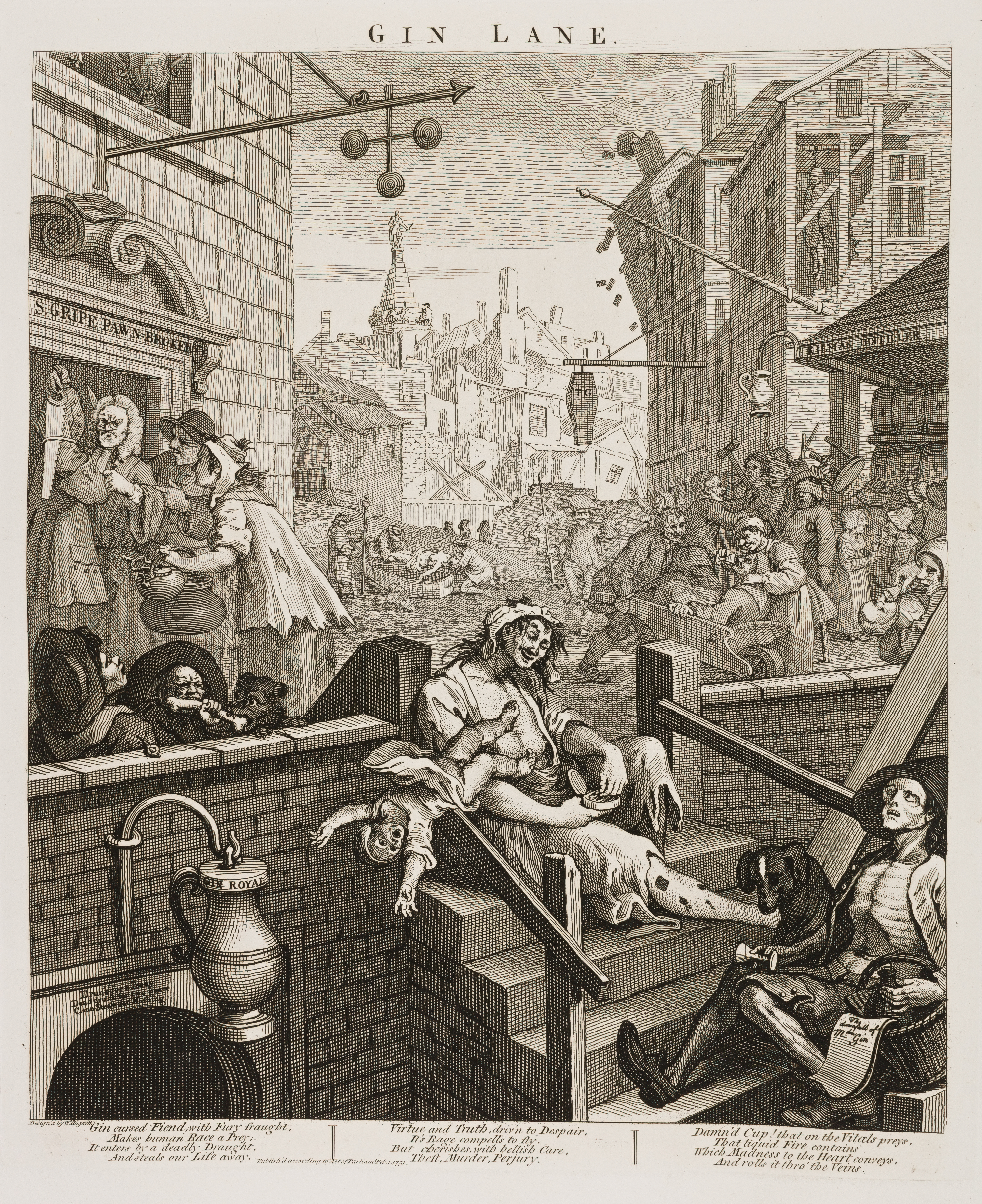
1. The Making of an Evangelist. England was a vile cesspool of drunkenness, gambling, prostitution, etc. London was so filled with bars, William Hogarth’s cartoon “Gin Lane” in the lower left depicted a sign over a bar that said, “Drunk for a Penny, Dead drunk for two pence, Clean Straw for Nothing.” The Church of England was dead as a doornail; Puritan churches were a dead form, partly due to the economic prosperity released by their hard work ethic; and the clergy: ungodly hypocrites and Pharisaic externalists. From out of the tavern culture, God found a young lad named George Whitefield, born December 16, 1714. His dad died when he was young; and his mother managed the bar his father started in the Bell Inn, Gloucester:–where he also lived with 6 siblings. He was sent to school; and at the age of 12, developed an impressive vocabulary. In his teens, George became a waiter at the bar, when a friend came one day, and told him about his experiences as a “sizar” at Oxford University. A sizar was a poor student who earned his way through college by being a servant to other students. George and his mother figured this was what he should do for his advancement; with a little bit of financial aid from his mother’s network of family and friends, off he went to Oxford.

2. The Holy Club–London, Georgia. John and Charles Wesley, the sons of an Anglican priest, had a campus ministry at Oxford called “the Holy Club,” which was committed to producing saints through the practice of spiritual disciplines such as fasting, prayer, Bible study, and giving to the poor. George joined this group through being invited by Charles. God must have been drawing him by the Spirit for him to have agreed with this. As George put into practice the great “methods” as they were called, for which they were ridiculed as “Methodists,” he pushed himself to the point of exhaustion and sickness. At which time, having observed he was overdoing it, Charles gave him a book by Henry Scougal called The Life of God in the Soul of Man. This book contained the Gospel message that George would adopt, and preach throughout England and America, spreading the Evangelical Revival known as the Great Awakening. After having been crushed by the law of God, George knew he was missing something…GRACE! He could identify with the Romans 7 struggle, but now he came to understand he needed the new birth and justification by faith in Jesus, spoken of in Romans 3, 4, and 8. As he studied Scougal and the New Testament, he journaled, “God showed me that true religion is union of the soul with God and Christ proved within us. A ray of Divine light was instantaneously darted in upon my soul and I knew I must be a new creature.” This conversion from the Wesleys’ Anglican works-justification occurred in 1736, two years before John Wesley’s “Aldersgate Experience” conversion on May 24th, 1738. Soon afterwards, George was ordained an Anglican priest, and began preaching sermons on the new birth (regeneration) and justification by faith. The poor common people were very attracted to his preaching and they would crowd the Anglican churches, much to the embarrassment of the carnal priests. George took collections during his sermons to give to the poor. Gradually, Whitefield started open-air preaching to the crowds as well, because they would stay and listen. Georgia was on his mind; his friends the Wesleys were asking him to come over to do missionary work with them. But every time he tried, there was some closed door with the ships, and he wouldn’t be able to get over there. So, he used his time open-air preaching in England, causing Evangelical revivals everywhere. When the Wesleys returned, depressed at their failure in Georgia, they told George not to go. But he went anyway, and spread the Great Awakening in Georgia through his Gospel message, and his own new birth:–which the Wesleys had not yet experienced.

3. America–The Revival Begins–God’s Open Air. Upon arriving in Savannah, Georgia, he gathered large crowds. His message was rare, powerful, and full of the Holy Ghost, and his preaching style was eloquent and fiery. George saw many orphaned children being taken advantage of by wicked businessmen; they were being abused in child labor. So, he succeeded in raising funds for the founding of an orphanage there. He returned on ship back home to England, but was blown off course and landed in Ireland. So, George took to the streets and gathered massive crowds again; revivals were everywhere! Eventually he made it to London, and there found that by now the Wesleys had experienced the same new birth through justification by faith (John Wesley’s came from hearing a reading of Martin Luther’s Preface to his Commentary on Romans, and felt the Holy Spirit burning in his heart!); so now they were preaching the same Gospel:–this was in 1738. But the Anglican priests had barred the Wesleys and Whitefield from their pulpits. They were sick of their “enthusiastic” fanaticism:–their charismatic belief in the witness of the Spirit by the new birth (Romans 8:16). It was a gift the priests did not possess; and so, it caused them no small embarrassment, and probably a bit of jealousy. Belden says that Whitefield was ordained an Anglican priest on January 14, 1739 (p. 15). (Was this a second ordination? He also says he was ordained on page 10–assuming that was in 1736. Hmm.) Either way, Whitefield’s ordination in 1739 was given to him reluctantly and regrettably by Bishop Butler–a Pharisaic Anglican priest. Whitefield found all of the Anglican churches closed to him, even though masses of common people swarmed to hear him preach. So, this turned Whitefield into an open-air preacher for good.Whitefield's Portable Field Pulpit He even made himself a portable, folding pulpit just for open-air preaching. And sometimes when a crowd would get too rowdy–he would fold up his pulpit and escape. It was more like a little stool with a gate around it. He would preach with it at the fairgrounds to clowns and freaks. He attained such notoriety, that even the rich and politically influential came to hear him, having something in common with Billy Graham here. There was one occasion when he preached to the elite at the mansion of Selina Hastings, the Countess of Huntingdon. David Hume, the popular agnostic philosopher, was even moved so much to come and hear Whitefield, that he walked 20 miles to hear him! Whitefield’s notoriety and influence made him into an 18th century apostle. At a crucial turning point, he seems to have broken fellowship with the Wesleys, because they became Arminians; whereas Whitefield came to identify more with the Westminster Confession and Calvinistic views of predestination. While the Wesleys were forming the Methodist Episcopal Church, Whitefield founded 47 independent congregationalist churches known as the “Calvinistic Methodists,” funded largely by the Countess.

Whitefield Statue4. America’s Debt to George Whitefield. So much of his preaching was in England and the surrounding United Kingdom, part of which was the American colonies. Committed to theological education in the promotion of preachers of the Gospel in the revivalist style, Whitefield raised funds and helped to found 51 colleges in America, the most prominent of which are Princeton and Pennsylvania University–which has a statue of Whitefield by Tait Mackenzie. After the Boston fire of 1760, Whitefield helped to re-stock the library of Harvard. Like Hume, Benjamin Franklin was another elite skeptic who so appreciated Whitefield’s zeal for good works, that he funded the publication of all his books. In both England and America, Whitefield’s preaching brought about societal change; and revived faith and holiness in the Anglican, Methodist, Baptist, and Presbyterian churches. One black spot remains on Whitefield’s record: his advocacy of slavery. With most of the churchmen of his day, he believed that a responsible and godly treatment of slaves was in agreement with Abraham’s ownership of slaves, etc. John Wesley, an abolitionist, preached against slavery and also against the American Revolution. Whitefield, on the other hand, believed in “godly slavery” and was supportive of the Revolution. Belden concludes, “Whitefield blazed the trail of revival in America as well as England. First into religious journalism; first into revivalist preachings; first into open-air evangelism; first into a new Christian philosophy and first effectively into the opening-up of the American colonies to the new evangelism and to a new movement towards Christian education” (p. 20). What Belden doesn’t say is that Whitefield died on September 30, 1770–and John Wesley preached his funeral, at Whitefield’s request.

Posted in Uncategorized | Tagged , , , , | Leave a comment

Living by God’s Economy – Chuck Bentley

Originally from here.

GAINESVILLE, Ga. (BP)–Many people list Jeremiah 29:11 as one of their favorite verses in the Bible: “‘For I know the plans I have for you,’ declares the LORD, ‘plans to prosper you and not to harm you, plans to give you hope and a future.'” This inspirational verse brings comfort to our lives when the future looks bleak and we feel like we have no hope. This verse reminds us that we can take comfort in knowing that our Heavenly Father has a plan for our lives, a good plan for our future.

But do we ever stop to think about the context of this verse? Who was God giving this promise to? Jerusalem had been attacked by the army of King Nebuchadnezzar, the city destroyed, and all the people carried away as captives to Babylon. Now, God’s chosen people lived as exiles in a strange country. Understandably, they were distraught and hopeless. What would become of them in this foreign land?

It was to these people that God spoke these words, through His prophet Jeremiah:

“This is what the LORD Almighty, the God of Israel, says to all those I carried into exile from Jerusalem to Babylon: ‘Build houses and settle down; plant gardens and eat what they produce. Marry and have sons and daughters; find wives for your sons and give your daughters in marriage, so that they too may have sons and daughters. Increase in number there; do not decrease. Also, seek the peace and prosperity of the city to which I have carried you into exile. Pray to the LORD for it, because if it prospers, you too will prosper‘” (Jeremiah 29:4-7).

To a people who had no hope, to a people who were captives in a foreign country, God gave them instructions on how to live their lives. They were to build houses, plant gardens, marry and have children. They should not stop living because they were in a land that was not their home. He also told them to pray for the peace and prosperity of the very land that held them captive. As that land prospered, so they also would prosper.

The promise continued in verse 10, “This is what the LORD says: ‘When seventy years are completed for Babylon, I will come to you and fulfill my gracious promise to bring you back to this place.'” This promise of deliverance is followed by the famous verse, “‘For I know the plans I have for you,’ declares the LORD, ‘plans to prosper you and not to harm you, plans to give you hope and a future'” (Jeremiah 29:10-11).

The Lord gave the people hope that they would be delivered from their captivity and brought back into their homeland. And then He assured them that none of this was happening by accident. God had a plan for His people, just as surely as He has a plan for each of us today.

We know that this world is not our final home. Yet, we are still here, for the amount of time that God grants us. How do we need to live, here in this “foreign land”? We should follow the Lord’s instructions to the Israelites: settle down, marry, and have children. Basically to go about our daily lives in the way He has instructed us. And one very important instruction is to pray for the peace and prosperity of the land.

Our country has undergone some major financial upheavals in the past year. Many people are beginning to see that they have been living by man’s economy, trusting in money and possessions to bring happiness, but finding out that man’s economy only brings worry, doubt and unhappiness. There is a better way.

God’s economy calls us to make Him the Lord of our lives, in every aspect, including our finances. Recognizing that God is the owner of all things and that we are stewards of His blessings will give us that peace we all search for. And by being wise stewards, we can be free to use His resources in the way He instructs, to bless our lives and the lives of others, to be free to be generous and to help others.

God still has a plan for His children today, a plan to prosper us and not to harm us, a plan to give us hope and a future, if we choose to live in God’s economy, even in the midst of a “foreign land.”

Posted in Uncategorized | Leave a comment

Escape From Rationalism Through Repentance and Faith!

The natural man does not receive the things of the Spirit of God, for they are foolishness to him; nor can he know them, because they are spiritually discerned.           –1 Cor. 2:14

Rationalism is the frame of mind that most Americans are in, whether they know it or not. It is the perspective that was advanced in the 1700s through France and England, and eventually brought over to America through founding fathers like Benjamin Franklin and Thomas Jefferson. It is basically the view that all of reality can be fully understood and measured by the five natural senses: sight, hearing, touch, taste, and smell. So, it also leads to another perspective called empiricism or scientism or naturalism. “I believe in science,” is basically the idea of scientism: only that which can be “scientifically proven” is what the rationalist is willing to believe.

Although Franklin was a contemporary and even a “friend” of George Whitefield during his Great Awakening, Franklin was not a Bible-believer. It is astonishing that a man could be in the presence of such a powerful prophet, under whose preaching thousands were moved by outpourings of the Holy Ghost—and yet we find Franklin unpersuaded to become a real Christian! Such is the darkness of the rationalist mind. Franklin goes down in history as a scientist, inventor, founding father, politician, postmaster, and even economist—who wrote the first “success” manual: The Way to Wealth. But nevertheless, I’m sure Franklin is in Hell right now, because he refused to repent and believe in the Gospel. A tragic case of rationalism.

There are so many Americans that are under the influence of rationalism! The spirit of Franklin lives on in them as they occupy their minds with education for lucrative careers, economic performance, and the hobbies of politics, TV, sports, and tourism. God is not in it. Most of them, although they are not atheists by name, could might as well write their own biographies of what it is like to live your life without God. They don’t want God; and they resist His Spirit; they are so without understanding of the benefits of experiencing the Holy Spirit, that they think God is a killjoy. Because they don’t know Him! Sure, many of them go to church:–but that is beside the point. The point is that they don’t know God or experience the Holy Spirit’s activity in their lives! Or witness angelic interventions. At best, most of them are practically deists:–“I believe in God,” they say. At least they are not atheists, they think. They are smart enough to believe God created the world. But “even the demons believe,” James 2:19 notes; and they are not saved! “Faith without works is dead” (2:26).

Church-going Americans need to realize they will NEVER be saved from an eternity in Hell unless they REPENT (turn away from their sinful lifestyles) and BELIEVE in the GOSPEL! (Mark 1:15). Being a “believer in God” is not good enough; it’s too vague and general. You have to become a Christian—a Christ-follower in order to enter the New Covenant of salvation by grace through faith in the cross of Jesus Christ. Or else: you will go to HELL!

Secondly, people will never experience life with the Holy Spirit and help from God’s angels unless they REPENT and trust the CROSS. In this way, we have “boldness to enter into the holiest by the blood of Jesus” (Hebrews 10:19). And the angels are “ministering spirits sent to serve those who will inherit salvation” (Hebrews 1:14). Do you lack evidence of the supernatural manifestations of God in your life? Then REPENT FROM YOUR SINS, PLACE YOUR FAITH IN THE CROSS, AND LIVE A HOLY LIFE!

Posted in Uncategorized | Leave a comment

Holy Hands – John P. Kee

1 Timothy 2:8: “I want the men everywhere to pray, lifting up holy hands without anger or disputing.”

Posted in Uncategorized | Leave a comment

Piety in Ministry – Paul Washer

Mark 1:35-38: “Very early in the morning, while it was still dark, Jesus got up, left the house and went off to a solitary place, where He prayed. Simon and his companions went to look for Him, and when they found Him, they exclaimed: ‘Everyone is looking for You!’ Jesus replied, ‘Let us go somewhere else–to the nearby villages–so I can preach there also. That is why I have come.’”

Acts 6:4: “We will give ourselves continually to prayer, and to the ministry of the Word.”

Posted in Uncategorized | Leave a comment

All Night – Alvin Darling and Celebration

Hallelujah,
Thank you Jesus

All Night (All night)
I wouldn’t give up

All Night (All night)
I wouldn’t let go

All Night (All night)
I just held on

I called on the Lord (I called on the Lord)
All night long and I wouldn’t let go

Until He blessed my soul. I’m a witness
That He came through

Jacob wrestled with the Angel all night and he wouldn’t
Go until the break of dawn.
He said, “You gotta bless me before You leave.”
I felt the same way, when I was on my knees
I asked the Lord to help me to be strong
I called Him all night long

I called on the Lord

I called on the Lord all night long and I wouldn’t let go

I call on the Lord all night long and I wouldn’t let go
Until He blessed m
y soul
I’m a witness that He came through

Posted in Uncategorized | Leave a comment

Jordan River – Georgia Mass Choir

(Jordan’s river I’m bound to cross)

Jordan River I’m bound to cross.
Jordan River I’m bound to cross,
I’ve got one more river to cross.

Mother will be waiting.
Mother can’t help me to cross.
Mother will be waiting, she can’t help me to cross.

Mother will be waiting, she can’t help me to cross,
(I’ve got) one more river to cross.

(Father will be waiting,
Father, can’t help me to cross).

Father will be waiting, he can’t help me to cross.
Father will be waiting, he can’t help me to cross,
(I’ve got) one more river to cross.

(Jesus will be waiting,
Jesus gonna help me to cross).

Jesus will be waiting,
He’s gonna help me to cross.

Jesus will be waiting,
He’s gonna help me to cross.

One more river,
One more river.

Hallelujah, thank You Jesus,
Made it over the river.

(I’ve got) one more river to cross.

—–

Originally from here.

The American theologian James Cone suggests that there are two basic meanings of the Jordan River as a symbol in African American spirituals. First, the Jordan represented death—a death that was typically seen as liberation from the harsh realities of slave life. Thus, “crossing Jordan” was a theme of going home to restore a community lost in oppression and slavery.

Second, the Jordan could also represent the border between slavery and freedom—and so the “other side of the Jordan” could just as often suggest the Northern states, even Canada, and thus freedom:

I’ll meet you in the morning
When you reach the Promised Land
On the other side of the Jordan
For I’m bound for the Promised Land.

—–

Third, I would add crossing Jordan could have also meant being “sanctified” by praying through in the holiness churches; and experiencing a sense of freedom from sin. Crossing from Romans 7 over to Romans 8.

Posted in Uncategorized | Leave a comment

I’m a Traditional Pentecostal, Not a Cheap Grace Charismatic

I’ve reached a point in my walk of faith that I’m much more comfortable viewing myself as a traditional Pentecostal than as a Charismatic Christian. Traditionally, Pentecostals accept holiness and morals, whereas Charismatics tend to be antinomian, cheap grace-oriented, and “love gospel” seeker-sensitives. 

To narrow it down further, because it needs narrowing, I’m more comfortable identifying with the following types of Pentecostalism:

1. William J. Seymour / Azusa Street Revival

2. Smith Wigglesworth / Healing Ministry

3. Jack Coe / Healing Ministry

To abide in this kind of spirituality, I would like to drink the following books down my spiritual gullet:

1. Donald Gee’s Concerning Spiritual Gifts

2. Smith Wigglesworth’s Ever-Increasing Faith

3. Stanley Frodsham’s Smith Wigglesworth

4. Larry Martin’s The Complete Azusa Street Library

5. P. C. Nelson’s Bible Doctrines

I believe the Assemblies of God has generally apostatized from this kind of Pentecostalism. So I don’t mean I’m an “Assemblies of God man” or some adherent of a Pentecostal denomination. I think Assemblies of God has the best Pentecostal theology, but I don’t plan on ever joining the denomination, because I know it is led by Pharisees. I will always henceforth be a traditional, non-denominational Pentecostal. 

By saying that, I reject the following antinomian Charismatic ministries as defective and not approaching the holiness of Jesus:

1. Rock Church International

2. Non-Denominational Charismatic churches

3. MorningStar Ministries

4. Catch The Fire

5. Bethel Church (Redding, CA)

Posted in Uncategorized | Leave a comment

Modern Day Pharisees Exposed! Seven Marks

Modern day Pharisees bear most if not all of the same theological and spiritual characteristics of the Pharisees in the four Gospels. In essence, this is what is meant when someone says a person has a “religious” spirit. It’s actually a demon power. It’s what Jesus meant when He called the Pharisees “children of the devil” (John 8:44). Their attributes are:

1. Hypocritical. They are hypocrites (lit. “stage actors”); they pretend to be godly, real Christians; but they put on a vain, public, social face (Luke 12:1). Why they bother to do this is anyone’s guess. It would be better if they did not go to church at all. Perhaps it is loneliness that drives them to “fit in” with church friends. But in the end, it turns the church into a “den of thieves” and a “brood of vipers” (Matthew 21:13; 23:33).

2. Malevolent. Pharisaic church goers are ill-willed. They are malicious gossips; intentionally, and not accidentally, harmful; cliquish; they really do hate other people (John 15:25). They bother, annoy, and abuse people verbally and emotionally; particularly people who are not like them. They are “weeds” planted in our churches by our enemy, the devil (Matthew 13:25).

3. Slanderers. Not only are Pharisaic church folks liars, they lie with the intent of demeaning other people; they are especially keen at lying about real Christians in their midst. They did this to Jesus when they lied that He was demon-possessed (John 8:48); and that He claimed to be a king instead of Caesar (Luke 23:2). The reason for this is rather simple: their attempts at tearing down the reputations of saints are meant to “level” things out, so that the saints’ godliness doesn’t seem to make a big difference from the Pharisees’ carnality and hypocrisy. Otherwise, the Pharisees’ social influence in the church is undermined; and church people can see more clearly through their moral pretending.

4. Authoritarian. The military is a necessary institution for the governments of countries to defend their borders. This demands hard, disciplined, driving male leadership. But in the church, which is a spiritual army and FAMILY, led by Jesus Christ through faith (1 Corinthians 11:3):–leadership is NOT supposed to take on a secular army-type of character. “It shall not be so among you,” Jesus said (Matthew 20:26). Leadership in the church should be spirituality-focused and should imitate Jesus in every aspect (1 Corinthians 11:1)…not Winston Churchhill, and not General Douglas MacArthur. Nor does Jesus intend on bishops and pastors imitating business managers featured in Forbes magazine. Pharisees, ancient and modern, totally fail to make this distinction; so it is no wonder why they think it’s normal for district superintendents and pastors not to be like Jesus, or John the Baptist, or spiritual mystic prophet-types. In psychology, authoritarian personalities are largely to blame for very many mental illnesses and psychological disorders; because they are usually very abusive, and inhibit other people’s emotions, imaginations, creativity, and overall freedom of spirit.

5. Institutional. Pharisees are “denomination men.” They were in the time Jesus, regarding the temple and the synagogues. Note: that both Jesus and John the Baptist were independent preachers (Matthew 3:1; 21:32). Nearby Bethany at the Jordan River, John the Baptist had an open-air ministry which was non-denominational, independent, and not connected to the temple or the synagogues; it was a non-denominational ministry; the same was the case with Jesus, which is probably why He said it “fulfilled all righteousness” for Him to be baptized publicly by John the Baptist (Matthew 3:15), so Jesus could continue the same non-denominational ministry begun by John the Baptist. The Pharisees, for this very same reason, opposed Jesus as they did John. “By what authority are You preaching?” they questioned Jesus (Mark 11:28). He replied it was the same divine authority by which John the Baptist was commissioned: direct revelation from the Holy Spirit. An authority which the Pharisees labeled demonic, simply because it did not comply with the human authority of the temple and the synagogues (John 12:42). Modern day superintendents and pastors are no different: all they ask is that you comply with their denomination. But if you don’t, then something must be devilishly wrong with you.

6. Diplomatic. In order for Pharisees to be good institutionalists, they have to be diplomatic, politically correct, compromisers of theology and morals. If they were totally authoritarian all the time, it would probably not lead to numerical success or church growth. All parties must be pleased. In the spirit of pleasing people with great customer service, they try their utmost to make sure their target audience feels like their needs are met at the local church: the family. Moms and dads, kids, grandmas and grandpas are their targets. This usually means love-centered sermons and family-friendly church events (2 Timothy 4:3). Preaching like John the Baptist or even most of what Jesus Christ Himself preached would be considered inappropriate, controversial, impolite, immature, and not befitting the church context. Hell, the Day of Judgment, the Atonement, keeping God’s laws, and deliverance from demons must rarely if ever be preached; and if so, only in the most indiscernible and watered-down manner possible. Hence, Pharisees stray away from preaching the lordship salvation Gospel! (Galatians 1:8-10). Justification by faith leading to holiness is a discarded old-time message. Holiness-or-Hell? (Hebrews 12:14). Forget it! Pharisees always intentionally preach the most lukewarm understandings of God.

7. Greedy. Pharisaic church leaders are covetous for tithes and offerings, because they have to manage the denominations they are so committed to (2 Peter 2:3). The church buildings and social programs of denominations often cost millions of dollars to fund on a large-scale basis. Some church leaders are transparent about the financial needs of their church—TOO TRANSPARENT. That is, it leads to the most distasteful BEGGING and guilt-trip sermons on giving and donations. If they were non-denominational, the pastors would not have to succumb to this. They would have no annual financial reports to be graded on by their superintendents; and there would be no pressure from the top to “grow their churches” numerically. They could work “tent-making” jobs like Paul, take some of the income generated from their jobs, and pour it into the churches’ financial needs (Acts 18:3; 1 Thessalonians 2:9; 2 Thessalonians 3:8-9). There would be no need to fleece the flock so frequently; but rather, there would be plenty of food to feed the sheep. “We will give ourselves continually to prayer, and to the ministry of the Word” was what the apostles said about pastoral ministry (Acts 6:4). Pharisees aren’t like that; they say, “We will give ourselves continually to man-pleasing, family-friendly church events, fund-raising, and building projects.”

Posted in Uncategorized | Leave a comment

Gospel Anthology: Selected Sermons of Jonathan Edwards and John Wesley, Modernized for Evangelistic Preaching (Book Outline)

1. Sinners in the Hands of an Angry God (Edwards, 1741)

2. Salvation by Faith (Wesley, 1738)

3. The New Birth (Wesley, 1760)

4. The Way of Holiness (Edwards, 1722)

5. A Call to Backsliders (Wesley, 1778)

6. Heaven, A World of Charity, or Love (Edwards, 1738)

John Wesley on Open-Air Preaching

Posted in Uncategorized | Leave a comment