
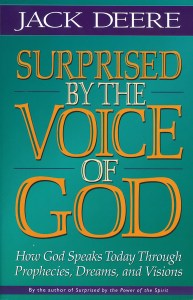
Jack Deere’s Surprised by the Voice of God (1996) is the best book on dreams, visions, the voice of God, and the gift of prophecy that I have found to date. It is more lively and experiential than Wayne Grudem’s The Gift of Prophecy (1988), but just as academically satisfying. Truly it is the best book on spiritual gifts that I could recommend to anyone at this point in my life. This book is a gift to the body of Christ. I don’t agree with everything he says though, and I will express my friendly but critical thoughts as I summarize what I learned from him…
CHAPTER 1 shows that Deere’s introduction to the gift of prophecy started when a seminary student came into his office one day and he went into a trance and saw a vision of the word “PORNOGRAPHY” as the student was talking. When he mentioned it to him, the young man admitted that he had become addicted to porn. He repented and was prayed for, and was freed from that addiction. On another occasion, he was praying for a troubled woman and the name “Don” kept popping into his mind. It turned out that man had done some very abusive and occultic things to her; and she was set free from demonic power by Deere’s praying.
CHAPTER 2 shows that Deere soon became friends with John Wimber, the founder of the Vineyard churches, and an amazing charismatic theologian in his own right (Power Evangelism, Power Healing, Power Encounters, Power Points, etc). Later on in the book, Deere says he joined Wimber’s pastoral staff for a few years in the 1980s at the Anaheim Vineyard Christian Fellowship. (He doesn’t mention him by name, but I believe John Paul Jackson was on the staff as well for a while, because he was so gifted with visions.) So, its clear from the beginning of the book, that Deere’s views on miraculous gifts come from a Vineyard, or Wimber perspective.
CHAPTER 3 shows that Deere believes as do I, that Jesus had to receive revelation just like all other humans have to (dreams, visions, the voice of God, impressions, etc). But he does not teach any kenosis doctrine of Jesus starting off as a human and becoming God later on. He just believes that God made Jesus to experience life as a human prophet who had to receive revelation just like every other prophet that had existed in the world. The only difference was that Jesus had the “Spirit without measure” (John 3:34). Even Elisha didn’t have it that good.
CHAPTER 4 shows a survey of supernatural experiences in the book of Acts. It starts with Peter’s proclamation of the prophecy of Joel 2:28-32 being fulfilled on the day of Pentecost through the baptism in the Holy Spirit, speaking in tongues, dreams and visions, signs and miracles, the last days, and evangelistic outreach (Acts 2:17-21). Spirit-filled dreams and visions are clearly seen as the source of the prophecies that come from God. After the ascension, the apostles cast lots to discover Matthias (1:26); during a prayer meeting, a violent wind blew through the room and visionary lights of fire shaped like tongues came and hovered over 120 disciples (probably signifying the Holy Spirit’s role in tongues and prophecy) (2:2-4); there is the healing of a paralytic (3:13); Peter got revelation on the death of Ananias and Sapphira and was later delivered from jail by an angel (5:3, 19-20); Stephen saw an open vision of Jesus standing on the right hand of God and declared it to the Pharisees (7:55); Philip was directed by an angel and the Holy Spirit, performed miracles as he preached the Gospel, and was teleported by God (8:26, 29, 39); Paul saw an open vision of Jesus on the road to Damascus and Ananias (not the man in ch. 5) heard God’s voice (9:3-6, 10-16); Cornelius saw an open vision of an angel while praying; Peter fell into a trance while he was hungry and saw an open vision of animals and then the Holy Spirit told Peter to go to Cornelius, and when he did he preached the Gospel and the Holy Spirit was poured out on his household and everyone spoke in tongues (10:4-6, 10-16, 19, 46); Agabus accurately prophesied a famine (11:28); Peter was again freed from jail by an angel (12:7-11); during worship and fasting, God’s voice spoke to an elder that Paul and Barnabas should be sent out as missionaries (13:2); Paul “saw” that a paralyzed man had faith to be healed (14:9-10); the Holy Spirit impressed the Jerusalem elders to not bind the ceremonial law on the Gentiles (15:28); Paul was given a vision of a man in Macedonia beckoning him to come and preach the Gospel (16:9-10); Jesus appeared to Paul in a vision at night and assured him that he would not be harmed in Corinth (18:9-11); Paul laid his hands on twelve people and they spoke in tongues and prophesied (19:6); the Holy Spirit warned Paul that suffering waited for him in Jerusalem (20:23); Agabus prophesied that Paul would be arrested in Jerusalem (21:10-11); Jesus appeared to Paul in his prison cell in an open vision and told him that he must testify of his conversion in both Jerusalem and Rome (23:11); while on a ship, an angel appeared to Paul in an open vision and let him know that they would be shipwrecked but everyone would live (27:10, 21-26); the faith of the people on Malta was heightened once they saw Paul’s hand bitten by a deadly viper and he was unharmed; then he prayed for the sick and people were healed (28:3-9).
Revelations are divinely implanted thoughts in the mind: they come either through dreams, visions, voices, and accompanying impressions from the Holy Spirit. They are thoughts that surprise, inform, enlighten, guide, and instruct. This is because, as God once said, “As the heavens are higher than the earth, so are My ways higher than your ways and My thoughts than your thoughts” (Isaiah 55:9). They are not the sorts of things that you would think up on your own. They come from God, hence they are thoughts that come from a higher source than your own mind. The prophet who would receive such thoughts from God must have a teachable spirit, willing to align himself with what is revealed to him by God.
CHAPTER 5 shows that evangelical charismatics are nothing new. While Catholic saints had no problem with charismatic experiences–Protestants have been a lot drier in this area. However, the gift of prophecy did seem to leap out of the Catholic Church during the Protestant Reformation and transfer to some of the reformers. This was especially the case with the Covenanters in Scotland, documented in John Howie’s The Scots Worthies. Deere highlights the following as having outstanding miraculous gifts in the prophetic: George Wishart (d. 1546), John Knox (d. 1572), John Welsh (d. 1622), Robert Bruce (d. 1631), and Alexander Peden (d. 1686). These men who loved the Bible so much–also had no problem with God speaking to them in visions and dreams. I would add to this list a charismatic continuation with George Fox (d. 1691), John Wesley (d. 1791), Smith Wigglesworth (d. 1947), John Wimber (d. 1997), and David Wilkerson (d. 2011). Basically the traditions of evangelical Quakerism, Methodism, holiness, Assemblies of God, and the Vineyard (Wimber era). Today it seems, and I say this with great reservation, that the Holy Spirit is most active in non-denominational charismatic churches that enthusiastically practice prophetic ministry. In the wake of Todd Bentley’s “Lakeland Revival” scandal in 2008, I would hope that some prophetic ministries have tried to purify their standards, and lean more towards Biblical holiness preaching, or a more evangelical direction. I think John Paul Jackson might be an example of that: he passed away on February 18, 2015.
CHAPTER 6 shows that Reformed cessationist scholars began to edit out any supernatural experiences or views in John Howie’s Scots Worthies; and in the 19th century during this rationalistic period, this explaining away of the supernatural in Christianity became more prominent. But in the 1600s, there were still some evangelical charismatics around. Samuel Rutherford (d. 1661), for example, was a prominent Puritan theologian who was part of the assembly that compiled the Westminster Confession. He was actually a charismatic! In his book, A Survey of the Spiritual Antichrist, he goes to great lengths explaining the difference between true charismatic prophets and false charismatics. He believed that John Wycliffe (d. 1384), John Hus (d. 1415), Martin Luther (d. Feb. 1546), George Wishart (d. March 1546), John Knox (d. 1572), and John Davidson of Prestonpans (d. 1604) were all true prophets who accurately predicted the future (p. 42). Davidson was also a Covenanter. Rutherford also believed that there were rules for spiritual discernment that could be used to judge whether a revelation was true (p. 43):
1. The prophecies do not contradict the Bible.
2. The prophecies come from godly people.
3. The prophets deny that their prophecies have the same authority as the Bible.
4. The prophets don’t require anyone to obey their prophecies.
Deere also makes some remarks about the character of these men and the circumstances in their lives that make prophecy possible. 1. They have the fear of God (Ps. 25:14). 2. They have prayer lives, which means they spend hours in prayer every day, especially like Welsh. 3. They stand for the truth of the Gospel even though it costs them respectability; and they are persecuted as common criminals. 4. They are often poor and needy; and prophecy was just part of God’s providence for them. Deere remarks, “Throughout the history of the church, there were amazing reports of the supernatural when extraordinarily godly Christians were persecuted. According to the contemporary historians, godliness, persecution, and need accounted for the supernatural outpouring of the Holy Spirit during this period. The same is true today” (p. 86). He points to the underground church in China, Corrie ten Boom, and Charles Spurgeon as more recent examples.
CHAPTERS 7-10 is my favorite part of the book: “The Language of the Holy Spirit.” In many ways it is the heart of the book and is the most practical.
In chapter 7, it shows that there is such a phenomenon, which the Catholics used to call sortes Biblicae (lots by the Bible). In this experience, the Holy Spirit directs the Christian to open up the Bible “at random” but ends up guiding the person to open up to a specific passage and speak something directly relevant to his situation. This happened to St. Augustine when he heard a voice say, “Take it and read, take it and read,” and when he opened up to Romans 13:13-14, it spoke directly to his situation, and he gave his life to Christ.
In chapter 8, it shows that God speaks to us through common events, circumstances, and coincidences that happen in our lives (signs from God). I have found that if you are willing to pay attention, even the most prayerless and unvisionary Christian can perceive these things happening around him. When a certain event happens in our lives, we should ask God, “What are You trying to say to me through this?” Sometimes certain events can be much more coincidental and unusually frequent in their thematic material, that you can do nothing else but conclude that the God who orchestrates all things is trying to communicate something to you.
In chapter 9, it shows that there are two kinds of voices that God speaks to people in, and that prophets would experience these more often, and with greater variety. Firstly, there is the audible voice. This happened to Francis Schaeffer, when he was alone praying in his room, he heard a voice–not in his mind–but come out of the air and say, “Uncle Harrison’s house.” In the midst of financial distress, he contacted his uncle, who rented out the house to him for free. Deere says that the audible voice is rare and usually happens to Christians in prominent places of leadership (Exod. 19:9), but the normal ways that God speaks to prophets are through visions and dreams (Num. 12:6-8). Deere connects the audible voice with prayer (Luke 3:21; 9:28-29; Acts 10:9-16; 22:17-21). The other kind of voice is what Deere calls an “internal audible voice,” and he points to Ezekiel 14:2 with the common Old Testament phrase “the word of the Lord came to me,” while Ezekiel was sitting with elders. The elders didn’t hear the voice, but he did. This is an example of the Holy Spirit speaking into the mind of the prophet, internally. I prefer to call this “the mental voice,” because it is a voice that is inside the head, the mind, the thoughts; it is also clearly distinguishable from your own thoughts, because it takes on the character of a voice, not just a thought (although God can implant thoughts in the mind too, which are called impressions); when Elijah heard the “still, small voice” of God–it was possibly a mental voice (1 Kings 19:12), or at least many people interpret it that way. Although I could see why someone might think that was a quiet audible voice too.
In chapter 10, it shows that dreams and visions are the most normal way that we are to expect God to speak to us in the direct sense (especially dreams). In the Bible, “the absence of dreams and visions was usually a sign of God’s judgment during a time of apostasy (Lam. 2:7; Mic. 3:6-7; 1 Sam. 3:1)” (p. 145). It is the normal experience of the New Testament church (Acts 2:17-18). Deere goes onto quote an example of a ballerina dream that brought healing to a woman. Although that grated against my masculinity, I can see why God could use something like that for a woman. I would’ve rather favored a citation of one of the dreams of John Fletcher, the Methodist leader: it was a dream of the day of judgment that led to his conversion. This is quoted in Archibald Alexander’s Thoughts on Religious Experience, ch. VII (7). One of the things I felt could have strengthened this part of the book would have been at least a 3-5 page section on dream interpretation (see John Paul Jackson’s The Biblical Model of Dream Interpretation). Since dreams are the most common way that the Holy Spirit speaks directly, it would become necessary to skilfully interpret dreams, and understand them, in order to be guided by them more accurately. Deere also shows that the Holy Spirit uses impressions to bring revelation, and often in the ministry of healing. An impression is a feeling, an intuition (a “know that you know”), a thought, that just dawns upon you: he refers to Mark 2:8: “Immediately Jesus knew in His spirit that this was what they were thinking in their hearts.” (As an aside, Deere says he was friends with Peter Lord, author or Hearing God (1988). That book is okay in some ways, but I dislike his citation of Morton Kelsey’s The Other Side of Silence (1976), which speaks favorably of yoga and Zen. Lord’s citation is fine. But many other parts of Kelsey’s book speak favorably of yoga and Zen, and that is totally heretical. I personally advise a ban on all of Morton Kelsey’s books, because for some reason his books have filtered their way into the charismatic movement, and I think that is harmful. The same goes for Herman Riffel–pronounced Riff-ull–who was influenced by Kelsey, and had some universalist views of dreams).
CHAPTER 11 shows that there are superficial reasons why people go to church (both pastors and church members). Pastors often go to church, because they want to teach the Bible and nothing more. Often they don’t care about evangelism, divine healing, marriages, the poor, or foreign missionaries. Church members often go to church, because they think its their duty, its a family tradition, its a good place to do business, it helps improve their image in the community, the happy feeling they get from seeing the stained glass windows, to see their friends, to be entertained and laugh, to be enlightened, to hear a great preacher, to learn the Bible, to please their mate, to find a mate, to get away from a mate, etc. In Biblical times, however, the reasons why people went to church were: 1. To hear Jesus and get healed (Luke 5:15; 6:18). 2. To worship God together (Ps. 100:1-5). 3. To be trained for ministry (Eph. 4:11-13). 4. To have their faith in Christ strengthened through prophetic ministry, sharing songs, and sharing teachings (1 Cor. 14:26). On this last point, Deere recommends Quakerish listening prayer (contemplation) in a group setting (large or small), the receiving of revelations like closed visions, and sharing them with each other: “What then shall we say, brothers and sisters? When you come together, each of you has a hymn, or a word of instruction, a revelation, a tongue or an interpretation. Everything must be done so that the church may be built up” (1 Cor. 14:26). This must be a Vineyard influence, because I attended a Vineyard church where a group of people prayed for me by laying their hands on my shoulders and just being quiet and listening to the Holy Spirit say something. In the “Signs and Wonders” videos by John Wimber, I saw him do the same thing. It might mean a long, awkward silence, but that might be what it takes to get a specific word from God for someone!
CHAPTER 12 shows that Deere believes in some type of covering theology for those involved in prophetic ministry, which I would differ with him about (p. 183). Coming from a Presbyterian background, he still has a high view of church polity. While I will admit that some itinerant prophets are really “out there,” I will also say that you can’t always fit God and His prophets into a convenient church box. This is rarely the case. Prophets walk with God and are attracted to revivals. You could hardly build the case that Paul was under anyone’s covering in all the things he did in the book of Acts. Sure, he was connected with Peter and James in Jerusalem, but that was hardly the case. In fact, of the few times that he came in contact with them, he rebuked them about the Judaistic tendencies they held on to. I believe that presbyterian church polity is the ideal administrative situation for any revived church, but I would qualify that the church in question has to be a revived one (under the influence of revival and a revivalist leader). The Vineyard in Wimber’s day was one such church, but I would be hard pressed to say that the Vineyard today is in the same condition, especially with its new LGBT inclusion policy. When I say “revival” I am referring to the evangelical revivalist tradition handed down by John Wesley, George Whitefield, Jonathan Edwards, Charles Finney, Smith Wigglesworth, etc. These names have to fit somewhere in the mix of the teaching, if not prominently and directly, then at least somewhere in the background. There also needs to be outpourings of the presence of God in meetings during worship, and strong soteriology with Puritan-like Gospel preaching with a sanctification emphasis, for the environment to be considered a “revival.” If this spirit of revival is not present in the pastor’s preaching and ministry perspectives, then any church polity used to administrate prophets in his church, will only prove to quench the Spirit, and make people despise prophecies (1 Thess. 5:19-20).
Deere also says something I’m strongly disturbed about, seeing that he’s a seminary professor: he believed that Christians who fall and commit suicide can go to Heaven (pp. 176-177). This shows that the “Dallas Doctrine” still remains with him in some form: its also called the no-lordship view of salvation. All you have to do is believe that Jesus is your Savior and your spiritual status will always be “once saved, always saved” from Hell. No continual repentance and faith are needed to maintain a salvific relationship with God. I utterly protest against any such notions. Its totally un-Biblical. Saul and Judas committed suicide; and they went to Hell. Suicide is self-murder: Augustine, the church fathers, and the pre-Vatican II Catholic Church were right to call suicide what it was: MURDER, and hence it was labeled a mortal sin. Be that as it may, Deere still has plenty of content in the rest of this book that pertains to sanctification. I will forgive him for this terrible blind spot, especially since it was something I think the devil took advantage of in his life, due to him having to cope with two of his own family members who committed suicide. Chapter 12 is my least favorite chapter, but he still has some good advice in it for pastors of charismatic churches.
CHAPTER 13 shows some pointers on how to handle prophetic words in a church setting.
1. Get permission from God to share a revelation. Many times God will give a vision, dream, or voice just for your personal information: these are revelations to be journaled and remembered, but not shared with others (see Dan. 8:26; 12:4; 2 Cor. 12:4; Amos 3:7; Jer. 33:3). But if you must prophesy or share a revelation with someone, then keep in mind that “a word aptly spoken is like apples of gold in settings of silver” (Prov. 25:11).
2. Get the right interpretation of a revelation before you share it. Some dreams, visions, and voices may very well be revelations. But revelations are not good enough all by themselves, because they may not be clear. Evangelical interpretation, as well as real life facts, and situational contexts about people and places surrounding the vision, all have to be taken into account, in order to be a good visionary hermeneut. Feelings felt in dreams (impressions) should also be taken into account. Its like the way that evangelicals interpret the Bible: in its proper context and distinguishing the literal from the symbolic. Approach dreams, visions, and voices the same way, especially if you think a vision is pointing out sin in a person’s life. It is better to share such a vision with a person privately (Matt. 18:15-17).
3. Be humble about sharing revelations. Try to avoid being overly confident and saying things like, “Thus saith the Lord.” You are not speaking with the authority of an infallible Old Testament prophet. You are not Samuel nor the prophet Isaiah. It is safer and humbler to say something like, “I think I could have a word from God for you. I’ll share it with you and let you test it…” Then share the dream, vision, or voice with the person; and then tell them what you think it could mean.
4. Leave the results up to God. If you felt like the Holy Spirit laid it on your heart to share a revelation with someone, then you have done your duty. Do not try to manipulate the person with any reminders or suggestions or pressuring behavior. Leave it to God.
5. Prophetic intercession. Pray for those that you have revelations about. It will be mixed with faith and will be more effective than the prayers of those without this insight.
6. Share negative revelations with tact and gentleness. Proverbs 15:1: “A gentle answer turns away wrath.”
CHAPTER 14 warns against several “Prophetic Pitfalls” to avoid, such as:
1. Hate. Prophesying in hate, as when Saul was jealous of David and had a murderous spirit (1 Sam. 18:10-11).
2. Self-Pity. Getting into self-pity over people rejecting you because you are a prophet or have prophesied God’s words and they have rejected you on account of it: this happened to Elijah (1 Kings 19:9-10)–on the contrary, Jesus said to rejoice if we are persecuted for being prophets (Matthew 5:11-12).
3. Flattery. Taking on a man-pleasing spirit of flattery in which you craft favorable but false visualizations, call them visions, and cut yourself off from the supernatural and lead yourself and others into deception–such deception that tolerates sin and provides false promises of comfort, and can even lead to a demonic lying spirit providing supernatural visions and dreams along these lines (Ezek. 12:24; 13:2, 15-16; 1 Kings 22:6-28).
4. Pride. Prophetic pride is another pitfall to avoid: the desire to glorify yourself as a “mighty prophet of God,” goes against John the Baptist’s dictum (the greatest prophet): Jesus must increase, I must decrease (John 3:30): a side-effect of such prophetic pride is rationalizing mistakes in prophecy or prediction in an attempt to save their credibility as a prophet. A godly prophet would apologize and admit his failure if he did fail; this would show humility, repentance, and his ability to distinguish what is truly supernatural and from God from what is a natural human error.
5. Greed. Like Gehazi and Balaam, and the false prophets in the Bible, these people will saying anything to make people happy so they will give them money (Micah 3:5-7). This can also lead to these prophets getting into making predictions about the stock market, which can pervert people’s understanding about the purpose of prophetic ministry that we see in 1 Corinthians 14:3: to edify, encourage, and comfort the church. Pentecostal and charismatic prophecy is not fortune telling. Its not about fortunes. Its about souls and faith and sanctification.
6. Gossip. Sometimes true prophets will receive visions and dreams that reveal embarrassing sins. Unless this person has specific permission from God, he should be polite about it and keep it a secret and only share it with the person about whom the sin was revealed (Matt. 18:15-17). Otherwise, it can take the nature of public embarrassment and shame. If the person is unrepentant, then tell it to the pastors and the church.
CHAPTER 15 on “Dreams and Visions” delves a little bit deeper into this important subject that he first touched on in chapter 10; and is my second favorite part of the book. He shows that people in the Bible took dreams seriously as potential revelations from God; and when confronted by God in a dream, instant obedience followed (Gen. 20:3; Matt. 1:21-22; 2:13): but, he says, “well-known preachers mock dreams and visions, warning their followers to have nothing to do with them” (p. 217). He is undoubtedly referring to cessationists like John MacArthur, who in his Charismatic Chaos (1993, p. 85ff), had recently attacked John Wimber, Mike Bickle, Jack Deere, James Ryle, and the Vineyard before the publication of this book in 1996. Perhaps my favorite quote in this book is a paragraph that says dreams and visions are the normal, regular way that God communicates with prophets:
According to the Bible, dreams and visions are the normal language of the Holy Spirit when God speaks to His prophets. Numbers 12:6 says, “When a prophet of the Lord is among you, I reveal Myself to him in visions, I speak to him in dreams.” Joel promised that one day dreams and visions would be common among the people of God, saying, “And afterward, I will pour out My Spirit on all people. Your sons and daughters will prophesy, your old men will dream dreams, your young men will see visions. Even on My servants, both men and women, I will pour out My Spirit in those days” (Joel 2:28-29). The apostle Peter claimed that the coming of the Spirit on Pentecost began the fulfillment of Joel’s prophecy (Acts 2:16ff) (p. 219).
Clearly prophecy emanates from experiences of dreams and visions, not by walking around and hearing voices, as is often assumed. For years, before I understood anything about the gift of prophecy, I assumed that the Old Testament prophets heard God speak to them in an audible voice in paragraphs. Now I tend to believe most of the content in the book of Isaiah or Ezekiel is either the result of dream interpretations turned into poetry and/or God “speaking” to them in dreams (Num. 12:6). Deere quotes another crucial Biblical text on the subject of prophetic dreams:
God does speak–now one way, now another–though man may not perceive it. In a dream, in a vision of the night, when deep sleep falls on men as they slumber in their beds, he may speak in their ears and terrify them with warnings, to turn man from wrongdoing and keep him from pride, to preserve his soul from the pit, his life from perishing by the sword (Job 33:14-18).
Some very important themes come out of this text which shows us the sorts of dreams that can be expected to come from the Holy Spirit:
1. God “speaks” in dreams: that is, His voice can literally be heard in them.
2. Dreams are also called “visions of the night” in the book of Job; and since this is thought to be the oldest book in the Bible–even older than Genesis–then prophetic dreams should be what is meant by this phrase.
3. It may be as men are in and out of a dream, in between waking and dreaming, that they perceive God’s audible voice coming into their physical ears.
4. Dreams from God are expected to terrify the dreamer with warnings against sin and pride: so the soul can be saved from the pit of Hell.
5. Dreams from God can also warn against natural dangers in this life.
I wish that more Pentecostals and charismatics saw dreams and visions this way! Mary Baxter’s A Divine Revelation of Hell, Bill Wiese’s 23 Minutes in Hell, and David Wilkerson’s The Vision are the closest things I know of to this. Of the few that do understand dreams and visions as a means of divine communication, the majority of this few seem to only accept messages of encouragement, prosperity, and positive attitudes. Warnings against sin and Hell through dreams are usually rejected as not part of prophetic ministry. Bill Johnson, the famous charismatic pastor, went so far to say this in 2006: “Prophetic ministry is not to be focused on the sins of the world” (Dreaming with God, p. 89). I think Job, the Old Testament prophets, Jesus, the apostle John, and the Colossian and Ephesian churches would beg to differ on that point. Sin separates us from God. By focusing on the problem of sin, and on the solution of repentance and faith in the cross, people are brought nearer to God! By definition, an exhortation is a summons to draw near (paraklesis); and that’s exactly one of the purposes of prophecy mentioned by Paul in 1 Corinthians 14:3, KJV. False prophets will never give prophecies of exhortation, because they often include calls to repentance and deeper holiness. There is nothing flattering about being exhorted by an exhorter, but that’s exactly the kind of men the prophets and apostles were (see Dan. 4:16, 27).
Dreams can provide encouragement and geographical guidance for missionaries (Acts 18:9-10; 16:9); they can impart wisdom and allow us to have close fellowship with God (1 Kings 3:5-15); they can reveal information about the future (Gen. 37); they can include direct commands from God (Gen. 31:13); they can call unbelievers to faith in God (Gen. 20:3-7; 41:1-7; Dan. 2:1; 4:9). Basically, anything that God wants you to know, can come to you through a dream. But because dreams are easily forgotten (Job 20:8), we would do well to imitate Daniel and “write down the substance of our dreams” (Dan. 7:1), especially if we feel we have received a dream from God that relates to our lives with Christ. Its good to keep a dream and/or spiritual journal in composition notebooks going on throughout the years of our lives, in the traditions of George Fox and John Wesley. Understanding Biblical symbols and the images that appear in dreams can help us to decipher the meanings of these cryptic messages. I recommend that Ira Milligan’s Understanding the Dreams You Dream remain a mainstay in the personal library of every Pentecostal and charismatic Christian. God has spoken to me through this book in miraculous ways, on many occasions. It is a charismatic dictionary of dream symbols with Biblical references. Taking into account the natural circumstances of the dreamer’s life in real daily life, can also help to shine light on the interpretations of dreams.
CHAPTERS 16-19, which are labeled under the section “Why Doesn’t God Speak to Me Like That?,” are helpful in that they might help to remove obstacles for the “open but cautious people” or the theoretical charismatics out there. I tend to think of people who are in the Christian & Missionary Alliance, the Southern Baptist Church, or the Assemblies of God. They are theoretically open to the miraculous gifts of prophecy, dreams, visions, etc–but they often don’t experience these things. They want to, but they still don’t receive it. What is wrong? Deere goes into great length why this is. Through years of experience as a pastor and charismatic conference speaker, I think he speaks with authority on the subject of why certain Christians do not hear the voice of God, or have dreams and visions.
1. Unbelief. Deere says that cessationists don’t hear the voice of God because of their unbelief. Jesus says many times in the Gospels that faith is essential to God giving His blessings. But if certain Christians have more faith in the Bible than they do in the idea that God can speak in dreams, visions, and voices…well, then God won’t speak in those ways. Why should He waste His time sending visions to people who will just find ways to explain them away? When the Son of Man returns, will He find faith on the earth? Let’s hope so. If you really want God to speak to you apart from the Bible yet not in contradiction to it, then you are going to have to pray and accept the idea that God does speak apart from the Bible. And dwell in faith and in trust that God will send you messages this way.
2. Pride. Deere maintains that it is because God opposes the proud, that God does not speak to them (1 Peter 5:5). I find that inconsistent with Job 33:14-18 mentioned above. God gives prophetic dreams to keep men from pride and Hell. However, if some men receive such warnings and still go on in their lives with a spirit of pride, without repentance, then yes, I would think the warnings would eventually cease; and the voice of God would stop speaking to that person. A person with a superior attitude is just like Satan (Isaiah 14:12-14); people who are always seeking management positions, exalting themselves over and above others, promoting themselves for vain purposes, looking down their noses at others, wanting to control others, exerting their authority and letting them “know who’s boss,” authoritarian, rivalrous, and competitive:–such people are children of the devil. God does not have a friendship with them; and God does not speak to them, no matter if they do go to church on Sunday. You may ask, “What about being a confident employee? A hard working, competitive employee?” Be careful. The trap that pride may lay for you might just be under the name of “confidence”. When you go to work, it should be about honoring God, pleasing your manager, and providing financial security for your family. It should not be about your “aggressive” work ethic that is out to prove that you are a harder worker than everyone on your team. Remember that pride goes before a fall (Prov. 16:18). Looking down on others economically, socially, morally, theologically, and religiously: is not okay (Luke 18:9-14). God has high moral standards and pride is not one of them. Proverbs 6:16-19: “There are six things the Lord hates, seven that are detestable to him: haughty eyes, a lying tongue, hands that shed innocent blood, a heart that devises wicked schemes, feet that are quick to rush into evil, a false witness who pours out lies and a person who stirs up conflict in the community.” What we call “looking down on others” is pride or “haughty eyes,” which God hates and detests. Pride of Bible knowledge is included (rationalism). Pride in the Westminster Confession tradition is included, such as its statement on Scripture in chapter 1, which speaks against continuing revelations (cessationism). Consider beggars as better than yourselves. Approach them, give to them, and pray with them, if you want to please God. Psalm 138:6: “Though the Lord is on high, He looks upon the lowly, but the proud He knows from afar.” Beware of the influence of the Pharisees and Sadducees who would cut you off from the gift of prophecy so they can control you with their Bible knowledge which they acquired at seminary (Matt. 16:5-12). Such men diligently study the Bible, but they have never heard God’s voice nor seen a vision of Him (John 5:37-40); and they will judge everyone by their lack of experience.
Deere makes an interesting point about the authority of Scripture, dreams, and visions:
Any time we say, “The Bible says…,” we run the risk of usurping God’s authority if our interpretation or application of the Bible is wrong. Instead of the authority being located in something as subjective as a dream or a vision, we have simply transferred that authority to our own interpretation, which may be every bit as subjective as anyone else’s dream or vision (pp. 267-268).
This is a valid point. Not that we should allow anything else to be considered a higher authority than the Bible. But, if we want to be more accurate in our interpretation and application of the Bible, I prefer to follow Wesley’s hermeneutical method delineated by Albert Outler, known as the “Wesleyan Quadrilateral”: Scripture, tradition, reason, and experience. All four sources of knowledge feed a full-orbed epistemology (or philosophy of knowledge). In the “tradition” category, the best I can say would be any books by or about John Knox, George Fox, John Wesley, Charles Finney, William Booth, William J. Seymour, Smith Wigglesworth, Donald Gee, David Wilkerson, Dennis Bennett, Kathryn Kuhlman, John Wimber, and Jack Deere. These are the best names I can list for any solid type of “evangelical charismatic” tradition: these names span from the Protestant Reformation to today. When people turn to the more “Reformed” theologians, you find that the theology becomes less spiritual, and more about the mind; theology becomes displaced by a dry Bible knowledge and everything is about the head: and such “knowledge puffs up” (1 Cor. 8:1). But if theology is done in and around “Wesleyan” theologians, it is likely the spiritual condition of the hermeneut will be more on target with the heart of God.
CHAPTER 20 shows the need to use words of knowledge as much as possible when evangelizing the lost. Deere does, however, adopt a very weak view of apologetics in evangelism. Something I think Jesus and the apostles would disagree with. Its not an either/or with power evangelism or apologetic evangelism. The Bible supports both. But one thing Ray Comfort’s Hell’s Best Kept Secret shows is that arguments based on the Ten Commandments center on the conscience; and are more effective than abstract philosophical ones. Deere thinks that too much argumentation just feeds into pride, haughty eyes, and an “I’m right, you’re wrong” way of thinking. Gentleness and respect, however, are the guiding rules for argument, says the apostle (1 Peter 3:15). Deere says that availability, willingness to obey the Holy Spirit, and humility (or dependence on God, Num. 12:3; Matt. 11:29) are essential Christian attitudes to bear in mind when listening for the voice of God (p. 309). “God speaks to those who are willing to do whatever He says to them” (p. 314).
CHAPTER 21 is entitled “Recognizing the Voice,” and offers a little list of rules for the discernment of spirits (to use an Ignatian phrase). Here are some rules for charismatics to follow:
1. God’s Voice Always Agrees with the Scriptures.
2. God’s Voice May Contradict Friends’ Opinions.
3. God’s Voice Has a Consistent Character (sounds like Jesus does in the Gospels).
4. God’s Voice Bears Good Fruit.
5. God’s Voice Is Different from Our Voice.
6. God’s Voice Is Easy to Reject.
After laying down these prophetic rules, Deere says that God wants a friendship with us; and that we should be like Mary the contemplative and not like Martha the works-driven chore doer (Luke 10:42). He gets a little “romantic” when talking about a “relationship” with God, like “intimacy” between “lovers,” and I don’t care for that. Mike Bickle gets into that “bridal mysticism” stuff too, as did many of the Catholic saints. I don’t care for that. But I do believe God wants us to be His friends, like Abraham (James 2:23).
CHAPTER 22 is about Jean Raborg, a woman who had developed schizophrenia, and was healed by Paul Cain in 1965. People had been praying for her healing for some time and eventually mentioned it to Paul; he had an open vision of her one night in which he saw her healed. He acted on the vision and she was healed. Since the publication of this book, Deere and Rick Joyner have distanced themselves from Cain, because he apostatized into homosexuality and alcoholism; and he distanced himself from them. But I believe that this healing really happened and that visions of healing, prayer for healing, and the power of God for healing (resulting in heat in the body), are all related to one another; and that when it comes to miraculous gifts, we need to put our faith in Jesus, and not in any fallible healing evangelist or prophet.
UPDATE – 10/13/19
A comprehensive study on dreams, visions, the voice of God, impressions, and signs from God in the lives of charismatic Christians; and the kind of holiness that needs to be in their lives.
Only one drawback: Paul Cain (later to be shown a rogue, gay, alcoholic prophetic minister,) had at this point convinced Deere that if a Christian commits suicide, then they can still be saved and go to Heaven—probably the result of a demonic revelation. This false belief may have influenced Deere’s son, who ended up committing suicide in 2001, just like his grandfather (pp. 176-177). Suicide is a mortal sin, and is against the command to not murder (Exod. 20:13)—because it is self-murder. Saul did it, after the Spirit of the Lord departed from him and he went to see a witch (1 Sam. 31:4). Judas Iscariot did it, even though he regretted betraying Jesus; and yet, Jesus still said he would go to Hell (Matt. 27:3-5; John 17:12). Having a demon is a cause for suicide (1 Sam. 16:14; John 6:70-71).
Page 177 is a horrible blot on this book, but it goes to show that even godly, educated, and experienced theologians like Deere are not perfect. There is a lot of good material in this book, but I would not recommend it to young people, laymen, or the mentally ill for this reason. An unstable or depressed person could be too easily swayed in the wrong direction.
 In his book Dream Language, James Goll said that Herman Riffel (pronounced Riff-ull) is “one of the ‘patriarchs’ of modern-day visionary revelation” (p. 170). He started writing books on the voice of God, dreams, and visions before the prophetic movement started in Kansas City with Mike Bickle. Riffel’s bibliography: Voice of God: The Significance of Dreams, Visions, Revelations (1978); Your Dreams: God’s Neglected Gift (1981); Learning to Hear God’s Voice (1986); Dreams: Wisdom Within (1990); Dream Interpretation: A Biblical Understanding (1993); Dreams: Giants and Geniuses in the Making (1996); and also a 22 1/2 hour video series called Christian Dream Interpretation. He had a strong influence on how Mark Virkler (How to Hear God’s Voice), Jim Goll (The Seer), and Ira Milligan (Understanding the Dreams You Dream) understood dream interpretation. He also introduced the idea of dream journaling into the charismatic movement. But before you jump at the opportunity to dive into his teachings, and accept them all wholeheartedly at face value, you might want to read the rest of this article.
 I dreamed that John Wesley was in a small church leading a children’s choir practice. It was interrupted by “fairy bells” in the back of the church, and everyone could hear it. It was assumed that the fairies were demons, but they went on referring to them as fairies. Wesley had long black hair and was dressed in a large black scholar’s gown from the medieval times. He stepped down from the choir, and walked around the church saying, “Devil, I cast you out of this church in Jesus’ name!” He eventually made his way to the back of the church, where the fairy bells were coming from; and when he did, a very black shadow appeared out of the corner and two or three small demons made of shadow appeared, and they had glowing yellow eyes. Wesley commanded them to leave in Jesus’ name and so they did.

