
-
-

-
LATEST POSTS
- The Believer’s Heaven (1977) – Estus Pirkle Evangelistic Association
- Dads Are Supposed to Teach the Bible to Their Kids – Paul Washer
- How Charismatics Are Welcoming the New Age – Minor Prophets
- The Perseverance Debate: Eternal Security vs Conditional Security – Joe Schimmel and Chris Date
- Discipleship, Baptism, and Divine Healing: The Churches Have Lost Them! – Andrew Strom
RECENT VIEWS
- Wesleyans and Calvinists: The Two Main Doctrinal Differences
- The Moral Law In the New Testament
- Old Testament Visions of Hell
- Hosanna! Music: The Revival Worship Label
- His Voice Was Not Heard in the Streets?
- Review of Adam Clarke’s “Christian Theology”
- Directions Against Fornication and All Uncleanness - Richard Baxter
- Ethnic Judaism’s Routine vs Gentile Christianity’s Faith (Romans 10)
- How Charismatics Are Welcoming the New Age - Minor Prophets
- Dads Are Supposed to Teach the Bible to Their Kids - Paul Washer
MONTHLY ARCHIVES
- September 2026 (60)
- August 2026 (90)
- July 2026 (101)
- June 2026 (89)
- May 2026 (94)
- April 2026 (100)
- March 2026 (114)
- February 2026 (104)
- January 2026 (177)
- December 2025 (208)
- November 2025 (231)
- October 2025 (148)
- September 2025 (113)
- August 2025 (95)
- July 2025 (89)
- June 2025 (69)
- May 2025 (82)
- April 2025 (136)
- March 2025 (139)
- February 2025 (116)
- January 2025 (130)
- December 2024 (87)
- November 2024 (129)
- October 2024 (125)
- September 2024 (76)
- August 2024 (79)
- July 2024 (101)
- June 2024 (92)
- May 2024 (58)
- April 2024 (54)
- March 2024 (34)
- February 2024 (95)
- January 2024 (61)
- December 2023 (6)
- November 2023 (34)
- October 2023 (22)
- September 2023 (7)
- August 2023 (1)
- July 2023 (2)
- June 2023 (3)
- May 2023 (2)
- April 2023 (7)
- March 2023 (2)
- January 2023 (2)
- December 2022 (1)
- October 2022 (4)
- September 2022 (1)
- August 2022 (3)
- July 2022 (2)
- June 2022 (1)
- May 2022 (2)
- April 2022 (6)
- March 2022 (4)
- February 2022 (2)
- January 2022 (4)
- December 2021 (6)
- November 2021 (5)
- September 2021 (1)
- August 2021 (1)
- July 2021 (2)
- June 2021 (1)
- May 2021 (2)
- March 2021 (3)
- February 2021 (2)
- December 2020 (1)
- October 2020 (1)
- November 2019 (1)
- October 2019 (2)
- September 2019 (1)
- August 2019 (1)
- July 2019 (7)
- June 2019 (4)
- May 2019 (4)
- April 2019 (18)
- March 2019 (7)
- February 2019 (4)
- January 2019 (6)
- December 2018 (3)
- November 2018 (2)
- October 2018 (4)
- September 2018 (5)
- August 2018 (3)
- July 2018 (2)
- June 2018 (1)
- May 2018 (3)
- April 2018 (8)
- January 2018 (1)
- December 2017 (5)
- November 2017 (1)
- October 2017 (8)
- September 2017 (4)
- August 2017 (6)
- July 2017 (6)
- June 2017 (6)
- May 2017 (10)
- April 2017 (20)
- March 2017 (15)
- February 2017 (10)
- January 2017 (10)
- December 2016 (8)
- November 2016 (10)
- October 2016 (19)
- September 2016 (15)
- August 2016 (4)
- July 2016 (8)
- June 2016 (3)
- May 2016 (7)
- April 2016 (3)
- March 2016 (9)
- February 2016 (3)
- January 2016 (9)
- December 2015 (7)
- November 2015 (9)
- October 2015 (7)
- September 2015 (4)
- August 2015 (13)
- July 2015 (9)
- June 2015 (2)
- May 2015 (6)
- April 2015 (38)
- March 2015 (26)
- February 2015 (28)
- January 2015 (28)
- December 2014 (19)
- November 2014 (12)
- October 2014 (5)
- September 2014 (9)
- August 2014 (16)
- July 2014 (30)
- June 2014 (16)
- May 2014 (17)
- April 2014 (16)
- March 2014 (6)
- February 2014 (8)
- January 2014 (8)
- December 2013 (2)
- November 2013 (2)
- October 2013 (3)
- September 2013 (2)
- August 2013 (2)
- June 2013 (2)
- May 2013 (7)
- April 2013 (7)
- March 2013 (5)
- February 2013 (3)
- January 2013 (5)
- December 2012 (2)
- November 2012 (2)
- October 2012 (4)
- September 2012 (6)
- August 2012 (3)
- July 2012 (7)
- June 2012 (1)
- May 2012 (3)
- April 2012 (5)
- March 2012 (2)
- February 2012 (3)
- January 2012 (1)
- December 2011 (5)
- November 2011 (4)
- October 2011 (9)
- September 2011 (2)
- August 2011 (3)
- July 2011 (2)
- June 2011 (4)
- May 2011 (4)
- April 2011 (4)
- March 2011 (6)
- February 2011 (4)
- January 2011 (1)
- December 2010 (5)
- November 2010 (5)
- October 2010 (9)
- September 2010 (3)
-
Donald Gee’s “Concerning Spiritual Gifts” – ch 4 – The Word of Wisdom
Posted in Uncategorized
Leave a comment
Floaty
Cover of “Floaty” by Foo Fighters. Dedicated to Ezekiel 1.
Posted in Uncategorized
Leave a comment
Aliens and UFOs: Does the Bible Explain These Things? – Creation Magazine LIVE!
Posted in Uncategorized
Leave a comment
Oneness Pentecostalism: My Response To It
For a good many years I’ve been against oneness Pentecostalism. The first time I heard about it, I didn’t think there was anything wrong with it. It’s basic idea is what you call modalism. This is the belief that because God is one, he appears in different modes, such as the Father, the Son, the Holy Spirit, (or fire). At first when I heard of the view, I thought that it did a good job at blending the monotheistic view of God in the Old Testament with the apparently tri-theistic view of God in the New Testament. And I even became a modalist for several months during college, but never joined any oneness denomination. I did attend a United Pentecostal Church (UPC) service once during this period. All I can remember is that the preacher said that long hair on a woman is like Samson having spiritual power in his long hair. But sooner or later, I changed my mind in my theology; and became much more in line with the Assemblies of God. Although I did not fully understand trinitarianism, I knew that I believed in it, because I knew that it was the teaching of the Bible and the early church.
The Trinity in the Old Testament
There are a number of teachings that appear in the New Testament that are not really all that evident in the Old Testament, but that doesn’t mean that they’re non-existent. It just means that they’re a little bit harder to find. The doctrine of Hell is one of those things and so also is the doctrine of the Trinity. But even in the Old Testament, we can find occasions of something that looks like a plurality of persons in the godhead. In Genesis 1:26, God said, “Let us make man in our own image.” That is definitely not a single person talking, but multiple people speaking amongst themselves. In Daniel 7:13, which was one of Jesus’s favorite Scriptures that He identified with Himself, it says, “I saw in the night visions, and, behold, one like the Son of Man came with the clouds of heaven, and came to the Ancient of Days, and they brought Him near before Him.” This looks like a clear reference to Jesus and God the Father. In the Old Testament, the Ancient of Days was another title for God. And all throughout the Old Testament the Spirit of the Lord is referred to again and again. So whether we refer to the Ancient of Days (the Father), the Son of Man (Jesus, the Son), or the Spirit of the Lord (the Holy Spirit), it looks like we have some type of Old Testament references to the Trinity: the Father, the Son, and the Holy Spirit. Some people refer to the time in Genesis 18, when Abraham was visited by the three visitors before the destruction of Sodom and Gomorrah. They will refer to this as a manifestation of the Trinity, but I’m not convinced by that. It is true that one of those visitors was actually God and that Abraham spoke face-to-face with Him. But it is not evidently true that the other two angels that destroyed Sodom and Gomorrah were the Son and the Holy Spirit. They come across only as angels.
The Trinity in the New Testament
When we come into the New Testament, the doctrine of the Trinity emerges through divine revelation and supernatural manifestation. Before the birth of Jesus it was announced by the angel Gabriel to Mary that “the Holy Spirit will come on you, and the power of the Most High will overshadow you. So the holy one to be born will be called the Son of God” (Luke 1:35). That is a trinitarian statement: the Most High is the Father, the Son of God is Jesus, and the Holy Spirit conceived Him in Mary’s womb. At the baptism of Jesus, the Father, the Son, and the Holy Spirit appear at the same time. Jesus is the Son of God and He was baptized by John the Baptist. The Holy Spirit appeared as a dove and lighted down upon Jesus. The Father’s voice was heard from the sky when He said, “This is My beloved Son, in whom I am well pleased” (Matt. 3:17). When we look at the transfiguration, again the Trinity manifests. This was the time when Peter, James, and John went up on Mount Tabor with Jesus. Jesus shone with the bright white light of the shekinah glory of God. The Holy Spirit appeared as a bright cloud and the disciples began to fall asleep. Moses and Elijah appeared and began to talk with Jesus; and the voice of the Father spoke out of the cloud to the apostles, and said, “This is my Son, whom I love; with Him I am well pleased. Listen to Him!” (Matt. 17:5). So at the transfiguration Jesus was present, the Holy Spirit was present in the cloud, and the voice of the Father came out of the cloud. This was yet again another manifestation of the Trinity. There are also many trinitarian statements in the New Testament. In John 17, we have a very clear example of Jesus praying to God the Father. This is a good example of a trinitarian relationship in the godhead. If God did not have three persons, then it would make no sense for Jesus to pray to the Father. It would make no sense for the Son to speak to the Father, as one person speaks to another person. Every time Jesus prayed to His Father in the New Testament, it is evidence of the Trinity. Jesus told Philip that every time he has seen Jesus, he has seen the Father (John 14:9). And that is true, because the Son and the Father are linked in the godhead, but they are not the same person. While Jesus is the image of the invisible God (Col. 1:15), Jesus is not personally the Father: Jesus is personally the Son.
The Trinity Shamrock
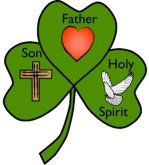 There are many trinitarian statements and expressions used in the letters of Paul. The historic Christian creeds of the early church defined God as a triune being, consisting in the three persons of the Father, the Son, and the Holy Spirit but being in one substance as a Spirit. The Bible says that God is a Spirit (John 4:24), but also implies that He is a three-minded God yet connected in unity and harmony, so that we can say that there is one “mind of God” and one “will of God.” In Ireland it used to be taught by St. Patrick, that the three leaf clover (or the shamrock) was created by God as a sign of what the Trinity is like. When you take a look at it, the three leaf clover, you have three leaves connected with one stem. So also, God has three persons or three minds, but is connected with one Spirit. Each of the three leaves on a three leaf clover can represent the Father, the Son, and the Holy Spirit; and the stem that connects them can represent the oneness of God. So Christians can agree with the Old Testament when it says, “Hear, O Israel: the Lord our God is one Lord” (Deut. 6:4). Monotheism is upheld and polytheism is rejected.
Oneness Pentecostalism: Modern Day Sabellianism
But the problem with oneness Pentecostalism is that they do not have the shamrock view of God. Whenever they hear a trinitarian talk, they get it in their heads that we are preaching polytheism. They seem to think that we believe God has three human bodies with three human heads, like the Mormons have conceived, and that they are not connected with one another. If that were true, then the doctrine of the Trinity would be just a form of polytheism. But this is the beginning of the strawman; and the beginning of the confusion from which oneness Pentecostalism grows. Oneness Pentecostalism, or modalism, is a reaction to what they think is “Christian polytheism.” It is a reaction to misinterpreting the doctrine of the Trinity to be a teaching of polytheism. The first modalists were Praxeas and Sabellius; and they had a charismatic type of spirituality. I think it’s interesting that oneness Pentecostals also have a charismatic type of spirituality; and have brought themselves to believe that the Trinity is a false doctrine. In my opinion, I think that oneness Pentecostalism comes from the activity of heretical demon spirits. Sometimes you’ll hear oneness Pentecostals speak of modalism as a revelation that they personally experienced from God’s Spirit. I think that such an occasion would be the devil deceiving them into thinking that they heard it from the Holy Ghost, but in fact they heard it from the devil to get them all confused about what the Bible teaches about God’s nature.
My Encounter With a Oneness Pentecostal
I recently had the unhappy privilege of meeting a oneness preacher. She was an older black woman. If this person could in any way be a representative sample of what all oneness people are like, then this experience might serve as a point of reference. But seeing that not everyone has the same personality, you can’t always make generalizations. As to some of her shibboleths, or theological oddities, I would like to make this short summary:
1. KJV Only. Only the King James Version of the Bible should be read; and no other Christian books (theology) should be read.
2. No TV For Kids. It’s okay to watch tennis on TV, but not okay to allow children to watch TV at all.
3. No Rock Music. It’s okay to listen to black gospel music like the kind made by Donnie McClurkin, and some contemporary Christian music, but not any secular rock music.
4. Closed-Minded. She had a very hateful attitude towards anyone who disagreed with her very narrow views. She liked to speak constantly, so as to shut out any other ideas or viewpoints; and was completely resistant to hearing about new ideas or other points of view (what she called “garbage” for the spirit); and was incapable of having a calm theological conversation…even though she has a Ph.D. in theology from Aenon Bible College.
5. Condemning. She complained a lot and was in the habit of condemning or suggesting that somebody was under the control of the devil, if they weren’t oneness or like her.
6. Oneness Mainly, Oneness Only. She seemed to mainly approve of preachers from the Pentecostal Assemblies of the World (PAW) or the United Pentecostal Church (UPC). Her ordination came from the PAW. But she appreciated some popular preachers like Bishop Noel Jones and Paul Washer.
7. Trinitarians Not Saved? She said that trinitarians do not have the correct understanding of God; and spoke as if their salvation were in question.
8. Argumentative. She had a very argumentative attitude. Whether it was about theology, or not about theology, she seemed to always make some sort of complaint. Or to be rude and pushy. I don’t want to blame the entire oneness movement for this, but something tells me that if you maintain an anti-trinitarian view, then you will likely have some degree of divisive or schismatic tendencies in your movement and attitude, because you’d have to always be preaching against the status quo, and defend your case, etc. But this might just have to do with the person that she was; or the family background that she came from.
9. Bullying. Her view of bullying, insults, or verbal abuse was as something that’s harmless. She looked upon such behavior coming from others as something that God gives us, in order to make us stronger. It’s no wonder then, since she yields to it, and accepts it as justifiable, that she becomes just like that.
10. Poor Discernment. She believes that 99% of her visions and dreams come from God; and that they did not have to be weighed, judged, sifted, or evaluated by the Bible. For her to do so would be a lack of faith. When I mentioned that Mark Virkler thought the same thing, and that he charged people $300 to teach them to hear the voice of God, she seem to find the whole thing agreeable. And also that it didn’t seem to be so much of a problem, if Pentecostal preachers had their own private jets, so that they could travel around the world and preach the “gospel.”
11. Mandatory Fasts to Eliminate Sins? Her particular prayer group fasts every Wednesday, with the Daniel fast, for the particular purpose of what she called “subduing her flesh,” to make sure all of her sins are drained out of her body, so that she can properly hear from God. I didn’t want to dash her hopes, but I doubted that it was working out for her, because her whole attitude was very contrary to the fruit of the Spirit.
12. Wearing Your Sunday Best: The Key to Holiness? Overall, I sensed the spirit of a Pharisee: a self-righteous, intolerant, irritable, high-minded, arrogant, prideful, haughty, extremely critical, rude, and extremely judgmental person, who is so uptight that I don’t think she is capable of having fun. Her view of holiness was extremely narrow, and not really very Biblical: and that was this one thing: when people go to church, they better dress up in really nice church clothes, otherwise they are not fearing God. This was one of her major concerns. Nothing to say of the ten commandments being written on the heart, the Sermon on the Mount, Colossians 3 or Ephesians 4-5, or the fruit of the Spirit, or of the works of charity or piety. (In her defense, she did make brief references to Philippians 4:8 and Hebrews 12:14.) Nothing to be said about modest clothing on women…I had to bring that up. Pretty much the sum total of her view of holiness was: if you go to church on Sunday, then you better wear your Sunday best or God’s going to get you; and she compared going to church like going to court to see Judge Judy.
May God have mercy on this person, and intervene in her life, and reveal Himself to her, and reveal His fatherhood, grace, and trinitarian nature: especially that. Because if she became a trinitarian, then that would basically put her in the evangelical stream of Christianity, which is the mainstream; and there is a whole lot better understanding of grace, and balance with God’s law, and interaction with culture. While evangelicalism is in a great need for revival, it still is the truth. But I think that when people adopt a view that is so marginal, and so heretical, like oneness Pentecostalism, they put themselves into a corner; and they’re not able to see the bigger picture; and they can entertain such strange views and foolish opinions; and hate everyone else that doesn’t agree with their preferences and particular beliefs.
Posted in Uncategorized
Leave a comment
Problems With Evolution
 I want to mention some of the major problems with the theory of evolution. Probably my favorite representation in the school of creationist thought would be Jonathan Wells’ Icons of Evolution (2000) and his video A Critique of Darwinist Icons (2001). He earned his Ph.D. in molecular and cell biology from Berkeley and published three articles in peer-reviewed scientific journals. There are five things that he says are really major problems with evolution: the Tree of Life, the homology argument, Ernst Haeckel’s embryos, peppered moths, and four-winged fruit flies. Kent Hovind’s video called Lies in the Textbooks (2002) does an excellent job at explaining these and many other problems with evolution. Whatever reservations you or I might have about Hovind, I still think that particular presentation by him is one of the best anti-evolution creationist videos ever made. Aside, that is, from the documentary called Icons of Evolution (2005), which is based on Wells’ book.
1. Darwin’s Tree of Life. A blasphemous name if there ever was one: probably taken as as a mockery of the Tree of Life in the Garden of Eden. This was an illustration in Charles Darwin’s The Origin of Species (1859). It starts off with a single celled organism at the very bottom and then it branches off into a tree with simple animals, complex animals, and eventually man at the top. The idea is that all of these animals and creatures were linked to one another, and descended from one another, becoming more and more advanced over time, with man becoming the chief crowning creation of the evolutionary process. God is not in the picture here. It is viewed as a naturalistic or materialist explanation for existence. The atheist creation story. Darwin, who had no other degree than a Master of Divinity, became renowned as a revolutionary biologist and scientist because he published a book with all of these ideas in it. He did, however, have his doubts about his theory; and one of his major doubts was that if it ever came to the surface over the course of time that paleontologists were unable to discover transitional intermediate fossils, then people would have a major reason to question his theory. Darwin said:
There is another and allied difficulty, which is much graver. I allude to the manner in which numbers of species of the same group, suddenly appear in the lowest known fossiliferous rocks…it cannot on my theory be supposed, that these old species were the progenitors of all the species of the orders to which they belong, for they do not present characters in any degree intermediate between them…The case at present must remain inexplicable; and may be truly urged as a valid argument against the views here entertained (The Origin of Species. New York: Bantam, 1999, pp. 300-302).
Over one hundred and fifty years later, it seems that there is absolutely no fossil evidence for this tree of life concept: especially when you look at the so-called Cambrian explosion. This is a period of time where rocks try to suggest that all of the different kinds of animals appeared at virtually the same time. This goes against Darwin’s idea, who would have suggested that all these different kinds of animals would have very gradually and intricately developed over very long, drawn out, large spaces of rock strata. But actually the truth is that most of them are concentrated to a very small section of rock strata called the Cambrian era; and it should make you wonder whether or not God created all of those animals in that time. Or that it was the time period in which the flood of Noah happened; and all the animals of Noah’s time were destroyed in that time. In either case, concentrating all these different kinds of animals into one little time does not fit into Darwin’s concepts.
Peter Raven says, “Many fossil intermediates in vertebrate evolution have indeed been found. A clear line of fossils now traces the transition between hoofed mammals and whales, between reptiles and mammals, between dinosaurs and birds, and between apes and humans. The fossil evidence of evolution between major forms is compelling” (Biology, 9th ed., p. 432). Really, is that so? Then why doesn’t the same biology textbook provide some convincing examples of intermediate transitional fossils? It doesn’t. I looked. This is Darwinism’s weakest link. If they could provide convincing examples of this, then maybe there would be less creationists denying evolution. The first problem is that you have to trust their system of dating rocks. If you can’t trust this, then all of their “fossil evidence” is worthless. It is a circular system. The skeleton of a T-Rex is said to be 65 million years old, because its fossils were found in so-called Jurassic rock strata. And how do they know the Jurassic rock strata is 65 million years old? Because the T-Rex fossils were found in it, they say. The fossils date the rocks, but the rocks date the fossils. In other words, you have to buy into their dating scheme in order to speak their language. But just because they have chosen to categorize rocks and fossils like this, it does not mean the ages they assign to these things have been scientifically proven, at least not to me. Even if they have radiometric devices that they have designed to support their claims. I think the millions of years thing is a hoaxed philosophy to help scientists catalog things according to their preferred system of Darwinistic categorization. But I don’t see any reason why I should believe in it: the whole thing is just from an evolutionist’s imagination.
Secondly, they don’t have any outstanding transitional fossils for us to look at. Just a lot of animal fossils; and they will categorize them to their liking, and using a lot of Darwinistic imagination, draw the conclusion that all of the fossils have descended from one another. One example they will use is the Archaeopteryx, supposedly a half-dinosaur, half-bird. If this is a true fossil, and not a hoaxed one, they might be getting somewhere with that. But there should be much, much more evidence than that. Humans with monkey tails, fish with legs, and other anomalies may exist in nature–but if this is the course that evolution took on a mass scale, then they wouldn’t be anomalies–there would be billions of human fossils with monkey tails, etc. But there is a major lack of things like that. Thirdly, even if something like the Archaeopteryx were real, it is no proof to me that the creature evolved from something simpler or that it was turning into a raptor dinosaur or something. How is that proof? Why couldn’t God just create the Archaeopteryx that way it was, fully formed, on the fifth day of creation? Archaeopteryx is no proof to me of evolution.
2. The Homology Argument. When you look in your biology textbooks, you’re going to see pictures of different kinds of bones or skeleton arms and legs placed beside one another. For example, you’ll have a cat arm next to a human arm or a bat arm and they may look similar in their structures (see Peter Raven’s Biology, 9th ed., p. 428). Evolutionists will say, “See, doesn’t this look like the animals and humans are similar?” So then they’ll go draw the conclusion that men came from animals, because parts of their arms look similar! Most of evolution functions from AN ARGUMENT FROM SIMILARITY. But its not scientific to say something like that. There’s no evidence that either came from one or the other based on that. It’s merely a suggestion or an idea. And what the creationist has always said, is that a common design suggests a Common Designer. That God in His mind thought it would be good to use different kinds of templates, on different types of creations, because He found that certain arms, and the similarity in their structure, were useful to different types of creatures. But bone similarity does not mean that one type of animal descended from another. The fact that a whale or a human may have similarities in their arms, is a far cry from saying people are descendants of whales, like how children are descended from their parents, and this can be determined by observing that they have similar traits in their appearance. I am not descended from a whale! I am descended from God who made Adam. It just so happens that the same God also made whales.
3. Haeckel’s Embryos. Back in Darwin’s day, in Germany he had a fan named Ernst Haeckel. He was an embryologist and had microscopes in his lab. He looked at human embryos underneath the microscope, and animal embryos underneath the microscope, and he saw a couple of things that looked similar; and he had the idea that he would fabricate and exaggerate the similarity between fish, salamander, turtle, chicken, pig, cow, rabbit, and human embryos; and he would draw exaggerated pictures leading people to believe that these embryos were 99% similar in their appearance. Microscopes were not popular devices in those days; and so people were not really able to verify what he was saying. But a few men were. Eventually the University of Jena at which he worked, brought him into an academic trial, where five professors accused him of fraud; and after they pressed him, he admitted that he had fabricated the evidence of the embryos. His confession, however modest, is still a strong evidence against using this idea as scientific evidence for evolution:
To put an end to this unsavory dispute, I begin at once with the contrite confession, that a small number (6 to 8 per cent.) of my embryo-diagrams are really forgeries in Dr. Brass’s sense; those namely for which the observed material is so incomplete or insufficient as to compel us…to fill in and reconstruct the missing links by hypothesis and comparative synthesis…I should feel utterly condemned and annihilated by this admission, were it not that hundreds of the best observers and most reputable biologists lie under the same charge. The great majority of all morphological, anatomical, histological, and embryological diagrams…are not true to nature, but are more or less doctored, schematized and reconstructed (A. F. Frumveller, America, May 22, 1909, No. 6, p. 145).
Just like with the homology argument, Ernst Haeckel converted a great part of Germany to Darwinism under the idea that the similarity of embryos suggested that in the early developmental stages of human life, that people were no more different than a fish or a chicken; and that people had descended from them at some point in evolutionary history. Ernst Haeckel proved to be a liar. He even admitted that he lied, and claimed that hundreds of biologists lie in the same way, for the cause of evolution. But many people went on believing in evolution in Germany because of him, eventually including Adolf Hitler and the Nazis. What is shocking is that to this day many biology textbooks will include Haeckel’s embryo drawings as evidence for the existence of evolution, while others have been more cautious about it and will just have a paragraph explaining the idea (see Peter Raven’s Biology, 9th ed., p. 428). What is more shocking, is that if you really do look at the different embryos at the specific times and stages that he suggested underneath the microscope, you will find that they look extremely different!

4. Peppered Moths. During the Industrial Revolution in England, a lot of coal powered machines then produced pollution on tree trunks. This soot blackened the tree trunks so that a lot of black moths were able to avoid being eaten by the birds. It was the white moths that were targeted by the birds. Over time it came to be seen that there were a new breed of peppered moths that had adapted to wanting to become more and more black; and tried to camouflage themselves from the birds. This was viewed as evidence for evolution! But this is not evidence for evolution: its only showing the same thing that happens when a guitar player can develop callused fingers when he plays guitar a lot. This does not mean that one animal is turning into a completely different kind of animal. This was only a case of adaptation or micro-evolution; and not macro-evolution, or Darwinism. Interesting tidbit here: most of the time these peppered moths in the textbook pictures are dead moths that have been pinned to the side of a tree trunk. Because it has been in has been found that in nature, that moths most of the time rest on the really high up branches, underneath the leaves. This kind of artistic license pales in comparison to Haeckel’s transgressions but still…is this evidence for evolution? Scientific proof that animals are turning into other kinds of more advanced animals? I don’t think so.
5. Four-Winged Fruit Flies. Some time ago, while trying to prove that mutation is a vehicle of evolution, some scientists took some fruit flies and exposed them to radiation. What resulted was a fly that had grown an extra pair of wings, so that it actually had four wings on its body. But the other two wings were deformed and made it impossible for the insect to fly in the air. This proved that radiation can cause extra appendages that are completely useless to appear on a body, but it in no way proved that mutations can occur that are beneficial…or that may give an animal or human any type of superpowers that you may see in the X-Men movies. It certainly didn’t give any evidence that one animal can change into a different, more advanced kind of animal. And yet the faith of high school students is rocked away from the Bible and towards atheism or deism on such weird and unreliable “evidence” as this!
The Age of the Earth: 4.6 Billion Years or 6,000 Years?
The last thing I would like to address is the belief in millions of years. Some Christians don’t believe in evolution processes, but they might still believe that the Earth could be over millions of years old. This is due to a belief called the “day age” theory, in which the first six days of creation in Genesis 1 are viewed as metaphorical, and not as literal twenty-four hour days; and that it may be possible to view those days as ages in which millions of years may exist. But there is nowhere in the whole Bible that remotely suggests that creation occurred in any more than six twenty-four hour days. Another thought I’ve always had is that anything that is called prehistorical or antediluvian (pre-Flood) is almost completely without evidence of age or being dated. In other words, there are no copyright years on cave paintings, so how can people possibly date them? To be an evolutionist, a person has to trust what is written in biology textbooks about ages.
In reality, any truth seeker should be taking on faith those things that ancient writers have said about these time periods, because they were there; or they had God tell them about it. My personal preference is to trust what Moses wrote in the Book of Genesis as literally referring to the six day creation. Mainly because the Book of Genesis is not a poetic or allegorical book; it is a historical narrative; it’s not like the book of Psalms or the Song of Solomon, which is almost totally allegorical. But almost all of the Book of Genesis is written as chronologically historical from beginning to end; that’s just the category of literature that it falls under: religious history. And I think it is a matter of gross unbelief if somebody cannot even believe in the first two pages of the Bible. It disturbs me that there are many evangelicals that are adopting theistic evolution, or the day age theory, and treating them as minor issues; and saying that this is not something that’s going to affect their faith in a negative way. Even the Assemblies of God is now allowing theistic evolution professors to teach in their colleges! What is happening!? Back in the days of R. A. Torrey, in the writing of those pamphlets called The Fundamentals, the fundamentalists drew the conclusion that evolution was directly tied to liberal Christianity, deism, agnosticism, and atheism (all the degrees of unbelief); and not believing in the miracles of Christ or the deity of Christ. The authority of Scripture over the person’s life was seen to be undermined, because if the first two pages of the Bible can’t be trusted, then why can the rest of it be trusted? Why obey God’s laws if they are only human laws? Liberal Christianity turned the church into a humanistic social club that is used to cater to people’s selfish needs and psychological health.
Let’s lay evolution concepts to rest and just believe the first 11 chapters of the Bible at face value. That’s all that Moses asks. If you’re honest with yourself, Genesis is a historical narrative and was never intended to be anything poetic or allegorical. Unlike the gospels, which combine Jesus’ allegorical parables and historical narratives of Jesus doing certain actions–there are virtually no allegorical moments in the Book of Genesis that I can think of: other than maybe the dreams of Jacob and Joseph. Other than that, you have the story of the origins of mankind, something that demands our respect; and I think that we have really no other choice, than to have faith in God, and faith in the writer of Genesis; and to just rest in that trust. If we can’t do that, then we will be tossed about like the waves of the sea; and blown around by every wind of doctrine (Eph. 4:14). How it is that scientists arrive at these outrageous, astronomical calculations for the age of the earth–4.6 billion years–is beyond me (radiometric dating? half-lives?). Its not important to me, because I doubt that its true anyway.
There is no human confirmed to exist beyond the length of 6,000 years before now. No human writings have been discovered before the cuneiform tablets from Sumeria, around 4,000 B.C. How is it then that evolutionists can claim that modern man known as Homo sapiens existed as far back as 1 million years? Where’s the literary evidence and the technological evidence for intelligent men living that far back in time? The only confirmed, archaeological evidence of intelligent human life that we have spans back no further than 6,000 years! James Ussher, the Puritan author of The Annals of the World, used a calculation based on something much more reasonable: the genealogies of the Bible from Adam to Christ, by adding the years of their lifespans together. Adam was created around 4,000 B.C. according to this Biblical timeline. Ussher and the Puritans, the Reformers, and medieval theologians, all generally held to the view of a 6,000 year old Earth. Why not go with something logical and Biblical like this, instead of trusting in atheistic scientists who need government grants to continue their evolutionary research projects? These men don’t follow God’s law; they make up their own morals, if they have any. In the 1800s, scientists said the Earth was 400 million years, while others contended for 22 million; in the early 1900s, it got bumped up to 570 million years; in 1911, the Earth was then believed to be 1.6 billion years; in 1927, it reached 3 billion years; and finally in 1956 it reached the age of 4.6 billion years old, which is what scientists say it is today. Hmmmmmmmm. I’ll just go with the Bible, thanks!
Further Material
Darwin, Charles. The Origin of Species. New York: Bantam, 1999.
Frumveller, A. F. “The Retirement of Prof. Haeckel.” America, May 22, 1909, p. 145.
Ham, Ken. The Lie: Evolution. Green Forest, AR: Master Books, 1987.
Hovind, Kent. Lies in the Textbooks. CSE Seminar Part 4. DVD. 2002.
Icons of Evolution. DVD. Coldwater Media, 2005.
Johnson, Phillip. Darwin on Trial. Downers Grove, IL: InterVarsity Press, 1991.
Raven, Peter, Johnson, Mason, etc. Biology. 9th ed. New York: McGraw-Hill, 2011.
Sarfati, Jonathan. Refuting Evolution. Green Forest, AR: Master Books, 1999.
Torrey, R. A., and A. C. Dixon. The Fundamentals. Grand Rapids, MI: Baker Books, 2003.
Ussher, James. The Annals of the World. Green Forest, AR: Master Books, 2003.
van Niekerk, E. “Countering revisionism–part 1: Ernst Haeckel, fraud is proven”
Wells, Jonathan. Icons of Evolution. Washington, DC: Regnery Publishing, 2000.
—. A Critique of Darwinist Icons. Access Research Network, 2014. Influenced this article.
Posted in Uncategorized
Leave a comment
Such a Parcel of Rogues in a Nation
Based on the version sung by Ewan MacColl. Drop D – tabs 3 and 6 alternating throughout.
Fareweel to a’ our Scottish fame,
Fareweel our ancient glory;
Fareweel ev’n to the Scottish name,
Sae fam’d in martial story.
Now Sark rins over Solway sands,
An’ Tweed rins to the ocean,
To mark where England’s province stands-
Such a parcel of rogues in a nation!
What force or guile could not subdue,
Thro’ many warlike ages,
Is wrought now by a coward few,
For hireling traitor’s wages.
The English steel we could disdain,
Secure in valour’s station;
But English gold has been our bane –
Such a parcel of rogues in a nation!
O would, ere I had seen the day
That Treason thus could sell us,
My auld grey head had lien in clay,
Wi’ Bruce and loyal Wallace!
But pith and power, till my last hour,
I’ll mak this declaration;
We’re bought and sold for English gold-
Such a parcel of rogues in a nation!
Posted in Uncategorized
Leave a comment
The Moral Law In the New Testament
The Three Uses of the Law
As far back as Martin Luther, Reformed theology said there are three uses for the law of God in Scripture. The first use of the law is to show men that they are condemned by it, as in Romans 3:20, the knowledge of sin comes by the law. The second use of the law is to show us how not to behave by condemning sins, as in the Ten Commandments: you shall not, you shall not, you shall not (Exodus 20). The third use of the law and I believe this is the most controversial, and it was only really underscored by certain Puritans like Richard Baxter and then amplified by John Wesley and the early Methodists: the third use of the law is the law that we find in the New Testament, which commands us what we ought to do with our lives: it serves as a moral guide for how we are to conduct ourselves, and is defined by positive commands and directions from Jesus and the apostles. I think that the best place to look for passages of Scripture like this are in the letters of Paul and other apostles, for which Ephesians 5 and Colossians 3 serve as examples.
Lawless Baptistic Dispensationalism!
These are precious truths. They have often come under attack every time a preacher comes into a knowledge of them. Whenever a preacher comes to preach on this, immediately he is criticized by most others as preaching “works salvation.” These New Testament moral laws have often only been preached during times of revival by certain preachers, namely, John Wesley, Charles Finney, Leonard Ravenhill, and others who emphasized a Methodist sense of personal holiness. Popular evangelical theology has always sort of been Baptistic and leaned in the direction of dispensationalist theology. While I would consider a good number of people that are Baptistic Christians to be members of the body of Christ, I am still very uncomfortable with their teachings when it comes to the law of God. With the exception of the 1689 Baptist Confession, Baptists almost always have an antinomian dispensationalist view of the law of God. This is where you find a strong differentiation between the role of the law in the Old Testament and the role of the law in the New Testament, or in other words, they might say there’s a strong difference between the Covenant of Works and the Covenant of Grace, or the law and the gospel, or law and grace: either way, they look at the Bible and they try to separate God’s commandments from the New Testament and the Christian life. They try to distance God’s law from the Christian life, as if it were something that only applied to the past and it does not apply today. Often times they will include the moral law along with the ceremonial law, and throw it all away into the distant past, which is a grave concern to me. They also do the same thing with miracles and spiritual gifts: cessationists always relegate such things to the faraway past, so they don’t have to apply those things to themselves today. So when you have people who are neither zealous for the law, nor for spiritual gifts, you can imagine how you end up with a pretty dead religion.
Dispensationalist antinomianism is probably the most popular form of evangelical Christianity. Most of the Baptist preachers on the radio preach it. Almost all of the leading preachers who are conservative evangelicals, featured in Christianity Today, they preach it. Most of the pastors in Southern Baptist churches preach it. And still also, many Pentecostal preachers preach it. It is truly one of the worst, most deplorable forms of theology that has ever been invented. Mainly because it overthrows the moral authority of the Bible in the Christian’s life without saying so explicitly. It allows people who say that they believe in the authority of Scripture, to turn around and say they don’t have to obey its commands, because that was only for people in the Old Testament days to worry about. Such false dichotomous thinking about the Old Testament versus the New Testament, was first invented by Marcion the gnostic heretic. He conceived that the god of the Old Testament was an evil, almost demonic being, whereas the god of the New Testament was one filled with grace, love, and forgiveness, and had no wrath for sin. Marcionites didn’t even use the Old Testament; they only used the New Testament with their warped interpretations. I think a lot of Baptists today are really Marcionites in spirit.
Modern day Baptistic antinomians hate open-air preaching, the mention of Hell, practical holiness, and anything to do with casting out demons: because they love their demons. They usually are naturalistic in their outlook and their biggest focus is on making friends. They watch the filthiest movies, make the dirtiest jokes, and excuse themselves all the way. They think that evangelism is equivalent to making friends with people who are non-Christians. I recently worked at a company where there were about three or four missionary young people from the Southern Baptist Church: and all of them used cuss words openly and flagrantly, the s-word, the a-word, the d-word, I think even the f-word, and they didn’t think anything was wrong with it. Whenever I hear somebody crying up words about how the law was just for the Old Testament, I want to say shut up! They’re going to have to answer to God for this: at the same time that they are distancing themselves from God, and grieving the Holy Spirit, they’re teaching others to do the same thing. They are teaching others to basically give up the fight against sin and show them Scriptures for why they think they’re right. It must be some kind of delusion, some satanically empowered deception, that makes them think they can allow people to take the Holy Bible, and twist it to such a degree, so they can make their lives anything other than holy. I can only agree with John Wesley when he says that the god of Calvinism is more monstrous than the devil. The loveliest terms that any Calvinistic dispensationalist Baptist antinomian can use are the words legalism and legalist. They use these words very frequently, to embolden themselves against people who see the truth for what it is: that Christians are called to obey the Word of God as it is plainly written. They like to blame them, and call them legalists in order to make themselves feel that they have the true faith. But with Wesley again, I can only agree with him when he says that he cannot find the word “legality” or legalism anywhere in his Bible.
In John Wesley’s sermons on “The Original, Nature, Property, and Use of the Law,” he shows the first, second, and third uses of the law; and essentially explains that the moral law of God continues in the New Testament, in light of the cross of Jesus, in light of justification by faith alone, that the moral law is used for our sanctification, not for our justification, but for our sanctification. The cross brings justification, but the moral law in the New Testament, which is found peppered throughout the letters of Paul, is for our sanctification: this is plainly clear to anyone who knows how to read. The law is holy!
Ephesians 4-5: An Example of the Moral Law
Ephesians 4:25 says that each of us must not use falsehood, but that we should speak truthfully to our neighbors: this is a reinforcement of the commandment not to bear false testimony against your neighbor. Ephesians 4:26 says that we should not let the sun go down while we are still angry, that we should not allow ourselves to become angry and hateful towards other people. Why? Because that could lead to murder, which again takes us back to the Ten Commandments. Ephesians 4:28 says that we should not steal, but we should work, doing something useful with our own hands: again this brings us back to the Ten Commandments, which says thou shalt not covet. Ephesians 4:29 says do not let any unwholesome talk come out of your mouth: so this is definitely a law against profanity, cussing, sexual innuendos, or any sort of dirty joking. Again you could say this brings us back to the Ten Commandments, because it says thou shalt not use the name of the Lord thy God in vain. Ephesians 4:30 implies that people who break such laws grieve the Holy Spirit of God. Ephesians 4:31 takes us further and says that we should get rid of all bitterness, rage, and anger, brawling and slander, along with every form of malice. I would sure hate to embrace a theology that says you’re not supposed to keep a commandment like that. Ephesians 4:32 says to be kind and compassionate to one another, forgiving each other. How does this not look like a direct positive command for how to get us to live our lives right? These are commands, these are laws, these are orders from the apostle: how can Christians do anything else than obey them as laws? Or at least try to? These are commands from God and they are found in the New Testament. They are laws against stealing, against lying, against profanity, against fighting, against anger, and against malice. I guess the question you have to ask yourself is, if you are an antinomian, and you believe that moral rules are not found in the New Testament, then what is the point of being a Christian? Is it just to be forgiven? If the whole goal of your religion is just to be forgiven, then are you implying that you’re free to steal, pick fights, and bully people; and still be in the state of salvation? I sure hope not.
Ephesians 5:3 says there should not be even a hint of sexual immorality, or any kind of impurity, or of greed. Ephesians 5:4 says there should be no obscenity, foolish talk, or coarse joking; it also says that there should be thanksgiving. Ephesians 5:5 says there should be no immoral, impure, or greedy person in the church, because such a man is an idolater, and he does not have any inheritance in the kingdom of Christ: in other words, he is not saved. If you are an antinomian, and you think that immoral and greedy backsliders are still saved, then you are deceived. Ephesians 5:18 says not to get drunk on wine, which leads to partying. I think there’s definitely enough food for thought here. Whether or not you consider these Bible verses to be commandments, or laws, or simply moral guidelines, the fact of the matter is, these are imperative commands coming from an apostle that was inspired by God, writing with the authority of Scripture. I can’t stand to listen to the vain talk and sleepy babblings of Moody Church’s Warren Wiersbe, or any Baptistic preacher, who tries to relegate all commandments and laws to the period of the Old Testament. Such people are confused and should not be in a position of teaching others. They speak out of both sides of their mouths. For some amount of time they might say that there is no law of God today, and then later on they might say that there is a law of God today, and then overturn it once again, leaving you all confused. Finally Ephesians 5:6-7 says to let no one deceive you with empty words, for because of such things God’s wrath comes on those who are disobedient: and therefore do not be partners with them. Oh! Give me that old-time Wesleyan Methodism that preached the truth, plain and simple! And away with these confusing and lawless falsehoods! Popularity is no sign of the truth.
Further Reading
Thomas Oden’s John Wesley’s Scriptural Christianity, see p. 373: “Antinomianism”
Fletcher’s Checks to Antinomianism. Ed. Peter Wiseman. Beacon Hill, 1953.
Mark Jones’ Antinomianism
John Gerstner’s Wrongly Dividing the Word of Truth: A Critique of Dispensationalism. Wolgemuth & Hyatt Pub, 1991.
Daniel Steele’s A Substitute for Holiness: Antinomianism Revived. Schmul, 1980.
J. I. Packer’s Concise Theology, p. 178.
Posted in Uncategorized
Leave a comment
The Fight for Joy and Righteousness
The thief cometh not, but for to steal, and to kill, and to destroy: I am come that they might have life, and that they might have it more abundantly. – John 10:10
Joy nor righteousness by faith in Jesus can never be maintained constantly. But it can be acquired at times, as often as we choose to, to plead for the Holy Spirit’s grace to allow it to continue in our lives: “righteousness, joy, and peace in the Holy Spirit” (Rom. 14:17). The human will is not perfect, and it always needs the Holy Spirit’s assistance and presence, in order to maintain the fruit of the Holy Spirit: love, joy, peace, righteousness, etc (Gal. 5:22).
Misery desires company and they that love it eat of its fruit. The Irish Christians used to call the devil “the Sorrow,” because his primary goal was to create misery or depression to such a point that people would despair not only of their earthly lives, as being a thing of joy, but also leading men to commit suicide: and that they would despair of eternal salvation. If we take this perspective, then having the joy of the Lord takes on not only an emotional state but also a state of spiritual warfare (Neh. 8:10). It is important that we do not allow the spirit of sorrow or, “the spirit of heaviness” as the Bible calls it, to come in and crowd in upon us. The Bible says that we should take on the garments of praise for the spirit of heaviness (Isa. 61:3).
The devil “comes not but for to kill, steal, and destroy” (John 10:10). John Wesley wrote a sermon once called “Heaviness Through Manifold Temptations.” I’m pretty sure it goes into these themes at greater length. If the devil is our enemy, then we should not be surprised if we find our thoughts and feelings come under attack by negative spirit forces. Those who suffer in mental hospitals from psychiatric disorders are only the most extreme cases, but the devil works upon the normal population in lesser degrees, and his work is still very real. We would be wise not to overnaturalize such things. Because if we do, then we will not recognize the need for naming the names of demon spirits, and praying for them to be cast out by calling on the name of Jesus at such times, which can be extremely effective (see John Eckhardt’s Demon Hit List). Just as God works in the natural circumstances of life, so also does the devil; and sometimes we give him a foothold. The greatest foothold that we can give the devil is that of anger at other people (Eph. 4:27). It’s important that we try to forgive people in our hearts, even when they have not apologized, and even when we cannot reconcile things with them socially. If we allow the sun to go down on our anger, then we will surely give the devil a foothold: opening ourselves up to psychological problems like nightmares, anxiety, and outbursts of rage.
In John Bunyan’s Pilgrim’s Progress we see spiritual warfare played out in the life of Christian. Many times his warfare comes in the form of bad, negative thoughts that bring him to places like Doubting Castle, which is inhabited by the Giant Despair. We have to remember the promises of God: particularly the promises of the Gospel, so that we can set our minds back on the right things again. Only then can we get our feet back on the right track; and walk in step with the Holy Spirit.
“Laughter can conceal a heavy heart…a cheerful heart is good medicine” (Proverbs 14:13; 17:22). Although we should not give ourselves over to hysteria as they do in comedies, we should have a degree of comedy and good humor in our lives because God created it. But not as the ancient Greek comedians laid down for us, which creeped into English theaters, and American films and television. There you will only find men who are filled with sexual immorality, profanity, and blasphemy; and we should not allow our happiness to come from such things, because they grieve the Holy Spirit (Eph. 5:3-4). But we should have a sense of what is humorous; and take advantage of it when it comes: such things can create a sense of being resilient during the hardships of life. When friendships, family members, churches, ministers, companies, managers, and co-workers fail us. The humor that God has given us can sustain us while we are practicing our faith in Jesus. It is healthy and good to crack jokes provided that they are not profane or blasphemous. Then Christians can truly be good humored and experience emotional healing in their lives on a regular basis.
Ecclesiastes 3:4: there’s “a time to weep and a time to laugh.” If I did not guard my heart and fight for my own joy and happiness, then I tell you right now, I would be a defeated Christian. I would have an unhappy life. I would be depressed and miserable all of my days. And even though Paul says that if Christ is not raised then we of all men are the most miserable (1 Cor. 15:19), it does not mean that we of all men are the most miserable at all, because we know that Christ has risen; and we have reason to hope for eternal salvation. So that does not by any means allow for our earthly lives to be characterized by misery. Happiness cannot be a constant state; it is a gift from God for sure, and it’s always a temporary one. But even as it is a gift from God, Christians should take advantage of humor and happiness, whenever it presents itself as an opportunity, provided that it is not profane. This does not mean that dry, bland, vanilla Christian comedy is the answer. That is NOT what I’m talking about. What I am saying is, that Christians in general should allow themselves to be good humored and lighthearted enough to be able to have conversations that are humorous, while at the same time guarding themselves with moral seriousness. So many people have such a killjoy understanding of Christianity, that they can’t even enjoy their lives, while thinking of the Christian life. They think the Christian life is all about suffering and dragging your cross throughout life, but I like the ESV translation of Romans 5:3, which tells us to “rejoice in our sufferings.” Too many people are influenced by worldly concepts of humor like Mel Brooks, Monty Python, Saturday Night Live, and Mad TV to get any idea of what a good humored attitude looks like in the state of sanctification. And that is truly sad, because I believe that when Jesus said, “I came that they may have life, and have it abundantly” (John 10:10), He was including in that a sense of good humor. Jesus said, “Blessed are you who weep now, for you will laugh” (Luke 6:21). If you are looking for it, you can even find humor in the gospels, like when Jesus refers to somebody having a beam in their eye (Matt. 7:3). This is actually a sarcastic, humorous parable against hypocritical judging. Don’t you think people at least snickered the first time they thought about a two-by-four sticking out of a man’s eye? Sarah said, “God has brought me laughter” (Gen. 21:6).
It’s not my objective to prove that Jesus was a comedian, because I don’t think He was. Neither were the apostles comedians. What I am saying though, is that there is evidence that they had a sense of humor; and there was a sharp difference between that and worldly humor. And I think that the false dichotomy, that people sometimes manufacture a joyless Christianity: that it is the devil’s design to hide from them true spiritual life, so they can see no other alternative but to go back to the way of the world. And so they forsake God, who is the Fountain of all true life; and they damn themselves. If any man thinks that Christianity is dull and lifeless, then he has yet to understand true Christianity. If you ever have the feeling that being a Christian does not make you emotionally happy, then something is wrong with your way of thinking. You would need an adjustment in your perspective. This doesn’t mean that Christianity is a religion of positive thinking, that ignores all the pains and troubles of this life. Jesus did say, “In the world you will have tribulation; but be of good cheer, I have overcome the world” (John 16:33). But here we see that having good cheer comes from our our sense of Jesus’ overcoming the world, by faith in the cross, and His resurrection from the dead. And when we root and ground our faith in this thought, then we can have a good cheer: because Jesus said so.
Surrounding yourself with the right people and keeping yourself away from the wrong people is essential to this task. I can’t think of anywhere in the whole Bible that contradicts or overrides simple concepts like how friendship with the world makes you an enemy of God, or how Christ is not the friend of Belial, how darkness cannot fellowship with light, how we are not to be unequally yoked with unbelievers, and how blessed is the man who does not sit in the counsel of the ungodly nor in the seat of scoffers (James 4:4; 2 Cor. 6:14-15; Ps. 1:1). There’s nowhere in the whole Bible that contradicts or overrides such principles; and they are very serious ones. Wesley considered them, in his sermon, “A Call to Backsliders,” one of the main reasons why people backslide: hanging around ungodly, non-Christian people for fun. I also think that it’s a sign of backsliding when people embrace such people as friends, simply because they’re feeling down and they would like to have a little bit of comedy in their life. Pilgrim’s Progress also portrays this in the character of Mr. Worldly Wiseman. These people, not knowing the whole time that Jesus allows us to be good humored, and not knowing that sanctification is necessary for salvation, because it says “without holiness no one will see the Lord” (Heb. 12:14), and at the same time wanting this desire for comedy and friendship but overthrowing sanctification in the process: they end up laughing their way to Hell. I’ve been recently reading Daniel Jennings’ collection of The Supernatural Occurrences of John Wesley. It’s definitely an interesting book; it takes all of the charismatic elements from the works of John Wesley and compacts them into a convenient volume. There’s more than one occasion when someone is warned about something negative in the future in a dream from God; and then they share the dream with someone else; and “they’re laughed out of it”; he says this, meaning that they’re talked out of believing in the dream; and they irreverently laughed it away like a joke: only to find the next day that the dream becomes fulfilled, the warning was not heeded, and someone dies. It’s important to have good humor in our lives. Laughter is good medicine for the heart, but we also have to realize that when people stop fearing God, they are drinking in a poison and not taking their medicine.
Posted in Uncategorized
Leave a comment

