Martin Luther (1953) – Lutheran Church Productions
Posted in Uncategorized
Comments Off on Martin Luther (1953) – Lutheran Church Productions
The Narcotics Story – Alpha Video
Posted in Uncategorized
Comments Off on The Narcotics Story – Alpha Video
How to Recover From a Bad Evangelism Experience – Living Waters
Posted in Uncategorized
Comments Off on How to Recover From a Bad Evangelism Experience – Living Waters
Shocking Exorcisms from the 1990s – Bob Larson
Posted in Uncategorized
Comments Off on Shocking Exorcisms from the 1990s – Bob Larson
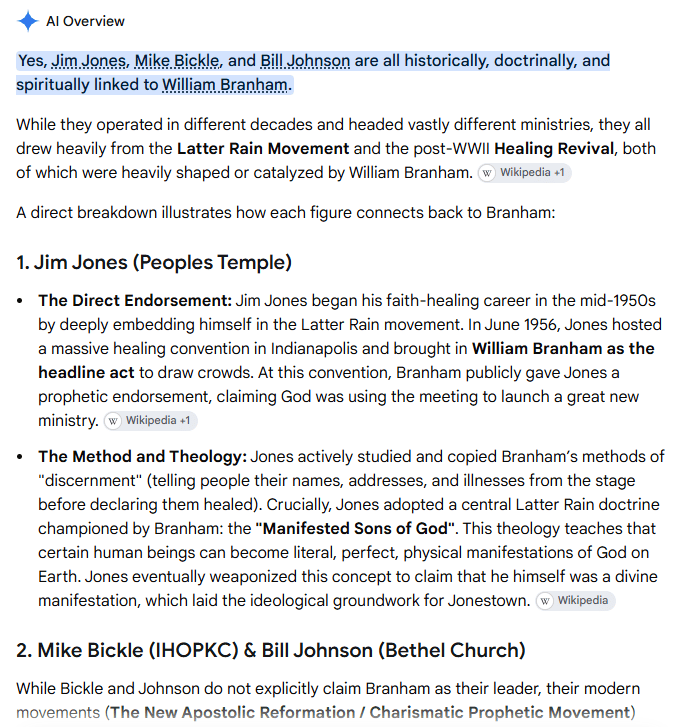
The Top Charismatic Cults In the Past 400 Years
The law is not laid down for the just but for the lawless and disobedient, for the ungodly and sinners, for the unholy and profane, for those who strike their fathers and mothers, for murderers, the sexually immoral, men who practice homosexuality, enslavers, liars, perjurers, and whatever else is contrary to sound doctrine.
–1 Timothy 1:9-10 (ESV)–
The works of the flesh are evident: sexual immorality, impurity, sensuality, idolatry, sorcery, enmity, strife, jealousy, fits of anger, rivalries, dissensions, divisions, envy, drunkenness, orgies, and things like these. I warn you, as I warned you before, that those who do such things will not inherit the kingdom of God. But the fruit of the Spirit is love, joy, peace, patience, kindness, goodness, faithfulness, gentleness, self-control; against such things there is no law. And those who belong to Christ Jesus have crucified the flesh with its passions and desires. If we live by the Spirit, let us also keep in step with the Spirit. Let us not become conceited, provoking one another, envying one another.
–Galatians 5:19-26 (ESV)–
Posted in Uncategorized
Comments Off on The Top Charismatic Cults In the Past 400 Years
The Three Uses of God’s Law – John Calvin
His delight is in the law of the Lord;
and in His law doth he meditate day and night.
–Psalm 1:2 (KJV)–
7 The law of the Lord is perfect, converting the soul: the testimony of the Lord is sure, making wise the simple. 8 The statutes of the Lord are right, rejoicing the heart: the commandment of the Lord is pure, enlightening the eyes. 9 The fear of the Lord is clean, enduring for ever: the judgments of the Lord are true and righteous altogether. 10 More to be desired are they than gold, yea, than much fine gold: sweeter also than honey and the honeycomb. 11 Moreover by them is thy servant warned: and in keeping of them there is great reward.
–Psalm 19:7-11 (KJV)–
Oh how I love Your law!
It is my meditation all the day.
–Psalm 119:97 (ESV)–
—
The profane heresy of the
Antinomians must be exploded.
–John Calvin–
Some unskilful persons, from not attending to this, boldly discard the whole law of Moses, and do away with both its Tables, imagining it unchristian to adhere to a doctrine which contains the ministration of death. Far from our thoughts be this profane notion. Moses has admirably shown that the Law, which can produce nothing but death in sinners, ought to have a better and more excellent effect upon the righteous. When about to die, he thus addressed the people, “Set your hearts unto all the words which I testify among you this day, which ye shall command your children to observe to do, all the words of this law. For it is not a vain thing for you; because it is your life,” (Deut. 32:46-47). If it cannot be denied that it contains a perfect pattern of righteousness, then, unless we ought not to have any proper rule of life, it must be impious to discard it. There are not various rules of life, but one perpetual and inflexible rule; and, therefore, when David describes the righteous as spending their whole lives in meditating on the Law (Psalm 1:2), we must not confine to a single age, an employment which is most appropriate to all ages, even to the end of the world. Nor are we to be deterred or to shun its instructions, because the holiness which it prescribes is stricter than we are able to render, so long as we bear about the prison of the body. It does not now perform toward us the part of a hard taskmaster, who will not be satisfied without full payment; but, in the perfection to which it exhorts us, points out the goal at which, during the whole course of our lives, it is not less our interest than our duty to aim. It is well if we thus press onward. Our whole life is a race, and after we have finished our course, the Lord will enable us to reach that goal to which, at present, we can only aspire in wish.
–JOHN CALVIN–
—
John Calvin, Institutes of the Christian Religion (Hendrickson, 2011), 2.7.
Posted in Uncategorized
Comments Off on The Three Uses of God’s Law – John Calvin
If God Saves People, Why Do We Need to Evangelize? – Living Waters
Posted in Uncategorized
Comments Off on If God Saves People, Why Do We Need to Evangelize? – Living Waters
A Truckload of Gospel Truth for an Agnostic – Mark Spence
This is really, really, really good.
–J.B.–
Posted in Uncategorized
Comments Off on A Truckload of Gospel Truth for an Agnostic – Mark Spence
This Democrat Candidate May Be Drunk–But She’s Got a Story to Tell – Matt Walsh
Posted in Uncategorized
Comments Off on This Democrat Candidate May Be Drunk–But She’s Got a Story to Tell – Matt Walsh
Ray Comfort’s Teaching on God’s Law: A Wesleyan-Holiness Response
D. L. Moody said, “The Law can only chase a man to Calvary, no further.” Christ redeemed us from the curse of the Law so we are no longer in bondage to it. If we try to keep one part of the Law (even out of love for God), we are obligated to keep the whole Law (Gal. 3:10) all 613 precepts. –Ray Comfort
Ray’s wrong here. He only believes in the first use of the law. This is unfortunately the most popular view of evangelicals such as Southern Baptists and independent Baptists. It literally means disobedience to God’s Word is not to be taken seriously. But the second and third uses of the law are clearly taught in the New Testament:
If you love me,
you will keep my commandments.
–Jesus, John 14:15 (ESV)–
This is the love of God,
that we keep his commandments.
And his commandments are not burdensome.
–1 John 5:3 (ESV)–
Sin will have no dominion over you,
since you are not under law but under grace.
What then? Are we to sin because we are
not under law but under grace?
By no means!
–Romans 6:14-15 (ESV)–
The law is holy,
and the commandment is holy
and righteous and good.
–Romans 7:12 (ESV)–
The righteous requirement of the law
might be fulfilled in us,
who walk not according to the flesh
but according to the Spirit.
–Romans 8:4 (ESV)–
Owe no one anything, except to love each other, for the one who loves another has fulfilled the law. For the commandments, “You shall not commit adultery, You shall not murder, You shall not steal, You shall not covet,” and any other commandment, are summed up in this word: “You shall love your neighbor as yourself.” Love does no wrong to a neighbor; therefore love is the fulfilling of the law.
–Romans 13:8-10 (ESV)–
The grace of God has appeared, bringing SALVATION for all people, training us to renounce ungodliness and worldly passions, and to live self-controlled, upright, and godly lives in the present age, waiting for our blessed hope, the appearing of the glory of our great God and Savior Jesus Christ, who gave himself for us to redeem us from all lawlessness and to purify for himself a people for his own possession who are zealous for good works.
–Titus 2:11-14 (ESV)–
I will put my laws into their minds,
and write them on their hearts.
–Hebrews 8:10 (ESV)–
—
In observing the Law for the purpose of obtaining righteousness without faith in Christ these law-workers go smack against the Law and against God. They deny the righteousness of God, His mercy, and His promises. They deny Christ and all His benefits…The very first thing for us to do is to believe in Christ. First, we must receive the Holy Spirit, who enlightens and sanctifies us so that we can begin to do the Law, i.e., to love God and our neighbor. Now, the Holy Ghost is not obtained by the Law, but by faith in Christ. In the last analysis, to do the Law means to believe in Jesus Christ. The tree comes first, and then come the fruits…The heart must be purified by faith before a person can lift a finger to please God…I cannot tell you in words how criminal it is to seek righteousness before God without faith in Christ, by the works of the Law. It is the abomination standing in the holy place. It deposes the Creator and deifies the creature. The real doers of the Law are the true believers. The Holy Spirit enables them to love God and their neighbor. But because we have only the first-fruits of the Spirit and not the tenth-fruits, we do not observe the Law perfectly. This imperfection of ours, however, is not imputed to us, for Christ’s sake…Christ alone can make us innocent of any transgression. How so? First, by the forgiveness of our sins and the imputation of His righteousness. Secondly, by the gift of the Holy Ghost, who engenders new life and activity in us…In our dealings with God the work is worth nothing without faith, for “without faith it is impossible to please him.” (Hebrews 11:6.)
The sacrifice of Abel was better than the sacrifice of Cain, because Abel had faith. As to Cain he had no faith or trust in God’s grace, but strutted about in his own fancied worth. When God refused to recognize Cain’s worth, Cain got angry at God and at Abel…Galatians 5:6, “Faith which worketh by love.” Leviticus 18:5, “Which if a man do, he shall live in them.” Matthew 19:17, “If thou wilt enter into life, keep the commandments.” Psalm 37:27, “Depart from evil, and do good.” In these and other passages where mention is made of doing, the Scriptures always speak of a faithful doing, a doing inspired by faith. “Do this and thou shalt live,” means: First have faith in Christ, and Christ will enable you to do and to live…“Who through faith subdued kingdoms, wrought righteousness, obtained promises, stopped the mouths of lions.” (Hebrews 11:33.) In this way will we correctly interpret all those passages that seem to support the righteousness of works. The Law is truly observed only through faith…“Christ hath redeemed us from the curse of the law, being made a curse for us.” (Gal. 3:13.) I hear with my own ears that I cannot be saved except by the blood and death of Christ. I conclude, therefore, that it is up to Christ to overcome my sins, and not up to the Law, or my own efforts. If He is the price of my redemption, if He was made sin for my justification, I don’t give a care if you quote me a thousand Scripture passages for the righteousness of works against the righteousness of faith. I have the Author and Lord of the Scriptures on my side.
–Martin Luther, Commentary on Galatians 3:10—
—
Dr. Thomas C. Oden, John Wesley’s Scriptural Christianity (Zondervan, 1994).
John Wesley, “The Original, Nature, Property, and Use of the Law.”
—. “The Law Established Through Faith: Discourse One.”
—. “The Law Established Through Faith: Discourse Two.”
John Calvin, Institutes of the Christian Religion (Hendrickson, 2011), 2.7.
The Book of Concord, Article VI, “The Third Use of the Law.”
Thomas Watson, The Ten Commandments (Banner of Truth, 1965).
Posted in Uncategorized
Comments Off on Ray Comfort’s Teaching on God’s Law: A Wesleyan-Holiness Response