
-
-

-
LATEST POSTS
- President Trump Bans Biased Liberal Media from the White House – Isabel Brown
- The Believer’s Heaven (1977) – Estus Pirkle Evangelistic Association
- Dads Are Supposed to Teach the Bible to Their Kids – Paul Washer
- How Charismatics Are Welcoming the New Age – Minor Prophets
- The Perseverance Debate: Eternal Security vs Conditional Security – Joe Schimmel and Chris Date
RECENT VIEWS
- Review of Adam Clarke’s “Christian Theology”
- Great Street Preacher Biographies
- How Charismatics Are Welcoming the New Age - Minor Prophets
- Review of Dr. Jack Deere’s “Surprised by the Voice of God”
- Dads Are Supposed to Teach the Bible to Their Kids - Paul Washer
- Hosanna! Music: The Revival Worship Label
- Old Testament Visions of Hell
- No Denominations in Heaven: John Wesley’s Dream - The British Friend
- The Rite of Exorcism: Taken from the Roman Ritual with Protestant Revisions
- I Believe In Julie Roys But Not Scot McKnight’s Deconstruction Message
MONTHLY ARCHIVES
- September 2026 (61)
- August 2026 (90)
- July 2026 (101)
- June 2026 (89)
- May 2026 (94)
- April 2026 (100)
- March 2026 (114)
- February 2026 (104)
- January 2026 (177)
- December 2025 (208)
- November 2025 (231)
- October 2025 (148)
- September 2025 (113)
- August 2025 (95)
- July 2025 (89)
- June 2025 (69)
- May 2025 (82)
- April 2025 (136)
- March 2025 (139)
- February 2025 (116)
- January 2025 (130)
- December 2024 (87)
- November 2024 (129)
- October 2024 (125)
- September 2024 (76)
- August 2024 (79)
- July 2024 (101)
- June 2024 (92)
- May 2024 (58)
- April 2024 (54)
- March 2024 (34)
- February 2024 (95)
- January 2024 (61)
- December 2023 (6)
- November 2023 (34)
- October 2023 (22)
- September 2023 (7)
- August 2023 (1)
- July 2023 (2)
- June 2023 (3)
- May 2023 (2)
- April 2023 (7)
- March 2023 (2)
- January 2023 (2)
- December 2022 (1)
- October 2022 (4)
- September 2022 (1)
- August 2022 (3)
- July 2022 (2)
- June 2022 (1)
- May 2022 (2)
- April 2022 (6)
- March 2022 (4)
- February 2022 (2)
- January 2022 (4)
- December 2021 (6)
- November 2021 (5)
- September 2021 (1)
- August 2021 (1)
- July 2021 (2)
- June 2021 (1)
- May 2021 (2)
- March 2021 (3)
- February 2021 (2)
- December 2020 (1)
- October 2020 (1)
- November 2019 (1)
- October 2019 (2)
- September 2019 (1)
- August 2019 (1)
- July 2019 (7)
- June 2019 (4)
- May 2019 (4)
- April 2019 (18)
- March 2019 (7)
- February 2019 (4)
- January 2019 (6)
- December 2018 (3)
- November 2018 (2)
- October 2018 (4)
- September 2018 (5)
- August 2018 (3)
- July 2018 (2)
- June 2018 (1)
- May 2018 (3)
- April 2018 (8)
- January 2018 (1)
- December 2017 (5)
- November 2017 (1)
- October 2017 (8)
- September 2017 (4)
- August 2017 (6)
- July 2017 (6)
- June 2017 (6)
- May 2017 (10)
- April 2017 (20)
- March 2017 (15)
- February 2017 (10)
- January 2017 (10)
- December 2016 (8)
- November 2016 (10)
- October 2016 (19)
- September 2016 (15)
- August 2016 (4)
- July 2016 (8)
- June 2016 (3)
- May 2016 (7)
- April 2016 (3)
- March 2016 (9)
- February 2016 (3)
- January 2016 (9)
- December 2015 (7)
- November 2015 (9)
- October 2015 (7)
- September 2015 (4)
- August 2015 (13)
- July 2015 (9)
- June 2015 (2)
- May 2015 (6)
- April 2015 (38)
- March 2015 (26)
- February 2015 (28)
- January 2015 (28)
- December 2014 (19)
- November 2014 (12)
- October 2014 (5)
- September 2014 (9)
- August 2014 (16)
- July 2014 (30)
- June 2014 (16)
- May 2014 (17)
- April 2014 (16)
- March 2014 (6)
- February 2014 (8)
- January 2014 (8)
- December 2013 (2)
- November 2013 (2)
- October 2013 (3)
- September 2013 (2)
- August 2013 (2)
- June 2013 (2)
- May 2013 (7)
- April 2013 (7)
- March 2013 (5)
- February 2013 (3)
- January 2013 (5)
- December 2012 (2)
- November 2012 (2)
- October 2012 (4)
- September 2012 (6)
- August 2012 (3)
- July 2012 (7)
- June 2012 (1)
- May 2012 (3)
- April 2012 (5)
- March 2012 (2)
- February 2012 (3)
- January 2012 (1)
- December 2011 (5)
- November 2011 (4)
- October 2011 (9)
- September 2011 (2)
- August 2011 (3)
- July 2011 (2)
- June 2011 (4)
- May 2011 (4)
- April 2011 (4)
- March 2011 (6)
- February 2011 (4)
- January 2011 (1)
- December 2010 (5)
- November 2010 (5)
- October 2010 (9)
- September 2010 (3)
-
An Exhortation to the Wicked – Thomas Vincent
Originally from here.
And now sinners what will you do? Will you dare to go on in that broad way of sin, which before long will open under you, and let you down into the horrible gulf of unquenchable burnings? Can you be contented with a portion in this life, and to receive all your good things here, when fire and brimstone, and everlasting burnings shall be the portion of your cup hereafter? Will any pleasure of the flesh and sin for a season countervail that everlasting pain and misery, which will be the bitter fruit and consequent of them? Let me therefore exhort you without any delay to come out of the broad way of sin. It is the way of hell, and will you proceed any further in it? You that are profane and unclean, you that are swearers, Sabbath-breakers, scoffers of religion, persecutors of God’s people, drunkards, covetous persons, yes, all you that are hypocrites, that are impenitent and unbelieving persons, give me leave to stop you in your course, or rather hearken unto the voice of God in his Word, who calls you to turn from your evil ways, that iniquity may not be your ruin. Come out of the broad way, and get into the narrow way. It has a strait gate, namely the gate of regeneration. This you most pass through; you must become new creatures, get new hearts, and lead new lives. You must walk in the narrow way of mortification, self-denial, new obedience, otherwise you will certainly be numbered among the damned, who will be everlastingly burned in the fire of hell. The passage is difficult, and the way narrow, but both are necessary. It is the passage from death to life, and the way from hell to heaven.
Posted in Uncategorized
Leave a comment
Review of Edith Blumhofer’s “The Assemblies of God: A Popular History”
1870 – 1900: Fundamentalists, Spirit Baptism, and Divine Healing
In the late 1800s and early 1900s, the writings of Charles Darwin were persuading the liberal churches to abandon beliefs in the supernatural, embrace evolution theory, and criticize the Bible. The majority of Protestants accepted these views, so much so that their churches came to be called “mainline” denominations. 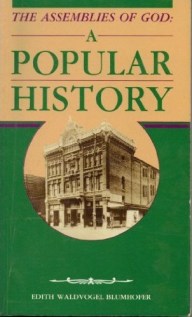 The fundamentalist movement rose up in protest against this movement, being led by R. A. Torrey, who eventually edited a collection of writings called The Fundamentals (1910-1915). Torrey and his friend D. L. Moody were champions of the early fundamentalist cause; but at the same time, they were influenced by the holiness movement, the Higher Life movement, and the Keswick movement: all of which taught that it is possible to be baptized in the Holy Spirit and have more power to live holy and do ministry. Torrey published The Baptism with the Holy Spirit in 1895. They viewed it the same way that Charles Finney had 25 years earlier in 1870 when he co-authored Asa Mahan’s The Baptism of the Holy Ghost and The Enduement of Power: Spirit baptism was only viewed as an enduement of power for service. No tongues or miraculous gifts were involved in this view. It was primarily centered on experiencing more of the fruit of the Spirit, the ethical side of the Holy Spirit.
A. B. Simpson founded the Christian & Missionary Alliance in 1887. He too preached about the baptism in the Holy Spirit, and living up until 1919, he played an important role in nurturing the fundamentalists and Pentecostals of the early 1900s into these views on the Holy Spirit. In his book The Holy Spirit (1899), the title of chapter 2 was “The Baptism with the Holy Ghost.” Torrey and Moody had more in common with A. B. Simpson than they did with Calvinistic cessationist theologians like B. B. Warfield. Torrey, Moody, and Simpson all believed in Spirit baptism and divine healing; and prayed for healing miracles to happen in their church services. They were cautiously charismatic fundamentalists. Some of the divine healing books of the era were Charles Cullis’ Faith Cures (1879), A. J. Gordon’s The Ministry of Healing (1882), A. B. Simpson’s The Gospel of Healing (1885), and Andrew Murray’s Divine Healing (1900). Moody died in 1899, leaving Torrey as the leader of his church and Moody Bible Institute in Chicago. Torrey, after years of praying for healing, eventually published Divine Healing (Moody Press, 1924). This was a major part of the theological background that nurtured the Welsh Revival (1904-1905), the Azusa Street Revival (1906-1909), the early Assemblies of God (founded in 1914), and early Pentecostal healing evangelists like Smith Wigglesworth (d. 1947) and F. F. Bosworth (d. 1958). While fundamentalist theology was an evangelical reaction to liberal theology, the divine healing movement was an evangelical reaction to the Christian Science cult, founded in 1879 in Boston. Coincidentally this was the same city that Charles Cullis operated his healing ministry and same year that he published Faith Cures. All of the healing ministers and authors above saw themselves as following in Cullis’ footsteps. For more about the pre-Pentecostal development of Spirit baptism and divine healing, see chs. 4 and 5 in Donald Dayton’s The Theological Roots of Pentecostalism.
1900 – 1916: Speaking in Tongues and the Assemblies of God
Charles Parham, a man of various contradictions and strange beliefs, was an independent healing evangelist during the late 1800s. He believed pretty much the same way that Simpson, Torrey, and Moody did about Spirit baptism and divine healing. But he still felt that some important aspects of miraculous gifts were missing from modern Christian experience. He felt that the experiences in the book of Acts had not been fully restored. He had heard about a man named Frank Sandford who had a religious community in Shiloh, Maine. Parham went there in good faith, not knowing at the time that Sanford was an abusive authoritarian leader. During his visit, however, he saw some people come out of a prayer tower and they were speaking in tongues. Parham was convinced that the only way to recapture the miraculous gifts in 1 Corinthians 12:8-10, was to experience this element of speaking in tongues (see Vinson Synan’s The Holiness-Pentecostal Tradition, p. 90). He began to set up temporary Bible schools for holiness people who were interested in experiencing some deeper things in God. The first of which was rented at a fine looking mansion called Stone’s Folly in Topeka, Kansas. He called it Bethel Bible College: it operated for no more than one and a half years, from 1900 through 1901.
In December of 1900, he challenged his students to search the Bible for clear and indisputable evidence of the baptism in the Holy Spirit. After personally seeing the people at Shiloh speak in tongues, and after having wondered if there was more to Spirit baptism than merely claiming it by faith as most in the holiness movement were doing, he asked his students to come to him with their findings. He left the school for several days on a trip and came back. They had all reached an agreement: the only real evidence of Spirit baptism that they could find in the Bible that was clear, indisputable, and definite–was the aspect of speaking in tongues: “And they were all filled with the Holy Ghost, and began to speak with other tongues, as the Spirit gave them utterance” (Acts 2:4); “On the Gentiles also was poured out the gift of the Holy Ghost. For they heard them speak with tongues, and magnify God” (Acts 10:45-46); “And when Paul had laid his hands upon them, the Holy Ghost came on them; and they spake with tongues, and prophesied” (Acts 19:6). From these three Scriptures they established the doctrine of “initial evidence”: later the keystone belief of the Azusa Street Revival, the Assemblies of God, and all Pentecostal denominations. It is the teaching that speaking in tongues is the only clear, indisputable, initial, physical evidence that someone has been baptized in the Holy Spirit.
A. B. Simpson and people in the Christian & Missionary Alliance begged to differ; and so did R. A. Torrey, who later said the Pentecostal revival was “emphatically not of God, and founded by a sodomite,” referring to Parham’s later fall into homosexuality (see Vinson Synan’s In the Latter Days, p. 77). The CMA and Torrey remained theoretically open to speaking in tongues, but believed there were enough moral experiences to prove an experience of Spirit baptism without tongues. Blumhofer says, “Alliance leaders virtually excluded tongues-speaking from their movement: They adopted the position that tongues should neither be sought nor forbidden” (p. 33). To differ with the CMA, might I reply that this idea appears to contradict 1 Corinthians 14:5: “I would like every one of you to speak in tongues.” Everyone else in the holiness movement rejected tongues as totally demonic, siding with the view in Alma White’s Demons and Tongues (1910). Agnes Ozman was the first person to speak in tongues at Bethel Bible College. Parham had never spoken in tongues himself, but she asked for him to lay his hands on her and pray to be baptized in the Holy Ghost and speak in tongues, as in Acts 19:6. And it happened to her; then it spread to the other students, and eventually to Parham. It was Parham’s confused, eccentric ministry and eclectic way of thinking that allowed for such religious experimentation. Despite his personal failings and gross imperfections, we can be thankful that he at least played his role in passing the tongues teaching on to the much godlier William J. Seymour, who led the Azusa Street Revival from 1906 to 1909 and really popularized the Pentecostal experience on a global scale. More about that in Frank Bartleman’s How Pentecost Came to Los Angeles (1925).
After the Azusa Street Revival was over, Pentecostal churches were mainly non-denominational and independent, scattered across the United States. Eventually two Pentecostal magazine editors came together, E. N. Bell and J. Roswell Flower, and rallied together a loosely knit Pentecostal alliance which they decided to call the Assemblies of God (AG). In 1914, they got large enough to where they incorporated as a denomination and eventually used Gospel Publishing House as their denominational headquarters in Springfield, Missouri. It was here that they printed the Pentecostal Evangel and their books. The AG became the largest Pentecostal denomination because they accepted William Durham’s teaching of a Baptistic progressive sanctification, empowered by a Pentecostal Spirit baptism, evidenced by speaking in tongues. All of the other Pentecostals believed in a Wesleyan entire sanctification, which kept the rest of the Protestants at a distance. The traditional Protestant view of holiness is gradual and nothing more. The AG’s acceptance of this gradual view of holiness made it easier for other Protestants to become Pentecostals by joining the AG. They also formed their Statement of Fundamental Truths in 1916 to keep the anti-trinitarian “oneness” Pentecostals out of the movement, and preserve orthodox evangelicalism.
1921 – 1948: GPH, Stanley Frodsham, and Smith Wigglesworth
As the AG began to grow, so also did its various ministries and institutions. The first was Gospel Publishing House (GPH), which came to be headed by Stanley Frodsham from 1921 to 1949. Frodsham was already an author of various articles in the British Pentecostal paper Victory, and had been aware of Smith Wigglesworth. He moved to Springfield, Missouri to be the chief editor. In my view, the Assemblies of God lived through its healthiest, most revivalistic times, during the period that Frodsham was editor. He had a sensitivity to the issues of Pentecostal experience. He also wrote the biography Smith Wigglesworth: Apostle of Faith (1948). However, I suspect that this book got him into some trouble with AG leaders, because general superintendent E. S. Williams was not a fan of Wigglesworth, mainly because he would sometimes hit people while praying for them. In 1949, Frodsham left the AG and became involved in the non-denominational Latter Rain Revival. He too felt, that by then, the AG had lost its desire for miraculous gifts. The view of AG leadership at the time might be summarized by this statement on Wigglesworth:
I had heard a thing about his oddities; and I didn’t feel swell about it. So I got three or four of my elders in my car, and we drove up to New York, and heard him one night, and we drove back to Philadelphia. And he’d get over your nose, funny things, and he’d hit ya. (He might hit where you’re hurt if you went down for prayer.) It didn’t appeal to me; but I told (my elders), “You look over here” (look at him hitting people). So after the meeting, they said, “We don’t want it.” They didn’t want him. Yeah. So, I didn’t have any close contact with him. I’ve nothing to say too much in his favor other than he was a kind of an eccentric man. And nothing against him, because he may have had some wonderful things take place…he’s a “legend,” but that’s a bit much, I think (“1979 Interview with E. S. Williams,” 58:40 – 1:01:23).
So, I think its safe to say that the AG leadership distanced themselves from Wigglesworth, because of his eccentric habit of hitting people during his meetings. The fact that he was non-denominational might have had something to do with it too. But there was a love-hate relationship towards him. His books are the most popular AG books. His Ever Increasing Faith (1924) is an AG classic on miraculous gifts. But when the Latter Rain Revival happened, accusing the AG for their anti-charismatic attitude, and for their institutionalism, even Frodsham had to agree–so much so that he left the AG. I won’t defend Wigglesworth’s “hitting prayer” eccentricity. I’ve even heard that he gave up the practice. But look at all of the supernatural ministry that is written about him! I haven’t seen anything like that written about E. S. Williams or any AG superintendent. Were they jealous and skeptical of the miraculous claims of Wigglesworth? Perhaps their jealousy, fear, and suspicion fueled their skepticism and lack of spiritual hunger.
Smith Wigglesworth was clearly the leader in miraculous gifts during that time period; but the top AG leaders didn’t even want to give him a chance to have dialogue and be used more for God’s glory. But it seems that lower level AG leaders did, especially in Great Britain, as he was invited by them to conduct a number of healing meetings. During this period, the AG leaders associated with E. S. Williams started a radio ministry, and some Bible colleges, but I would ask, “What good is that if you can’t even recognize a true prophet like Wigglesworth when you see one?” Ralph Riggs might have had some experience with miraculous gifts, as he seems to show an in-depth knowledge of them in his book The Spirit Himself (1949). He served in various AG leadership capacities, eventually becoming general superintendent from 1953 to 1959. But who knows the name of Riggs outside of AG circles? Pharisees tend to climb the ladder in religious organizations, but prophets always end up on the outside, even though they adhere to the religion claimed by that organization more fanatically and strictly than those who wrote up the Statement of Faith (more on this in Margaret Poloma’s The Assemblies of God at the Crossroads: Charisma and Institutional Dilemmas). I don’t know if Riggs was a Pharisee or a man of God. But Jesus said, “Blessed are you when men hate you, when they exclude you and insult you and reject your name as evil, because of the Son of Man. Rejoice in that day and leap for joy, because great is your reward in Heaven. For that is how their fathers treated the prophets” (Luke 6:22-23). At least Frodsham managed to publish some Wigglesworth books while he was at GPH.
Foreign missions and home missions began to grow in the late 1920s and 30s as the financial support gradually increased in the AG. But at first, many of the AG missionaries were sent out on faith and lived in total poverty. Home missions, or evangelistic projects in the United States, were focused on church planting, ministry to the deaf and handicapped, Native American reservations, evangelism to the Jewish people in America, prison evangelism, and church planting in Alaska; also, David Wilkerson’s Teen Challenge, the Pentecostal drug rehab program mentioned in The Cross and the Switchblade (1962), was eventually absorbed into AG’s home missions department (pp. 85, 87). During World War II in the 1940s, most of the people in the AG were pacifists, but there was a trend towards soldiers and military chaplains coming from the AG. While many American men had to join the Army, many American women, including those in the AG, had to join the workforce; and this changed the economic landscape in America, as well as the image of a traditional family. With all these changes going on in the natural realm: AG departments, World War II, women joining the workforce, etc: by the time Wigglesworth died in 1947, many of the new converts and young people in the AG had never seen a healing; and the AG was in a period of “declension,” definitely needing a Pentecostal revival. In this same year, a twelve year old AG boy by the name of Elvis Presley was learning about the world in Memphis, Tennessee. Ten years later, he would demoralize America’s youth with his sexually provocative style of rock music.
1948 – 1952: The Latter Rain Revival and the Healing Revival
In the beginning of 1948, a Pentecostal revival began in Canada called the Latter Rain Revival, which was inspired by the word of knowledge and healing ministry of William Branham. There were several attributes about this revival (p. 95):
1. They rejected the AG and all Pentecostal denominations as dead and backslidden.
2. They believed the AG had lost its miraculous gifts, because they had compromised with the world.
3. They rejected the AG’s form of church government–Presbyterian polity–and favored an independent congregationalism.
4. They believed in prophetic ministry through the laying on of hands, impartation of miraculous gifts, and giving words of knowledge. Strangely, to this day the AG rejects the idea that miraculous gifts can be imparted by the laying on of hands (this goes against Acts 19:6, one of the key Pentecostal verses).
5. Sometimes, Latter Rain prophets would have revelations that they considered to have equal or greater authority than the Bible. One of these ideas was the infamous “manifest sons of God” idea: the view that some super-Pentecostals would rise out of the Latter Rain Revival and experience immortality, do miracles greater than the apostles in the book of Acts, and hasten the return of Christ.
6. Sometimes, Latter Rain healers’ emphasis on healing and deliverance stemmed from an arrogant delusion of grandeur, that they were super apostles.
Faced with these challenges, the AG replied with an article denouncing the “New Order of the Latter Rain” in 1949. That same year Stanley Frodsham, the chief editor of Gospel Publishing House, left the AG and joined the Latter Rain Revival. He probably aligned himself with the more sober-minded revivalists. (I think if I were living in those times, then I would probably follow Frodsham’s lead as well. Even today I have seen a lot of the same “deadness” problems in Pentecostal denominations; and the “aliveness” of prophetic ministry in non-denominational charismatic churches.) Obviously, there is no excuse for the “manifest sons of God” idea or the grandiose title mongering of the word “apostle,” but all of the other aspects of this revival appeared to be pure. At the same time, the Healing Revival gained national publicity through television broadcasts as William Branham, Oral Roberts, and Jack Coe preached and prayed for thousands of people in their gospel tents. By 1952, however, Branham and Roberts started to preach different heresies and their influence died out. Roberts left us the ungodly legacy of the prosperity gospel, later to be featured nonstop on the Trinity Broadcasting Network (TBN). Jack Coe died in 1956. The Healing Revival also featured many other Pentecostal evangelists, brought together through Gordon Lindsay’s The Voice of Healing magazine; and Lindsay also put together a 513 page book on miraculous gifts called Commissioned with Power. The Healing Revival, did however, have a positive influence on the Assemblies of God pastors. Many more of them began to pray for the sick in their churches (p. 99).
1920s – 1960s: The AG and Youth Ministries
Youth ministry ideas really had their start in the AG during the late 1920s among California pastors. They would have Pentecostal youth rallies and eventually a Pentecostal youth magazine called The Christ’s Ambassadors Herald. This was pretty much the trend in the ’30s and ’40s as well, with their youth rallies growing in popularity. Speed-the-Light was a sort of YWAM type AG youth missionary endeavor that involved fund raising for AG missionary airplanes and other equipment. (My understanding is that YWAM, or Youth With A Mission, branched off of this in 1960; and became a farther reaching endeavor open to young people from all denominations. The AG’s response to YWAM seems to have been Ambassadors In Mission, or AIM, in 1966 for short-term mission trips.) Campus ministry began in the 1950s under the name of Chi Alpha (originally abbreviated CA and then to XA); and had a magazine called Campus Ambassador. Campus ministries really grew in size during the 1960s. Royal Rangers and Missionettes (comparable to Boy Scouts and Girl Scouts involving community service projects), focused on K-12 boys and girls respectively, were developing in the ’60s also; as did Teen Challenge, a youth-oriented drug rehab ministry founded by David Wilkerson, and related in his book The Cross and the Switchblade.
The 1960s: The AG and the Charismatic Movement
In the 1960s, David du Plessis and David Wilkerson, both AG ministers, and both with the name “David,” incidentally enough, played major roles in influencing the charismatic movement in the mainline liberal churches. Du Plessis was especially more cooperative with them and paved the way for charismatic renewal in the Catholic Church. Wilkerson’s influence came through his book The Cross and the Switchblade (1962) and by getting invited to speak at charismatic conferences. Dennis Bennett, the Episcopal priest, also showed that he was influenced by AG theology when he articulated his view on miraculous gifts in The Holy Spirit and You (1971), particularly things related to Wigglesworth. But the AG leaders generally rejected the charismatic movement, because although many claimed to be baptized in the Holy Spirit, they stayed in liberal theology, and did not embrace the holiness lifestyle of the AG. The remaining, lingering question to all charismatics was, “So, when are you going to join an AG church?”
The Decline of Pentecostal Revival Experiences in the AG Churches
By the late ’50s, many AG leaders saw that their numbers were dramatically decreasing; and that Pentecostal revival experiences were being replaced by institutionalism, respectability, and spiritual complacency. In my view, this probably had to do with a decrease of holiness-related and evangelistic Gospel preaching, as it always seems to be the reason why evangelical revivals decline and fade away. David Wilkerson, in a number of his sermons, indicated that the AG had become a dead institution, which is why he broke ties with the AG after he founded Times Square Church. I spoke to an AG district superintendent in 2012 when I was once again reconsidering ministry with the denomination. He told me that an AG pastor’s job is to get people saved and an AG evangelists’ job is to get them speaking in tongues; that they keep statistical records of how many people speak in tongues in their churches; and that the more property and the more tongue-speaking there is going on in a church, the better it is–and that these are the marks of success for an AG pastor. Would you believe it if I told you that I decided not to be an AG pastor that day? When any evangelical church stops placing the emphasis on repentance preaching, Hell, and the moral law of God–that church is no longer in a state of revival. That’s my conclusion. And when any Pentecostal church stops placing an emphasis on the baptism in the Holy Spirit, speaking in tongues, Pentecostal worship, words of knowledge, and praying for divine healing–that church is no longer in a state of revival. Writing in 1985, Blumhofer said of AG membership, “Some are Pentecostals in name only, never having experienced the baptism in the Holy Spirit” (p. 143).
For those who are students of revival, I’d have to say that after the 1950s, the charismatic or Pentecostal experiences spread into the Charismatic Movement through Dennis Bennett, Larry Christensen, John Sherrill, and David Wilkerson’s influence–stretching through the 1960s. In the 1970s, you saw the appearance of more non-denominational charismatic churches, with Derek Prince, New Wine Magazine, and the shepherding movement leading the way in all things charismatic. Kathryn Kuhlman’s healing ministry also got a lot of attention on TV during the ’70s. Then in the 1980s, it was John Wimber and the Vineyard churches, headquartered at what is now called the Vineyard Church of Anaheim. (The AG in the ’80s, however, had the sex scandals of Jimmy Swaggart and Jim Bakker to deal with.) Mike Bickle, author of Growing in the Prophetic, and founder of what is now called IHOP-KC, used to be a Vineyard church, and has played a big role in bringing words of knowledge back into charismatic churches–this is now called “prophetic ministry” and there are several other names associated with this: Jack Deere (Surprised by the Voice of God), Steve Thompson (You May All Prophesy), Larry Randolph (Spirit Talk), Jim Goll (The Seer), and John Paul Jackson (The Biblical Model of Dream Interpretation). In my view, the last great evangelical revival in the United States was also a Pentecostal one, and an AG one at that: the Brownsville Revival, from 1995 to 2000, led by Steve Hill. The New York Times took notice in 1997 with their article: “In Florida, a Revival That Came but Didn’t Go.” But that same superintendent that I had spoken to before, also told me that the AG leaders shut down that revival for one simple reason: they didn’t like people shaking. Once again, respectability and complacency killed the fires of revival. One can only hope that another revival like the one in Brownsville will hit the AG, and that next time, the leaders won’t let respectability and complacency get the best of them.
Posted in Uncategorized
Leave a comment
Warnings Against Freemasonry: From Charles Finney’s Articles
FINNEY’S ARTICLES:
Posted in Uncategorized
Leave a comment
Freemasonry Is a False Religion: A Universalistic Rosicrucian Cult – Charles Finney
Originally from here.
 Some Freemasons claim that Freemasonry is a saving institution, and that it is true religion. Others hold a different opinion, claiming that it is the handmaid of religion, a system of refined morality. Others still are free to admit that it is only a mutual aid or mutual insurance society. This discrepancy of views among them is very striking, as every one knows who has been in the habit of reading sermons, lectures, and orations on Masonry published by themselves. In this article I propose to inquire, first, Do their standard authorities claim that Masonry is identical with true religion? Secondly, Does Freemasonry itself claim to be true religion? and, Thirdly, Are these claims valid?
1. Do their standard authorities claim that Masonry is true religion?
I quote Salem Town. I read his work some forty years ago. The book professes on its title-page to be A System of Speculative Masonry, exhibited in a course of lectures before the Grand Chapter of the State of New York, at their annual meetings in the City of Albany. It was reduced to a regular system by their special request, and recommended to the public by them as a system of Freemasonry. It is also recommended by nine grand officers, in whose presence the lectures were delivered; by another who had examined them; and by “the Hon. DeWitt Clinton, General Grand High Priest of the General Grand Chapter of the United States of America, Grand Master of the Grand Lodge of the State of New York, etc., etc.”
The book was extensively patronized and subscribed for by Freemasons throughout the country, and has always been considered by the fraternity as a standard authority. From this author I quote as follows:
“The principles of Freemasonry have the same coeternal and unshaken foundations, contain and inculcate the same truths in substance, and propose the same ultimate end, as the doctrines of Christianity.”–P. 53. Again he says: “The same system of faith and the same practical duties taught by revelation are contained in and required by the Masonic institution.”–P. 174. “Speculative Masonry combines those great and fundamental principles which constitute the very essence of the Christian system.” –P. 37. “It is no secret that there is not a duty enjoined nor a virtue required in the volume of inspiration but what is found in and taught by Speculative Freemasonry.” “The characteristic principles are such as embrace the whole subject-matter of divine economy.” –P. 31.
Again he says: “As the Word in the first verse of St. John constitutes both the foundation, the subject-matter, and the great ultimate end of the Christian economy, so does the same Word, in all its relations to man, time, and eternity, constitute the very spirit and essence of Speculative Freemasonry.”–P. 155. Again, referring to the promise of the Messiah, he says: “The same precious promise is the great corner-stone in the edifice of Speculative Freemasonry.”–P. 171. Again he says: “The Jewish order of priesthood from Aaron to Zacharias, and even till the coming of Messias, was in confirmation of the great event, which issued in the redemption of man. All pointed to the eternal priesthood of the Son of God, who by his own blood made atonement for sin, and consecrated the way to the Holy of holies. This constitutes the great and ultimate point of Masonic research.”–P. 121.
“That a knowledge of the divine Word, or Logos, should have been the object of so much religious research from time immemorial adds not a little to the honor of Speculative Freemasonry.”–P. 151.
Again he says: “It is a great truth, and weighty as eternity, that the present and everlasting well-being of mankind is solely and ultimately intended.” –P. 170. This he says of Freemasonry. But again he says: “Speculative Masonry, according to present acceptation, has an ultimate reference to that spiritual building erected by virtue in the heart, and summarily implies the arrangement and perfection of those holy and sublime principles by which the soul is fitted for a meet temple of God in a world of immortality.” –P. 63. Does not Freemasonry profess to be a saving religion?
Again he says: “In advancing to the fourth degree, the good man is greatly encouraged to persevere in the ways of well-doing even to the end. He has a name which no man knoweth save him that receiveth it. If, therefore, he be rejected and cast forth among the rubbish of the world, he knows full well that the great Master-builder of the universe, having chosen and prepared him a lively stone in that spiritual building in the heavens, will bring him forth in triumph, while shouting grace, grace to the Divine Redeemer. Then the Freemason is assured of his election and final salvation. Hence, opens the fifth degree, where he discovers his election to, and his glorified station in, the kingdom of his Father.” Then again he is assured of his “election and glorified station in the kingdom of his Father.” If this is not claiming for Freemasonry a saving power what is? Salem Town is the great light in Freemasonry, as the title and history of his work imports. Does he not claim that Freemasonry is a saving religion? To be sure he does, or no words can assert such a claim. “With these views, the sixth degree is conferred, where the riches of divine grace are opened in boundless prospect.” “Then he beholds in the eighth degree, that all the heavenly sojourners will be admitted within the veil of God’s presence, where they will become kings and priests before the throne of his glory forever and ever.”–Pp. 79-81. By the “heavenly sojourners,” he certainly means Freemasons. Observe what he asserts of them: “Then he (the Freemason) beholds in the eighth degree that all the heavenly sojourners will be admitted within the veil of God’s presence, where they will become kings and priests before the throne of his glory forever and ever.” This clenches the claim. “The maxims of wisdom are gradually unfolded, till the whole duty of man is clearly and persuasively exhibited to the mind.”–P. 184.
Again: “Principles and duties which lie at the foundation of the Masonic system, and are solemnly enjoined upon every brother; whoever, therefore, shall conscientiously discharge them in the fear of God fulfills the whole duty of man.”–P. 48. Then he claims for Freemasonry all that is or can be claimed for the law or Gospel of God.
Again he says: “The Divine Being views no moral character in a man with greater complacency than his who in heart strictly conforms to Masonic requirements.” “The more prominent features of a true Masonic character are literally marked with the highest beauties.”–Pp. 33, 185. Then again he represents Masonry as forming as holy a character in man as the Gospel does or can.
Again he says that “every good Mason is of necessity truly and emphatically a Christian.”–P. 37. Then he represents Freemasonry as identical with Christianity. A true Mason must necessarily be a true Christian. That Masonry professes to conduct its disciples to heaven we find affirmed by Town, in the following language. Of the inducements to practice the precepts of Masonry he says: “They are found in that eternal weight of glory, that crown of joy and rejoicing laid up for the faithful in a future world.”–P. 188.
By the faithful here he means faithful Freemasons. This same writer claims that Solomon organized the institution by inspiration from God. On page 187, he says: “So Masonry was transmitted from Enoch, through Noah, Abraham, Moses, and their successors, till Solomon, being inspired of God, established a regular form of administration.” [Edit–what AN OUTRAGEOUS FABRICATION!]
This will suffice for the purpose of showing what is claimed for Masonry by their standard authorities. The same in substance might be quoted from various other standard writers. I have made these quotations from Elder Stearns’ book, not finding in my library a copy of Town. In another place I shall find it convenient to quote sundry others of their standard writers, who, while they claim it to be a religion, do not consider it the Christian religion.
This conducts us to the second inquiry: What does Freemasonry claim for itself?
And here I might quote from almost any of the Masonic degrees to show that this claim is put forth in almost every part of the whole institution. As Town claims for it, so it claims for itself, a power to conduct its disciples to heaven. Any one who will take pains to read Bernard’s Light on Masonry through, will be satisfied that Town claims for the institution no more than it claims for itself.
I beg of all who feel any interest in this subject to get and read Bernard on Masonry; to read it through, and see if Town has not rightly represented the claims of Freemasonry. I deny, observe, that he has rightly represented its principles, and that which it really requires of Masons. That he has misrepresented Masonic law I insist. But in respect to its promises of heaven as a reward for being good Freemasons he has not misrepresented it. It claims to be a saving institution. This certainly will appear to any person who will take the pains to examine its teachings and its claims as revealed in Light on Masonry. Mr. Town has grossly misrepresented Masonic law and morality as we have seen in examining its claims to benevolence, and in scrutinizing their oaths and their profane use of Scripture. But that Mr. Town has not misrepresented the claims of Masonry to be a saving religion has been abundantly shown in these pages by quotations from Light on Masonry. I might quote many pages from the body of Masonry where it teaches the candidates that the observance of Masonic law, principles and usages will secure his salvation. The Gospel professes no more than this, that those who obey it shall be saved. Surely Masonry claims to be a saving religion just as much as the Gospel of Christ does.
Just take the following from the degree of “The Knights of the East and West.” Light on Masonry, first edition, p. 217, already quoted in another place.
In explaining the ceremony of sounding the seventh trumpet, and conducting the candidate to the vacant canopy, we find the following: “This canopy it will be recollected is at the right side of the All Puissant who represents JEHOVAH. The sounding of the seventh trumpet, and the conducting of the candidate to the vacant canopy, is a representation of the end of the world, and the glorification of all true Masons at the right hand of God, having passed through the trials of Freemasonry and washed their robes in their own blood.” If Freemasonry does not claim to be a saving religion how can such a claim be made? The compiler adds: “If this is not Antichrist what is?” But I must beg of the reader to examine the books that reveal Masonry for themselves, since to quote the claims of Masonry on this head further than I have done, would not only be useless and tiresome, but would swell this work too much.
This brings me to the third inquiry: Are the claims that Masonry is a true and saving religion valid?
To this question I reply that it is utterly false; and in this respect Freemasonry is a fatal delusion. From the quotations that I have made from Town, it will be perceived that he represents Freemasonry as identical with Christianity.
Mr. Preston is another of their standard writers. I quote the following note from Stearns on Masonry, p. 28: “Mr. Preston’s book, entitled Illustrations of Masonry, has been extensively patronized by the fraternity as a standard work. The copy before me is the first American, from the tenth London edition.” Mr. Preston says in his book, p. 30: “The universal principles of the art unite in one indissoluble bond of affection men of the most opposite tenets, of the most distant countries, and of the most contradictory opinions.” Again, p. 125, he says: “Our celebrated annotator has taken no notice of Masons having the art of working miracles, and foresaying things to come. But this was certainly not the least important of their doctrines. Hence, astrology was admitted as one of the arts which they taught, and the study of it warmly recommended.” [EDIT–the Freemasons are a pseudo-Christian cult that claimed to have miraculous gifts and dabbled in occult ideas like astrology–I have read that Rosicrucian mysticism (through Elias Ashmole) was part of their mystical views in Salem Kirban’s Satan’s Angel’s Exposed, p. 142.]
“This study became, in the course of time, a regular science.” So here we learn that Masons formerly claimed the power of working miracles. I quote again from Bradley, p. 8. He says: “We leave every member to choose and support those principles of religion and those forms of government which appear consistent to his views.” In the work of Preston, p. 51, we have the following: “As a Mason, you are to study the moral law as contained in the sacred code, the Bible; and in countries where that book is not known, whatever is understood to contain the will or law of God.” O, then, in every country Masons are to embrace the prevalent religion, whatever it may be, and accept whatever is claimed in any country where they may reside, to be the law and will of God. [EDIT–This is TOTAL UNIVERSALISM.] But is this Christianity, or consistent with it? It is well known and admitted that Masonry claims to have descended from the earliest ages, and that the institution has existed in all countries and under all religions; and that the ancient philosophers of Greece and Rome, the astrologers and soothsayers, and the great men of all heathen nations have belonged to that fraternity.
It is also well known that at this time there are multitudes of Jews, Mohammedans, and skeptics of every grade belonging to the institution. I do not know that this is denied by any intelligent Mason. Now, if this is so, how can Freemasonry be the true religion, or at all consistent with it? Multitudes of Universalists and Unitarians, and of errorists of every grade, are Freemasons; and yet Freemasonry itself claims to save its disciples, to conduct them to heaven!
The third question proposed for discussion in my last number is: Are the claims of Masonry to be a true and saving institution valid? To this I answer, No. This will appear if we consider, first, that the morality which it inculcates is not the morality of the law and Gospel of God. The law and the Gospel, as I have shown in a former number, lay down the same rule of life. And Christ, in commenting upon the true meaning and spirit of the law, says: “If ye love them that love you, what thank have ye? Do not even the publicans the same?” He requires us to love our enemies, and to pray for them, as truly as for our friends. In short, He requires universal benevolence; whereas Freemasonry requires no such thing. Its oaths, which are its law, simply require its members to be just to each other. I say just, for their boasted benevolence is simply the payment of a debt.
They do, indeed, promise to assist each other in distress, and to help each other’s families, provided they fall into poverty. But on what condition do they promise this? Why, that a certain amount is to be paid into their treasury as a fund for this purpose. But this, surely, is not benevolence, but the simple payment of a debt, on the principle of mutual insurance.
This I have abundantly shown in a former number. Again, the motives presented in Freemasonry to secure the course of action to which they are pledged are by no means consistent with the law or the Gospel of God. In religion, and in true morality, everything depends on the motive or reason for the performance of an action. God accepts nothing that does not proceed from supreme love to Him and equal love to our fellow-men. Not merely to our brother Masons; but to our neighbor–that is, to all mankind. Whatever does not proceed from love and faith is sin, according to the teachings of the Bible. And by love, I say again, is meant the supreme love of God and the equal love of our neighbor.
But Masonry teaches no such morality as this. The motive urged by Masons is, to honor Masonry, to honor the institution, to honor each other. While they are pledged to assist each other in distress; to keep each other’s secrets, even if they be crimes; and to aid each other, whether right or wrong, so far as to extricate them from any difficulty in which they are involved; yet they never present the pure motives of the Gospel. They are pledged not to violate the chastity of a brother Mason’s wife, sister, daughter, or mother; but they are not pledged by Masonry, as the law and Gospel of God require, to abstain from such conduct with any female whatever. But nothing short of universal benevolence, and universal morality, is acceptable to God.
But again: It has been shown that Masonry claims to be a saving institution; that this is claimed for it by the highest Masonic authorities; and that this claim is one set up by itself as well. But an examination of Freemasonry shows that it promises salvation upon entirely other conditions than those revealed in the Gospel of Christ. The Gospel nowhere inculcates the idea that any one can be saved by obedience to the law of God. “By the deeds of the law shall no flesh be justified” is the uniform teaching of the Bible. Much less can any one be saved by conformity to Masonic law, which requires only a partial, and therefore a spurious, morality. The Bible teaches that all unconverted persons are in a state of sin, of total moral depravity, and consequent condemnation by the law of God; and that the conditions of salvation are repentance and a total renunciation of all sin, faith in our Lord Jesus Christ, and sanctification by the Holy Spirit. Now these are by no means the conditions upon which Freemasonry proposes to save its members. The teachings of Freemasonry upon this subject are summarily this: Obey Masonic law, and live.
Now, surely, whatever promises Heaven to men upon other conditions than those proposed in the Gospel of Christ is a fatal delusion. And this Freemasons can not deny, for they profess to accept the Bible as true. Freemasonry lays no stress at all upon conversion to Christ by the Holy Spirit. It presents no means or motives to secure that result. The idea of being turned from sin to holiness, from a self-pleasing spirit to a supreme love of God, by the preaching of the Gospel, accompanied by the Holy Spirit, is not taught in Freemasonry.
It nowhere recognizes men as being justified by faith in Christ, as being sanctified by faith in Christ, and as being saved as the Gospel recognizes men as being saved.
Indeed, it is salvation by Masonry, and not salvation by the Gospel, that Masonry insists upon. It is another gospel, or presents entirely another method of salvation than that presented in the Gospel. How can it be pretended by those who admit that the Gospel is true that men can be saved by Freemasonry at all? If Freemasons are good men, it is not Freemasonry that has made them so; but the Gospel has made them so, in spite of Freemasonry. If they are anything more than self-righteous, it is because of the teachings of the Gospel; for certainly Freemasonry teaches a very different way of salvation from that which the Gospel reveals. But, again, the prayers recorded in Freemasonry, and used by them in their lodges, are not Christian prayers; that is, they are not prayers offered in THE NAME OF CHRIST.
But the Gospel teaches us that it is fundamental to acceptable prayer that it be offered in the name of Christ. Again, as we have seen in a former number, the teachings of Freemasonry are scandalously false; and their ceremonies are a mockery, and truly shocking to Christian feelings.
Again, Freemasonry is a system of gross hypocrisy. It professes to be a saving institution, and promises salvation to those who keep its oaths and conform to its ancient usages. It also professes to be entirely consistent with the Christian religion. And this it does while it embraces as good and acceptable Masons hundreds of thousands who abhor Christianity, and scoff at the Bible and everything that the Bible regards as sacred. In a Christian nation it professes to receive Christianity as a true religion; in Mohammedan countries it receives the Koran as teaching the true religion; in heathen countries it receives their sacred books as of as much authority as that which is claimed in Christian countries for the Bible. In short, Freemasonry in a pagan country is pagan, in a Mohammedan country it is Mohammedan, and in a Christian country it professes to be Christian; but in this profession it is not only grossly inconsistent, but intensely hypocritical.
Notwithstanding all the boasts that are made in its lower degrees of its being a true religion, if you will examine the matter through to the end, you will find that, as you ascend in the scale of degrees, the mask is gradually thrown off, until we come to the “Philosophical Lodge,” in the degree of the “Knights Adepts of the Eagle or Sun;” in which, as will be seen, no concealment is longer attempted. I will make a short quotation from this degree, as any one may find it in Light on Masonry.–P. 18.
“Requisitions to make a good Mason.–If you ask me what are the requisite qualities that a Mason must be possessed of to come to the center of truth, I answer you that you must crush the head of the serpent, ignorance. You must shake off the yoke of infant prejudice, concerning the mysteries of the reigning religion, which worship has been imaginary and only founded on the spirit of pride, which envies to command and be distinguished, and to be at the head of the vulgar in affecting an exterior purity, which characterizes a false piety joined to a desire of acquiring that which is not its own, and is always the subject of this exterior pride and unalterable source of many disorders; which, being joined to gluttonness, is the daughter of hypocrisy, and employs every matter to satisfy carnal desires, and raises to these predominant passions altars upon which she maintains without ceasing the light of iniquity, and sacrifices continually offerings to luxury, voluptuousness, hatred, envy, and perjury.
“Behold, my dear brother, what you must fight against and destroy before you can come to the knowledge of the true good and sovereign happiness! Behold this monster which you must conquer–a serpent which we detest as an idol that is adored by the idiot and vulgar under the name of religion!” — See Light on Masonry, pp. 270, 271. 8th edition.
Here, then, Masonry stands revealed, after all its previous pretensions to being a true religion, as the unalterable opponent of the reigning or Christian religion. That it claims to be a religion is indisputable; but that it is not the Christian religion is equally evident. Nay, it finally comes out flat-footed, and represents the reigning or Christian religion as a serpent which Masons detest, as an idol which is adored by the idiot and vulgar under the name of religion.
Now let professed Christians who are Freemasons examine this for themselves. Do not turn away from examination of this subject.
And here, before I close this article, I beg to be understood that I have no quarrel with individual Masons. It is with the system that I have to deal. The great mass of the fraternity are utterly deceived, as I was myself. Very few, comparatively, of the fraternity are at all acquainted with what is really taught in the higher degrees as they ascend from one to another. None of them know anything of these degrees any further than they have taken them, unless they have studied them in the books as they are revealed. I can not believe that Christian men will remain connected with this institution, if they will only examine it for themselves and look it through to the end. I know that young Masons, and those who have only taken the lower degrees, will be shocked at what I have just quoted from a higher degree. I was so myself when first I examined the higher degrees. But you will inquire how, and in what sense, are we who have only taken the lower degrees responsible for the oaths and teachings of the higher degrees, which we have not taken. In a future number I shall briefly answer this question. Most Freemasons, and many who have been Masters of lodges of the lower degrees, are really so ignorant of what Masonry as a whole is, that when they are told the simple truth respecting it, they really believe that what you tell them is a lie. I am receiving letters from this class of Freemasons, accusing me of lying and misrepresentation, which accusations I charitably ascribe to ignorance. To such I say, Wait, gentlemen, until you are better informed upon the subject, and you will hold a different opinion.
I have quoted from Salem Town showing that he claims that Solomon established the institution by divine authority–that Town claims for it all that is claimed for Christianity as a saving religion. I might show that others of their standard writers set up the same claim. Now I am unwilling to believe that these writers are hypocrites. It must be that they have been imposed upon as I was. They were ignorant of the origin of Freemasonry. Perhaps this was not strange, especially as regards Mr. Town; for until within the last half century this matter has not been searched to the bottom. But certainly there is now no excuse for the ignorant or dishonest assertions that are so often made by Freemasons. Such pretenses palmed off, as they now often are, upon those whose occupation or other causes forbid their examination of the subject, ought to arouse the righteous indignation of every honest citizen. I say it ought to do so; yes, and it must do so, when we see our dear young men lured by false pretenses in crowds into this snare of Satan. They get drawn in and committed, and, as we see, are afraid to be convinced of their error and become uncandid and will not honestly examine the subject. They will shun the light when it is offered. Can men be saved in this state of mind? [EDIT–see also William Schnoebelen’s Masonry: Beyond the Light (1991) for an exposé of their heretical mystical views.]
Posted in Uncategorized
Leave a comment
The Freemasons: Humanistic Anti-Christian Liars, White Collar Gangsters, a Favoritistic Social Club – Charles Finney
 Originally from here.
The benevolence so much boasted of by Freemasonry is a sham; and the morality of the institution is opposed to both law and Gospel.
The law of God requires universal benevolence, supreme love to God, and equal love to our neighbor–that is, to all mankind.
This the Gospel also requires, and this is undeniable. But does Masonry inculcate this morality? and is this Masonic benevolence?
By no means. Masonic oaths require partial benevolence; or, strictly, they require no benevolence at all. For real benevolence is universal in its own nature. It is good-willing; that is, it consists in willing the well-being or good of universal being–and that for its own sake, and not because the good belongs to this or that particular individual.
In other words, true benevolence is necessarily impartial. But Masonic oaths not only do not require impartial and universal benevolence, but they require the exact opposite of this. The law and Gospel of God allow and require us to discriminate in our doing good between the holy and the wicked.
They require us to do good as we have opportunity to all men, but especially to the household of faith. But the Masonic oaths make no such discriminations as this, nor do they allow it. These oaths require Masons to discriminate between Masons and those that are not Masons; giving the preference to Masons, even if they are not Christians, rather than to Christians if they are not Masons.
Now this is directly opposite to both the law and the Gospel. But this is the benevolence and morality of Freemasonry, undeniably.
The law and the Gospel require our discriminations in our treatment of men to be conditional upon their holiness and likeness to God and their faith in Jesus Christ.
But the oaths of Freemasons require their discriminations to be founded upon the mere relation of a brother Mason, whatever his Christian or moral character may be.
Now this, I say again, is not only not in accordance with Christian morality, and with the law and Gospel of God; but it is directly opposed to both law and Gospel.
But, again, the utter want of true benevolence in the Masonic institution will further appear if we consider the exclusiveness of the institution. A minister in Cleveland, recently defending the institution of Masonry, declared that the glory of Masonry consists in its exclusiveness. But is this in accordance with the benevolence required in the Gospel?
Masonry, observe, professes to be a benevolent institution. But, first, it excludes all women from a participation in its rights, ceremonies, privileges, and blessings, whatever they may be. Secondly, it excludes all old men in their dotage. Thirdly, it excludes all young men in their nonage; that is, under twenty-one years of age. Several other classes are excluded; but these that I have named comprise a vast majority, probably not less than two-thirds of all mankind. Again, they admit no deformed person, and none but those who are physically perfect. In short, they admit none who are likely to become chargeable to the institution.
Now, is this benevolence, or Gospel morality? No, indeed! It is the very opposite of Gospel morality or true benevolence. In a recent number of the National Freemason–I think its date is the 18th of January–it is admitted by the editor of that great national organ that benevolent institutions have been so much multiplied that there is now seldom any call upon Masons for charitable donations. Yes; but who has multiplied these benevolent societies? Surely Masons have not done this. Christians have done it. And Masonry now seems forced to admit that Christian benevolence has covered the whole field, and left them nothing to do. So far as I have had experience in Freemasonry, I can say that I do not recollect a single instance in which the lodge to which I belonged ever gave any money to any charitable object whatever.
As a Freemason, I never was called upon, and to my recollection I never gave a cent as a Freemason, either to an individual as a matter of charity or to any object whatever. My dues and fees to the lodges, of course, I paid regularly; but that the money thus collected was given to any charitable object whatever I do not believe.
Again, Freemasonry, at the best, is but a mutual insurance company. Their oaths pledge them to assist each other, if in distress or in necessitous circumstances; and each other’s families, if left in want. This they can well afford to do, on the principle of mutual insurance: for they have vast sums, almost incalculable in amount, taking the whole fraternity together; and they can lay out almost any amount of money in fitting up their sumptuous lodges of the higher degrees, in building Masonic temples, in seeking each other’s promotion to office, and in defending each other in case any one of them commits a crime and is liable to suffer for it.
The following estimate, taken from a note in the revised edition of Bernard’s Light on Masonry, p. 96, will give some idea how large are the sums held by Masons. “Supposing that in the United States there are 500,000 entered apprentices, 400,000 masters, and 200,000 royal arch Masons, also 10,000 knights, and that they all paid the usual fees for the degrees, the amount would be the enormous sum of 11,250,000 dollars; the yearly interest of which, at 7 per cent, is 787,500 dollars, which sum (allowing 100 dollars. to each individual) would support 7,875 persons.
Now I ask, Do Masons by their charities, support this number of poor in the United States? Do they support one-tenth part of this number? Supposing they do, is it necessary to give 10, or 50 dollars for the privilege of contributing 1, 5, or 50 dollars masonically? Must the privilege of being a charitable man be bought with gold? How many there are who have rendered themselves incompetent to bestow charities, by their payment for and attendance on Masonic secrets and ceremonies! If all the money paid for the degrees of Masonry was applied to charitable purposes, the subject would appear differently; but it is principally devoted to the erection of Masonic temples, support of the grand lodges, and for refreshment for the craft, and I think I may add, for their support in kidnapping and murder.“
It is no doubt true that but a very small part of their funds is ever used for the support of even their own poor. If it is, it behooves them to show it, and let the public know. They boast much of their benevolence; and the charities of Freemasons are frequently compared with those of the church–and that, too, boastfully; they maintaining that they are more benevolent and charitable, and do more for the poor and destitute than even the church has done.
But let us look at this. Is there any truth in all this boasting? What has Freemasonry done for general education in any part of the world? Let them tell us. Again, what has Freemasonry done for the general poor? Nothing. What have they done for their own poor, as a matter of charity and benevolence? Absolutely nothing. They have not even disbursed the funds which have been paid in for that purpose. Let them show, if they can, that, on the principle of a mutual insurance society they have faithfully paid out to their own poor that fund which has been paid in by Masons for the purpose of securing to themselves and families, in case they should be reduced to poverty, what would meet their absolute necessities. We challenge them to show any such thing. We challenge them to show that, on the principle of benevolence and charity, they have really done anything for either the general poor or their own poor. They compare themselves with the Church of Christ in this respect! What have they done for the Southern poor during our great struggle, and during the long period of starvation and distress that has reigned in the South? What have Freemasons, as such, done for the freedmen? And what are they now doing? What have they done in any age of the world, as Freemasons, for Christian missions, for the conversion of the world, for the salvation of the souls of men? What! compare themselves boastfully with the Church of God, as being more benevolent than Christians?
The fact is, the Church of Christ has done ten thousand times as much for humanity as they have ever done. And she has not done it on the principle of a mutual insurance company, but as a matter of true benevolence; including in her charities the poor, the lowly, the halt and the blind, the old and the young, the black and the white.
The Church of Christ has done more for the bodies of men, ten thousand times more, than Freemasonry has ever done or ever will do.
Besides, the Church of Christ has poured out its treasure like a flood to enlighten mankind generally, to save their souls, and to do them good both for time and eternity. But what has Freemasonry done in this respect? Their boasted benevolence is a sham. I admit that they do sometimes afford relief to an indigent brother Mason, and to the families of such. I admit that they have often done this. But I maintain that this is not done as an act of Christian charity, but only as an act of Masonic charity; and that Masonic charity is only the part payment of a debt. Masons pay in their money to the Masonic fund; and this fund is that out of which their poor are helped, when they are helped at all.
What individuals do for individuals, on rare occasions, is but a trifle. Indeed, it is seldom that they are called on as individuals. The help granted to the poor is almost always taken from the funds of the lodges. And I seriously doubt whether there is a lodge in the United States that has ever paid as much for the support of their own poor as has been paid in to their funds by those who have joined the lodge. Let it be understood, then, that their boast of benevolence and of Christian morality is utterly false. Their oaths do not pledge them at all to the performance of any truly Christian morality; but to a Masonic benevolence, which is the opposite of true Christian morality.
Instead, therefore, of Masonry’s inculcating really sound morality, instead of its being almost or quite true religion, the very perfection of that morality which their oaths oblige them to practice is anti-Christian, and opposed to both the law and Gospel of God. It is partial. And here let me again appeal to the dear young men who have been persuaded to join the Masonic fraternity under the impression that it is a benevolent institution. Do not, my dear young men, suffer yourselves to be deceived in this respect. If you have well considered what the law and Gospel require, you will soon perceive that the benevolence and morality required by your Masonic oaths is not Gospel morality or true benevolence at all; but that it is altogether a spurious and selfish morality. Indeed, you yourselves are aware that you joined the lodge from selfish motives; and that the morality inculcated by Masons is an exclusive, one-sided, and selfish affair altogether. In some of the lectures, you are aware that occasionally the duty of universal good-will is, in few words, inculcated. But you also know that your oaths, which lay down the rule of your duty in this respect, require no such thing as universal and impartial benevolence; but that they require the opposite of this. That is, they require you to prefer a Mason because he is a Mason to a Christian because he is a Christian; and, instead of requiring you to do good especially to the household of faith (Galatians 6:10), your oaths require you to do good especially to those who are Freemasons, whether they belong to the household of faith or not. But this you know to be anti-Christian, and not according the Gospel. But you know also that Christians devote themselves to doing good to Masons and to those who are not Masons, to all classes and descriptions of men. And this they do, not on the principle, as I have said, of a mutual insurance society, but as a mere matter of benevolence. They deny themselves for the sake of doing good to the most lowly and even to the most wicked men.
Do not allow yourselves, therefore, to suppose that there is any good in Masonry. We often hear it said, and sometimes by professed Christians and Christian ministers, that “Masonry is a good thing.”
But be not deceived. If by good is intended morally good, the assertion is false. There is nothing morally good in Freemasonry. If there are any good men who are Freemasons, Freemasonry has not made them so; but Christianity has made them so. They are good not by virtue of their Freemasonry, but by virtue of their Christianity. They have not been made good by anything they have found in Freemasonry; but, if they are good, they have been made good by Christianity, in spite of Freemasonry. I must say that I have always been ashamed of Freemasons whenever I have read, in their orations, or in the sermons of ministers who have eulogized it, or in their eulogistic books, the pretense that Freemasonry is a benevolent institution. Many have claimed it to be religion, and true religion. This question I shall examine in another place. But the thing I wish to fix your especial attention upon in the conclusion of this article is, that Freemasonry has no just claims to Christian morality or benevolence; but that in its best estate it is only partiality, and the doing in a very slovenly manner the work of a mutual insurance company.
Editorial Note:
I would like to mention that, whenever my family has fallen on hard times of poverty or unemployment, the most helpful organizations in the area of either bill assistance or food pantry help has been the Roman Catholic Church (in conjunction with the Society of St. Vincent de Paul) and the United Methodist Church. Both churches emphasize good works. Calvinistic churches haven’t helped us; and neither has the Salvation Army.
Posted in Uncategorized
Leave a comment
Avoiding Ungodly Friendships: In Work, School, Church, Sports, Family, Neighbors, Etc.
Writings on Biblical Separation from the World
Reed, Rodney. Holy With Integrity: The Unity of Personal and Social Ethics in the Holiness Movement, 1880-1910.
Rice, John R. How to Make a Grand Success of the Christian Life, ch. 8: “Five Bible Rules About Fellowship”
Ryle, J. C. Separation from the World – extracted from Practical Religion (1878)
Thornton, Wallace. Radical Righteousness.
Wesley, John. “On Friendship with the World” (Sermon 80)
Posted in Uncategorized
Leave a comment
On Friendship with the World – John Wesley
Originally from here. Published in 1786.
Ye adulterers and adulteresses, know ye not that the friendship of this world is enmity with God? Whosoever therefore desireth to be a friend of the world is an enemy of God.
–James 4:4
1. There is a passage in St. Paul’s Epistle to the Romans, which has been often supposed to be of the same import with this: “Be not conformed to this world:” (Rom. 12:2). But it has little or no relation to it; it speaks of quite another thing. Indeed the supposed resemblance arises merely from the use of the word world in both places. This naturally leads us to think that St. Paul means by conformity to the world, the same which St. James means by friendship with the world: whereas they are entirely different things, as the words are quite different in the original: for St. Paul’s word is aivn St. James’s is kosmos. However, the words of St. Paul contain an important direction to the children of God. As if he had said, “Be not conformed to either the wisdom, or the spirit, or the fashions of the age; of either the unconverted Jews, or the heathens, among whom ye live. You are called to show, by the whole tenor of your life and conversation, that you are ‘renewed in the spirit of your mind’, after the image of Him that created you;’ and that your rule is not the example or will of man, but ‘the good, and acceptable, and perfect will of God.'”
2. But it is not strange, that St. James’s caution against friendship with the world should be so little understood, even among Christians. For I have not been able to learn that any author, ancient or modern, has wrote upon the subject: No, not (so far as I have ever observed) for sixteen or seventeen hundred years. Even that excellent writer, Mr. Law, who has treated so well many other subjects, has not, in all his practical treatises, wrote one chapter upon it; no, nor said one word, that I remember, or given one caution, against it. I never heard one sermon preached upon it either before the u niversity or elsewhere. I never was in any company where the conversation turned explicitly upon it even for one hour.
3. Yet are there very few subjects of so deep importance; few that so nearly concern the very essence of religion, the life of God in the soul; the continuance and increase, or the decay, yea, extinction of it. From the want of instruction in this respect the most melancholy consequences have followed. These indeed have not affected those who were still dead in trespasses and sins; but they have fallen heavy upon many of those who were truly alive to God. They have affected many of those called Methodists in particular; perhaps more than any other people. For want of understanding this advice of the apostle, (I hope rather than from any contempt of it) many among them are sick, spiritually sick, and many sleep, who were once thoroughly awakened. And it is well if they awake any more till their souls are required of them. It has appeared difficult to me to account for what I have frequently observed: many who were once greatly alive to God, whose conversation was in Heaven, who had their affections on things above, not on things of the earth; though they walked in all the ordinances of God, though they still abounded in good works, and abstained from all known sin, yea, and from the appearance of evil; yet they gradually and insensibly decayed; (like Jonah’s gourd, when the worm ate the root of it) insomuch that they are less alive to God now, than they were ten, twenty, or thirty years ago. But it is easily accounted for, if we observe, that as they increased in goods, they increased in friendship with the world; which, indeed, must always be the case, unless the mighty power of God interpose. But in the same proportion as they increased in this, the life of God in their soul decreased.
4. Is it strange that it should decrease, if those words are really found in the oracles of God: “Ye adulterers and adulteresses, know ye not that the friendship of the world is enmity with God?” What is the meaning of these words? Let us seriously consider. And may God open the eyes of our understanding; that, in spite of all the mist wherewith the wisdom of the world would cover us, we may discern what is the good and acceptable will of God!
5. Let us, first, consider, what it is which the apostle here means by the world. He does not here refer to this outward frame of things, termed in Scripture, heaven and earth; but to the inhabitants of the earth, the children of men, or at least, the greater part of them. But what part? This is fully determined both by our Lord himself, and by his beloved disciple. First, by our Lord himself. His words are, “If the world hate you, ye know that it hated me before it hated you. If ye were of the world, the world would love its own: But because ye are not of the world, but I have chosen you out of the world, therefore the world hateth you. If they have persecuted me, they will also persecute you. And all these things will they do unto you, because they know not Him that sent me” (John 15:18-21). You see here “the world” is placed on one side, and those who “are not of the world” on the other. They whom God has “chosen out of the world,” namely, by “sanctification of the Spirit, and belief of the truth,” are set in direct opposition to those whom He hath not so chosen. Yet again: those “who know not Him that sent me,” saith our Lord, who know not God, they are “the world.”
6. Equally express are the words of the beloved disciple: “Marvel not, my brethren, if the world hate you: we know that we have passed from death unto life, because we love the brethren” (1 John 3:13-14). As if he had said, “You must not expect any should love you, but those that have ‘passed from death unto life.'” (Edit–that is, people who are genuinely saved and true Christians, pursuing a holy life, and trying to avoid sin.) It follows, those that are not passed from death unto life, that are not alive to God, are “the world.” The same we may learn from those words in the fifth chapter, verse 19, “We know that we are of God, and the whole world lieth in the wicked one” (1 John 5:19). Here “the world” plainly means, those that are not of God, and who, consequently “lie in the wicked one.”
7. Those, on the contrary, are of God, who love God, or at least “fear Him, and keep his commandments.” This is the lowest character of those that “are of God;” who are not properly sons, but servants; who depart from evil, and study to do good, and walk in all His ordinances, because they have the fear of God in their heart, and a sincere desire to please Him. Fix in your heart this plain meaning of the term, “the world;” those who do not thus fear God. Let no man deceive you with vain words: it means neither more nor less than this.
8. But understanding the term in this sense, what kind of friendship may we have with the world? We may, we ought, to love them as ourselves; (for they also are included in the word neighbor) to bear them real good-will; to desire their happiness, as sincerely as we desire the happiness of our own souls; yea, we are in a sense to honor them, (seeing we are directed by the apostle to “honor all men”) as the creatures of God; nay, as immortal spirits, who are capable of knowing, of loving, and of enjoying Him to all eternity. We are to honor them as redeemed by His blood who “tasted death for every man.” We are to bear them tender compassion when we see them forsaking their own mercies, wandering from the path of life, and hastening to everlasting destruction. We are never willingly to grieve their spirits, or give them any pain; but, on the contrary, to give them all the pleasure we innocently can; seeing we are to “please all men for their good.” We are never to aggravate their faults; but willingly to allow all the good that is in them.
9. We may, and ought, to speak to them on all occasions in the most kind and obliging manner we can. We ought to speak no evil of them when they are absent, unless it be absolutely necessary; unless it be the only means we know of preventing their doing hurt: otherwise we are to speak of them with all the respect we can, without transgressing the bounds of truth. We are to behave to them, when present, with all courtesy, showing them all the regard we can without countenancing them in sin. We ought to do them all the good that is in our power, all they are willing to receive from us; following herein the example of the universal Friend, our Father which is in Heaven, who, till they will condescend to receive greater blessings, gives them such as they are willing to accept; “causing His sun to rise on the evil and the good, and sending” His “rain on the just and on the unjust.”
10. “But what kind of friendship is it which we may not have with the world? May we not converse with ungodly men at all? Ought we wholly to avoid their company?” By no means. The contrary of this has been allowed already. If we were not to converse with them at all, “we must needs go out of the world.” Then we could not show them those offices of kindness which have been already mentioned. We may, doubtless, converse with them, First, on business; in the various purposes of this life, according to that station therein, wherein the providence of God has placed us; Secondly, when courtesy requires it; only we must take great care not to carry it too far: Thirdly, when we have a reasonable hope of doing them good. But here too we have an especial need of caution, and of much prayer; otherwise, we may easily burn ourselves, in striving to pluck other brands out of the burning.
11. We may easily hurt our own souls, by sliding into a close attachment to any of them that know not God. This is the friendship which is “enmity with God:” We cannot be too jealous over ourselves, lest we fall into this deadly snare; lest we contract, or ever we are aware, a love of complacence or delight in them. Then only do we tread upon sure ground, when we can say with the Psalmist, “All my delight is in the saints that are upon earth, and in such as excel in virtue.” We should have no needless conversations with them. It is our duty and our wisdom to be no oftener and no longer with them than is strictly necessary. And during the whole time we have need to remember and follow the example of him that said, “I kept my mouth as it were with a bridle while the ungodly was in my sight” (Ps. 39:1). We should enter into no sort of connection with them, farther than is absolutely necessary. When Jehoshaphat forgot this, and formed a connection with Ahab, what was the consequence? He first lost his substance: “The ships” they sent out “were broken at Ezion-geber.” And when he was not content with this warning, as well as that of the prophet Micaiah, but would go up with him to Ramoth-Gilead, he was on the point of losing his life.
12. Above all, we should tremble at the very thought of entering into a marriage covenant, the closest of all others, with any person who does not love, or at least, fear God. This is the most horrid folly, the most deplorable madness, that a child of God can possibly plunge into; as it implies every sort of connection with the ungodly which a Christian is bound in conscience to avoid. No wonder, then, it is so flatly forbidden of God; that the prohibition is so absolute and peremptory: “Be not unequally yoked with an unbeliever” (2 Cor. 6:14). Nothing can be more express. Especially, if we understand by the word unbeliever, one that is so far from being a believer in the Gospel sense–from being able to say, “The life which I now live, I live by faith in the Son of God, who loved me, and gave Himself for me”–that he has not even the faith of a servant: he does not “fear God and work righteousness.”
13. But for what reasons is the friendship of the world so absolutely prohibited? Why are we so strictly required to abstain from it? For two general reasons: First, because it is a sin in itself: Secondly, because it is attended with most dreadful consequences. First, it is a sin in itself; and indeed, a sin of no common dye. According to the oracles of God, friendship with the world is no less than spiritual adultery. All who are guilty of it are addressed by the Holy Ghost in those terms: “Ye adulterers and adulteresses.” It is plainly violating of our marriage contract with God, by loving the creature more than the Creator; in flat contradiction to that kind command, “My son, give me thine heart.”
14. It is a sin of the most heinous nature, as not only implying ignorance of God, and forgetfulness of Him, or inattention to Him, but positive “enmity against God.” It is openly, palpably such. “Know ye not,” says the apostle, can ye possibly be ignorant of this, so plain, so undeniable a truth, “that the friendship of the world is enmity against God?” Nay, and how terrible is the inference which he draws from hence! “Therefore, whosoever will be a friend of the world,” (the words, properly rendered, are, Whosoever desireth to be a friend of the world) of men who know not God, whether he attain it or not, is, ipso facto, constituted an enemy of God. This very desire, whether successful or not, gives him a right to that appellation. (Edit–that is, by allowing yourself to won over to their ways, their profanities, greed, sexual immorality, impure jokes, liquors, cigars, and sinful compromises. This is not referring to the reserved form of “friendship evangelism” that Wesley was referring to in section 10.)
15. And as it is a sin, a very heinous sin, in itself, so it is attended with the most dreadful consequences. It frequently entangles men again in the commission of those sins from which “they were clean escaped.” It generally makes them “partakers of other men’s sins,” even those which they do not commit themselves. It gradually abates their abhorrence and dread of sin in general, and thereby prepares them for falling an easy prey to any strong temptation. It lays them open to all those sins of omission whereof their worldly acquaintance are guilty. It insensibly lessens their exactness in private prayer, in family duty, in fasting, in attending public service, and partaking of the Lord’s Supper. (Edit–that is, close friendship with non-Christians or worldly churchgoers is ANTI-HOLINESS, ANTI-THEOLOGY, ANTI-SPIRITUALITY, and ANTI-GOD.) The indifference of those that are near them, with respect to all these, will gradually influence them: even if they say not one word (which is hardly to be supposed) to recommend their own practice, yet their example speaks, and is many times of more force than any other language. By this example, they are unavoidably betrayed, and almost continually, into unprofitable, yea, and uncharitable, conversation; till they no longer “set a watch before their mouth, and keep the door of their lips;” till they can join in backbiting, tale-bearing, and evil-speaking without any check of conscience; having so frequently grieved the Holy Spirit of God, that He no longer reproves them for it: insomuch that their discourse is not now, as formerly, “seasoned with salt, and meet to minister grace to the hearers.”
16. But these are not all the deadly consequences that result from familiar intercourse with unholy men. It not only hinders them from ordering their conversation aright, but directly tends to corrupt the heart. It tends to create or increase in us all that pride and self-sufficiency, all that fretfulness to resent, yea, every irregular passion and wrong disposition, which are indulged by their companions. It gently leads them into habitual self-indulgence, and unwillingness to deny themselves; into unreadiness to bear or take up any cross; into a softness and delicacy; into evil shame, and the fear of man, that brings numberless snares. It draws them back into the love of the world; into foolish and hurtful desires; into the desire of the flesh, the desire of the eyes, and the pride of life, till they are swallowed up in them. So that, in the end, the last state of these men is far worse than the first.
17. If the children of God will connect themselves with the men of the world, though the latter should not endeavor to make them like themselves, (which is a supposition by no means to be made) yea, though they should neither design nor desire it; yet they will actually do it, whether they design it, and whether they endeavor it, or no. I know not how to account for it, but it is a real fact, that their very spirit is infectious. While you are near them, you are apt to catch their spirit, whether they will or no. Many physicians have observed, that not only the plague, and putrid or malignant fevers, but almost every disease men are liable to, are more or less infectious. And undoubtedly so are all spiritual diseases, only with great variety. The infection is not so swiftly communicated by some as it is by others. In either case, the person already diseased does not desire or design to infect another. The man who has the plague does not desire or intend to communicate his distemper to you. But you are not therefore safe: So keep at a distance, or you will surely be infected. Does not experience show that the case is the same with the diseases of the mind? Suppose the proud, the vain, the passionate (the hateful, the hot-tempered), the wanton (the lustful), do not desire or design to infect you with their own distempers; yet it is best to keep at a distance from them. You are not safe if you come too near them. You will perceive (it is well if it be not too late) that their very breath is infectious. It has been lately discovered that there is an atmosphere surrounding every human body, which naturally affects everyone that comes within the limits of it. Is there not something analogous to this, with regard to a human spirit? If you continue long within their atmosphere, so to speak, you can hardly escape the being infected. The contagion spreads from soul to soul, as well as from body to body, even though the persons diseased do not intend or desire it. But can this reasonably be supposed? Is it not a notorious truth, that men of the world (exceeding few excepted) eagerly desire to make their companions like themselves? Yea and use every means, with their utmost skill and industry, to accomplish their desire. Therefore, fly for your life! Do not play with the fire, but escape before the flames kindle upon you.
18. But how many are the pleas for friendship with the world! And how strong are the temptations to it! Such of these as are the most dangerous, and, at the same time, most common, we will consider. (Edit–OFFICE POLITICS is, I suppose the most common temptation in this area for working adults. Wesley touches on this briefly in section 23. Many business managers want to build trust and rapport with their employees, and vice versa. Most often, it seems that Christian employees throw their Christian habits to the side in order to mingle with worldly men. And before they know it, they’ve lost their connection with God, because they put their fear of men in place of their fear and love for God. Christians must have a strong faith in the providence of God, or supernatural provision, for their finances. Otherwise, they will too often get scared of losing their jobs, and play into the devil’s social clubs waiting for them at their companies. They call this networking. But in these situations, the only net Christians are working themselves into, are ones of flattery and destruction: “whoever flatters his neighbor is spreading a net for his feet” (Prov. 29:5); “proud men have hidden a snare for me; they have spread out the cords of their net and have set traps for me along my path” (Ps. 140:5). Also, as a general rule, if you don’t cuss around people who like to cuss, then they won’t want to be your friends. They will contradict you; and pick fights with you, even over the fact that you are “quiet” or “don’t cuss” like they do. And they will either avoid you or pick on you. You make them feel like they can’t speak freely around you; you make them feel uncomfortable–to be sure, they will try to trip you up by some other means and get you away from them. A lot of this WORLDLY RAPPORT-BUILDING is based on THE FEAR OF LOSING A JOB. People mistrust people they don’t know, so they engage in office politics to build trust and rapport. They often do this by non-Christian styles of joking often involving cussing. They feel the end justifies the means: after all, they have bills to pay. Even if they are not comfortable with this, they will play along. Later on, they may or may not realize they have lost their walk with God. It begs the question: should non-cussing Christians, committed to not becoming friends with the world, even be in the workplace? Should they only seek out a form of employment in which they could work for themselves, independently, such as selling insurance or real estate? It seems this would be a wiser decision, at least in the United States currently, with all the godlessness everywhere so rampant and antagonistically anti-Christian).
To begin with one that is the most dangerous of all others, and, at the same time, by no means uncommon. “I grant,” says one, “the person I am about to marry is not a religious person. She does not make any pretensions to it. She has little thought about it. But she is a beautiful creature. She is extremely agreeable, and, I think, will make me a lovely companion.”
This is a snare indeed! Perhaps one of the greatest that human nature is liable to. This is such a temptation as no power of man is able to overcome. Nothing less than the mighty power of God can make a way for you to escape from it. And this can work a complete deliverance: His grace is sufficient for you. But not unless you are a worker together with Him: Not unless you deny yourself, and take up your cross. And what you do, you must do at once! Nothing can be done by degrees. Whatever you do in this important case must be done at one stroke. If it is to be done at all, you must at once cut off the right hand, and cast it from you! Here is no time for conferring with flesh and blood! At once, conquer or perish!
19. Let us turn the tables. Suppose a woman that loves God is addressed by an agreeable man; genteel, lively, entertaining; suitable to her in all other respects, though not religious: What should she do in such a case? What she should do, if she believes the Bible, is sufficiently clear. But what can she do? Is not this
A test for human frailty too severe?
Who is able to stand in such a trial? Who can resist such a temptation? None but one that holds fast the shield of faith, and earnestly cries to the Strong for strength. None but one that gives herself to watching and prayer, and continues therein with all perseverance. If she does this, she will be a happy witness, in the midst of an unbelieving world, that as “all things are possible with God,” so all “things are possible to her that believeth.”
20. But either a man or woman may ask, “What, if the person who seeks my acquaintance be a person of a strong natural understanding, cultivated by various learning? May not I gain much useful knowledge by a familiar intercourse with him? May I not learn many things from him, and much improve my own understanding?” Undoubtedly you may improve your own understanding, and you may gain much knowledge. But still, if he has not at least the fear of God, your loss will be far greater than your gain. For you can hardly avoid decreasing in holiness as much as you increase in knowledge. And if you lose one degree of inward or outward holiness, all the knowledge you gain will be no equivalent. (Edit–most professional learning is contained in books anyway–if that’s what you desire, then read some of them or get audio books.)
21. “But his fine and strong understanding, improved by education, is not his chief recommendation. He has more valuable qualifications than these: He is remarkably good humored: He is of a compassionate, humane spirit; and has much generosity in his temper.” On these very accounts, if he does not fear God, he is infinitely more dangerous. If you converse intimately with a person of this character, you will surely drink into his spirit. It is hardly possible for you to avoid stopping just where he stops. I have found nothing so difficult in all my life as to converse with men of this kind (good sort of men, as they are commonly called) without being hurt by them. O beware of them! Converse with them just as much as business requires, and no more: Otherwise (though you do not feel any present harm, yet) by slow and imperceptible degrees, they will attach you again to earthly things, and damp the life of God in your soul.
22. It may be, the persons who are desirous of your acquaintance, though they are not experienced in religion, yet understand it well, so that you frequently reap advantage from their conversation. If this be really the case, (as I have known a few instances of the kind) it seems you may converse with them; only very sparingly and very cautiously; Otherwise you will lose more of your spiritual life than all the knowledge you gain is worth.
23. “But the persons in question are useful to me, in carrying on my temporal business. Nay, on many occasions, they are necessary to me; so that I could not well carry it on without them.” Instances of this kind frequently occur. And this is doubtless a sufficient reason for having some intercourse, perhaps frequently, with men that do not fear God. But even this is by no means a reason for your contracting an intimate acquaintance with them. And you here need to take the utmost care, “lest even by that converse with them which is necessary, while your fortune in the world increases, the grace of God should decrease in your soul.”
24. There may be one more plausible reason given for some intimacy with an unholy man. You may say, “I have been helpful to him. I have assisted him when he was in trouble. And he remembers it with gratitude. He esteems and loves me, though he does not love God. Ought I not then to love him? Ought I not to return love for love? Do not even heathens and publicans so?” I answer, you should certainly return love for love; but it does not follow that you should have any intimacy with him. That would be at the peril of your soul. Let your love give itself vent in constant and fervent prayer. Wrestle with God for him. But let not your love for him carry you so far as to weaken, if not destroy, your own soul.
25. “But must I not be intimate with my relations; and that whether they fear God or not? Has not His providence recommended these to me?” Undoubtedly it has: but there are relations nearer or more distant. The nearest relations are husbands and wives. As these have taken each other for better for worse, they must make the best of each other; seeing, as God has joined the together, none can put them asunder; unless in case of adultery, or when the life of one or the other is in imminent danger. Parents are almost as nearly connected with their children. You cannot part with them while they are young; it being your duty to “train them up,” with all care, “in the way wherein they should go.” How frequently you should converse with them when they are grown up is to be determined by Christian prudence. This also will determine how long it is expedient for children, if it be at their own choice, to remain with their parents. In general, if they do not fear God, you should leave them as soon as is convenient. But wherever you are, take care (if it be in your power) that they do not want the necessaries or conveniences of life. As for all other relations, even brothers or sisters, if they are of the world you are under no obligation, to be intimate with them: you may be civil and friendly at a distance.
26. But allowing that “the friendship of the world is enmity against God,” and consequently, that it is the most excellent way, indeed the only way to Heaven, to avoid all intimacy with worldly men; yet who has resolution to walk therein? Who even of those that love or fear God? for these only are concerned in the present question. A few I have known who, even in this respect, were lights in a benighted land; who did not and would not either contract or continue any acquaintance with persons of the most refined and improved understanding, and the most engaging tempers, merely because they were of the world, because they were not alive to God: Yea, though they were capable of improving them in knowledge, or of assisting them in business: Nay, though they admired and esteemed them for that very religion which they did not themselves experience: A case one would hardly think possible, but of which there are many instances at this day. Familiar intercourse even with these they steadily and resolutely refrain from, for conscience sake.
27. Go thou and do likewise, whosoever thou art that art a child of God by faith! Whatever it cost, flee spiritual adultery. Have no friendship with the world. However tempted thereto by profit or pleasure, contract no intimacy with worldly-minded men. And if thou hast contracted any such already, break it off without delay. Yea, if thy ungodly friend be dear to thee as a right eye, or useful as a right hand, yet confer not with flesh and blood, but pluck out the right eye, cut off the right hand, and cast them from thee! It is not an indifferent thing. Thy life is at stake; eternal life or eternal death. And is it not better to go into life having one eye or one hand, than having both to be cast into Hell-fire? When thou knewest no better, the times of ignorance God winked at. But now thine eyes are opened, now the light is come, walk in the light! Touch not pitch, lest thou be defiled. At all events, “keep thyself pure!” (1 Tim. 5:22).
28. But whatever others do, whether they will hear, or whether they will forbear, hear this, all ye that are called Methodists! However importuned or tempted thereto, have no friendship with the world. Look round, and see the melancholy effects it has produced among your brethren! How many of the mighty are fallen! How many have fallen by this very thing! They would take no warning: They would converse, and that intimately, with earthly-minded men, till they “measured back their steps to earth again!” O “come out from among them!” from all unholy men, however harmless they may appear; “and be ye separate:” At least so far as to have no intimacy with them. As your “fellowship is with the Father, and with his Son Jesus Christ;” so let it be with those, and those only, who at least seek the Lord Jesus Christ in sincerity. So “shall ye be,” in a peculiar sense, “my sons and my daughters, saith the Lord Almighty.”
Posted in Uncategorized
Leave a comment
Kinds of Prayer in the New Testament
Taken from every New Testament occasion of the word “prayer” in the KJV.
MATTHEW
17:21 – deliverance prayer with fasting (cp. Mark 9:29)
21:13 – prayer at church (cp. Mark 11:17; Luke 19:46)
21:22 – petition
23:14 – against Pharisaical, pretentious long prayers
LUKE
1:13 – prayer against infertility
6:12 – all night prayer vigil
22:45 – prayer for strength in Gethsemane
ACTS
1:14 – group supplication (asking earnestly for the baptism in the Holy Spirit)
3:1 – going to church for the daily hour of prayer
6:4 – habitual pastoral prayer and Bible preaching
10:31 – angelic answer to private prayer
12:5 – group church prayer for Peter in prison
16:13 – women’s prayer meeting by the river
16:16 – walking to the synagogue for the hour of prayer
ROMANS
10:1 – prayer for Israel to be saved and become Christian
12:12 – continuing and persevering in the practice of prayer
1 CORINTHIANS
7:5 – abstaining from marital sex and food for a time of prayer
2 CORINTHIANS
1:11 – group church prayer for missionaries
9:14 – praying for other Christians
EPHESIANS
6:18 – praying in the Spirit (tongues) for all Christians
PHILIPPIANS
1:4 – joyfully praying for other Christians
1:19 – prayer for protection for a missionary
4:6 – ask God and thank God
COLOSSIANS
4:2 – thank God and continue in the practice of prayer
1 TIMOTHY
4:5 – all food is sanctified for eating by Scripture and prayer
JAMES
5:15-16 – the fervent prayer of a righteous man for healing
1 PETER
4:7 – keep up the discipline of prayer
Posted in Uncategorized
Leave a comment

