Revival Principles from an Intercessor, Revivalist, and Evangelist
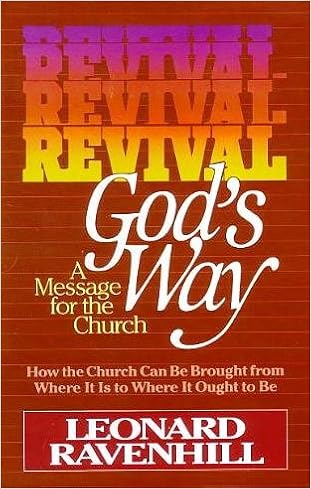
Leonard Ravenhill was a man of God; and in my estimation a saint. Some have gone so far as calling him a prophet, and maybe he was. He was not the type of person to have tons of dreams and visions; or share prophecies and supernatural words of knowledge, but I think its possible he had moments like that, since in this book he at least expresses sympathy for those things (pp. 102-103). If anything, he was what you might call an intercessor. Aside from that label, I’d say he was a revivalist and an evangelist. He represented the Wesleyan holiness tradition until his death in 1994; and he was and still is the best modern holiness preacher, in my view. But as an intercessor, he was absorbed with the idea of prayer and the practice of it. Prayer was everything to him, especially the kind taught by E. M. Bounds, who although he doesn’t mention him in this book, he did compile some of his writings in A Treasury of Prayer. I personally believe that his intercessions for national revival, which spanned over many years, were finally answered after he died in 1994. Steve Hill and Michael Brown were mentored by him in his final days, and both of them led the Brownsville Revival, which was national, involved several million people, was mentioned in The New York Times, and lasted from 1995 to 2000, until it was shut down by Pharisees in the Assemblies of God, who didn’t like people shaking in response to God’s Spirit.
For those of you who have read his signature book Why Revival Tarries, you will find in the Preface of Revival God’s Way, that it is meant to be a sequel, or part 2 to that original book. This was the last book that Ravenhill published. It was in 1983, just after what I call the Lindale, Texas revival (1979 – 1982), where he often preached at Last Days Ministries, and lived nearby Keith Green and David Wilkerson. This was the time that the video sermons on SermonIndex and YouTube were recorded. If you read Revival God’s Way, you get the sense that this is the Ravenhill you’ve come to know and love from those videos on the internet: that fiery, sin-rebuking critic of the Church, who breaks down idols, and challenges Christians to spend more time alone with God in prayer. Peppered throughout, you will also find a good amount of Christian poems, which probably came from him being around a songwriter like Keith Green.
Intercessory Prayer Comes Out As a Main Revival Principle
Its clear to me that he was a man of prayer and that this book was written in the spirit of prayer. But with that–and this is my main critique of the book–comes a sort of random, unstructured presentation of the principles of revival. The same approach was in Why Revival Tarries. Unless you have a highlighter, and a pen, and are taking careful notes, you might get lost trying to follow his train of thought. You might not remember much of what you read, because the subjects change so often. But then again, there is enough repetition on the theme of intercessory prayer, that its hard to forget that revival principle. In this way, his unstructured approach to spiritual subjects is not that different than Charles Finney’s Lectures on Revivals of Religion; but in my view, Finney’s book is a little bit more structured so far as the Table of Contents are concerned: at least with him, its not hard to grasp his revival thesis, just from skimming the contents: that revival involves intercessory prayer, the baptism in the Holy Spirit, preaching the Gospel correctly, and understanding the hindrances to revivals. Because of the allegorical chapter titles in Ravenhill’s books, however, you really have to read the chapters to see what they are about; and after finding what they are about, you then find that the subjects change often, and its hard to grasp a consistent thesis on the nature of revival. This can be sort of frustrating, but I did take notes on what they are about! And what is of value to the Church should be found in this: that while Ravenhill may not have been a really organized academic theologian, he was by far more advanced in the spiritual life of prayer than most evangelical church leaders. Of this I am deeply persuaded; and anything he has to say, while you may not always agree with it, is still worth considering with the Word of God in hand.
A Summary of Chapter Themes
His chapter themes touch on the following subjects: the joy of obedience to God vs. greed: a nice alternative to John Crowder’s antinomian view of joy (ch. 1), intercession (ch. 2), lukewarm preachers on TV (ch. 3), cults and cheap grace antinomianism (ch. 4), prayer and revival linked (ch. 5), Hell (ch. 6), morally weak sermons, a skeptical critique of Vinson Synan’s claim that 5 million people have been baptized in the Holy Spirit as of the 1980s (ch. 7), the relation of Puritan and Wesleyan preaching to the presence of God, and of revival changing the moral climate of the community: not just one church (ch. 8), Evan Roberts’ weeping and tears in prayer: something I think Ravenhill emphasized too much, and which has unfortunately been faked by certain of his fans, crying fake “revival” tears. Most men are just not that sensitive. This could be because David Matthews, who wrote I Saw the Welsh Revival, and whom he quotes on page 73, played a role in leading his dad to Christ. John Wesley called it the gift of tears; and I would grant that, but its not something that should be faked or manufactured. I was given this gift once, when I was driving to a spot for street preaching, listening to a Robin Mark song. I was suddenly overwhelmed with intense, heartfelt crying, and I cried like a little boy, with a voice that was much higher pitched than I would have liked: it was with “strong crying and tears” (Heb. 5:7), because after so much of my street preaching efforts, I thought of how so many people would just walk by unfazed and seem completely unconcerned about their spiritual conditions (ch. 9).
True prophets (ch. 10), prayer and contemplation leads to prophecy during “pulpit prayer” (ch. 11), purity and prayer with preachers (ch. 12), prophetic intercession: this stood out to me as practical and supernatural: compare with James Goll’s The Prophetic Intercessor (chs. 13-14), prophetic thorns for intercessors (ch. 15), intercession: praying for salvations, makes me think of using prayer lists with people’s names: “God forbid that I should sin against the Lord in ceasing to pray for you” (1 Sam. 12:23) (ch. 16), hunger for God (ch. 17), carnal pastors, the rarity of intercessors (ch. 18), social ills all around: to prayer! (ch. 19), Christian suffering (ch. 20), social ills: prayer! (ch. 21), and finally, America must either experience a national revival or face the judgment of God (ch. 22). Regarding the last chapter, I’d say that the Brownsville Revival, if anything, might have held back national judgment: 4 million people, they say, attended those Ravenhill-like meetings. What did God say to Elijah? “I reserve seven thousand in Israel—all whose knees have not bowed down to Baal” (1 Kings 19:18). In that case, only seven thousand true followers of the Lord were needed to spare the country from destruction. Ravenhill wrote something eerily prophetic on page 74:
Cotton Mather devoted 490 days and nights in intercession for revival in New England. Mather died in 1727 just prior to the First Great Awakening. Dr. Lovelace noted, “Where prayer is, revival cannot be far behind.”
As it was with Cotton Mather, Jonathan Edwards, and the Great Awakening–so also, it seems, it was with Leonard Ravenhill, Steve Hill, and the Brownsville Revival. Ravenhill died in 1994; and the Brownsville Revival, as I have mentioned, began in 1995.
If God has called you to be truly like Jesus in all your spirit, He will draw you into a life of crucifixion and humility. He will put on you such demands of obedience that you will not be allowed to follow other Christians. In many ways, He seems to let other good people do things which He will not let you do.
Others who seem to be very religious and useful may push themselves, pull wires, and scheme to carry out their plans, but you cannot. If you attempt it, you will meet with such failure and rebuke from the Lord as to make you sorely penitent.
Others can brag about themselves, their work, their successes, their writings, but the Holy Spirit will not allow you to do any such thing. If you begin to do so, He will lead you into some deep mortification that will make you despise yourself and all your good works.
Others will be allowed to succeed in making great sums of money, or having a legacy left to them, or in having luxuries, but God may supply you only on a day-to-day basis, because He wants you to have something far better than gold, a helpless dependence on Him and His unseen treasury.
The Lord may let others be honored and put forward while keeping you hidden in obscurity because He wants to produce some choice, fragrant fruit for His coming glory, which can only be produced in the shade.
God may let others be great, but keep you small. He will let others do a work for Him and get the credit, but He will make you work and toil without knowing how much you are doing. Then, to make your work still more precious, He will let others get the credit for the work which you have done; this to teach you the message of the Cross, humility, and something of the value of being cloaked with His nature. The Holy Spirit will put a strict watch on you, and with a jealous love rebuke you for careless words and feelings, or for wasting your time, which other Christians never seem distressed over.
So make up your mind that God is an infinite Sovereign and has a right to do as He pleases with His own, and that He may not explain to you a thousand things which may puzzle your reason in His dealings with you.
God will take you at your word. If you absolutely sell yourself to be His slave, He will wrap you up in a jealous love and let other people say and do many things that you cannot. Settle it forever; you are to deal directly with the Holy Spirit, He is to have the privilege of tying your tongue or chaining your hand or closing your eyes in ways which others are not dealt with. However, know this great secret of the Kingdom: When you are so completely possessed with the Living God that you are, in your secret heart, pleased and delighted over this peculiar, personal, private, jealous guardianship and management of the Holy Spirit over your life, you will have found the vestibule of heaven, the high calling of God.
Hardships and Temptations:
Jesus Had Them and So Will True Christians
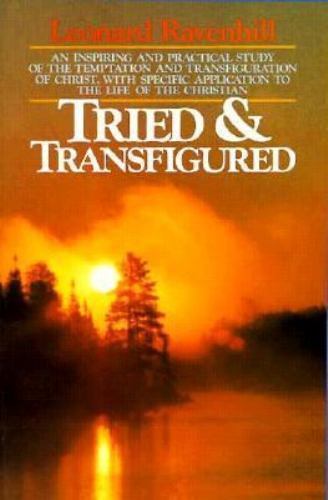
This book is broken up into two main parts. Part 1 is about the temptations of Jesus (hence the word Tried or trial in the title); and Part 2 is about the transfiguration of Jesus (hence the word Transfigured or sanctified with Spirit-baptism in the title). Most of the book is a Bible study about these experiences in Jesus’ life; and explaining what they mean. But occasionally the suggestion is drawn that Christians are to expect the same things in their own lives, in different ways. Ravenhill advances the thesis that true Christians, who are reflections of Jesus, will go through both trials (painful hardships) and temptations (pleasurable, sinful seductions) in order to prove the genuineness of their faith in God. 1 Peter 1:6-7: “In all this you greatly rejoice, though now for a little while you may have had to suffer grief in all kinds of trials. These have come so that THE PROVEN GENUINENESS OF YOUR FAITH—of greater worth than gold, which perishes even though refined by fire—may result in praise, glory and honor when Jesus Christ is revealed.” Ravenhill said, “Gold tried in a fire is of greater value than gold which still has a mixture of alloys. Gold that is shaped into an ornament has yet more value. Of still higher worth is gold purified, then shaped into a vessel, and finally beautifully engraved” (p. 64). I also think about Job 1:8-12, when Satan himself was allowed to test Job’s faith with hardships, in order to prove to the spirit world that Job feared God with no strings attached.
All kinds of trials. When thinking about Jesus, he refers to Jesus in the desert for 40 days, fasting, hungering, starving, getting challenged by the devil to make bread out of stones in order to prove to Himself that he was the Son of God (implied was a suggestion to Jesus that he was not the Son of God but illegitimate), to throw Himself down from the temple and see if the angels would come and levitate Him, and to seduce Him with worldwide religious and political authority if He would only bow down and worship the devil—perhaps an appeal to follow Roman religion and have influence in the Roman empire as a chief magician, like Jannes and Jambres were for Pharaoh (Exod. 7:22; 2 Tim. 3:8).
With each demonic vision or voice, Jesus appealed to the authority of Scripture, saying, “It is written” (Matt. 4:4, 7, 10); and after the third time “the devil left Him, and angels came and attended Him” (4:11). The angels would have come to strengthen His faith. Even Jesus needed to live by faith, because He lived as a man. So, after proving His spiritual strength by conquering bodily cravings, by shunning the vanity of materialism and earthly authority, by placing His faith verbally in Scripture all by Himself in isolation from other people, by rejecting the Dark Side of the Force and Satan’s lure to become the next Darth Vader, and by overcoming the devil in the desert unlike Adam had in the Garden—Jesus proved to the spirit world that He had authority over all evil spirits: even over Satan himself. Before the desert, there is no mention of Jesus casting out demons. But afterwards, it happened almost constantly for three years until He was crucified.
The Transfiguration: Baptism in the Holy Spirit, Empowerment to Face Even Greater Trials
When we come to the transfiguration part of the book, which is longer, we see different themes touched on. In its Introduction, conditional security is mentioned: the possibility of backsliding after mountaintop experiences with the Lord. Peter denied Jesus three times after he saw the transfiguration of Jesus (his body shining with the bright white light of the Holy Spirit), and Moses, Elijah, the bright white cloud of God, the audible voice of God, falling into a trance, feeling the fear of God (Matt. 17:1-9). Even after all of that, Peter still weakened and buckled under pressure when his life was threatened. The moral of the story is that spiritual highs in the present are no guarantee against losing your faith in the future. Salvation is by faith (Eph. 2:8); so much for the doctrine of once saved, always saved! We must keep ourselves in check, God helping us. 1 Corinthians 10:12: “So, if you think you are standing firm, be careful that you don’t fall!” Biblical scholars generally date the transfiguration one year before the crucifixion. So, after this extremely supernatural experience of God, it took about one year for Peter to backslide to the point of denying Jesus three times, when threatened with martyrdom (Matt. 26:69-75).
I was pleasantly surprised to see Ravenhill favorably refer to Evelyn Underhill’s The Mystic Way on page 81, a 400 page book on Catholic mystical theology from an Anglican perspective. At first I was a little concerned, because in her book Mysticism, she takes a pluralistic approach, mixing the religions, but in the one quoted by Ravenhill, it looks like she had cleaned up her theology and only turned to sources like Catholic saints. It was about how contemplation can lead to transfiguration or even encounters with the shekinah glory (light of the Holy Spirit): St. Francis of Assisi and St. Catherine of Bologna are mentioned as examples. I recently wrote about this in my booklet on Supernatural Lights, drawing from Alexander Golitzin’s St. Symeon the New Theologian: On the Mystical Life, vol. 3, where he shares at length about the role of shekinah glory in the life of this Greek Orthodox saint. Foreign sounding to Baptist, Pentecostal, Lutheran, Presbyterian, and other Protestant ears, but it begs the question of whether they are missing out on something due to a theological blind spot.
When referring to these mountaintop or transfiguration-like experiences, he brings it down a notch for the rest of Christianity. Not everyone is like St. Francis of Assisi, not everyone is literally going to light up like Jesus or Moses did. (Why not!?) But seriously, though, there are lower level experiences from the Holy Spirit that can follow the same pattern, following periods of trial and temptation, only to be followed by worse ones later on. Ravenhill said:
Christ’s glory-baptism on the Mount must have been a special means of ministry for His soul’s fortification. This was the entrance to a future, gloomy tunnel of soul-strain that led to the waste places of the valley of humiliation. It was a special anointing for service…Christ had this glory-baptism, this unique anointing of majesty on the Mount of Transfiguration. It was a gateway through which He began to tread the Via Dolorosa (pp. 127-128).
In other words, His transfiguration was a supernatural empowerment of confidence and divine protection, to energize Him for the greater trials that lied ahead (Matt. 17): namely, negative repercussions from cleansing the temple, persecution from politically empowered Jewish leaders in Jerusalem, Gethsemane where He sweat blood, Judas Iscariot’s betrayal and suicide, kangaroo court proceedings, mockery from Roman soldiers, the crown of thorns, Peter’s denials, beatings, scourgings, His crucifixion (definitely that), and knowing that most of His disciples did not believe He would rise from the dead (Matt. 21-28). Ravenhill also saw the transfiguration as a kind of baptism in the Holy Spirit, without speaking in tongues: and no doubt, it was: the glory cloud of the Holy Spirit was permeating the atmosphere to where you could both feel it and see it! All of them were Spirit baptized in a sense, but especially Jesus, since He shone with light. It might have been the greatest Spirit baptism He ever experienced. But by the time He’s on the cross a year later, He couldn’t feel God’s presence, and He cried, “My God, my God, why have You forsaken Me!” (Matt. 27:46). No presence of God was felt on the cross. It seems that the transfiguration baptism had all dried up by then. By the time of Gethsemane, just before the crucifixion, He needed extra encouragement from an angel (Luke 22:43). But He got there. Jesus didn’t run away, even though God told Him through Moses and Elijah what He wanted to happen. Luke 9:30-31: “There talked with Him two men, which were Moses and Elijah: who appeared in glory, and spake of His decease which He should accomplish at Jerusalem.” Does it look like I’m presenting an all-too-human Jesus to you? How human can you get…dying on a cross. That is one of the most humiliating ways to die. Compare that with the way the Pharisees probably died: with honors and respect, as rabbi-saints, respected in the community, lying on their deathbeds, blessing and prophesying to a group of loving admirers. Not Jesus. He died with probably nothing more than a loin cloth on His body, with shredded skin and muscle tissue hanging out, with huge holes in His hands and feet, gasping for His final breaths while thugs laughed at him. Jesus was and is the Son of God, but He lived as a human being and was “tempted in every way, just as we are—yet He did not sin” (Heb. 4:15). He was the Son of God yes, but he was also the Son of Man (through the virgin Mary), and that is what qualifies Him to be a mediator, or middleman, between God and humankind. But this same Jesus definitely needed encouragement from the Holy Spirit, the voice of God, saints from Heaven, and from angels sometimes! And SO DO WE!
I disagree with Ravenhill’s doctrine of entire sanctification in ch. 16, which is what he thinks the transfiguration symbolizes for the life of the believer. On the contrary, I think it more so symbolizes what we have in Acts 2:4: “All of them were filled with the Holy Spirit and began to speak in other tongues as the Spirit enabled them.” The presence of God part, more so than the tongues part, but they aren’t mutually exclusive now that we live in the Pentecostal age. But along with Wesley and all the confused Methodists and holiness people who hold to entire sanctification, Ravenhill at least said that backsliding from perfection was possible, which to me, nullifies the entire claim of the doctrine: “I am not inferring that this endowment is a kind of perpetual nonforfeitable” thing (p. 143). Well, then brother Ravenhill, I would say then that although God is omnipotent, the flesh will always remain sinful (Rom. 7:23), and only physical death will eradicate bodily sin entirely (glorification). There is no entire sanctification before death. However, SPIRIT-BAPTISMS should be the focus, because it is SPIRIT-BAPTISMS, or FEELING GOD’S PRESENCE that strengthens our faith and resolve to fight sin, when things get dry. And how do we get them? They are “maintained only by prayer and close submission to the will of God” (p. 143). Pentecostal praise and worship is a form of prayer. Bible study and faith-based obedience to Scripture is the best form of submission to God that I know of. James 4:7: “Submit yourselves, then, to God. Resist the devil, and he will flee from you.”
We have hinted that Antinomianism has had its cycles in the history of the Church. Its full development, since the Reformation, is due to John Agricola (1492-1566), one of the early coadjutors of Luther, some of whose expressions, as to justification and the law, in the heat of his great controversy with Rome, were hasty, extravagant, and quite Antinomian. These utterances Agricola developed into a system so extreme, and so subversive of Christian morals, that he published in 1537 these words: “Art thou steeped in sin–an adulterer or a thief? If thou believest, thou art in salvation. All who follow Moses must go to the devil; to the gallows with Moses.” This was the kind of tares sown in Luther’s field by a professed friend. Luther attacked him violently, calling him a fanatic, and other hard names. After Agricola’s death, Amsdorf and Otto advocated his doctrines, and maintained that good works are an obstacle to salvation. Similar sentiments were preached in England in the days of Oliver Cromwell.
But it remained for Dr. Crisp, (1600-1642), a rector of the Church of England, to give this error its full development in Anglican theology, from the seed-corn of high Calvinism. The following sentiments abound in his sermons: “The law is cruel and tyrannical, requiring what is naturally impossible.” “The sins of the elect were so imputed to Christ, as that, though He did not commit them, yet they became actually His transgressions, and ceased to be theirs. The feelings of conscience which tell them that sin is theirs, arise from a want of knowing the truth. It is but the voice of a lying spirit in the hearts of believers that saith they have yet in wasting their conscience, and lying as a burden too heavy for them to bear. Christ’s righteousness is so imputed to the elect, that they, ceasing to be sinners, are as righteous as He was, and all that He was. An elect person is not in a condemned state while an unbeliever; and should he happen to die before God calls him to believe, he would not be lost. Repentance and confession of sin are not necessary to forgiveness. A believer may certainly conclude before confession, yea, as soon as he hath committed sin, the interest he hath in Christ, and the love of Christ embracing him.”
This doctrine completely destroys the distinction between right and wrong, and removes all motives to abstain from sin. It boasts in the perseverance of the saints, while it believes in no saint but one, that is, Jesus, and neglects to persevere. Several vigorous theologians opposed this baneful doctrine, the chief of whom were Richard Baxter and Daniel Williams, who, after heroic efforts and no small suffering, finally triumphed.
…a number of unsent persons (went) preaching about…much smooth, undigested nonsense, preached up heresy, even that worst of heresies, (as not striking at the branches, but the whole root of holiness at once,) I mean antinomianism. — John Wesley
…a number of unsent men traveled about preaching smooth, undigested nonsense. They preached heresy, even that worst of heresies–antinomianism–which strikes not at the branches, but at the whole root of holiness. — paraphrase
Baxter, Richard. An Extract of Mr. Richard Baxter’s Aphorisms of Justification. Publish’d by John Wesley. Gale, 2018.
Brown, Michael. Hyper-Grace: Exposing the Dangers of the Modern Grace Message. Lake Mary, FL: Charisma House, 2014.
Do not give dogs what is sacred; do not throw your pearls to pigs. If you do, they may trample them under their feet, and turn and tear you to pieces. –Matthew 7:6–
When you are involved in theology or philosophy, there is a path of reasoning that you can pursue in which you sort out wrong ideas and right ones. This is called a theological or philosophical “argument,” and if Christians are to be involved in this, which they are, they should do so in a way that is characterized by gentleness and respect (1 Pet. 3:15). What is often called “judging,” and is condemned under the censure of “judge not, lest ye be judged” (Matt. 7:1), is often just reasoning, and is not about put-downs, insults, and the nitpicky chewing out that I think Jesus is referring to when he speaks against judging. In Matthew 7:5, just four verses after saying, “Judge not, lest ye be judged,” he says, “You hypocrite! First take the plank out of your own eye, and then you will see clearly to remove the speck from your brother’s eye!” Jesus judges the man, calling him a hypocrite, a pretender, an actor. Accusing him of being a false Christian who is merely pretending to be good, but whom on the inside, is rotten and mean-spirited. The hypocrite had a plank in his eye. He had a felony on his record currently; a capital offense presently; a mortal sin. But he had the audacity to criticize this other person who had but a speck in his eye; a misdemeanor currently; an honest mistake that anyone could make, which was easy to do; a venial sin. Matthew Henry said:
Here is a good rule for reprovers, Matthew 7:5. Go in the right method, first cast the beam out of thine own eye. Our own badness is so far from excusing us in not reproving, that our being by it rendered unfit to reprove is an aggravation of our badness; I must not say, “I have a beam in my own eye, and therefore I will not help my brother with the mote out of his.” A man’s offence will never be his defence: but I must first reform myself, that I may thereby help to reform my brother, and may qualify myself to reprove him. Note, those who blame others, ought to be blameless and harmless themselves. Those who are reprovers in the gate, reprovers by office, magistrates and ministers, are concerned to walk circumspectly, and to be very regular in their conversation: an elder must have a good report, 1 Timothy 3:2, 7. The snuffers of the sanctuary were to be of pure gold.
“A man’s offence must never be his defence.” That can’t be all he’s got to stand on to be in God’s will. What else should he have in his defense? As a criticizer, he should have this in his defense: that he bears the fruit of the Spirit: love, joy, peace, patience, kindness, goodness, faithfulness, gentleness, and self-control (Gal. 5:22-23). But if there is found in him a great amount of sexual immorality, impurity, debauchery, idolatry, witchcraft, hatred, discord, jealousy, fits of rage, selfish ambition, dissension, faction, envy, drunkenness, or orgies (Gal. 5:19-21), then you can be sure that his critiques and judgments are most likely not in line with the Holy Spirit, but coming from a natural source: the carnal, natural reasonings of the human brain, and nothing additional or divinely aided. People that get involved in theological debates are not likely involved in fornication, idolatry, drunkenness, or the occult. But they could very well have lots of baggage with demon spirits, or natural and unmortified inclinations, that tend to hatred and fighting, fits of rage, and selfish ambition.
Such people often have what I call contrary spirits. These spirits may or may not be demonic, but they basically come down to a contradictory attitude. You say white, they say black; you say green, they say red; you say left, they say right; you say up, they say down. Its not really logical or about reasoning things out intellectually. Its based on picking a fight with you, because they don’t like you, and they just want to contradict you. Jonathan Edwards said that the godly man “has a mean opinion of the contrary spirit, and that, not only in others, but in himself. He looks upon it as a dishonorable and hateful spirit.” Jesus said that contrary people are like dogs or pigs; and that you should not throw your theological pearls to them, or else they will tear you to pieces with their words (Matt. 7:6). I’ve said in another place that theologians and pastors should not censure people who ask theological questions. But at the same time, I don’t think preachers should throw their pearls to swine. The difference is obvious: an inquisitive soul will have an inquisitive, curious, and prying spirit, and might get excitable at times, but will be reasonable throughout a discussion, and the subjects that are touched upon. But a dog, or a pig-like man (pigs are dirty, aggressive animals), will only have the presence of mind to contradict you; and have not that many reasons for why, other than that they made a contrary statement against what you said. And they will make it known that they don’t like you and your views, just because they don’t. These people are not spiritual seekers, they are just troublemakers. So, I’d say Jesus would have us to ignore such troublemakers.
Puritan Capitalism vs. Adam Smith’s Agnostic Capitalism
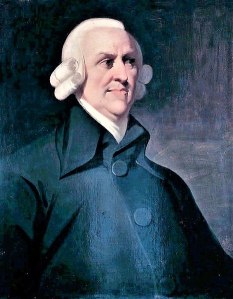
Adam Smith’s Wealth of Nations (1776) laid the philosophical foundations for what we today call capitalism. While there were truthful facts to be found in its pages, it was nothing really all that new, at least in the Puritan sense. About a century earlier, Richard Steele’s The Religious Tradesman (1684) taught Christian men to provide for their families through the virtues of diligence (hard working productivity), contentment (frugality, thrift), and retirement (which no doubt involved saving and investing). All of these things Smith continued to agree with as determinants of economic growth. But the ethical difference between Steele and Smith was very great. While Steele the Puritan taught people to temper their working lives with things such as prudence, justice, truth, and the Christian faith, Smith the agnostic and rationalistic economic philosopher, taught people to ignore Biblical ethics about money and instead be motivated completely by self-interest and competition.
Self-Interest and Competition: Shaky Motivators for Economic Growth
The vices of self-interest and competition are still found today in American business practices. No sales team is thought to be good that is not motivated by these things. Sales managers train their sales reps to be self-interested, to look out for number one, and be competitive. In so doing, by advancing the idea that “greed is good,” they motivate people with greed, with the desire for sales commissions, for more money. Maybe even with the desire for a hot car like a Lamborghini. During sales meetings they did this when I was with Lincoln Heritage Life Insurance Company. They actually motivated their sales reps to “get that Lambo,” in their pursuit of finding clients for burial insurance. Knocking on their houses door-to-door unannounced, and pressuring the elderly to buy insurance policies on the spot. Yeah, Smithian capitalism is still very much alive today: its self-interested. But its also competitive: why? Its competitive not only externally with other companies that are selling similar products (which I can’t really condemn altogether), but its competitive internally with other co-workers, in the same company, who have been assigned with the same tasks that you have. Back to sales as an example, if your sales manager wants you to sell 5 policies a week, pressure will be put on all the sales reps to reach 5 sales a week. Then when we come to the meeting at the end of the week, and it is announced by the sales manager that I made 7 sales that week, while everyone else made 3-5 sales, here we have a competition between co-workers. Now, it is always couched in terms of being a “friendly competition,” where contests and awards are given. But a lot of that is deceptive. The reality is, the best sales rep is isolated from everyone else socially; and everyone else feels jealousy and resentment about that guy, because he makes them look lazy. Not only that, the best sales rep has more money and possessions than everyone else; and in a culture of greed and self-interest, this makes them even more jealous. Smith didn’t really think that part of it through. I like what Art Gish had to say about this:
Adam Smith was wrong. Human egoism is not an adequate basis for economic development because private self-interest is seldom consistent with general social interest. When the self-serving elite control the means of production and distribution, we can expect that resources will be used for short-run profit rather than in harmony with the kingdom of God. It seems self-evident that a system built on internal competition will eventually destroy itself (Wealth and Poverty, p. 144).
Totally! Jesus said that a house divided cannot stand (Matt. 12:25). When we allow demons to enter into a company’s leadership, the company is now haunted, the business is now demon-possessed; and a house such as this will not stand for long, it’s only a matter of time. That’s why so many companies today have such outrageously high turnover rates. Nobody is content with their job: they want more money, they fear losing their jobs due to self-interested and competitive co-workers, and they try their best to assuage these fears through worldly office politics, adulterously flirting and swearing because everyone else does, and they lose their souls in the process; and most likely, still lose their jobs, because of self-interested and competitive co-workers. These vices of self-interest and competition are opposed to the Bible! The Merriam-Webster dictionary defines SELF-INTEREST as “a concern for one’s own advantage and well-being,” and further defines it with synonyms such as egocentricity, narcissism, self-absorption, self-centeredness, and selfishness. It defines COMPETITION as “a contest between rivals,” and uses synonyms such as having a bout, a contest, or a tournament. What is a bout? Its a fight. Fighting, in other words, is what capitalism is based on. That’s why competitive team sports are such an important part of American culture. Somewhere in the past, people must have decided that in order to beat their enemies in the workplace, they must first learn to beat their enemies at sports games. So lets train up a child in the way he should go. Teach him to beat an enemy senseless at football, basketball, or baseball.
Everything is about winners and losers in this economic system. But what does the Bible have to say about this? The total opposite. Jesus tells us to love our enemies: in other words, to resist and push back against the idea of having rivals and competitors (Matt. 5:44). Paul says, “Be devoted to one another in love. Honor one another above yourselves” (Rom. 12:10). But by adopting Adam Smith’s capitalism, the result is hate, all in the name of looking out for your own well-being. You have to make a choice. This might be why Jesus said, “No one can serve two masters. Either you will hate the one and love the other, or you will be devoted to the one and despise the other. You cannot serve both God and money” (Matt. 6:24). Probably because the vices of self-interest and competition are of the flesh; and have always been at the heart of business practices, even in Jesus’ day. In business, either the unrestrained love of money will win your heart, or your love for God will win. But you can’t have both. If you choose God, sure you might not make as much money as you would if you didn’t use Biblical restraints, but at least your salvation is likely intact! Philippians 2:3-4: “Do nothing out of selfish ambition or vain conceit. Rather, in humility value others above yourselves,not looking to your own interests but each of you to the interests of the others.” Could the Scripture be anymore plain than this? This command is in direct contradiction to Adam Smith’s Wealth of Nations. Do nothing out of self-ambition! No self-interest. Have humility! Rather than pride over your accomplishments, which are acquired competitively. Consider others as better than you! Don’t look out for your own interests! Look to the interests of others! “What anti-capitalistic nonsense is this?” says the modern businessman. Well, if he didn’t know who was saying it, or that it was coming from Paul’s letter to Philippians, he might not have been so quick to blaspheme the Word of God, if he is a Christian.
Take the Enron Corporation as recent example of unrestrained self-interest and internal competition among co-workers. This used to be a $100 billion natural gas company. It no longer exists. What happened? It went bankrupt through long, drawn out accounting fraud. Somebody in the accounting department got greedy and dishonest; somebody was motivated by self-interest; and somebody didn’t care a hill of beans about what happened to all of the families employed by Enron, because they were looking out for number one in the spirit of self-interest and competition with others. The house was divided, and as Jesus said, it did not stand. Oh, it stood for a while. It lasted from 1985 to 2007: a whopping 22 years. That company could have lasted for 100 years or more. But it collapsed because of self-interest, internal competition, greed, and dishonesty. That’s what happens when you don’t run a company by Biblical principles. It eventually implodes. The failure might not always be as dramatic in terms of numbers, which is why the Enron scandal attracted the attention of the media some years back, but I don’t think any business will last for very long if the Bible and Christian faith are not guiding principles among management.
Biblical Capitalism: The Journey Back to Richard Steele’s Economics
If we are followers of Jesus and Biblical principles, there must come a time when we judge Corporate America and reject its worldly ideas. Reject what your family has told you; and follow Biblical principles no matter if it costs you your job, your career, perhaps your marriage. Because even if your marriage ends for following the Bible, it is proof that it was based on money and not on Christ anyway. God calls us to Christian business activity, a Christian marriage, and a Christian family. He expects us to be different: not to compromise with the world system, but to reject self-interested and competitive business ideas, to embrace universal Christian love, giving to the poor, and above all to seek the glory of God rather than our own self-interest, and to cooperate and unify with people rather than compete with them as rivals. Acts 2:44: “All the believers were together and had everything in common.” The Amish and the Catholic monks are onto something here. When the Church becomes an economic refuge in times of crisis, there we have the opposite of Adam Smith’s views. When Christians seek to live in community, koinonia, and friendship, there we have the opposite of competition, self-interest, and rivalry. There we have the Holy Spirit, love, and joy. There is no “keeping up with the Joneses” when everyone is part of the Jones family! When all of the church “has everything in common.”
I’m not talking about atheistic communism obviously. I’m talking about Christian people sharing with one another; and enjoying each others’ company. When believers meet together in homes; and share their toys with one another; when they love, serve, and joke around with each other. This is the opposite of self-interest and competition. The opposite of pride, greed, and hate. It is the kingdom of God and is not of this world. That leaves us with Richard Steele’s Religious Tradesman, in which he taught Christians to be prudent, diligent, just, honest, content, faithful to God, and retiring. Adam Smith’s Wealth of Nations will lead us to be productive, frugal with our money, and invest (especially in farming, trucking, and manufacturing), and we can thank him for his scientific analysis of these things. But we can’t allow self-interest and competition to seep into our view of economics, because the moment we do this, is the moment we cease to be truly Christian. It is hard for me to see true Christianity as workable in any employment situation other than jobs that are solo, or in businesses that allow you to say in an interview, “I’m a Christian guy and I don’t use profanity,” or in actual Christian businesses that publicly claim to operate by Biblical principles like Interstate Batteries and Chick-fil-A. The Fellowship of Companies for Christ International (FCCI) has a $50 per month membership that anyone can join. In Augusta, Georgia, there is a Christian radio station called WAFJ and they have a job board that local companies and even a few temp agencies can post jobs on. But it is hard for me to sit here and thoughtlessly consecrate 90% of the jobs that exist out there with most other temp agencies or on Indeed.com, because they are mostly driven by self-interest and competition. Not to mention, they usually put you in the temptation of being with flirters and cussers all the time. At least its that way in the sales force, of which I’ve been a part for 5 years. Matthew 6:13: “Lead us not into temptation.” Psalm 1:1: “Blessed is the one who does not walk in step with the wicked or stand in the way that sinners take or sit in the company of mockers.” Most jobs are in companies that are filled with mockers of Christians. Whatever your job situation is though, try your hardest to avoid the demons and self-interest and competition. You will not go to Heaven if you don’t resist them. If you keep telling yourself that they are “means to an end,” then you have followed Worldly Wiseman to Carnal Policy, and you will find your end to be in Hell! (Luke 16:19-31).
Bibliography
Bauer, P. T. Dissent on Development.
Baxter, Richard. A Christian Directory, Parts 2 and 4.
Chilton, David. Productive Christians.
Foster, Richard J. Freedom of Simplicity.
Gish, Art. Wealth and Poverty.
—. Beyond the Rat Race.
MacArthur, Kathleen. The Economic Ethics of John Wesley.
Mandeville, Bernard. The Fable of the Bees. The origin of self-interested economics.
North, Gary. Puritan Economic Experiments.
Ryken, Leland. Worldly Saints: The Puritans As They Really Were.
Smith, Adam. The Wealth of Nations.
Spengler, Joseph. “Adam Smith’s Theory of Economic Growth, Parts 1 and 2.”
Steele, Richard. The Religious Tradesman.
Tawney, R. H. Religion and the Rise of Capitalism.
Weber, Max. The Protestant Ethic and the Spirit of Capitalism.
Wilbur, Charles. “The ‘New’ Economic History Re-examined.”
This is a good 10 part sermon series from a charismatic point of view on the subject of John MacArthur’s Strange Fire conference and his cessationism. The above is Part 1.
Evolutionists fallaciously think that billions of years of time makes particles-to-people evolution possible. So Teaching about Evolution and the Nature of Science presents what it claims is evidence for vast time spans. This is graphically illustrated in a chart on pages 36–37: man’s existence is in such a tiny segment at the end of a 5 billion year timeline that it has to be diagrammatically magnified twice to show up.
On the other hand, basing one’s ideas on the Bible gives a very different picture. The Bible states that man was made six days after creation, about 6,000 years ago. So a timeline of the world constructed on Biblical data would have man almost at the beginning, not the end. If we took the same 15 inch (39 cm) timeline as does Teaching about Evolution to represent the Biblical history of the earth, man would be about 1/1000 of a mm away from the beginning! Also, Christians, by definition, take the statements of Jesus Christ seriously. He said: “But from the beginning of the creation God made them male and female” (Mark 10:6), which would make sense with the proposed Biblical timeline, but is diametrically opposed to the Teaching about Evolution timeline.
This chapter analyzes rock formation and dating methods in terms of what these two competing models would predict.
The Rocks
The vast thicknesses of sedimentary rocks around the world are commonly used as evidence for vast age. First, Teaching about Evolution gives a useful definition on page 33:
Sedimentary rocks are formed when solid materials carried by wind and water accumulate in layers and then are compressed by overlying deposits. Sedimentary rocks sometimes contain fossils formed from the parts of organisms deposited along with other solid materials.
The “deep time” indoctrination comes with the statement “often reaching great thicknesses over long periods of time.” However, this goes beyond the evidence. Great thicknesses could conceivably be produced either by a little water over long periods, or a lot of water over short periods. We have already discussed how different biases can result in different interpretations of the same data, in this case the rock layers. It is a philosophical decision, not a scientific one, to prefer the former interpretation. Because sedimentation usually occurs slowly today, it is assumed that it must have always occurred slowly. If so, then the rock layers must have formed over vast ages. The philosophy that processes have always occurred at roughly constant rates (“the present is the key to the past”) is often called uniformitarianism.
Uniformitarianism was defined this way in my own university geology class in 1983, and was contrasted with catastrophism. But more recently, the word “uniformitarianism” has been applied in other contexts to mean also constancy of natural laws, sometimes called “methodological uniformitarianism,” as opposed to what some have called “substantive uniformitarianism.”
It should also be pointed out that uniformitarian geologists have long allowed for the occasional (localized) catastrophic event. However, modern historical geology grew out of this general “slow and gradual” principle, which is still the predominantly preferred framework of explanation for any geological formation. Nevertheless, the evidence for catastrophic formation is so pervasive that there is a growing body of neo-catastrophists. But because of their naturalistic bias, they prefer, of course, to reject the explanation of the Genesis (global) flood.
However, a cataclysmic globe covering (and fossil forming) flood would have eroded huge quantities of sediment, and deposited them elsewhere. Many organisms would have been buried very quickly and fossilized.
Also, recent catastrophes show that violent events like the flood described in Genesis could form many rock layers very quickly. The Mount St. Helens eruption in Washington state produced 25 feet (7.6 meters) of finely layered sediment in a single afternoon!1 And a rapidly pumped sand slurry was observed to deposit 3 to 4 feet (about 1 meter) of fine layers on a beach over an area the size of a football field. Sedimentation experiments by the creationist Guy Berthault, sometimes working with non-creationists, have shown that fine layers can form by a self-sorting mechanism during the settling of differently sized particles.2,3
In one of Berthault’s experiments, finely layered sandstone and diatomite rocks were broken into their constituent particles, and allowed to settle under running water at various speeds. It was found that the same layer thicknesses were reproduced, regardless of flow rate. This suggests that the original rock was produced by a similar self-sorting mechanism, followed by cementing of the particles together.4 The journal Nature reported similar experiments by evolutionists a decade after Berthault’s first experiments.5
So when we start from the bias that the Bible is God’s Word and is thus true, we can derive reasonable interpretations of the data. Not that every problem has been solved, but many of them have been.
Conversely, how does the “slow and gradual” explanation fare? Think how long dead organisms normally last. Scavengers and rotting normally remove all traces within weeks. Dead jellyfish normally melt away in days. Yet Teaching about Evolution has a photo of a fossil jellyfish on page 36.It clearly couldn’t have been buried slowly, but must have been buried quickly by sediments carried by water. This water would also have contained dissolved minerals, which would have caused the sediments to have been cemented together, and so hardened quickly.
The booklet Stones and Bones6 shows other fossils that must have formed rapidly. One is a 7 foot (2 m) long Ichthyosaur (extinct fish shaped marine reptile) fossilized while giving birth. Another is a fish fossilized in the middle of its lunch. And there is a vertical tree trunk that penetrates several rock layers (hence the term polystrate fossil). If the upper sedimentary layers really took millions or even hundreds of years to form, then the top of the tree trunk would have rotted away.
Ironically, NASA scientists accept that there have been “catastrophic floods” on Mars7 that carved out canyons8 although no liquid water is present today. But they deny that a global flood happened on earth, where there is enough water to cover the whole planet to a depth of 1.7 miles (2.7 km) if it were completely uniform, and even now covers 71 percent of the earth’s surface! If it weren’t for the fact that the Bible teaches it, they probably wouldn’t have any problem with a global flood on earth. This demonstrates again how the biases of scientists affect their interpretation of the evidence.
Radiometric Dating
As shown above, the evidence from the geological record is consistent with catastrophes, and there are many features that are hard to explain by slow and gradual processes. However, evolutionists point to dating methods that allegedly support deep time. The best known is radiometric dating. This is accurately described on page 35 of Teaching about Evolution:
Some elements, such as uranium, undergo radioactive decay to produce other elements. By measuring the quantities of radioactive elements and the elements into which they decay in rocks, geologists can determine how much time has elapsed since the rock has cooled from an initially molten state.
However, the deep time “determination” is an interpretation; the actual scientific data are isotope ratios. Each chemical element usually has several different forms, or isotopes, which have different masses. There are other possible interpretations, depending on the assumptions. This can be illustrated with an hourglass. When it is upended, sand flows from the top container to the bottom one at a rate that can be measured. If we observe an hourglass with the sand still flowing, we can determine how long ago it was upended from the quantities of sand in both containers and the flow rate. Or can we? First, we must assume three things:
An hourglass “clock” tells us the elapsed time by comparing the amount of sand in the top bowl (“Parent”) with the amount in the bottom bowl (“Daughter”).
1. We know the quantities of sand in both containers at the start. Normally, an hourglass is upended when the top container is empty. But if this were not so, then it would take less time for the sand to fill the new bottom container to a particular level.
2. The rate has stayed constant. For example, if the sand had become damp recently, it would flow more slowly now than in the past. If the flow were greater in the past, it would take less time for the sand to reach a certain level than it would if the sand had always flowed at the present rate.
3. The system has remained closed. That is, no sand has been added or removed from either container. However, suppose that, without your knowledge, sand had been added to the bottom container, or removed from the top container. Then if you calculated the time since the last upending by measuring the sand in both containers, it would be longer than the actual time.
Teaching about Evolution addresses assumption 2:
For example, it requires that the rate of radioactive decay is constant over time and is not influenced by such factors as temperature and pressure—conclusions supported by extensive research in physics.
It is true that in today’s world, radioactive decay rates seem constant, and are unaffected by heat or pressure. However, we have tested decay rates for only about 100 years, so we can’t be sure that they were constant over the alleged billions of years. Physicist Dr. Russell Humphreys suggests that decay rates were faster during creation week, and have remained constant since then. There is some basis for this, for example radiohalo analysis, but it is still tentative.
Teaching about Evolution also addresses assumption 3:
It also assumes that the rocks being analyzed have not been altered over time by migration of atoms in or out of the rocks, which requires detailed information from both the geologic and chemical sciences.
This is a huge assumption. Potassium and uranium, both common parent elements, are easily dissolved in water, so could be leached out of rocks. Argon, produced by decay from potassium, is a gas, so moves quite readily.
Anomalies
There are many examples where the dating methods give “dates” that are wrong for rocks of known historical age. One example is rock from a dacite lava dome at Mount St. Helens volcano. Although we know the rock was formed in 1986, the rock was “dated” by the potassium argon (K-Ar) method as 0.35 ± 0.05 million years old.9 Another example is K-Ar “dating” of five andesite lava flows from Mt Ngauruhoe in New Zealand. The “dates” ranged from < 0.27 to 3.5 million years—but one lava flow occurred in 1949, three in 1954, and one in 1975!
What happened was that excess radiogenic argon (40Ar*) from the magma (molten rock) was retained in the rock when it solidified. The secular scientific literature also lists many examples of excess 40Ar* causing “dates” of millions of years in rocks of known historical age. This excess appears to have come from the upper mantle, below the earth’s crust. This is consistent with a young world—the argon has had too little time to escape.10
If excess 40Ar* can cause exaggerated dates for rocks of known age, then why should we trust the method for rocks of unknown age?
Another problem is the conflicting dates between different methods. If two methods disagree, then at least one of them must be wrong. For example, in Australia, some wood was buried by a basalt lava flow, as can be seen from the charring. The wood was “dated” by radiocarbon (14C) analysis at about 45,000 years old, but the basalt was “dated” by the K-Ar method at c. 45 million years old!11 Other fossil wood from Upper Permian rock layers has been found with 14C still present. Detectable 14C would have all disintegrated if the wood were really older than 50,000 years, let alone the 250 million years that evolutionists assign to these Upper Permian rock layers.12[Update: see also Radiometric dating breakthroughs for more examples of 14C in coal and diamonds, allegedly millions of years old.]
According to the Bible’s chronology, great age cannot be the true cause of the observed isotope ratios. Anomalies like the above are good supporting evidence, but we are not yet sure of the true cause in all cases. A group of creationist Ph.D. geologists and physicists from the Creation Research Society and the Institute for Creation Research are currently working on this topic. Their aim is to find out the precise geochemical and/or geophysical causes of the observed isotope ratios.13 One promising lead is questioning Assumption 1—the initial conditions are not what the evolutionists think, but are affected, for example, by the chemistry of the rock that melted to form the magma. [Update: it turned out that Assumption 2 was the most vulnerable, with strong evidence that decay rates were much faster in the past. See the results of their experiments in Radioisotopes & the Age of the Earth volumes 1 and 2.]
Evidence for a Young World
Actually, 90 percent of the methods that have been used to estimate the age of the earth point to an age far less than the billions of years asserted by evolutionists. A few of them:
Red blood cells and hemoglobin have been found in some (unfossilized!) dinosaur bone. But these could not last more than a few thousand years—certainly not the 65 million years from when evolutionists think the last dinosaur lived.14
The earth’s magnetic field has been decaying so fast that it couldn’t be more than about 10,000 years old. Rapid reversals during the flood year and fluctuations shortly after just caused the field energy to drop even faster.15
Helium is pouring into the atmosphere from radioactive decay, but not much is escaping. But the total amount in the atmosphere is only 1/2000 of that expected if the atmosphere were really billions of years old. This helium originally escaped from rocks. This happens quite fast, yet so much helium is still in some rocks that it couldn’t have had time to escape—certainly not billions of years.16
A supernova is an explosion of a massive star—the explosion is so bright that it briefly outshines the rest of the galaxy. The supernova remnants (SNRs) should keep expanding for hundreds of thousands of years, according to the physical equations. Yet there are no very old, widely expanded (Stage 3) SNRs, and few moderately old (Stage 2) ones in our galaxy, the Milky Way, or in its satellite galaxies, the Magellanic clouds. This is just what we would expect if these galaxies had not existed long enough for wide expansion.17
The moon is slowly receding from earth at about 1½ inches (4 cm) per year, and the rate would have been greater in the past. But even if the moon had started receding from being in contact with the earth, it would have taken only 1.37 billion years to reach its present distance. This gives a maximum possible age of the moon—not the actual age. This is far too young for evolution (and much younger than the radiometric “dates” assigned to moon rocks).18
Salt is pouring into the sea much faster than it is escaping. The sea is not nearly salty enough for this to have been happening for billions of years. Even granting generous assumptions to evolutionists, the seas could not be more than 62 million years old—far younger than the billions of years believed by evolutionists. Again, this indicates a maximum age, not the actual age.19
Creationists admit that they can’t prove the age of the earth using a particular scientific method. They realize that all science is tentative because we do not have all the data, especially when dealing with the past. This is true of both creationist and evolutionist scientific arguments—evolutionists have had to abandon many “proofs” for evolution as well. For example, the atheistic evolutionist W. B. Provine admits: “Most of what I learned of the field in graduate (1964–68) school is either wrong or significantly changed.”20Creationists understand the limitations of these dating methods better than evolutionists who claim that they can use certain present processes to “prove” that the earth is billions of years old. In reality, all age dating methods, including those which point to a young earth, rely on unprovable assumptions.
Creationists ultimately date the earth using the chronology of the Bible. This is because they believe that this is an accurate eyewitness account of world history, which can be shown to be consistent with much data.
Addendum: John Woodmorappe has published a detailed study demonstrating the fallacy of radiometric “dating,” including the “high-tech” isochron method: The Mythology of Modern Dating Methods (El Cajon, CA: Institute for Creation Research, 1999).
References and Notes
1. S. A. Austin, Mount St. Helens and catastrophism, Proceedings of the First International Conference on Creationism, 1:3–9, ed. R. E. Walsh, R. S. Crowell, Creation Science Fellowship, Pittsburgh, PA, USA, 1986; for a simplified article, see Ken Ham, I got excited at Mount St Helens! Creation 15 (3):14–19, June–August 1993. Return to text.
5. H. A. Makse, S. Havlin, P. R. King, and H. E. Stanley, Spontaneous stratification in granular mixtures, Nature 386 (6623):379–382, 27 March 1997. See also A. Snelling, Sedimentation experiments: Nature finally catches up!Journal of Creation 11 (2):125–6, 1997. Return to text.
10. A. A. Snelling, The cause of anomalous potassium argon “ages” for recent andesite flows at Mt. Ngauruhoe, New Zealand, and the Implications for potassium argon “dating,” Proceedings of the Fourth International Conference on Creationism, Creation Science Fellowship, Pittsburgh, ed. E. Walsh, 1998, p. 503–525. This document lists many examples. For example, six were reported by D. Krummenacher, Isotopic composition of argon in modern surface rocks, Earth and Planetary Science Letters 8 (2):109–117, April 1970; five were reported by G. B. Dalrymple, 40Ar/36Ar analysis of historic lava flows, Earth and Planetary Science Letters 6 (1):47–55, 1969. Also, a large excess was reported in D. E. Fisher, Excess rare gases in a subaerial basalt from Nigeria, Nature Physical Science 232 (29):60–61, 19 July 1971. Return to text.
13. Institute for Creation Research, Acts and Facts 27 (7), July 1998. Return to text.
14. C. Wieland, Sensational dinosaur blood report!Creation 19 (4):42–43, September–November 1997; based on research by M. Schweitzer and T. Staedter, The real Jurassic Park, Earth, June 1997, p. 55–57. [Update: see Squirming at the Squishosaur and the linked articles for more recent evidence of elastic blood vessels in T. rex bones.] Return to text.
15. D. R. Humphreys, Reversals of the Earth’s Magnetic Field During the Genesis Flood, Proceedings of the First International Conference on Creationism, vol. 2 (Pittsburgh, PA: Creation Science Fellowship, 1986), p. 113–126; J. D. Sarfati, The earth’s magnetic field: evidence that the earth is young, Creation 20 (2):15–19, March–May 1998. Return to text.
18. D. DeYoung, The Earth-Moon System, Proceedings of the Second International Conference on Creationism, vol. 2, ed. R. E. Walsh and C. L. Brooks, 1990, 79–84; J. D. Sarfati, The moon: the light that rules the night, Creation 20 (4):36–39, September–November 1998. Return to text.
20. Teaching about Evolution and the Nature of Science, A Review by Dr. Will B. Provine; available online from fp.bio.utk.edu/darwin/NAS_guidebook/provine_1.html. (cited 18 February 1999).


 With each demonic vision or voice, Jesus appealed to the authority of Scripture, saying, “It is written” (Matt. 4:4, 7, 10); and after the third time “the devil left Him, and angels came and attended Him” (4:11). The angels would have come to strengthen His faith. Even Jesus needed to live by faith, because He lived as a man. So, after proving His spiritual strength by conquering bodily cravings, by shunning the vanity of materialism and earthly authority, by placing His faith verbally in Scripture all by Himself in isolation from other people, by rejecting the Dark Side of the Force and Satan’s lure to become the next Darth Vader, and by overcoming the devil in the desert unlike Adam had in the Garden—Jesus proved to the spirit world that He had authority over all evil spirits: even over Satan himself. Before the desert, there is no mention of Jesus casting out demons. But afterwards, it happened almost constantly for three years until He was crucified.

 When you are involved in theology or philosophy, there is a path of reasoning that you can pursue in which you sort out wrong ideas and right ones. This is called a theological or philosophical “argument,” and if Christians are to be involved in this, which they are, they should do so in a way that is characterized by gentleness and respect (1 Pet. 3:15). What is often called “judging,” and is condemned under the censure of “judge not, lest ye be judged” (Matt. 7:1), is often just reasoning, and is not about put-downs, insults, and the nitpicky chewing out that I think Jesus is referring to when he speaks against judging. In Matthew 7:5, just four verses after saying, “Judge not, lest ye be judged,” he says, “You hypocrite! First take the plank out of your own eye, and then you will see clearly to remove the speck from your brother’s eye!” Jesus judges the man, calling him a hypocrite, a pretender, an actor. Accusing him of being a false Christian who is merely pretending to be good, but whom on the inside, is rotten and mean-spirited. The hypocrite had a plank in his eye. He had a felony on his record currently; a capital offense presently; a mortal sin. But he had the audacity to criticize this other person who had but a speck in his eye; a misdemeanor currently; an honest mistake that anyone could make, which was easy to do; a venial sin. Matthew Henry said:
 Adam Smith’s Wealth of Nations (1776) laid the philosophical foundations for what we today call capitalism. While there were truthful facts to be found in its pages, it was nothing really all that new, at least in the Puritan sense. About a century earlier, Richard Steele’s The Religious Tradesman (1684) taught Christian men to provide for their families through the virtues of diligence (hard working productivity), contentment (frugality, thrift), and retirement (which no doubt involved saving and investing). All of these things Smith continued to agree with as determinants of economic growth. But the ethical difference between Steele and Smith was very great. While Steele the Puritan taught people to temper their working lives with things such as prudence, justice, truth, and the Christian faith, Smith the agnostic and rationalistic economic philosopher, taught people to ignore Biblical ethics about money and instead be motivated completely by self-interest and competition.
 Take the Enron Corporation as recent example of unrestrained self-interest and internal competition among co-workers. This used to be a $100 billion natural gas company. It no longer exists. What happened? It went bankrupt through long, drawn out accounting fraud. Somebody in the accounting department got greedy and dishonest; somebody was motivated by self-interest; and somebody didn’t care a hill of beans about what happened to all of the families employed by Enron, because they were looking out for number one in the spirit of self-interest and competition with others. The house was divided, and as Jesus said, it did not stand. Oh, it stood for a while. It lasted from 1985 to 2007: a whopping 22 years. That company could have lasted for 100 years or more. But it collapsed because of self-interest, internal competition, greed, and dishonesty. That’s what happens when you don’t run a company by Biblical principles. It eventually implodes. The failure might not always be as dramatic in terms of numbers, which is why the Enron scandal attracted the attention of the media some years back, but I don’t think any business will last for very long if the Bible and Christian faith are not guiding principles among management.
 If we are followers of Jesus and Biblical principles, there must come a time when we judge Corporate America and reject its worldly ideas. Reject what your family has told you; and follow Biblical principles no matter if it costs you your job, your career, perhaps your marriage. Because even if your marriage ends for following the Bible, it is proof that it was based on money and not on Christ anyway. God calls us to Christian business activity, a Christian marriage, and a Christian family. He expects us to be different: not to compromise with the world system, but to reject self-interested and competitive business ideas, to embrace universal Christian love, giving to the poor, and above all to seek the glory of God rather than our own self-interest, and to cooperate and unify with people rather than compete with them as rivals. Acts 2:44: “All the believers were together and had everything in common.” The Amish and the Catholic monks are onto something here. When the Church becomes an economic refuge in times of crisis, there we have the opposite of Adam Smith’s views. When Christians seek to live in community, koinonia, and friendship, there we have the opposite of competition, self-interest, and rivalry. There we have the Holy Spirit, love, and joy. There is no “keeping up with the Joneses” when everyone is part of the Jones family! When all of the church “has everything in common.”