Do nothing out of selfish ambition or vain conceit. Rather, in humility value others above yourselves, not looking to your own interests but each of you to the interests of the others. –Philippians 2:3-4
Anyone who hates a brother or sister is a murderer, and you know that no murderer has eternal life residing in him. –1 John 3:15
Starting a quarrel is like breaching a dam; so drop the matter before a dispute breaks out. –Proverbs 17:14
“Your name will no longer be Jacob,” the man told him. “From now on you will be called Israel, because you have fought with God and with men and have won.” –God in Genesis 32:28 (NLT)
The fruit of the Spirit is love, joy, peace, forbearance, kindness, goodness, faithfulness, gentleness and self-control. Against such things there is no law. –Galatians 5:22-23
—
Richard Baxter, “Directions About Sports and Recreations,” A Christian Directory.
GotQuestions.org, “What does it mean to do nothing out of selfish ambition or vain conceit (Philippians 2:3)?”
In Scripture, predestination is usually expressed generally to the body of Christ, and never to a living individual: it was always God’s plan, before the foundation of the world, to make the Gospel a part of human experience. But it is not sound to draw assurance of salvation from this doctrine. Scripture exhorts us to make our calling and election sure, because only God knows the elect. Election means that God foresees those particular saints who will persevere to the end of their lives with repentant faith in Christ; and it is these saints whom God will choose out of mankind for eternal salvation. The most Calvinistic sounding passage in the Bible is Romans 9:6-29. In this passage, the apostle Paul cites some examples of a few individuals: Jacob as the elect and Esau as the reprobate; and then Moses as the elect and Pharaoh as the reprobate. In this passage he refers to the prevenient grace of God drawing Jacob and Moses to faith by the activity of his Spirit. This does not mean that the Spirit put forth no effort to draw Esau and Pharaoh to God. In fact, the ten plagues of Egypt are evidence enough that God cared about Pharaoh’s salvation. Many of the Egyptians came to believe in God because of those plagues, but Pharaoh refused to believe. He said, “Who is the Lord, that I should obey him and let Israel go? I do not know the Lord and I will not let Israel go.” His own unreasonable and personal resistance to the Holy Spirit, much like the stubborn Pharisees whom Stephen rebuked, allowed his heart to become hardened, and drove the Holy Spirit away from him, in the same way that “the Spirit of the Lord had departed from Saul,” and allowed it to be fairly said that God has “mercy on whom he wants to have mercy, and he hardens whom he wants to harden.”
God does not arbitrarily force his Spirit into some and pass by or overlook others. There is not one clear teaching of double predestination in all the Bible. Peter used to believe that the Jews were God’s chosen people; and that they had a special salvation status when compared with the Gentiles; but after receiving a vision, he changed his mind and said, “I now realize how true it is that God does not show favoritism.” We only wish it were the same way with high Calvinists who continue to assert such a favoritistic notion with their doctrine of election. They take this from the Westminster Confession 3.7, which says, “The rest of mankind, God was pleased, according to the unsearchable counsel of His own will, whereby He extendeth or withholdeth mercy as He pleaseth, for the glory of His sovereign power over His creatures, to pass by, and to ordain them to dishonor and wrath for their sin, to the praise of His glorious justice.” They support this view with several Scriptures, among which is Romans 9:21-22: “Does not the potter have the right to make out of the same lump of clay some pottery for special purposes and some for common use? What if God, although choosing to show his wrath and make his power known, bore with great patience the objects of his wrath—prepared for destruction?” The Arminian understands that Paul was only using rhetorical questions, hypothesis, and conjecture here. Notice his use of “what if God” (Gk. ei de thelo ho theos), which shows that he was suggesting to his readers, “What if double predestination were in reality the way that God relates to mankind? I’m not saying that it is, but what if it was? Well, if that were the case, then people should still have an attitude of reverence to submit themselves to the will of God, and not be argumentative and just godlessly chatter against what has been revealed in Scripture.”
However, the apostle Paul did not say that double predestination is a revelation from God. He only brought up the concept as a philosophical response, to those who would irreverently chatter against the Biblical revelation that God decides to judge and send some people to Hell for their sinfulness. There is not one clear revelation in all of Scripture which states that God passes some people by, and “ordains them to dishonor and wrath,” as it says in the Westminster Confession. Such a view of God is monstrous, unjust, unfair, unloving, and completely unreasonable. Biblical election may be a personal experience. It might be possible for the elect to identify themselves as those who feel the presence of God and have true faith in the Gospel: compared with everyone else, whose minds are filled with skepticism, rationalism, and always rely on natural explanations for supernatural occurrences and miracles (Romans 8:28-30; Ephesians 1:4-5, 11; 2 Peter 1:10; 3:9; Hebrews 12:14; Matthew 24:13; Acts 13:48; 2 Timothy 1:9; Revelation 13:8; Exodus 5:2; 11:3; 12:33; Acts 7:51; 1 Samuel 16:14; Romans 2:11; Acts 10:34; WCF 3.7).
“Woe to me!” I cried. “I am ruined! For I am a man of unclean lips, and I live among a people of unclean lips, and my eyes have seen the King, the Lord Almighty.”Then one of the seraphim flew to me with a live coal in his hand, which he had taken with tongs from the altar. With it he touched my mouth and said, “See, this has touched your lips; your guilt is taken away and your sin atoned for.” –Isaiah 6:5-7
I have been crucified with Christ and I no longer live, but Christ lives in me. –Galatians 2:20
I bear on my body the marks of Jesus. –Galatians 6:17
We do not want you to be uninformed, brothers and sisters, about the troubles we experienced in the province of Asia. We were under great pressure, far beyond our ability to endure, so that we despaired of life itself.Indeed, we felt we had received the sentence of death. But this happened that we might not rely on ourselves but on God, who raises the dead. –2 Corinthians 1:8-9
Endure hardship as discipline; God is treating you as his children. –Hebrews 12:7
The Lord said to Satan, “Have you considered my servant Job? There is no one on earth like him; he is blameless and upright, a man who fears God and shuns evil.”“Does Job fear God for nothing?” Satan replied. “Have you not put a hedge around him and his household and everything he has? You have blessed the work of his hands, so that his flocks and herds are spread throughout the land. But now stretch out your hand and strike everything he has, and he will surely curse you to your face.” The Lord said to Satan, “Very well, then, everything he has is in your power, but on the man himself do not lay a finger.” –Job 1:8-12
—
Joan Carroll Cruz, Mysteries Marvels Miracles, ch. 16.
Herbert Thurston, The Physical Phenomena of Mysticism, ch. 2.
Go into all the world and preach the Gospel to every creature. –Mark 16:15
I said, I will not make mention of him, nor speak any more in his name. But his Word was in mine heart as a burning fire shut up in my bones, and I was weary with forbearing, and I could not stay. –Jeremiah 20:9 (KJV)
We cannot help speaking about what we have seen and heard. –Acts 4:20 (NIV)
The righteous are bold as a lion. –Proverbs 28:1 (KJV)
When they saw the boldness of Peter and John, and perceived that they were unlearned and ignorant men, they marvelled; and they took knowledge of them, that they had been with Jesus. –Acts 4:13
Now, Lord, behold their threatenings: and grant unto thy servants, that with all boldness they may speak thy word…And when they had prayed, the place was shaken where they were assembled together; and they were all filled with the Holy Ghost, and they spake the word of God with boldness. –Acts 4:29, 31
No one takes this honor for himself, but only when called by God. –Hebrews 5:4
Christ himself gave the apostles, the prophets, the evangelists, the pastors and teachers. –Ephesians 4:11
The gifts and the calling of God are irrevocable. –Romans 11:29
Preach the Word; be ready in season and out of season; reprove, rebuke, and exhort, with complete patience and teaching. –2 Timothy 4:2
Before I formed you in the womb I knew you, and before you were born I consecrated you; I appointed you a prophet to the nations. –Jeremiah 1:5
Because you are lukewarm—neither hot nor cold—I am about to spit you out of my mouth. –Revelation 3:16 (NIV)
Never be lacking in zeal, but keep your spiritual fervor, serving the Lord. –Romans 12:11 (NIV)
You belong to your father, the devil, and you want to carry out your father’s desires. He was a murderer from the beginning, not holding to the truth, for there is no truth in him. When he lies, he speaks his native language, for he is a liar and the father of lies. –John 8:44 (Jesus rebukes the lukewarm pastors of his times, the Pharisees)
Don’t we have the right to take a believing wife along with us, as do the other apostles and the Lord’s brothers and Cephas? –1 Corinthians 9:5 (NIV)
In his book The Purpose Driven Life and in his video series 40 Days of Purpose, he does not give a clear Gospel. As a matter of fact, the gospel that he does give is very weak, and very watered-down, and this is alarming to people: many of them who went through the series, who do not know Jesus Christ, and don’t know the true Gospel. –Gary Gilley, “Rick Warren Exposed (Documentary)” (10:33 – 10:52)
The Comforter (Gk. parakletos, helper), which is the Holy Ghost. –John 14:26 (KJV)
But to which of the angels said he at any time, Sit on my right hand, until I make thine enemies thy footstool?Are they not all ministering (Gk. leitourgikós, serving, helping) spirits, sent forth to minister for them who shall be heirs of salvation? –Hebrews 1:13-14 (KJV)
O Timothy, keep that which is committed to thy trust, avoiding profane and vain babblings, and oppositions of science falsely so called. –1 Timothy 6:20 (KJV)
Be ye not unequally yoked together with unbelievers: for what fellowship hath righteousness with unrighteousness? and what communion hath light with darkness?And what concord hath Christ with Belial? or what part hath he that believeth with an infidel?And what agreement hath the temple of God with idols? for ye are the temple of the living God; as God hath said, I will dwell in them, and walk in them; and I will be their God, and they shall be my people.Wherefore come out from among them, and be ye separate, saith the Lord, and touch not the unclean thing; and I will receive you.And will be a Father unto you, and ye shall be my sons and daughters, saith the Lord Almighty. –2 Corinthians 6:14-18 (KJV)
From whence come wars and fightings among you? come they not hence, even of your lusts that war in your members?Ye lust, and have not: ye kill, and desire to have, and cannot obtain: ye fight and war, yet ye have not, because ye ask not.Ye ask, and receive not, because ye ask amiss, that ye may consume it upon your lusts.Ye adulterers and adulteresses, know ye not that the friendship of the world is enmity with God? whosoever therefore will be a friend of the world is the enemy of God.Do ye think that the scripture saith in vain, The spirit that dwelleth in us lusteth to envy?But he giveth more grace. Wherefore he saith, God resisteth the proud, but giveth grace unto the humble.Submit yourselves therefore to God. Resist the devil, and he will flee from you.Draw nigh to God, and he will draw nigh to you. Cleanse your hands, ye sinners; and purify your hearts, ye double minded. –James 4:1-8 (KJV)
“Come out from among them,” God says! And then we have the promise of God that He will receive us, He will be to us a Father and we shall be truly His sons and daughters. If you want the joy of the Spirit’s presence, the joy of unbroken fellowship with God, then break your yoke with unbelievers today. Come out and be separate and God will bless you. –John R. Rice, The Unequal Yoke, p. 13.
An idle time wasting sensual sporter, every one should look on with pity as a miserable wretch. –Richard Baxter
—
Ken Ham, “Young Earth Creationism,” Creation, Evolution, and Intelligent Design.
Paul Nelson, “Young Earth Creationism,” Three Views on Creation and Evolution.
R. A. Torrey, ed. The Fundamentals: A Testimony to the Truth (Baker, 4 vols).
The natural man receiveth not the things of the Spirit of God: for they are foolishness unto him: neither can he know them, because they are spiritually discerned. –1 Corinthians 2:14 (KJV)
Even the Spirit of truth; whom the world cannot receive, because it seeth him not, neither knoweth him: but ye know him; for he dwelleth with you, and shall be in you. –John 14:17 (KJV)
The god of this world hath blinded the minds of them which believe not. –2 Corinthians 4:4 (KJV)
Trust in the Lord with all thine heart; and lean not unto thine own understanding. –Proverbs 3:5 (KJV)
The wrath of God is revealed from heaven against all ungodliness and unrighteousness of men, who hold the truth in unrighteousness. Because that which may be known of God is manifest in them; for God hath shewed it unto them. For the invisible things of him from the creation of the world are clearly seen, being understood by the things that are made, even his eternal power and Godhead; so that they are without excuse. –Romans 1:18-20 (KJV)
—
Josh McDowell, Answers to Tough Questions Skeptics Ask About the Christian Faith.
Norman Geisler, When Skeptics Ask.
Craig Keener, Miracles (2 vols).
Kathryn Kuhlman, I Believe in Miracles (256 pgs, Prentice Hall).
—. Captain LeVrier Believes in Miracles (87 pgs, Bethany Fellowship).
James Randi, The Faith Healers (318 pgs, an atheist book aimed at debunking healings).
John MacArthur, Charismatic Chaos (quotes Randi on p. 255; naturalistic borrowing).
Jack Deere, Surprised by the Power of the Spirit. (refutes MacArthur).
—. Why I Am Still Surprised by the Power of the Spirit. (refutes MacArthur).
O Timothy, keep that which is committed to thy trust, avoiding profane and vain babblings, and oppositions of science falsely so called: which some professing have erred concerning the faith. –1 Timothy 6:20-21 (KJV)
The fool hath said in his heart, “There is no God.” They are corrupt, they have done abominable works, there is none that doeth good. –Psalm 14:1 (KJV)
All Scripture is given by inspiration of God, and is profitable for doctrine, for reproof, for correction, for instruction in righteousness: that the man of God may be perfect, thoroughly furnished unto all good works. –2 Timothy 3:16-17 (KJV)
No prophecy of the Scripture is of any private interpretation. For the prophecy came not in old time by the will of man: but holy men of God spake as they were moved by the Holy Ghost. –2 Peter 1:20-21 (KJV)
Strangers from the covenants of promise, having no hope, and without God in the world. –Ephesians 2:12 (KJV)
The wicked, through the pride of his countenance, will not seek after God: God is not in all his thoughts. –Psalm 10:4 (KJV)
Having the understanding darkened, being alienated from the life of God through the ignorance that is in them, because of the blindness of their heart: who being past feeling have given themselves over unto lasciviousness, to work all uncleanness with greediness. –Ephesians 4:18-19 (KJV)
The natural man receiveth not the things of the Spirit of God: for they are foolishness unto him: neither can he know them, because they are spiritually discerned. –1 Corinthians 2:14 (KJV)
—
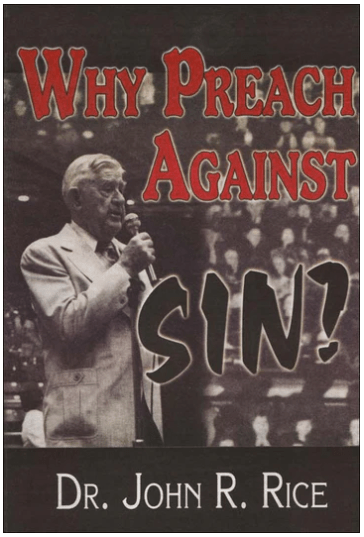
Dr. Rice will show you in this pamphlet why preachers ought to preach against sin; first, because Christians are against sin; second, because to preach all the Bible one must preach against sin; third, because the Bible plainly commands this; fourth, because of Jesus’ example; and fifth, because it brings revival.
Preach on booze. Preach on the scarlet sin, adultery…Preach on the dance, tell people that it is rotten as sin…Preach on the movies…made by vile, lewd people, holding up rotten moral standards, breaking down respect for marriage, pure love, hard work, God and the Bible…Preach against lodges…Preach against evolution and false cults. Preach on death, sin, Hell, judgment! Such preaching with boldness, with love, with tears, with Scripture, with faith, will bring great revivals, will save hardened sinners. –John R. Rice
—
R. Albert Mohler, “When the Bible Speaks, God Speaks,” Five Views on Biblical Inerrancy.
John R. Rice, Hell–What the Bible Says About It.
—. The Last Judgment of the Unsaved Dead.
—. Evolution or the Bible–Which?
—. Why Preach Against Sin?
Hugh Pyle, The Truth About Homosexuals.
David Meunier, Why I Can’t Be a Theistic Evolutionist.
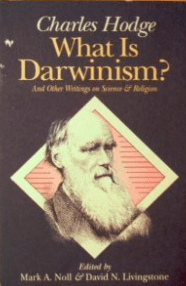
Charles Hodge, What Is Darwinism? (warning: rejects evolution, but not young earth).
Ken Ham, “Young Earth Creationism,” Creation, Evolution, and Intelligent Design.
R. A. Torrey, ed. The Fundamentals: A Testimony to the Truth (Baker, 4 vols).
Evan Howard, “Evangelical Spirituality,” Four Views on Christian Spirituality.
Denny Burk, “Eternal Conscious Torment,” Four Views on Hell.
Kerby Anderson, A Biblical Point of View on Homosexuality.
R. Douglas Geivett, “Particularist View: Evidentialist Approach,” Four Views on Salvation.
John MacArthur, Ashamed of the Gospel (against the seeker-sensitive movement).
Josh McDowell, More Than a Carpenter.
—. The New Evidence That Demands a Verdict.
—. A Ready Defense.
—. Evidence for Christianity.
—. Handbook of Today’s Religions.
W. G. T. Shedd, Dogmatic Theology (Calvinist soteriology). NOTE: Useful in lots of ways, but unfortunately he supports theistic evolution. Might be well balanced out by Charles Hodge’s Systematic Theology which is against evolution in all forms.
John Gerstner, Jonathan Edwards: A Mini-Theology (Calvinist soteriology).
Harald Lindstrom, Wesley and Sanctification (Wesleyan soteriology).
Kenneth J. Collins, Wesley on Salvation (Wesleyan soteriology).
—
Arianism – of or relating to Arius or his doctrines especially that the Son is not of the same substance as the Father but was created as an agent for creating the world. –Merriam-Webster dictionary
Socinianism – an adherent of a 16th and 17th century theological movement professing belief in God and adherence to the Christian Scriptures but denying the divinity of Christ and consequently denying the Trinity. –Merriam-Webster dictionary
Thou wilt keep him in perfect peace, whose mind is stayed on thee. –Isaiah 26:3 (KJV)
I was in the city of Joppa praying: and in a trance I saw a vision. –Acts 11:5 (KJV) (Peter’s vision)
And it came to pass, that, when I was come again to Jerusalem, even while I prayed in the temple, I was in a trance;and saw him saying unto me, Make haste, and get thee quickly out of Jerusalem: for they will not receive thy testimony concerning me. –Acts 22:17-18 (KJV) (Paul’s vision)
And when he had spoken these things, while they beheld, he was taken up; and a cloud received him out of their sight. –Acts 1:9 (KJV)
When Peter was come down out of the ship, he walked on the water, to go to Jesus. –Matthew 14:29 (KJV)
Did not our heart burn within us, while he talked with us by the way, and while he opened to us the Scriptures? –Luke 24:32 (KJV)
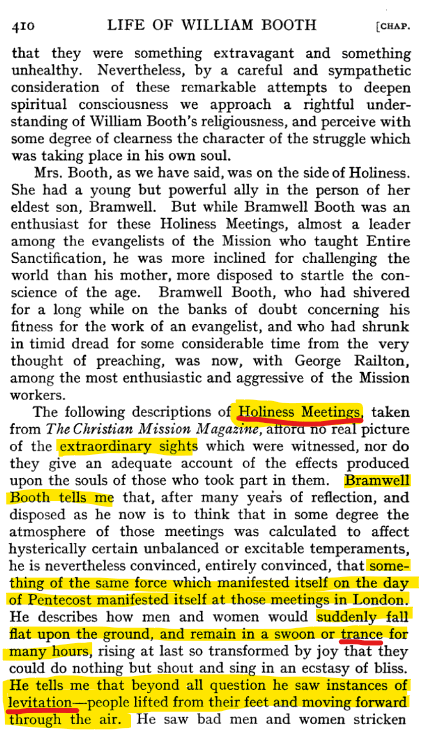
The Holy Ghost would take hold of men on the back seat and lift them bodily over the congregation and drop them at the altar. I’ve said to Pentecostals, “If you saw that, you’d run for the door, you’d say its spiritism or something.” –Leonard Ravenhill on William Booth’s prayer meetings (video below: 2:24)
Joan Carroll Cruz, Mysteries Marvels Miracles: In the Lives of the Saints, ch. 2, 12.
Herbert Thurston, The Physical Phenomena of Mysticism, chs. 1, 8.




 WesleyGospel Ministries