
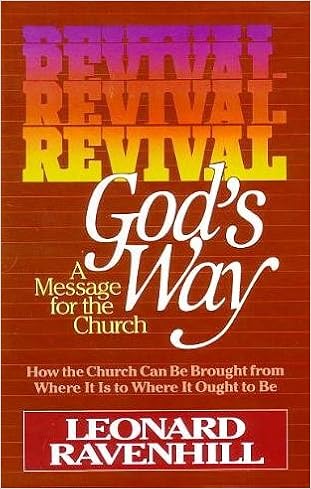
Leonard Ravenhill was a man of God; and in my estimation a saint. Some have gone so far as calling him a prophet, and maybe he was. He was not the type of person to have tons of dreams and visions; or share prophecies and supernatural words of knowledge, but I think its possible he had moments like that, since in this book he at least expresses sympathy for those things (pp. 102-103). If anything, he was what you might call an intercessor. Aside from that label, I’d say he was a revivalist and an evangelist. He represented the Wesleyan holiness tradition until his death in 1994; and he was and still is the best modern holiness preacher, in my view. But as an intercessor, he was absorbed with the idea of prayer and the practice of it. Prayer was everything to him, especially the kind taught by E. M. Bounds, who although he doesn’t mention him in this book, he did compile some of his writings in A Treasury of Prayer. I personally believe that his intercessions for national revival, which spanned over many years, were finally answered after he died in 1994. Steve Hill was mentored by him in his final days, and both of them led the Brownsville Revival, which was national, involved several million people, was mentioned in The New York Times, and lasted from 1995 to 2000, until it was shut down by Pharisees in the Assemblies of God, who didn’t like people shaking in response to God’s Spirit.
For those of you who have read his signature book Why Revival Tarries, you will find in the Preface of Revival God’s Way, that it is meant to be a sequel, or part 2 to that original book. This was the last book that Ravenhill published. It was in 1983, just after what I call the Lindale, Texas revival (1979 – 1982), where he often preached at Last Days Ministries, and lived nearby Keith Green and David Wilkerson. This was the time that the video sermons on SermonIndex and YouTube were recorded. If you read Revival God’s Way, you get the sense that this is the Ravenhill you’ve come to know and love from those videos on the internet: that fiery, sin-rebuking critic of the Church, who breaks down idols, and challenges Christians to spend more time alone with God in prayer. Peppered throughout, you will also find a good amount of Christian poems, which probably came from him being around a songwriter like Keith Green.
Intercessory Prayer Comes Out As a Main Revival Principle
Its clear to me that he was a man of prayer and that this book was written in the spirit of prayer. But with that–and this is my main critique of the book–comes a sort of random, unstructured presentation of the principles of revival. The same approach was in Why Revival Tarries. Unless you have a highlighter, and a pen, and are taking careful notes, you might get lost trying to follow his train of thought. You might not remember much of what you read, because the subjects change so often. But then again, there is enough repetition on the theme of intercessory prayer, that its hard to forget that revival principle. In this way, his unstructured approach to spiritual subjects is not that different than Charles Finney’s Lectures on Revivals of Religion; but in my view, Finney’s book is a little bit more structured so far as the Table of Contents are concerned: at least with him, its not hard to grasp his revival thesis, just from skimming the contents: that revival involves intercessory prayer, the baptism in the Holy Spirit, preaching the Gospel correctly, and understanding the hindrances to revivals. Because of the allegorical chapter titles in Ravenhill’s books, however, you really have to read the chapters to see what they are about; and after finding what they are about, you then find that the subjects change often, and its hard to grasp a consistent thesis on the nature of revival. This can be sort of frustrating, but I did take notes on what they are about! And what is of value to the Church should be found in this: that while Ravenhill may not have been a really organized academic theologian, he was by far more advanced in the spiritual life of prayer than most evangelical church leaders. Of this I am deeply persuaded; and anything he has to say, while you may not always agree with it, is still worth considering with the Word of God in hand.
A Summary of Chapter Themes
His chapter themes touch on the following subjects: the joy of obedience to God vs. greed: a nice alternative to John Crowder’s antinomian view of joy (ch. 1), intercession (ch. 2), lukewarm preachers on TV (ch. 3), cults and cheap grace antinomianism (ch. 4), prayer and revival linked (ch. 5), Hell (ch. 6), morally weak sermons, a skeptical critique of Vinson Synan’s claim that 5 million people have been baptized in the Holy Spirit as of the 1980s (ch. 7), the relation of Puritan and Wesleyan preaching to the presence of God, and of revival changing the moral climate of the community: not just one church (ch. 8), Evan Roberts’ weeping and tears in prayer: something I think Ravenhill emphasized too much, and which has unfortunately been faked by certain of his fans, crying fake “revival” tears. Most men are just not that sensitive. This could be because David Matthews, who wrote I Saw the Welsh Revival, and whom he quotes on page 73, played a role in leading his dad to Christ. John Wesley called it the gift of tears; and I would grant that, but its not something that should be faked or manufactured. I was given this gift once, when I was driving to a spot for street preaching, listening to a Robin Mark song. I was suddenly overwhelmed with intense, heartfelt crying, and I cried like a little boy, with a voice that was much higher pitched than I would have liked: it was with “strong crying and tears” (Heb. 5:7), because after so much of my street preaching efforts, I thought of how so many people would just walk by unfazed and seem completely unconcerned about their spiritual conditions (ch. 9).
True prophets (ch. 10), prayer and contemplation leads to prophecy during “pulpit prayer” (ch. 11), purity and prayer with preachers (ch. 12), prophetic intercession: this stood out to me as practical and supernatural: compare with James Goll’s The Prophetic Intercessor (chs. 13-14), prophetic thorns for intercessors (ch. 15), intercession: praying for salvations, makes me think of using prayer lists with people’s names: “God forbid that I should sin against the Lord in ceasing to pray for you” (1 Sam. 12:23) (ch. 16), hunger for God (ch. 17), carnal pastors, the rarity of intercessors (ch. 18), social ills all around: to prayer! (ch. 19), Christian suffering (ch. 20), social ills: prayer! (ch. 21), and finally, America must either experience a national revival or face the judgment of God (ch. 22). Regarding the last chapter, I’d say that the Brownsville Revival, if anything, might have held back national judgment: 4 million people, they say, attended those Ravenhill-like meetings. What did God say to Elijah? “I reserve seven thousand in Israel—all whose knees have not bowed down to Baal” (1 Kings 19:18). In that case, only seven thousand true followers of the Lord were needed to spare the country from destruction. Ravenhill wrote something eerily prophetic on page 74:
Cotton Mather devoted 490 days and nights in intercession for revival in New England. Mather died in 1727 just prior to the First Great Awakening. Dr. Lovelace noted, “Where prayer is, revival cannot be far behind.”
As it was with Cotton Mather, Jonathan Edwards, and the Great Awakening–so also, it seems, it was with Leonard Ravenhill, Steve Hill, and the Brownsville Revival. Ravenhill died in 1994; and the Brownsville Revival, as I have mentioned, began in 1995.

 WesleyGospel Ministries