
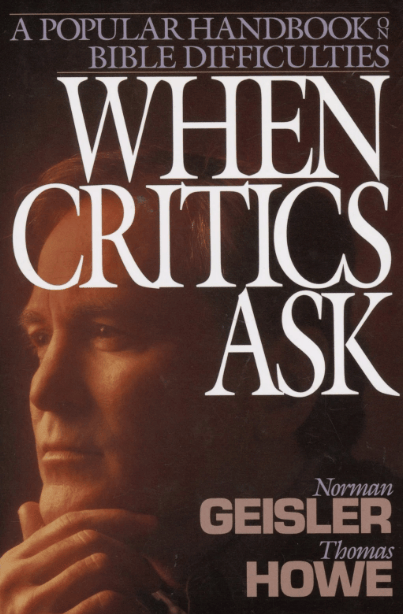
I personally believe that the modern day Baptist teaching of Biblical inerrancy is just about as modern as the Baptist teaching of cessationism. These words are modern. Cessationism just used to be called deism–if you rejected miracles, dreams, visions, etc–you were labeled a deist a few hundred years ago. Inerrancy–in the Norman Geisler sense, the Chicago Statement–it just doesn’t exist throughout the history of theology. The top verse is Psalm 19:7 (KJV): “The law of the Lord is perfect.” And by that we mean the Ten Commandments; or perhaps the 613 commandments, but even they didn’t last the test of time. Only the Ten Commandments did. So I personally believe that most Bible difficulties or “contradictions” can be adequately answered (see Norman Geisler’s When Critics Ask, and the biblio at the back). But I think its wrong to say there are absolutely no discrepancies about dates, times, and places in the Bible…And if you do find them, then Hell’s not real and atheism’s true? That’s the problem with inerrancy teaching! It’s like a spiritual land mine for Christians.
The smallest tiniest thing with this stuff can lead to atheism. This is why its so important to have an actual relationship with Jesus and the Holy Spirit through God the Father. The level of certainty required by anti-Bible contradiction thinking today–I think is unrealistically high–so high, that its kind of foolish. And it just sets people up for failure. As if a perfect God can’t inspire imperfect and fallible men to write things out. If the slightest punctuation is wrong–the level of perfectionism!–now Hell’s not real. That’s what’s going on with this stuff. I think the way inerrancy is presented by Baptists, its spiritually dangerous, intellectually dishonest; and it distracts people from just trusting in Jesus and the Word of God as inspired by the Holy Spirit and useful for holy living. Its a massive spiritual distraction.
—
Dr. Michael F. Bird, “Inerrancy Is Not Necessary for Evangelicalism Outside the USA,” in Five Views on Biblical Inerrancy (Zondervan, 2013).


 WesleyGospel Ministries