
In vain do they worship me,
teaching as doctrines the commandments of men.
–Mark 7:7 (ESV)–
God is a Spirit: and they that worship him
must worship him in spirit and in truth.
–John 4:24 (KJV)–
—
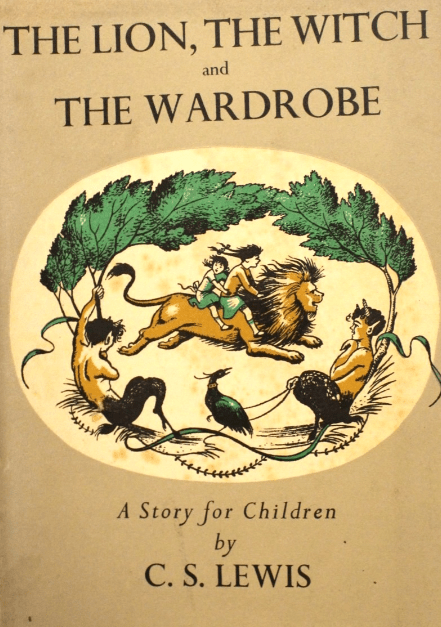
C. S. LEWIS’ UNIVERSALISM, SYNCRETISM, AND PAGANISM
There are people who do not accept the full Christian doctrine about Christ but who are so strongly attracted by Him that they are His in a much deeper sense than they themselves understand. There are people in other religions who are being led by God’s secret influence to concentrate on those parts of their religion which are in agreement with Christianity, and who thus belong to Christ without knowing it. For example, a Buddhist of good will may be led to concentrate more and more on the Buddhist teaching about mercy and to leave in the background (though he might still say he believed) the Buddhist teaching on certain other points.
–C. S. Lewis, Mere Christianity, p. 178–
God said in the Bible that “we were ‘gods’ and He is going to make good His words. If we let Him–for we can prevent Him, if we choose–He will make the feeblest and filthiest of us into a god or goddess, a dazzling, radiant, immortal creature, pulsating all through with such energy and joy and wisdom and love as we cannot now imagine.”
–C. S. Lewis, Words to Live By, p. 218–
I have therefore no difficulty in accepting, say, the view of those scholars who tell us that the account of Creation in Genesis is derived from earlier Semitic stories which were Pagan and mythical.
–C. S. Lewis, Reflections on the Psalms, p. 110–
I believe, Christ…fulfills both Paganism and Judaism.
–C. S. Lewis, Reflections on the Psalms, p. 129–
I have the deepest respect even for Pagan myths,
still more for myths in the Holy Scripture.
–C. S. Lewis, The Problem of Pain, p. 66–
No one ever attempted to show in what sense Christianity fulfilled Paganism or Paganism prefigured Christianity…In the midst of a thousand such religions stood our own, the thousand and first, labeled True. But on what grounds could I believe in this exception? It obviously was in some general sense the same kind of thing as all the rest. Why was it so differently treated? Need I, at any rate, continue to treat it differently? I was very anxious not to.
–C. S. Lewis, Surprised by Joy, p. 62–
The question was no longer to find the one simply true religion among a thousand religions simply false. It was rather, ‘Where has religion reached its true maturity? Where, if anywhere, have the hints of all Paganism been fulfilled?’…the intellect and the conscience, as well as the orgy and the ritual, must be our guide. There could be no question of going back to primitive, untheologized and unmoralized, Paganism. The God whom I had at last acknowledged was one, and was righteous. Paganism had been only the childhood of religion, or only a prophetic dream. Where was the thing full grown?…There were really only two answers possible: either in Hinduism or in Christianity.
–C. S. Lewis, Surprised by Joy, p. 235–
Religions of the Earth-Mother have hitherto been spiritually inferior to those of the Sky-father, but, perhaps, it is now time to readmit some of their elements. I shouldn’t believe it very strongly, but some sort of case could be made out.
–C. S. Lewis, quoted by Mark Freshwater, C. S. Lewis and the Truth of Myth, p. 14–
C. S. LEWIS’ HIGHER CRITICISM OF THE BIBLE
The Book of Job appears to me unhistorical…unconnected with all history or even legend…the author quite obviously writes as a story-teller not as a chronicler.
–C. S. Lewis, Reflections on the Psalms, p. 110–
C. S. LEWIS’ DARWINISM
Man is “an animal; but an animal called to be, or raised to be, or (if you like) doomed to be, something more than an animal. On the ordinary biological view (what difficulties I have about evolution are not religious) one of the primates is changed so that he becomes man; but he remains still a primate and an animal.”
–C. S. Lewis, Reflections on the Psalms, p. 115–
For long centuries God perfected the animal form
which was to become the
vehicle of humanity and the image of Himself.
–C. S. Lewis, The Problem of Pain, p. 72–
C. S. LEWIS’ PURGATORY
I hope that when the tooth of life is drawn and I am coming round, a voice will say, ‘Rinse your mouth out with this’ This will be purgatory.’
–C. S. Lewis, quoted by Kathryn Lindskoog, C. S. Lewis: Mere Christian, p. 105–
C. S. LEWIS’ DEPRAVITY AND PERVERSION
I cannot give pederasty anything like a first place among the evils of the Coll. There is much hypocrisy on this theme. People commonly talk as if every other evil were more tolerable than this. But why? Because those of us who do not share the vice feel for it a certain nausea, as we do, say, for necrophily? I think that of very little relevance to moral judgment.
–C. S. Lewis, Surprised by Joy, p. 109–
—
Paul Kerry, ed. The Ring and the Cross (Fairleigh Dickinson, 2011). About LOTR.
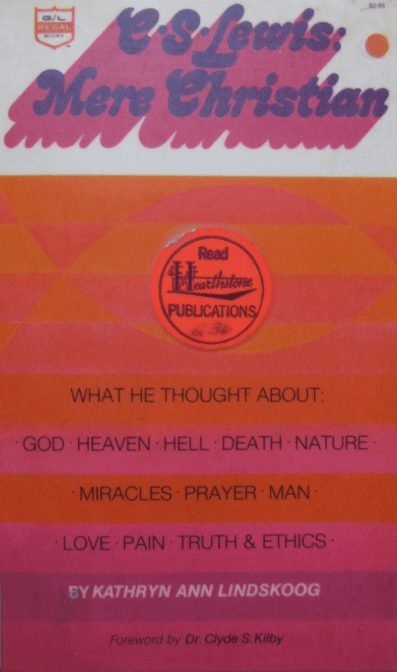
Kathryn Ann Lindskoog, C. S. Lewis: Mere Christian (Regal Books, 1973).
David Cloud, C. S. Lewis and Evangelicals Today (Way of Life Literature, 2000).
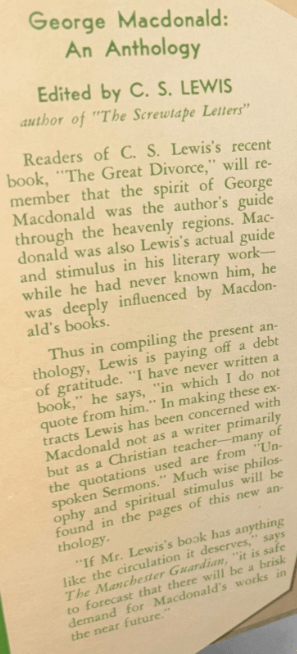
C. S. Lewis, ed. George Macdonald: An Anthology (Macmillan, 1947).
Discovery Institute, “C. S. Lewis: Not On Our Side Exposed As a Heretic and Occultist.”
North American Anglican, “The Salvation Theology of C. S. Lewis.” “It is not possible to ignore the urgency and necessity of George MacDonald and his universalist ideas in the development of C. S. Lewis’ theology. While it did not force Lewis into a total belief in universalism, it is certainly the case that it broadened Lewis’ theology of salvation, to the point that it differs considerably from orthodox, traditional beliefs within both Protestantism and the Roman Catholic Church. It is likely, as can be seen in The Great Divorce, that Lewis leaves open the possibility of universal salvation, limited only by our own innate ability to deny God, even in death. This results in a reality that renders the possibility of universalism unlikely, even within Lewis’ expansive theology of salvation. We must again acknowledge his fairly unorthodox belief that other religions contain truth that points back to God. This is a very large leap of faith on Lewis’ part because it flies in the face of many accepted and traditional beliefs within the universal church. Again, however, in choosing to argue for this possibility, Lewis is ultimately arguing for the supreme sovereignty of God to act in any way God deems fit. Lewis does not outright reject the idea of universalism. Instead, Lewis makes provides explicit and detailed examples that together show salvation, while not being universal, is much broader, merciful and understanding than the church has often taught.”
Dr. John R. Rice, What Is Wrong With the Movies? (Sword of the Lord, 1938). VidAngel, Clearplay, and TCM–the next best thing to completely smashing your TV.
—. The Double Curse of Booze (Sword of the Lord, 1960).
—. Tobacco: Is Its Use Sin? (Sword of the Lord, 2000).
Jeff Amsbaugh, Pay-Per-View…Cost of Pornography (Sword of the Lord, 2008).


 WesleyGospel Ministries