The night he unveiled his vision to an unsuspecting audience. He was scheduled to speak at a massive charismatic conference in Minneapolis, hosted by the acknowledged charismatic movement leader David du Plessis. His invitation to Dad gave my father’s message an added weight. The auditorium held about ten thousand people, mostly charismatic Lutherans…the atmosphere was giddy, with throngs of happy Christians doing sit-down-stand-up songs. It was the sort of thing Dad abided until his turn came to speak. That night, when he stepped to the microphone, he got straight down to business…Several district superintendents in the Assemblies of God shut him off. It was a horribly hard time for him, because he lost some friends. Some just didn’t want to be associated with him, probably to preserve their reputations…Dad’s ministry did suffer…we lost track of how many times we heard someone report that Dad was having a nervous breakdown…When The Vision came out (1973), [the Texas State Baptist Convention/Southern Baptists] pulled away as if they’d been scalded. Brother Dave understood that. I think he knew it was going to happen…Our father got a phone call from a minister friend within the denomination. As Dad hung up the receiver, he was ashen. “So-and-so just told me off,” he said…Even a few people involved in Teen Challenge had turned against him…When they started to hear about little black boxes on TV sets turning homes into porno palaces, they rejected him…Those reactions were tempered somewhat as The Vision’s predictions started coming to pass…Brother Dave brought a prophet’s mantle into the church, and people didn’t know how to respond to it…He was a prophet (Gary Wilkerson, David Wilkerson, pp. 173-174).
The term charismatic comes from the Greek word charismata, which means spiritual gifts. It is the informal name given to the movement which is calling the Christian church back to a fuller recognition of the Holy Spirit in Christian experience, and in the life and mission of the church, including the exercise of all the spiritual gifts described in the New Testament.
The modern Pentecostal movement which began in 1906 did not make much of an impact on the mainline denominations, affecting mainly the lower classes of society. What is called the charismatic movement emerged in the early 1960s in the mainline denominations and has had an impact on most denominations. It holds that being a Christian includes having a definite experience with the Spirit and the exercise of spiritual gifts, often speaking in tongues.
In the Mennonite Church (MC), in 1906 the Pacific Coast Conference resolved that all ministers, evangelists, and all members having the baptism of the Holy Ghost encourage everywhere that believers seek a definite experience of the baptism of the Holy Ghost.
In 1954 and 1955 Gerald Derstine, pastor, and a number of young people of the Strawberry Lake Mennonite Church (MC), Ogema, Minnesota, experienced unusual signs of the Spirit, such as speaking in tongues and being slain in the Spirit. Conference officials asked Derstine to say that at least some of the activities were of the devil, but he refused. In 1956 the conference withdrew his ministerial credentials and he left.In 1977 the officials apologized for what they had done to Derstine and welcomed him back into the Mennonite Church. He continued his independent ministries from Christian Retreat Center, Bradenton, FL. Other pastors and members had the “baptism with the Spirit” during the 1950s and 1960s, often without revealing it publicly. In 1970 retired missionary Nelson Litwiller experienced the baptism with the Spirit in a Catholic charismatic prayer meeting in South Bend, Indiana. He exercised significant leadership in the charismatic movement in the Mennonite Church until his death in 1987.
The official response of the church came in several ways. In 1972 a consultation was held on the person and work of the Spirit at Eastern Mennonite Seminary, Harrisonburg, Virginia. Festivals of the Spirit were held at Goshen College in 1972 and 1973 with an attendance of several thousand persons. In 1974 the General Board (MC) appointed a task force to develop a statement on “The Holy Spirit in the Life of the Church” to be brought to Mennonite Church (MC) General Assembly in 1975. The assembly commended the statement to congregations for study and to return counsel to improve the statement. With some changes it was adopted in 1977 as a resource for teaching throughout the church, giving a favorable response to the charismatic movement.
Some lay leaders and ministers planned a churchwide charismatic conference in 1974, held at the Landisville (Pennsylvania) campgrounds and a second one at the Missionary Church campgrounds (Goshen) in 1975. Kevin Ranaghan, executive director of the Conference on Christian Renewal Among the Churches, wrote Nelson Litwiller and Harold Bauman, asking whether the Mennonite Church would help in planning the event.
A group of 32 people met in Youngstown, Ohio, in October 1975 and formed Mennonite Renewal Services (MRS). The purposes were to provide consultative and liaison services to individuals and conferences, to represent charismatic Mennonites to groups within and beyond the denomination, to converse with leaders of the Mennonite Church, to provide information and referral services, and to sponsor teaching ministries and conferences. Nelson Litwiller represented MRS on the planning for the Conference on Christian Renewal (interdenominational charismatic conference) at Kansas City in 1977 and for the North American Congress on the Spirit and World Evangelization, held in New Orleans in 1987. Mennonite Renewal Services has reported to each Mennonite Church (MC) General Assembly and has been affirmed in its work by Mennonite Church General Board. The leaders of MRS sought to renew the church and to encourage renewed members to stay with the church and not to leave it. A significant factor in the renewal in the Mennonite Church (MC) has been renewal conferences. Mennonite Renewal Services continued holding churchwide conferences until 1978. Annual regional conferences emerged in 10 to 12 areas across North America. The MRS organization also held annual consultations involving persons active in renewal ministries throughout the church. People from other Anabaptist and Mennonite groups were invited to participate in the early stages of this development. While some members of other groups joined MRS, no official delegates were sent more than a few times.
In April 1987 MRS decided to change its name to Believers Church Renewal Ministries and incorporated people from the Church of the Brethren renewal ministries. This was the result of working with these leaders for several years. In the same month an Apostolic and Prophetic Council was established as an aid to charismatic congregations which needed a different kind of ministry than what their conference leaders were able to provide. In November 1987 a consultation brought together leaders of charismatic congregations and conference leaders to work at strengthening relationships. Sponsored by the Mennonite Board of Congregational Ministries, the consultation developed practical steps to strengthen relationships. By 1989 the new body was known as Empowered Ministries. This organization continued until 1995 when reduced financial support prevented its continuation. Its periodical, Empowered, also ceased at this time.
In a survey of one of every three Mennonite Church (MC) congregations in 1986, pastors reported 10 to 15 percent of the members called themselves charismatic. Between 25 to 30 percent of the pastors identified themselves as charismatic.
The General Conference Mennonite Church has been affected less by the charismatic movement in the United States than in Canada. A number of Canadian Mennonite congregations in the western provinces have a significant number of people with the charismatic experience. Some congregations have been able to minister to these persons while in others there have been tensions. Some members have left to join Pentecostal groups.
Some of the issues the charismatic movement has brought to congregations include whether the baptism with the Spirit is another name for the new birth, or is a definite experience with the Spirit as a part of conversion, or is an experience subsequent to conversion. Other issues involve worship: the raising of hands, speaking in tongues, prophecy, and the use of Scripture songs. Some charismatics have borrowed views of central leadership authority from other charismatic groups. Some of the contributions of the charismatic movement have been renewed vigor in worship, renewed interest in releasing spiritual gifts in congregational life, and new motivation for evangelism and missions.
Within the inspirationist wing of the Anabaptist movement, it was not unusual for charismatic manifestations to appear, such as dancing, falling under the power of the Holy Spirit, “prophetic processions” (at Zurich in 1525, at Munster in 1534 and at Amsterdam in 1535),[39] and speaking in tongues.[40] In Germany some Anabaptists, “excited by mass hysteria, experienced healings,glossolalia, contortions and other manifestations of a camp-meeting revival”.[41] The Anabaptist congregations that later developed into the Mennonite and Hutterite churches tended not to promote these manifestations, but did not totally reject the miraculous. Pilgram Marpeck, for example, wrote against the exclusion of miracles: “Nor does Scripture assert this exclusion…God has a free hand even in these last days.” Referring to some who had been raised from the dead, he wrote: “Many of them have remained constant, enduring tortures inflicted by sword, rope, fire and water and suffering terrible, tyrannical, unheard-of deaths and martyrdoms, all of which they could easily have avoided by recantation. Moreover one also marvels when he sees how the faithful God (Who, after all, overflows with goodness) raises from the dead several such brothers and sisters of Christ after they were hanged, drowned, or killed in other ways. Even today, they are found alive and we can hear their own testimony…Cannot everyone who sees, even the blind, say with a good conscience that such things are a powerful, unusual, and miraculous act of God? Those who would deny it must be hardened men.”[42]TheHutterite Chronicle and The Martyrs Mirror record several accounts of miraculous events, such as when a man named Martin prophesied while being led across a bridge to his execution in 1531: “…this once yet the pious are led over this bridge, but no more hereafter.” Just “a short time afterwards such a violent storm and flood came that the bridge was demolished.”[43]
Holy Spirit Leadership
The Anabaptists insisted upon the “free course” of the Holy Spirit in worship, yet still maintained it all must be judged according to the Scriptures.[44] The Swiss Anabaptist document titled Answer of Some Who Are Called (Ana-)Baptists – Why They Do Not Attend the Churches. One reason given for not attending the state churches was that these institutions forbade the congregation to exercise spiritual gifts according to “the Christian order as taught in the Gospel or the Word of God in 1 Corinthians 14.” “When such believers come together, ‘Everyone of you (note every one) hath a psalm, hath a doctrine, hath a revelation, hath an interpretation’ (1 Corinthians 14:26), and so on. When someone comes to church and constantly hears only one person speaking, and all the listeners are silent, neither speaking nor prophesying, who can or will regard or confess the same to be a spiritual congregation, or confess according to 1 Corinthians 14 that God is dwelling and operating in them through His Holy Spirit with His gifts, impelling them one after another in the above-mentioned order of speaking and prophesying.“[45]
[44] Oyer, John S (1964), Lutheran Reformers Against Anabaptists, The Hague: M Nijhoff, p. 86.
[45] Peachey, Paul; Peachey, Shem, eds. (1971), “Answer of Some Who Are Called (Ana-)Baptists – Why They Do Not Attend the Churches”, Mennonite Quarterly Review 45 (1): 10, 11.
John Bunyan (d. 1688), the great Puritan preacher, author of The Pilgrim’s Progress, Sighs From Hell, The Holy War, and many other prophetic and evangelistic writings, actually wrote a hymn called “Who Would True Valour See.” It was the only hymn he wrote. It is recorded by the British folk group Maddy Prior and the Carnival Band in Sing Lustily and with Good Courage from SayDisc.
Who would true valour see, Let him come hither; One here will constant be, Come wind, come weather There’s no discouragement Shall make him once relent His first avowed intent To be a pilgrim.
Whoso beset him round With dismal stories Do but themselves confound; His strength the more is. No lion can him fright, He’ll with a giant fight, But he will have a right To be a pilgrim.
Hobgoblin nor foul fiend Can daunt his spirit, He knows he at the end Shall life inherit. Then fancies flee away, He’ll fear not what men say, He’ll labor night and day To be a pilgrim.
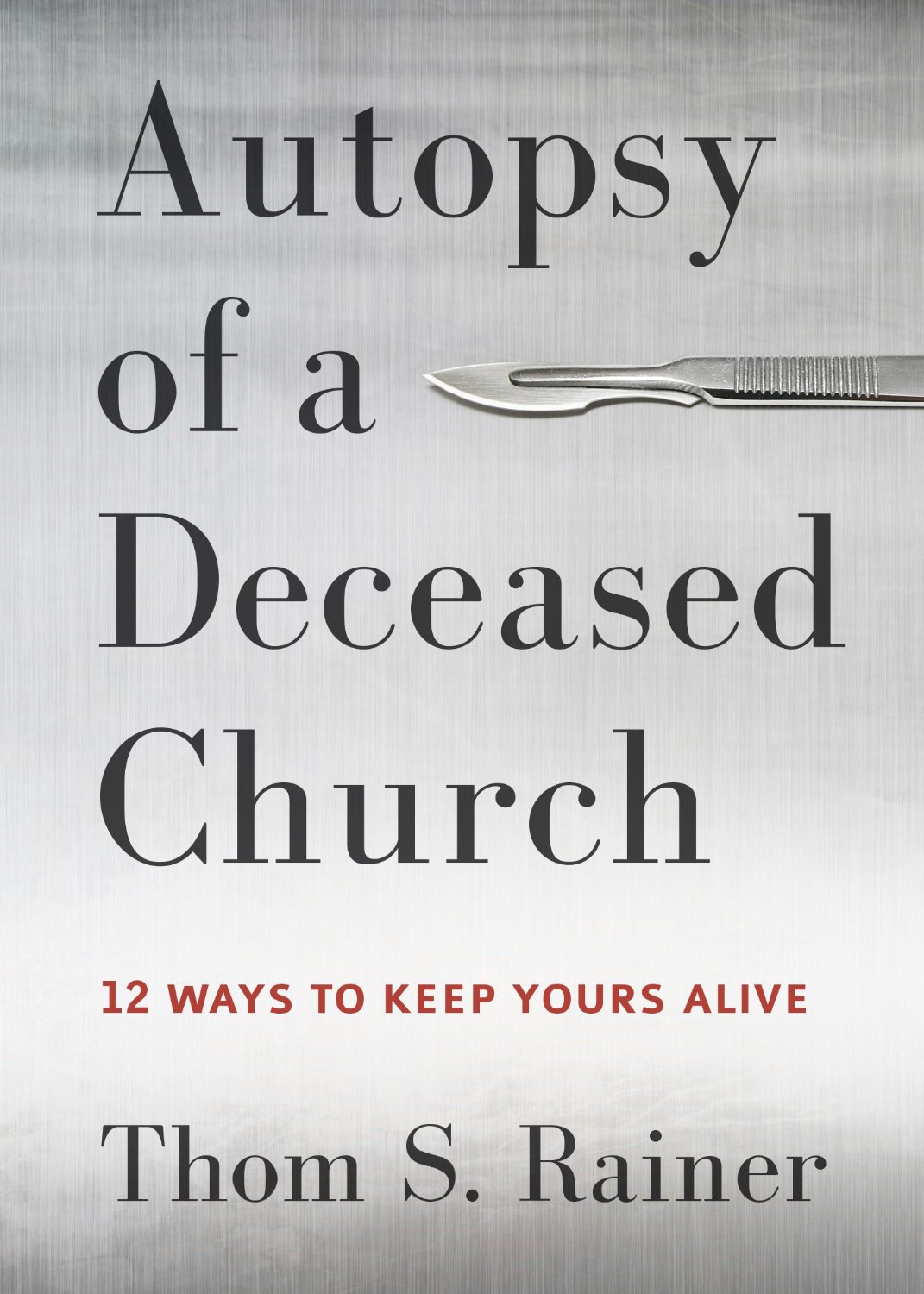
Thom Rainer is the president of LifeWay bookstores, the publishing arm of the Southern Baptist Convention. He has written several highly insightful books for church leaders, such as The Millennials, Evangelism and Church Growth: A Practical Encyclopedia (with Elmer Towns), Effective Evangelistic Churches, etc.
In Autopsy of a Deceased Church, Rainer examines several churches that got sick, very sick, those dying, and those that finally died and had to close their doors. He goes into all the reasons why this occurs, finding common denominators along the way. In finding the problems, Rainer highlights the opposing solutions. Rainer is repetitive: the main problem is that sick and dying churches, which comprise 90% of the churches in America (p. 86), DO NOT DO EVANGELISM OR ANY COMMUNITY OUTREACH ACTIVITIES.
CHAPTERS 1-4 detail that dying churches have elders who are spiritually, and evangelistically complacent: apathetic about Hell and the lost in their communities. They see their church as a social club, or a family, and all their church events are about and for themselves.And as Haggai 1:9 says, “My house still lies in ruins, while each of you is busy with his own house.” Years and years of church going desensitizes the members to the decline in attendance, the decline of evangelistic fervor, and decline of spirituality. The present is not regarded as something spiritual: the past always is. Prophecies and the voice of God are not guiding the people. Proverbs 29:18: “Where there is no vision, the people perish.” Rather than seeking to save souls from Hell in their communities, the elders, the church board, the church voters, will quarrelover church styles–regarding church music styles, worship styles, the protocol of the church bulletin, church building styles, the scheduled time of the Sunday service, memorial pews and special rooms, sound systems, overhead projector screens in church, casual church clothes vs “Sunday best,” etc (pp. 20, 22), and really being against anything up-to-date and contemporary, anything not from the past, or which is traditional. Talk about straining out a gnat to swallow a camel! (Matthew 23:24). Their communities are dying and going to Hell–and they are worried about a pew! Mark 7:13: “You nullify the Word of God by your tradition that you have handed down. And you do many things like that.” Pharisee spirit. Rainer doesn’t mention the word “Hell” even once in his book; he just uses the word “gospel” and “outreach.” I wish he could have been a bit clearer here: what’s the motive? More church members? Or rescuing souls from an eternity in Hell!?
CHAPTERS 5-8 detail the great error of how dying churches misuse their money: rather than spending it on the Great Commission or giving to the poor (Matthew 28:19-20; Mark 10:21-22), like Jesus said–they ONLY spend it on themselves, for their church staff, their building, and various social events for themselves. This is not due to ignorance, but evangelistic rebellion against God’s Word: “The deceased church, somewhere in its history, forgot to act upon the Great Commission…Perhaps it is more accurate to say the church ‘decided’ not to act upon Christ’s command…Obedience to the Great Commission faded; it usually faded gradually…They chose their own comfort over reaching others with the Gospel” (pp. 41-43). There is no welcome place for evangelists in the local church to reach out to the community. Instead, as was previously mentioned, the vain church leaders bother themselves with mere trifles, while everyone else is dying and going to Hell: trifles such as church service times, the music style, the length and order of the Sunday service, the designs and colors of various buildings and rooms in the church, self-centered programs and activities and events, more church staff, etc. Jesus said in Matthew 7:1-5: “Do not judge, or you too will be judged.For in the same way you judge others, you will be judged, and with the measure you use, it will be measured to you. Why do you look at the speck of sawdust in your brother’s eye and pay no attention to the plank in your own eye?How can you say to your brother, ‘Let me take the speck out of your eye,’ when all the time there is a plank in your own eye?You hypocrite, first take the plank out of your own eye, and then you will see clearly to remove the speck from your brother’s eye.” This is what Jesus meant when He taught on judging. Pharisaic people squabbling over mere trifles, while there are lost sinners all around them on their way to a burning Hell!! And what’s worse is they add this to their sin: they would rather criticize and condemn these lost sinners around them than preach the Gospel to them and invite them to their church! Hypocrites! Also, their opposition to Christian rock and contemporary praise and worship music, like Hillsong music–does not help, but only hurts their influence with the younger generations, such as Generation X and the Millennials (my generation: born 1985 and on). Jeremiah said, after Jerusalem had been sacked by the Babylonians, that this was one of the things he sorrowed over in Lamentations 5:14-15: “The young men have stopped their music. Joy is gone from our hearts; our dancing has turned to mourning.” Old men are not supposed to lead praise and worship–YOUNG MEN are…with THEIR MUSIC! That’s in Scripture! Hymns are great and good and should continue to be studied and sung with reverence…but let the young men lead, let them spice up the hymns with their music styles, albeit with reverence and holiness. Regarding dying churches and their pastors–they have a long standing cycle of short-term pastors, who only serve about 2-3 years before they are fired or leave. The church board is resistant to changes that need to be made–changes that they initially asked the pastor to call for. Conflict occurs; then there’s a church vote. Pastors have no job security…many pastors experience this at so many churches, that they get tired of the game, and they quit the ministry totally out of discouragement. Once again the church board gives into a spirit of apathy, complacency, lukewarmness, and no evangelism. Such people will be spit out of the mouth of Christ (Revelation 3:16).
CHAPTERS 9-11 underscore what dying churches find themselves preoccupied with, or distracted with, as idols, from the Gospel of Jesus Christ. Unlike in Acts 2:24, these dead churches never had any fervent prayer meetings filled with intercession for the lost. Rather, if they had Wednesday night prayer meetings at all, it was a dry ritual where they would pass out a prayer list, and afterwards have a fellowship meal. Church became meaningless and without any sense of purpose: What’s the point? became the attitude. Going through the motions, religious routine, playing the church game, complacency. No zeal to preach the Gospelto the lost at all; not Gospel-centered, and not Gospel-driven. Rainer says: “A church without a Gospel-centered purpose is no longer a church at all” (p. 75). They are not Hell-conscious and not eternity-conscious. It’s no wonder why so many churches don’t even have crosses decorating them. While thousands of souls in their cities are dying in hospice, being cast into “the mighty damnation which lasts to eternity”[1]–silly old church ladies are debating over such petty things as tea parties and bridal chambers (p. 78)–what sorts of doilies and chairs, and who shall be permitted to use these privileged rooms? WHO CARES! I’d rather these careless hypocrites go to Hell and every pauper in the area get converted and take over the church! And Jesus thinks so too: “Truly I tell you, the tax collectors and the prostitutes are entering the kingdom of God ahead of you” (Matthew 21:31).
CHAPTERS 12-14 pose what Rainer sees as the answers to the problem. Church members need to (with some of my views thrown in):
1. Acknowledge that their church is sick, and dying, and needs to change.
2. They need to be willing to obey any Biblical directions their pastor would give them for positive change and improvement.
3. They must start witnessing in their community to the message of salvation in Christ (Acts 1:8).
4. They must refuse to just keep to themselves as a church clique.
5. Outreach and evangelistic church events need to be geared not only towards bringing new people to the Sunday services, but also towards converting them soundly.
6. Allow new godly people from the local area into the church and have a voice and influence in the church.
—–
[1] E. B. Pusey, What Is of Faith as to Everlasting Punishment? (London: James Parker & Co., 1880), p. 57.
Unless your righteousness surpasses that of the scribes and Pharisees, you will not enter the kingdom of Heaven. –Matthew 5:20
Jesus’ number one human enemies were the Pharisees (Mark 8:11). They were churchy, religious pretenders of holiness (Matthew 23:27-28). They only cared about external, physical things that you could touch and see…especially the matter of being part of the “in crowd.” They did not bother with the inward psychological state of people; or whether morals were growing in their hearts. In fact, when John the Baptist and Jesus came on the scene, in the same Spirit as the Old Testament prophets, with a message of repentance from sin, righteous living, and forgiveness of sins by faith in God—the Pharisees were the first to resist such a message (Luke 7:30). The message was hard for them to bear in many areas—especially the view of Jesus as the Son of God (John 10:33)—but even though Jesus and His forerunning prophet had impeccable morality, of which the Pharisees could scarcely come up with a reason to accuse them—they resisted because they were content to be lovers of money (Luke 16:13-15), sexually immoral with regard to divorce and remarriage (Matthew 19:3), leading silly women astray laden with sins (2 Timothy 3:6), and OPPONENTS OF GOD IN THE FLESH! If any one group of clergy were ever demon-possessed, it was the Pharisees! And Jesus says it was so in the Gospels, multiple times, calling them children of the devil and Hell (John 8:44; Matthew 23:15).
1. The Pharisees resisted Jesus and His message mainly because He was a preacher of great morality. He exposed the Pharisees for cancelling out God’s commandments through man-made religious traditions (Mark 7:9). Jesus called for them to abandon these silly traditions and get back to obeying God’s commandments from the heart, as they were meant to be. While the Pharisees tried to level various accusations against Jesus, such as blasphemy (Matthew 26:65), sedition (John 19:15), tax evasion (Luke 23:2), or some other such thing—their testimonies always contradicted in the court in which He was tried. Such was the immoral kangaroo court system by which Jesus was condemned to the cross. Jesus was moral; and His enemies were immoral—so it should be no surprise that the court in which His enemies prevailed did not truly administer justice.
2. Throughout all of church history, the spirit of the Pharisees has continued among the clergy. In the early church, it was found among the Judaizers and Gnostics. Those who opposed the church fathers had a Pharisaic spirit. Many of the Catholic popes, cardinals, and bishops in the medieval times had some of the worst Pharisaic spirits ever, in that they scarcely allowed the Catholic saints to be admitted the barest necessities for their survival—and only by divine interventions, were these saints helped by God, in spite of these Pharisaic church leaders. Butler’s Lives of the Saints; St. Patrick, St. Francis of Assisi, and Martin Luther bear strong testimony of this. In the 1500s, 1600s, and 1700s, the Church of England’s clergymen were always prone to a Pharisaic, externalist, formal spirit. God rose up the Puritans in these times, and finally John Bunyan, Jonathan Edwards, George Whitefield, and John Wesley—leading to the formation of the Methodist Episcopal Church and countless independent Calvinist churches inspired by these saints. There are many stories of Anglican clergy persecuting these blessed saints of God, with the worst Pharisaic hatred and violence known to the imagination. During the English Reformation, it seems both the Catholic and Anglican clergy tried to outdo each other with their brutal torments of “heretics,” as recorded in Foxe’s Book of Martyrs, or the “dissenters” in Benjamin Brook’s Lives of the Puritans. The clergy who opposed the revivals of Edwards, Wesley, and Charles Finney—all morally-driven revivals—should bear the label of modern Pharisees, and I’m sure they are in Hell now if they didn’t repent. In the modern era, Pharisees can be found opposing other morally-driven saints, such as Evan Roberts, William J. Seymour, Smith Wigglesworth, Leonard Ravenhill, David Wilkerson, as if they were on some kind of Pharisaic hit list. All of these saints had to leave their denominations in order to continue their journey on the way to Heaven: whether it was a holiness association, or the Salvation Army, or Church of the Nazarene, or Assemblies of God. The Pharisaic spirit looms over all denominations at the leadership levels—and the same will be for any church or denomination that will ever be established in the future.
3. Resistance to Morals: The Number One Sign of a Pharisee. I think theology generally tends to distract people from the subject of true righteousness and living a life of holiness, which is the only thing that really determines entrance into Heaven (Hebrews 12:14). Pharisees seem to thrive on abstract doctrines and Bible teachings, which have no point of reference to morals (2 Timothy 3:7). But notice: Jesus and the apostles were the exact opposite: everything they taught was to point people to greater morals, holiness, and righteousness by faith in God (Acts 17:30). Don’t be deceived: whether it’s called cheap grace, no-lordship salvation, easy-believism, or antinomianism—Pharisees are always immoral. They always find ways to excuse their carnality, immorality, and the like—and they are also resistant to people morally correcting them, because they are unrepentant. Like the time Stephen rebuked the Pharisees, and they grinded their teeth, stopped up their ears, and stoned him to death! (Acts 7:51-60). Pharisees always resist the Holy Spirit, because they are inhabited by demons of rebellion (John 8:44). They are in the habit of reading portions of the Bible, and ignoring or explaining away the moral sections; they don’t submit to, or obey God’s commandments in Scripture, when they come across them. There is resistance to change–resistance to transformation by the morals of God’s Word. And so, there is a spiritual veil on their eyes in the reading of the divine text (2 Corinthians 3:15). There is simply no way that a carnal, self-excusing, immoral clergyman is even saved (Matthew 23:33)—and there is simply no way God is calling him to do what he is doing (Jeremiah 23:21). Whether he is a priest, pastor, bishop, elder, overseer, or some other such clergyman—if he is intentionally carnal and resistant to true morals and holiness: he’s a Pharisee; and not living in the state of salvation.
[Note: It was the French Prophets in London that influenced the charismatic views of John Wesley and the Methodist Episcopal Church.]
They first appeared in Dauphiny and Vivarais. In the year 1688, five or six hundred Protestants, of both sexes, gave themselves out to be prophets inspired of the Holy Ghost, and they soon amounted to many thousands. They had strange fits, which came upon them with tremblings and faintings, as in a swoon, which made them reel and stagger till they dropped. They beat themselves, fell on their backs, shut their eyes, and heaved their breasts, as in fits; and when they came out of these trances said, they saw the heavens open, the angels, Paradise, and Hell; and then began to prophesy.
The burden of their discourses was, Repent, amend your lives: the end of all things draweth nigh! The walls of their assemblies, and, when in the open air, the hills rebounded with their loud cries for mercy; and with imprecations against the priests, the church, and the pope, with predictions of the approaching fall of popery.
In the year 1706, three or four of these prophets came over into England, and brought their prophetic Spirit with them, which discovered itself by ecstasies, agitations, and inspirations under them, as it had done in France; and they propagated the like Spirit to others, so that before the year was out, there were two or three hundred of these prophets in and about London, of both sexes, of all ages; men, women, and children; and they had delivered four or five hundred prophetic warnings.
The great thing they [pretended] by their Spirit was, to give warning of the near approach of the kingdom of God, the happy times of the church, the millennium state. Their message was, that the grand jubilee, the acceptable year of the Lord, the accomplishment of those numerous passages in Scripture concerning the new heavens, and the new earth, &c. was now even at the door–that this great work was to be wrought on the part of man by spiritual arms, only, proceeding from the mouths of those who should, by inspiration of the Spirit, be sent forth in great numbers, to labour in the vineyard–that this mission of his servants should be witnessed to by signs and wonders from Heaven, by a deluge of judgments on the wicked throughout the world; as famine, earthquakes, &c.–that the exterminating angels should root out the tares, and leave upon earth only good corn; and that the works of men being thrown down, there should be but one Lord, one faith, one heart, and one voice, among mankind. They declared, that all these great things would be manifest over the whole earth within the term of three years.
These prophets also [pretended] to the gift of languages (tongues), of discerning the secrets of the heart; the power of conferring the same Spirit on others, and the gift of healing by the laying on of hands. To prove that they were really inspired by the Holy Ghost, they alleged the complete joy and satisfaction they experienced, the spirit of prayer which was poured forth upon them, and the answer of their prayers by the Most High.[1]
Original Footnotes
[1] Chauncey’s Works, vol. iii. p. 2-39. Prophetical Warnings of the Eternal Spirit. A Brand snatched from the burning, &c.
I am not coming to you as a pastor but with a prophetic word. God so shook me recently with this message that I should bring it somewhere, sometime in Springfield. This morning the Lord, by His Spirit, spoke to my heart that this is the time. He has called me to be one of His watchmen, and I have wept over this and prayed that He will help me deliver the message in a spirit of love. This is not a chastisement but a warning for the Assemblies of God.
A New Gospel
Accommodate means to adapt, to make suitable and acceptable, to make convenient. A gospel of accommodation is creeping into the United States. It’s an American cultural invention to appease the lifestyle of luxury and pleasure. Primarily a Caucasian, suburban gospel, it’s also in our major cities and is sweeping the nation, influencing ministers of every denomination, and giving birth to megachurches with thousands who come to hear a nonconfronting message. It’s an adaptable gospel that is spoon-fed through humorous skits, drama, and short, nonabrasive sermonettes on how to cope—called a seeker-friendly or sinner-friendly gospel.
To begin with, those terms are unscriptural. The gospel of Jesus Christ has always been confronting—there is no such thing as a friendly gospel but a friendly grace.
This new gospel is being propagated by bright, young, talented ministers. They have come upon a formula which states you can go into any town or city; and if you have the right formula, within a short time you can raise a megachurch.
If you are a young man and have certain skills, you find those skills and a part of the city that would best suit you. You move into that area, poll it, and find out what the nonchurchgoers want:
“You don’t like choirs. Well, would you go to a church that didn’t have a choir?” Yes.
“You don’t like to wear suits. Would you go where it’s informal?” Yes.
Then you go to your computer and design a gospel that will not confront but will shoot out the desires and the needs of the people. After you have gathered a handful of people, you keep interviewing them to find out what they want; then you design your message to help people cope with their needs. The program you design is intended to make the church comfortable and friendly for all sinners who wish to attend.
This gospel is fast becoming the most prosperous and flourishing of all religious movements. Thousands attend these churches. The pastor is the CEO, and it becomes a business. They make no bones about it: They are following Madison Avenue tactics and can make a success of it. Their formula for quick church growth is cleverly packaged and is being sold especially to young ministers—those who want to be a part of the big boys and what’s happening on a fast track. They want it to happen quickly.
Paul’s Warning
Paul warned of the coming of another gospel and another Jesus (2 Corinthians 11:4). He warned the church that it’s really not another gospel but a perversion of the true gospel of Jesus Christ. If you hear any other gospel, he said, let that preacher be accursed. In other words, no matter how pleasant, how pious, or how sincere, if the message is not the death of sin through the cross of Jesus Christ, let it be accursed.
I tremble when I read in the Scriptures that in the last days Satan is going to come right into the church posing as an angel of light. He’s going to take ministers who, at one time, had the touch of God, and he’s going to transform them into angels of light to become his tool of deception. That’s frightening. It causes me to fall on my face before God for such false, deceitful workers transforming themselves into the apostles of Christ. No marvel, for Satan himself is transformed into an angel of light. Therefore, it’s no great thing if ministers also are transformed as the ministers of righteousness whose end shall be according to their works.
Paul said they are going to glory in the flesh, in their bigness, their numbers, their influence, and their contemporariness. They will boast they are contemporary, that there is a gospel that is out of style that doesn’t reach human need anymore. They will glory in the world’s acceptance. Jesus warned, “Beware of false prophets, which come to you in sheep’s clothing, but inwardly they are ravening wolves” (Matthew 7:15). The context of that warning was: “Straight is the gate, and narrow is the way, which leadeth to life, and few there be that find it” (verse 14).
His warning was to beware of the wolves who are going to say it’s really not that narrow and straight—they are going to come posing as submissive sheep. Jesus put His finger on the cause: ambition—ambitious ravening wolves. In the Greek it means “starved for recognition and quick gratification, quick growth.”
Jesus left no doubt about His meaning. For example, He was addressing a struggling pastor who has worked for years and hasn’t seen the kind of growth he wants to see. A young man with an accommodating gospel moves into town and and within a very short time has a megachurch. People are flocking there because there is entertainment; it’s a gospel of fun. I’ve been in some of them. It’s the gospel of entertainment that has no conviction whatsoever. There is very little in their gospel that speaks to sinners of repentance, brokenness, and cross-bearing. A Christ is preached, Jesus’ name is mentioned, but Paul said their’s is another gospel, another Jesus.
Paul warned that if you are caught in this trap, if you want that hook of entertainment, that hook of sudden growth, this is the hook: The enemy will put in your path a teaching.
I have two preacher sons. One of them confessed to me, “Dad, I was that close to being sucked in because I fasted and prayed and didn’t see the growth I wanted to see, and I saw these others grow. That hook was there, and I almost bought it.”
That is something this Movement and every movement is going to have to look at and deal with: It is possible, through unholy ambition, to be transformed from a man of God, who has been seeking God and getting a word from heaven, to an unholy ambition and a tool of Satan. Let every pastor heed this warning: The moment you begin to consider the “competition,” seeds of accommodation will be planted in your heart. Suddenly, Satan will put in your path a wolf in sheep’s clothing—a man who will try to seduce you into ungodly ambition and achieving church growth at any cost. Yet the truth is, it could cost you your soul.
The Right Formula
If you find the right formula, according to the accommodation gospel, you can succeed in any field of endeavor.
An editorial in the New York Times (March 1, 1998) was entitled, How To Manufacture a Best-Seller. It told the story of John Baldwin, a 53-year-old carpenter and a would-be writer, who had struggled for years to make a living from writing. He determined to become famous and rich overnight by writing a best-selling medical thriller. He studied five or six best thrillers. After 7 years’ research he found 10 steps to producing a best-selling medical novel. He honed it with some Hollywood writers and agents, and here is the 10-step formula he used:
The hero is an expert.
The villain is an expert.
You must watch all the villain’s activities over his shoulder.
The hero has a team of experts behind him, working in various fields.
Two or more on the team must fall in love.
Two or more on the team must die.
The villain must turn his attention from his initial goal to the team.
The villain and the hero must live to do battle again in the sequel.
All deaths must proceed from the individual to the group.
If the story bogs down, just kill somebody.
John Baldwin had the formula but no story, so he read of research by John Marr who was studying the epidemiological causes of the 10 plagues, hoping to explain their causes scientifically. The two men formed a partnership, and using Baldwin’s 10-step formula, together wrote a 640 page manuscript called The Eleventh Plague. Harper Collins bought it for almost $2 million.
Baldwin, who has no passion for writing, said, “If I get the formula, I’m going to be a multimillionaire and famous.” Well, he’s going to make another $3 million on the movie rights, and he’s laughing all the way to the bank. His philosophy: “If you have the right formula, you can be a success at anything.”
You see, this is the gospel of accommodation—the formula. You get the formula, you get what people want, and you can be a success. I am here to tell you that a formula-based, accommodating gospel is contrary to everything in the Scriptures.
God’s Method
Certain men of God met at Antioch to send out men to preach the gospel and establish churches (Acts 13). Here is God’s method:
1. They ministered to the Lord and fasted. This was their planning session—worshiping, fasting, waiting on the Lord, and calling for direction from the Holy Ghost. They did not move until the Holy Ghost spoke. There were no formulas, no surveys, no door-to-door asking people what they wanted and then serving it to them.
2. They prayed—no strategizing, no network, and not one step until the Holy Ghost spoke His mind. Then and only then did they lay hands upon them, anoint them, and send them out in the power and demonstration of the Holy Ghost.
Paul lived his whole religious life on religious formulas, and he said they didn’t work. He gave up on formulas and said, “I determined not to know anything among you, save Jesus Christ, and him crucified” (1 Corinthians 2:2). Paul boasted unashamedly, “We preach Christ crucified, unto the Jews a stumblingblock, and unto the Greeks foolishness” (1 Corinthians 1:23). He was saying, “Gentlemen (he was talking to his peers), they want us to accommodate. The Jews are looking for signs in our gospel. The Greeks want the wisdom. They want to know how to cope, but I’m not compromising. There’s only one message. Our gospel has been and will be the Cross and its demands as well as its victories. As for me, I’m determined to preach nothing among you but Christ and Him crucified.”
What the Gospel of Accommodation Does
I see three things in the gospel of accommodation:
1. It is the accommodation of man’s love for pleasure.
“This know also, that in the last days perilous times shall come. For men shall be lovers…of pleasures more than lovers of God” (2 Timothy 3:1–4). The Greek for pleasure is “sensuous, lustful, voluptuous, exciting, gratifying, sensual pleasure.” If you move toward this gospel of accommodation, you are going to have to accommodate the people’s lust because they are not going to give up their love for excitement. They’ve made gods of sports, pleasure, and lust. Unless that is confronted by the gospel of Jesus Christ, unless there is a truth that comes forth, you have to accommodate this lust that is in the American lifestyle.
I was shocked by an article in the New York Times.1 Philip Wogaman, President Clinton’s pastor, said, “Sexual misconduct does not automatically render a leader immoral. Morality should also be judged by indicators like courage, concern for the poor, fostering world peace, running the economy responsibly, and furthering racial equality. Heterosexuality and homosexuality are merely cultural expressions.” In other words, Mr. Clinton has been told that he has enough good indicators to overrule another that would be immoral in his life.
God said that men who preach doctrines like these resist the truth; they are men of corrupt minds counterfeiting the faith.
In disbelief I watched a televised Sunday night service of a seeker-friendly church—seeker-friendly by its own admission. To a packed church where thousands attend, the pastor said, “This is fun night, a David Letterman night.” The youth pastor came out and did his monologue as David Letterman. Then they showed 10 of the most boring things teenagers do during preaching. Three of the 10 were throwing spitballs, yawning, and picking their noses. The crowd went crazy. After the service, the pastor brazenly announced, “We’re not here to offend people, but to make church comfortable for everyone.” I wept.
I ask you, how long do you think that audience would stay in church if the pastor was gripped by the Holy Ghost, convicted for “entertaining” people toward hell, and suddenly preached a message entitled, “Be sure your sins will find you out”? How long would people keep coming back if a gospel of holy living and separation from the world was preached? Two things would happen: (1) Those who are misguided, hungry, and didn’t know any better would weep and run to the altar. (2) Those who are judiciously blinded by their pleasures in madness would flee from the church and never come again. The church doors would close.
I keep this foremost in my mind and before my eyes, because every minister of the gospel one day has to face it when he stands before the Lord. He will say, “Son of man, I made thee a watchman. You were to hear the words of My mouth and give them warnings from Me. You were to tell the wicked, ‘Thou shalt surely die.’ And you gave them no warning nor spoke to warn the wicked to turn from their wicked ways to save their lives. These same wicked men died in their sins, but their blood I’ll require at your hands.”
What the Gospel of Accommodation Does
2. This gospel of accommodation accommodates all man’s aversion to self-denial.
The gospel of Jesus Christ is one of self-denial. Jesus said, “If any man will come after me, let him deny himself, take up his cross, and follow me” (Matthew 16:24). Self-denial is not something you give. It’s someone you give up—the giving up of yourself, giving up everything you are. It’s a living sacrifice to the Lord Jesus Christ to present your body a living sacrifice, holy, acceptable to God, which is your reasonable service. God has every right to say to His church, “If you expect to give Me your body, your resurrected body, all through eternity, I have every right—it’s only reasonable of Me and your reasonable service—to ask your body why you’re here on earth. I want every part of you. I want you to be spiritually minded. I want to possess you.”
The gospel we preach must bring people under the total possession of the Lord Jesus Christ. Otherwise, it’s a gospel of accommodation.
The seeker-friendly gospel accommodates the body. The human body belongs to Him. What we see in America is a neognosticism where you take your physical body on one side and do as you please as long as your spirit is right with God. This is coming even out of the White House, this dividing of personality. No, we are one personality, and it all belongs to Jesus Christ. This neognosticism is destroying the faith of many throughout the nation.
What the Gospel of Accommodation Does
3. There is an accommodation of man’s offense to the gospel.
The Scriptures state, “Behold, I lay in Zion a stumblingstone and rock of offense.” Paul spoke of the offense of the Cross. This is the heart of God’s anger. We’re not called to the Cross but to go through the Cross—to experience the same thing Jesus did, not only coming to the Cross but dying and going into the grave with Jesus Christ and then being raised from the dead to a newness of life.
It’s cruel, pastor, to lead sinners to the Cross, tell them they are forgiven by faith, and then allow them to go back to their habits and lusts of the flesh, unchanged and still in the devil’s shackles. If the preaching of grace doesn’t have as its goal the producing of a walk of righteousness, then it’s another gospel, another Jesus.
I listened in horror to a man, who attended one of the largest seeker-friendly churches, being interviewed by CBS. He said, “I come to this church because I’m comfortable. I’m never made to feel uneasy. I bring my Jewish friends and my business friends, and I know nothing will ever be said that will offend them. The best part of it is, the whole thing only lasts an hour.”
Take it from me: You can get your big church and be one of the big boys, but it’s going to cost you your soul if you preach with a focus only on earthly things, rather than on the things of God.
I’ve lived in New York City 35 years. We have 103 nationalities from all walks of life—from the poorest to the richest. Probably 300 or more from the United Nations live there. But I look over a congregation (so does my dear friend, Jim Cymbala, in Brooklyn) and see men who have just walked in from the porno shops and are wild animals. I see a businessman friend who was CEO of a multimillion–dollar company, but he started snorting coke, lost everything, and is now a bum on the street. He sits in the congregation. A little 14-year-old girl with AIDS is up on 8th Avenue performing lewd acts before dirty old men. She comes to church and keeps saying, “Pastor Dave, I’ve got to get out. I’ve got to get help.”
I’m not about to put up a silly skit and preach a 15-minute message on how to cope to a multitude of people who are dying and going to hell. I tremble at the thought.
People don’t like to hear this, but we’re headed for perilous times—just a few years away from a collapse like the world has never known. When that happens, all who preached prosperity are going to disappear because the people will say, “Your gospel has failed me.” When that time comes, I want to grasp onto Jesus, and I want everyone I’ve preached to to have faith in the keeping power of Jesus Christ. I want them to know Him in His fullness. I want to know that I’ve done it in love, in grace, that they would know the difference between the holy and the profane.
May God, in Jesus’ name, spare the Assemblies of God forever. If I have ever given a prophetic message in my lifetime that God intended for a purpose, it is now.
Many are being deceived. If they are not awakened, what I warn you about will happen.
I pray that God will keep the Assemblies of God in its original purposes. In New York City, He has proved that the people come to hear a straight gospel, and thousands will come where the Word of God is being preached without compromise and yet with grace. May the young men who are discouraged in the Movement not try for a shortcut but be broken and on their faces before the Lord.
May we get our eyes off growth and onto a new revelation of who Jesus is.