Thomas C. Oden, John Wesley’s Scriptural Christianity, pp. 118-120.
The unbeliever does not welcome what comes from God’s Spirit, because it is foolishness to him; he is not able to understand it since it is evaluated spiritually. –1 Corinthians 2:14 (HCSB)
You are deceived, because you don’t know the Scriptures or the power of God. –Matthew 22:29 (HCSB)
The Spirit himself testifies with our spirit that we are God’s children. –Romans 8:16
—
I was fully convinced of what I had long suspected, 1. That the Montanists, in the second and third centuries, were real, Scriptural Christians; and, 2. that the grand reason why the miraculous gifts were so soon withdrawn, was not only that faith and holiness were well nigh lost; but that dry, formal, orthodox men began even then to ridicule whatever gifts they had not themselves, and to decry them all as either madness or imposture. –John Wesley, Journal, August 15, 1750
—
John Sherrill, They Speak with Other Tongues.
Don Basham, A Handbook on Holy Spirit Baptism.
—. Spiritual Power.
—. A Handbook on Tongues, Interpretation, and Prophecy.
Harold Horton, The Gifts of the Spirit.
French Arrington, Christian Doctrine, volume 3, part 1. (official Church of God theology).
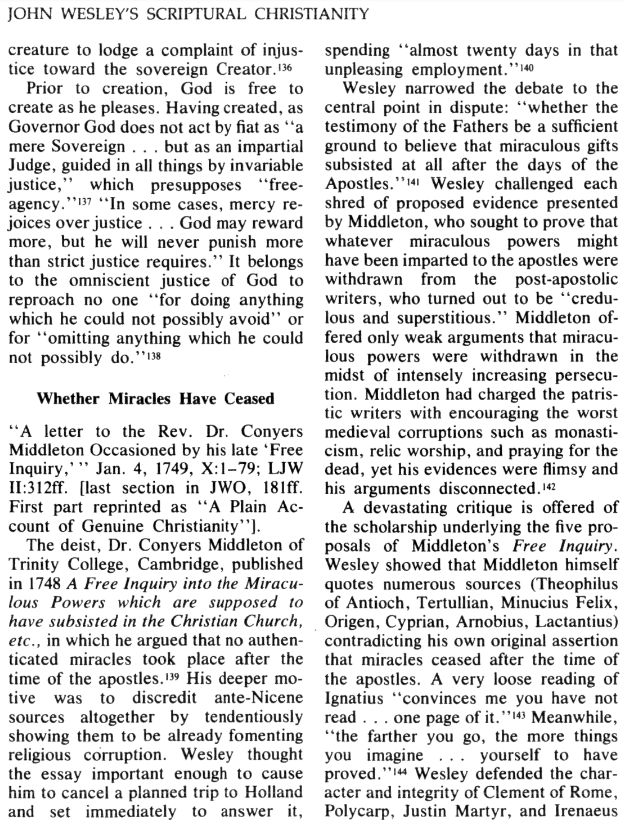
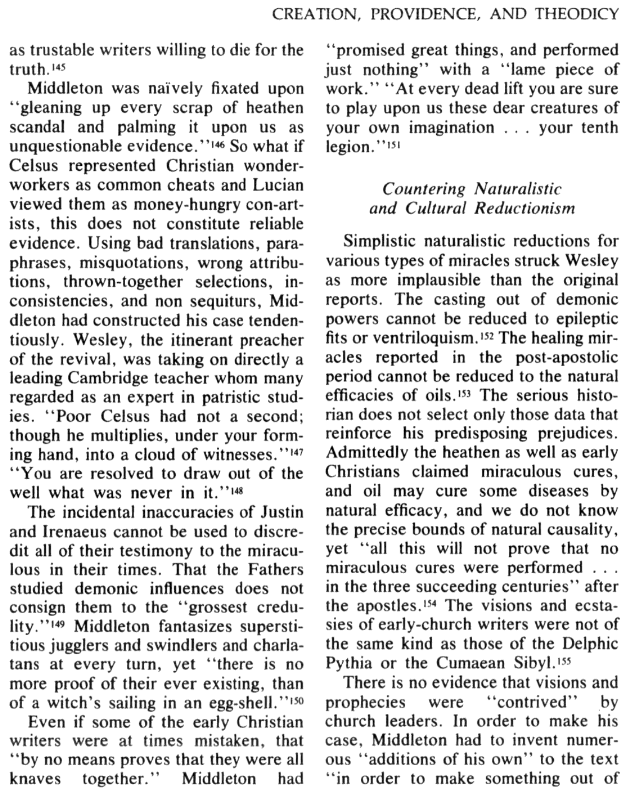
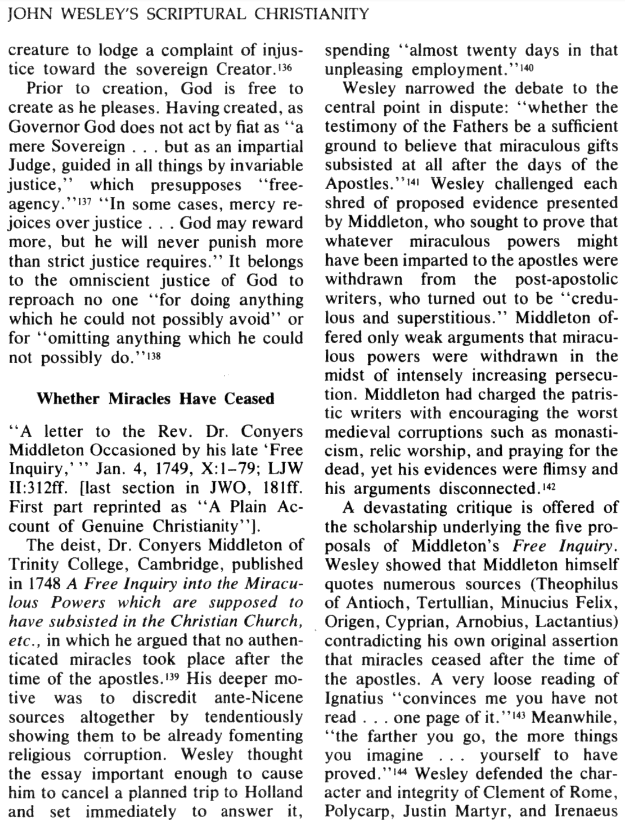
First came David Hume’s An Enquiry Concerning Human Understanding (1748), with his chapter called “Of Miracles,” from that philosophical king of skeptics and deists. Then this naturalistic skepticism traveled into the Church under the cloak of cessationism, in the form of Conyers Middleton’s A Free Inquiry Into the Miraculous Powers (1749), and created a firestorm in the Protestant theological community. Religious scholars came to call it the Middletonian Controversy. John Wesley was probably the most famous preacher to reply to it from an Anglican charismatic point of view; but there were others who sided with Wesley. An over 400 page continuationist reply was found in Zachary Brooke’s An Examination of Dr. Middleton’s Free Inquiry (1749). Then there was William Dodwell’s A Free Answer to Dr. Middleton’s Free Inquiry (1749); and finally a 70 page pamphlet: John Jackson’s Remarks on Dr. Middleton’s Free Enquiry (1749). In the wake of all these, probably the most complete and maturely formulated book was Thomas Church’s A Vindication of the Miraculous Powers (1750), which looks like it could have been written by Jack Deere had he lived in the 18th century. Middleton completed a reply to this last one called A Vindication of the Free Inquiry. And how did God repay Dr. Middleton’s impenitence? And for spreading so much unbelief into the Church? Without a doubt by taking his life, one year after his first book was published, in 1750 at the age of 66. His second one had to be published in 1751 after MIDDLETON DIED.
B. B. Warfield completely admits that Conyers Middleton was the main influence on his cessationist views in Counterfeit Miracles (pp. 28-31). WARFIELD DIED 3 years after the book’s publication at the age of 69. Was it dead religion that animated these teachings? The death-defying John MacArthur called Warfield an “astute theologian” in his book Charismatic Chaos (p. 245). Therefore, it is reasonable to conclude, that behind all the creative cessationist “exegesis” that Dr. MacArthur has developed over his life and ministry in the form of The Charismatics (1978), Charismatic Chaos (1993), and Strange Fire (2013), what we’re looking at is really just the same naturalistic skepticism and unbelief about the supernatural that originally came from Hume; and then was sanctified for the Church by Middleton and Warfield. What I’m saying, is that John MacArthur’s cessationism is derived from David Hume and Conyers Middleton! Both of whom were outspoken deists and skeptics! Warfield was in the same category as them, but he only hid it better than they did. Doctors of theology yes, but at the same time deists and skeptics in the spiritual sense: unbelievers to use a harsher and more honest word. Being that Hume’s skepticism came from Scotland, it only seems ironically right to point back a few hundred years before him in that same country, to the time of John Knox and the Covenanters, that time recalled in John Howie’s The Scots Worthies (click here and try a keyword search of such words as dream, vision, prophecy, heal, devil, etc), which told the stories of many visions and miracles that happened among those Calvinist charismatics, as they were persecuted by representatives of the Catholic Church. More about this in Jack Deere’s Why I Am Still Surprised by the Voice of God, ch. 3, which is called “The Miracles of the Scottish Covenanters.”
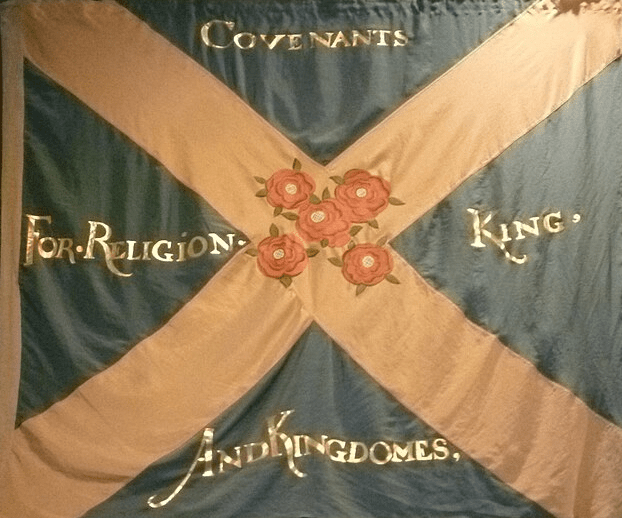
A replica of the Covenanter flag. This was used in the English Civil War: as in the 1970 film Cromwell.
Brave man that he was, a charismatic man from Scotland of all places, said that the Holy Spirit told him to publicly rebuke Dr. MacArthur for his cessationist teaching not long after he published Strange Fire (2013). Scotland: the place of Calvinist charismatics…
It is impossible for those who have once been enlightened, who have tasted the heavenly gift, who have shared in the Holy Spirit, who have tasted the goodness of the word of God and the powers of the coming age and who have fallen away, to be brought back to repentance. To their loss they are crucifying the Son of God all over again and subjecting him to public disgrace. –Hebrews 6:4-6
If we deliberately keep on sinning after we have received the knowledge of the truth, no sacrifice for sins is left, but only a fearful expectation of judgment and of raging fire that will consume the enemies of God. Anyone who rejected the law of Moses died without mercy on the testimony of two or three witnesses. How much more severely do you think someone deserves to be punished who has trampled the Son of God underfoot, who has treated as an unholy thing the blood of the covenant that sanctified them, and who has insulted the Spirit of grace? For we know him who said, “It is mine to avenge; I will repay,” and again, “The Lord will judge his people.” It is a dreadful thing to fall into the hands of the living God. –Hebrews 10:26-31
There are strong grounds to hope that the truly regenerate will persevere unto the end, and be saved, through the power of divine grace which is pledged for their support;127 but their future obedience and final salvation are neither determined nor certain, since through infirmity and manifold temptations they are in danger of falling;128 and they ought, therefore, to watch and pray lest they make shipwreck of their faith and be lost. —Free Will Baptist Treatise, ch. 13
127 Romans 8:38, 39: For I am persuaded, that neither death, nor life, nor angels, nor principalities, nor powers, nor things present, nor things to come, Nor height, nor depth, nor any other creature, shall be able to separate us from the love of God, which is in Christ Jesus our Lord. 1 Cor. 10:13: God is faithful, who will not suffer you to be tempted above that ye are able; but will with the temptation also make a way to escape, that ye may be able to bear it. 2 Cor. 12:9: My grace is sufficient for thee. Job 17:9; Matt. 16:18; John 10:27, 28; Phil. 1:6.
128 2 Chronicles 15:2: The LORD is with you, while ye be with him; and if ye seek him…but if ye forsake him, he will forsake you. 2 Pet 1:10: Wherefore the rather, brethren, give diligence to make your calling and election sure: for if ye do these things, ye shall never fall. Ezek. 33:18: When the righteous turneth from his righteousness, and committeth iniquity, he shall even die thereby. John 15:6; 1 Cor. 10:12; Heb. 6:4-6; 12:15; 1 Chron. 28:9; Rev. 2:4; Tim. 1:19; 2 Pet. 2:20, 21; 1 Cor. 9:27; Matt. 24:13; Acts 1:25; Rev. 22:19.
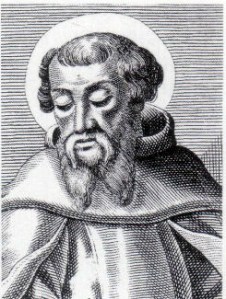
IRENAEUS (d. 202)
“Those who do not obey Him, but being disinherited by Him, have ceased to be His sons.” [Against Heresies 4.41.3]
“We should fear ourselves, least perchance after [we have come to] the knowledge of Christ, if we do things displeasing to God, we obtain no further forgiveness of sins, but are shut out from His Kingdom. And for that reason, Paul said, ‘For if [God] spared not the natural branches, [take heed] lest He also not spare you’” (Romans 11:21). [Against Heresies 4.27.2]
“It is not to those who are on the outside that he said these things, but to us – LEST WE SHOULD BE CAST FORTH FROM THE KINGDOM OF GOD, by doing any such thing.” [Against Heresies 4.27.4]
“Knowing that WHAT PRESERVES HIS LIFE, NAMELY, OBEDIENCE TO GOD, is good, he may diligently keep it with all earnestness.” [Against Heresies 4.39.1]
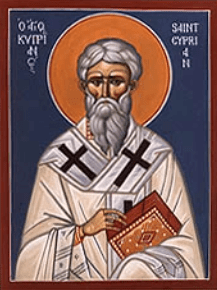
CYPRIAN (d. 258)
“Only let not Christ be forsaken, so that THE LOSS OF SALVATION and of an eternal home would be feared.” [On the Lapsed, Treatise 3, Ch. 10]
“Faith itself and the saving birth do not make alive by merely being received. Rather, they must be preserved…The Lord taught this in His instruction when He said…‘Sin no more, lest a worst thing come upon you’ (John 5:14)…SOLOMON, SAUL, and many others were able to keep the grace given to them so long as they walked in the Lord’s ways. However, when the discipline of the Lord was forsaken by them, grace also forsook them.” [Epistle 6.2]
“Whoever that confessor is, he is not greater, better, or dearer to God than SOLOMON. Solomon retained the grace that he had received from the Lord, as long as he walked inGod’s ways. However, AFTER HE FORSOOK THE LORD’S WAY, HE ALSO LOST THE LORD’S GRACE. For that reason it is written, ‘Hold fast that which you have, lest another take your crown’ (Revelation 3:11)…‘He that endures to the end, the same shall be saved’ (Matthew 10:22).” [Treatise 1.20-21]
“Even a baptized person LOSES THE GRACE that he has attained, unless he remains innocent.” [Treatise 12.3.27]
—
Four Views on Eternal Security by J. Matthew Pinson. My point of view is represented as the Reformed Arminian and Wesleyan Arminian views.
For more evidence of conditional security among the church fathers, see Thomas Oden’s The Transforming Power of Grace, ch. 8: “Election Made Sure Through Faith.”
Several of these quotes from the church fathers can be found in David Bercot’s A Dictionary of Early Christian Beliefs.





 WesleyGospel Ministries