HELL VIDEO & HELL SERMON: The Eternity of Hell-Torments – George Whitefield

Matthew 25:46 “These shall go away into everlasting punishment.”

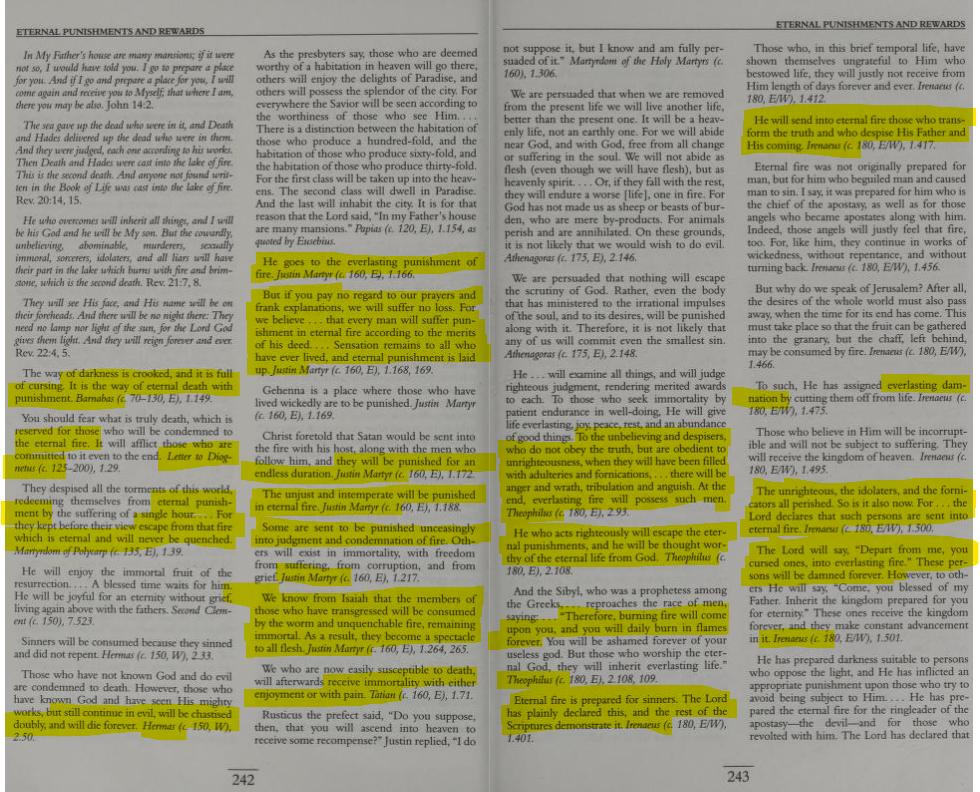
The excellency of the gospel dispensation, is greatly evidenced by those sanctions of rewards and punishments, which it offers to the choice of all its hearers, in order to engage them to be obedient to its precepts. For it promises no less than eternal happiness to the good, and denounces no slighter a punishment than everlasting misery against the wicked: On the one hand, It is a favor of life unto life,” on the other, “A favor of death unto death.” And though one would imagine, the bare mentioning of the former would be sufficient to draw men to their duty, yet ministers in all ages have found it necessary, frequently to remind their people of the latter, and to set before them the terrors of the Lord, as so many powerful dissuasives from sin.

But whence is it that men are so disingenuous [insincere, deceitful]? The reason seems to be this: The promise of eternal happiness is so agreeable to the inclinations and wishes of mankind, that all who call themselves christians, universally and willingly subscribe to the belief of it: but then there is something so shocking in the consideration of eternal torments, and seemingly such an infinite disproportion between an endless duration of pain, and short life spent in pleasure, that men (some at least of them) can scarcely be brought to confess it as an article of their faith, that an eternity of misery awaits the wicked in a future state.

I shall therefore at this time, beg leave to insist on the proof of this part of one of the Articles of our Creed; and endeavor to make good what our blessed Lord has here threatened in the words of the text, “These (that is, the wicked) shall go away into everlasting punishment.”

Accordingly, without considering the words as they stand in relation to the context; I shall resolve all I have to say, into this one general proposition, “That the torments reserved for the wicked hereafter, are eternal.”

But before I proceed to make good this, I must inform you that I take it for granted,

All present do steadfastly believe, They have something within them, which we call a soul, and which is capable of surviving the dissolution of the body, and of being miserable or happy to all eternity.

I take it for granted farther, That you believe a divine revelation; that those books, emphatically called the Scriptures, were written by the inspiration of God, and that the things therein contained, are founded upon eternal truth.

I take it for granted, That you believe, that the Son of God came down to die for sinners; and that there is but one Mediator between God and man, even the man Christ Jesus.

These things being granted, (and they were necessary to be premised) proceed we now to make good the one general proposition asserted in the text, That the torments reserved for the wicked hereafter are eternal. “These shall go away into everlasting punishment.” The

First argument I shall advance to prove that the torments reserved for the wicked hereafter, are eternal, is, That the word of God himself assures us, in line upon line, that it will be so.

To quote all the texts that might be produced in proof of this, would be endless. Let it suffice to instance only in a few. In the Old Testament, in the book of Daniel, chap. 12, ver. 2 we are told, that “some shall wake to everlasting life, and others to everlasting contempt.” In the book of Isaiah, it is said, that “the worm of those that have transgressed God’s law, and die impenitently, shall not die, nor their fire be quenched.” And in another place the holy Prophet , struck, no doubt, with astonishment and horror at the prospect of the continuance of the torments of the damned, breaks out into this moving expostulation, “Who can dwell with everlasting burnings?”

The New Testament is still fuller as to this point, it being a revelation which brought this and such-like particulars to a clear light. The Apostle Jude tells us of the profane despisers of dignities in his days, that “for them was reserved the blackness of darkness forever.” And in the book of the Revelation, it is written, that “the smoke of the torments of the wicked ascendeth for ever and ever.” And if we believe the witness of men inspired, the witness of the Son of God, who had the Spirit given him, as Mediator, without measure, is still far greater: and in St. Mark’s gospel, He repeats this solemn declaration three several times, It is better for thee to enter into life maimed;” that is, it is better to forego the gratification of thy lust, or incur the displeasure of a friend, which may be as dear to thee as a hand, or as useful as a foot, “than having two hands and feet, (that is, for indulging the one, or disobeying God to oblige the other) to be cast into hell, where the worm dieth not, and the fire is not quenched.”

And here again, in the words of the text, “These (the wicked) shall go away into everlasting punishment.”

I know it has been objected by some who have denied the eternity of hell-torments, That the words everlasting and ever and ever, are often used in the Holy Scriptures (especially in the Old Testament) when they signify not an endless duration, but a limited term of time.

And this we readily grant: but then we reply, That when the words are used with this limitation, they either manifestly appear to be used so from the context; or are put in opposition to occasional types which God gave his people on some special occasions, as when it is said, “It shall be a perpetual or everlasting statute,” or, “a statute for ever;” that is, a standing type, and not merely transient or occasional, as was the pillar of cloud, the manna, and such-like. Or, lastly, they have a relation to that covenant, God made with his spiritual Israel; which, if understood in a spiritual sense, will be everlasting, though the ceremonial dispensation be abolished.

Besides, it ought to be observed, that some of the passages just now referred to, have neither of these words so much as mentioned in them, and cannot possibly be interpreted, so as to denote only a limited term of years.

But let that be as it will, it is evident even to a demonstration, that the words of the text will not admit of such a restrained signification, as appears from their being directly opposed to the words immediately following, “That the righteous shall go into life eternal.” From which words, all are ready to grant, that the life promised to the righteous will be eternal. And why the punishment threatened to the wicked should not be understood to be eternal likewise, when the very same word in the original, is used to express the duration of each, no shadow of a reason can be given.

But, Secondly, There cannot be one argument urged, why God should reward his saints with everlasting happiness, which will not equally prove that he ought to punish sinners with eternal misery.

For, since we know nothing (at least for a certainty) how he will deal with either but by a Diving Revelation; and since, as was proved by the foregoing argument, he hath as positively threatened eternally to punish the wicked, as to reward the good; it follows, that his truth will be as much impeached and called in question, did he not inflict his punishments, as it would be, if he did not confer his rewards.

To this also it has been objected, That though God is obliged by promise to give his rewards, yet his veracity could not be called in question, supposing he should not execute his threatenings, as he actually did not in the case of Nineveh; which God expressly declared by his Prophet Jonah, “should be destroyed in forty days:” notwithstanding the sequel of the story informs us, that Nineveh was spared.

But in answer to this objection we affirm, that God’s threatenings, as well as promises, are without repentance; and for this reason, because they are both founded on the eternal laws of right reason. Accordingly we always find, that where the conditions were not performed, on the non-performance of which the threatenings were denounced, God always executed the punishment threatened. The driving Adam out of Eden, the destruction of the old world by a deluge of water, and the overthrow of Sodom and Gomorrah, are, and will be always so many standing monuments of God’s executing his threatenings when denounced, though to our weak apprehensions, the punishment may seem far to exceed the crime.

It is true, God did spare Nineveh, and that because the inhabitants did actually repent, and therefore performed the conditions upon which it was supposed, by the Prophet’s being sent to warn them, the threatened punishment should be withheld.

And so in respect to gospel threatenings. If men will so far consult their own welfare, as to comply with the gospel, God certainly will not punish them, but on the contrary, confer upon them his rewards. But to affirm that he will not punish, and that eternally to, impenitent, obstinate sinners, according as he hath threatened; what is it, in effect, but to make God like a man, that he should lie, or the son of man, that he should repent?

But the absurdity of such an opinion will appear still more evident from

The Third argument I shall offer to prove, that the torments reserved for the wicked hereafter are eternal, From the nature of the christian covenant.

And here I must again observe, that it was taken for granted at the beginning of this discourse, that you believe the Son of God came down to save sinners; and that there is but one Mediator between God and men, even the Man Christ Jesus.

And here I take it for granted farther, (unless you believe the absurd and unwarrantable doctrine of purgatory) that you are fully persuaded, this life is the only time allotted by Almighty God for working out our salvation, and that after a few years are passed over, there will remain no more sacrifice for sin.

And if this be granted (and who dares deny it?) it follows, that if the wicked man dieth in his wickedness, and under the wrath of God, he must continue in that state to all eternity. For, since there is no possibility of their being delivered out of such a condition, but by and through Christ; and since, at the hour of death, the time of Christ’s mediation and intercession for him is irrecoverably gone; the same reason that may be given, why God should punish a sinner that dieth under the guilt of his sins for a single day, will equally hold good, why he should continue to punish him for a year, an age, nay all eternity.

But I hasten to the Fourth and last argument, to prove, That the torments reserved for the wicked hereafter are eternal, Because the devil’s punishment is to be so.

That there is such a being whom we call the devil; that he was once an angel of light, but for his pride and rebellion against God, was cast down from heaven, and is now permitted, with the rest of the spiritual wickednesses, to walk to and fro, seeking whom they may devour; that there is a place of torment reserved for them, or, to use the Apostle’s words, “That they are reserved in everlasting chains under darkness unto the judgment of the great day;” are truths all here present were supposed to be convinced of, at the beginning of the discourse, you believing the Holy Scriptures to be written by the inspiration of God, wherein these truths are delivered.

But then if we allow all this, and think it no injustice in God to punish those once glorious spirits for their rebellion; how can we think it unjust in him, to punish wicked men for their impenitency to all eternity?

You will say, perhaps, that they have sinned against greater light, and therefore deserve a greater punishment. And so we grant that the punishment of the fallen angels may be greater as to degree, than that of wicked men; but then we affirm, it will be equal as to the eternal duration of it: for in that day, as the lively oracles of God inform us, shall the Son of Man say to them on his left hand, “Depart from me, ye cursed, into everlasting fire, prepared for the devil and his angels.” Where we find that impenitent sinners are to be cast into the same everlasting fire, with the devil and his angels; and that too very justly. For though they may have sinned against greater light, yet christians sin against greater mercy. Since Christ took not hold of, did not die for, the fallen angels, but for men and for our salvation. So that if God spared not those excellent beings, assure thyself, O obstinate sinner, whoever thou art, he will by no means spare thee.

From what then has been said it plainly appears, that verily the torments reserved for the wicked hereafter, war eternal. And if so, brethren, how ought we to fly to Jesus Christ for refuge; how holy ought we to be in all manner of conversation and godliness, that we may be accounted worthy to escape this wrath to come!

But before I proceed to a practical exhortation, permit me to draw an inference or two from what has been said.

And First, If the torments reserved for the wicked hereafter are eternal, what shall we say to those, who make an open profession in their creed to believe a life everlasting, a life of misery as well as happiness, and yet dare to live in the actual commission of those sins which will unavoidably, without repentance, bring them into that place of torment? Thou believest that the punishments of the impenitently wicked in another life, are eternal: “Thou dost well, the devils also believe and tremble.” But know O vain man, unless this belief doth influence thy practice, and makes thee bid adieu to thy sins, every time thou repeatest thy creed, thou doest in effect say, I believe I shall be undone for ever.

But, Secondly, If the torments reserved for the wicked hereafter are eternal, then let this serve as a caution to such persons, (and it is to be feared there are some such) who go about to dissuade others from the belief of such an important truth: There being no surer way, in all probability, to encourage and promote infidelity and profaneness, than the broaching or maintaining so unwarrantable a doctrine. For if the positive threats of God concerning the eternity of hell-torments, are already found insufficient to deter men from sin, what a higher pitch of wickedness may w imagine they will quickly arrive at, when they are taught to entertain any hopes of a future recovery out of them; or, what is still worse, that their souls are hereafter to be annihilated, and become like the beasts that perish? But woe unto such blind leaders of the blind. No wonder if they both fall into that ditch. And let such corrupters of God’s word know, that I testify unto every man that heareth me this day, “That if any one shall add unto, or take away from the words that are written in the book of God, God shall take his part out of the book of life, an shall add unto him all the plagues that are in that book.”

Thirdly and Lastly, If the torments reserved for the wicked hereafter are eternal, then this may serve as a reproof for those who quarrel with God, and say it is inconsistent with his justice, to punish a person to all eternity, only for enjoying the pleasures of sin for a season. But such persons must be told, that it is not their thinking or calling God unjust, will make him so, no more than a condemned prisoner’s saying the law or judge is unjust, will render either duly chargeable with such an imputation. But knowest thou, O worm, what blasphemy thou are guilty of, in charging God with injustice? “Shall the thing formed say to him that formed it, why hast thou made me thus?” Wilt thou presume to arraign the Almighty at the bar of thy shallow reasoning? And call him unjust, for punishing thee eternally, only because thou wishest it may not be so? But hath God said it, and shall he not do it? He hath said it: and let God be true, though every man be a liar. “Shall not the judge of all the earth do right?” Assuredly he will. And if sinners will not own his justice in his threatenings here, they will be compelled ere long to own and feel them, when tormented by him hereafter.

But to come to a more practical application of what has been delivered.

You have heard, brethren, the eternity of hell-torments plainly proved, from the express declarations of holy scriptures, and consequences naturally drawn from them. And now there seems to need no great art of rhetoric to persuade any understanding person to avoid and abhor those sins, which without repentance will certainly plunge him into this eternal gulf. The disproportion between the pleasure and the pain (if there be any pleasure in sin) is so infinitely great, that supposing it was only possible, though not certain, that the wicked would be everlastingly punished, no one that has the reason of a man, for the enjoying a little momentary pleasure, would, one might imagine, run the hazard of enduring eternal pain. But since the torments of the damned are not only possible, but certain (since God himself, who cannot lie, has told us so) for men, notwithstanding, to persist in their disobedience, and then flatter themselves, that God will not make good his threatenings, is a most egregious [gross, excessive] instance of folly and presumption.

Dives himself supposed, that if one rose from the dead, his brethren would amend their lives, but Christians, it seems, will not repent, though the Son of God died and rose again, and told them what they must expect, if they continue obstinate in evil-doing.

Would we now and then draw off our thoughts from sensible objects, and by faith meditate a while on the miseries of the damned, I doubt not but we should, as it were, hear many an unhappy soul venting his fruitless sorrows, in some such piteous moans as these.

“O wretched man that I am, who shall deliver me from this body of death!” O foolish mortal that I was, thus to bring myself into these never- ceasing tortures, for the transitory enjoyment of a few short-lived pleasures, which scarcely afforded me any satisfaction, even when I most indulged myself in them. Alas! Are these the wages, these the effects of sin? O damned apostate! First to delude me with pretended promises of happiness, and after several years drudgery in his service, thus to involve me in eternal woe. O that I had never hearkened to his beguiling insinuations! O that I had rejected his very first suggestions with the utmost detestation and abhorrence! O that I had taken up my cross and followed Christ! O that I had never ridiculed serious godliness; and out of a false politeness, condemned the truly pious as too severe, enthusiastic, or superstitious! For I then had been happy indeed, happy beyond expression, happy to all eternity, yonder in those blessed regions where they fit, clothed with unspeakable glory, and chanting forth their seraphic hallelujahs to the Lamb that sitteth upon the throne for ever. But, alas! These reflections come now too late; these wishes now are vain and fruitless. I have not suffered, and therefore must not reign with them. I have in effect denied the Lord that bought me, and therefore justly am I now denied by him. But must I live for ever tormented in these flames? Must this body of mine, which not long since lay in state, was clothed in purple and fine linen, and fared sumptuously every day, must it be here eternally confined, and made the mockery of insulting devils? O eternity! That thought fills me with despair: I must be miserable for ever.”

Come then, all ye self-deluding, self-deluded sinners, and imagine yourselves for once in the place of that truly wretched man I have been here describing. Think, I beseech you by the mercies of God in Christ Jesus, think with yourselves, how racking, how unsupportable the never- dying worm of a self-condemning conscience will hereafter be to you. Think how impossible it will be for you to dwell with everlasting burnings.

Come, all ye christians of a lukewarm, Laodicean spirit, ye Gallie’s in religion, who care a little, but not enough for the things of God; O think, think with yourselves, how deplorable it will be to lose the enjoyment of heaven, and run into endless torments, merely because you will be content to be almost, and will not strive to be altogether christians. Consider, I beseech you consider, how you will rave and curse that fatal stupidity which made you believe any thing less than true faith in Jesus, productive of a life of strict piety, self-denial, and mortification, can keep you from those torments, the eternity of which I have been endeavoring to prove.

But I can no more. These thoughts are too melancholy for me to dwell on, as well as for you to hear; and God knows, as punishing is his strange work, so denouncing his threatenings is mine. But if the bare mentioning the torments of the damned is so shocking, how terrible must the enduring of them be!

And now, are not some of you ready to cry out, “These are hard sayings, who can bear them?”

But let not sincere Christians be in the least terrified at what has been delivered: No, for you is reserved a crown, a kingdom, an eternal and exceeding weight of glory. Christ never said that the righteous, the believing, the upright, the sincere, but the wicked, merciless, negatively good professors before described, shall go into everlasting punishment. For you, who love him in sincerity, a new and living way is laid open into the Holy of Holies by the blood of Jesus Christ: and an abundant entrance will be administered unto you, at the great day of account, into eternal life. Take heed, therefore, and beware that there be not in any of you a root of bitterness springing up of unbelief: but on the contrary, steadfastly and heartily rely on the many precious promises reached out to you in the gospel, knowing that he who hath promised is faithful, and therefore will perform.

But let no obstinately wicked professors dare to apply any of the divine promises to themselves: “For it is not meet to take the children’s meat and give it unto dogs:” No, to such the terrors of the Lord only belong. And as certainly as Christ will say to his true followers, “Come, ye blessed children of my Father, receive the kingdom prepared for you from the beginning of the world;” so he will unalterably pronounce this dreadful sentence against all that die in their sins, “Depart from me, ye cursed, into everlasting fire, prepared for the devil and his angels.”

From which unhappy state, may God of his infinite mercy deliver us all through Jesus Christ; to whom, with thee O Father, and thee O Holy Ghost, three Persons and one eternal God, be ascribed, as is most due, all honor, power, might, majesty, and dominion, now and for ever more.

Posted in Uncategorized | Leave a comment

“Beards Nothin’ More Than Pride!” Says Heretical Oneness Preacher

Behold, how good and how pleasant it is for brethren to dwell together in unity! It is like the precious ointment upon the head, that ran down upon the beard, even Aaron’s beard: that went down to the skirts of his garments. –Psalm 133:1-2 (KJV)

William J. Seymour and Tom Hezmalhalch had beards. Other guys at the Apostolic Faith Gospel Mission had mustaches. I think its safe to say that anti-beard Oneness preachers are basically just wrong.
Posted in Uncategorized | Leave a comment

What Charismatics Should Do If Mike Bickle Has Hurt Their Faith

GOSPEL PUBLISHING HOUSE BOOKS – ASSEMBLIES OF GOD

PATHWAY PRESS BOOKS – CHURCH OF GOD (CLEVELAND, TN)

LEONARD RAVENHILL SERMONS


DAVID WILKERSON SERMONS

St. Augustine himself (A wonderful saint! As full of pride, passion, bitterness, censoriousness, and as foul-mouthed to all that contradicted him, as George Fox himself.) –John Wesley

Posted in Uncategorized | Leave a comment

Supernatural Theology 116: Reformed Christianity vs Pentecostalism

Chris Magoc, Imperialism and Expansionism in American History.
Posted in Uncategorized | Leave a comment

Supernatural Theology 115: The Prophet Without Honor

Jesus, said unto them, A prophet is not without honour, but in his own country, and among his own kin, and in his own house. –Mark 6:4 (KJV)
CHURCH OF GOD AND PENTECOSTAL HOLINESS PEOPLE NEED TO USE THIS INSTEAD!


JUNE 2, 2012

Dr. Kenneth Collins is probably, in my opinion, the greatest Wesleyan soteriologist alive today. This is not to say I think he knows more about Wesley than others: just to say, I think he understands, and articulates Wesley’s views of the Gospel with more clarity, and HONESTY than any other scholar. Collins leaves no stones unturned. He is critical of all Wesleyan scholars: he only cares about the truth, not nonsensical speculations:

WHAT DID WESLEY BELIEVE!? That’s all Collins cares about. WHAT DID WESLEY PREACH!? Again, that’s all Collins seems to mind. Never mind what Albert Outler said, or what Colin Williams, William Cannon, or Randy Maddox argue and maintain. If what these Methodist scholars say doesn’t line up with WESLEY:–then he THROWS IT OUT! Will the real John Wesley please stand up? Dr. Collins honestly tries to reveal this Rev. John Wesley, the fire-brand evangelist that set the world on fire for God. Collins tactfully opposes Outler’s disrespect for the Aldersgate Experience, Williams’ rejection of the moral law, Cannon’s distortion of synergism, and in a recent e-mail, confirmed to me with utmost clarity, that he is against the highly speculative and utterly non-evangelistic nature, of Randy Maddox’s Christian universalism expressed in chapter 1 of Responsible Grace:

Hi Dr. Collins,

I’m really struggling with Randy Maddox’s Responsible Grace. In chapter 1, he has an “Excursus: The Possibility of Extra-Christian Salvation.” And for a couple of pages, it appears he is trying to make the argument that John Wesley believed in “anonymous Christian” universal salvation (good heathens who have never heard the Gospel)–because Wesley deleted an Anglican article of religion for the American Methodists (Article XVIII), entitled: “Of Obtaining Eternal Salvation Only by the Name of Christ”).

When I read this, I was disturbed in my heart about Maddox ever since.

If you have the time, could you read this section, and help me understand your view of this subject? I know you wouldn’t buy it. It would totally contradict the Aldersgate Experience where Wesley felt “Christ alone” forgave his sins.

John

_______________

Hi John!

I am very familiar with this issue and I once again differ from Maddox.

A few observations are in order:

1) Many scholars on this topic are confusing prevenient grace (which is a measure of grace to be sure) with saving grace properly speaking (justifying and regenerating grace). Simply put, prevenient grace is not saving grace.

2) There are not two paths to salvation but only one: faith in Jesus Christ. Simply put, all sinners need a Mediator; none can go directly to the Father given the alienation of sin. How then can one be united to Christ and not know Him? How can one be united to the Church, as the body of Christ, and not know it? Is there such a thing as an individual, isolated, Christian? Wesley stated that Christianity is a social religion and to turn it into a solitary one is to destroy it.

3) This is a very speculative issue but how many people in the world today (given the information revolution, the Internet, etc.) have not been exposed to the claims of the Gospel? And if they haven’t heard, then we need to send the missionaries and not construct theologies that comfort us in doing next to nothing in this regard.

Again if someone has not heard the Gospel then we should rightly ask: Is that person a recipient of justifying and regenerating graces, are they free from the guilt and power of sin? Are they holy? Not likely, though I suppose some will argue that the Holy Spirit can directly offer Christ to the heart and that heart can then embrace the offer. Clearly, this is a highly speculative issue and therefore not a good basis upon which to construct a well grounded theology. Again, it is far better to send the missionary.

Beyond this, such a view as what Maddox and others are arguing cannot take account of Romans 10:14-15. It’s an embarrassment to their theological constructs:

14 How then will they call on Him in whom they have not believed? How will they believe in Him whom they have not heard? And how will they hear without a preacher? 15 How will they preach unless they are sent? Just as it is written, “How beautiful are the feet of those who bring good news of good things” (Romans 10:14-15, NASB).

Blessings!

Ken Collins


Posted in Uncategorized | Leave a comment

Do You Have Excessive Religious OCD Scrupulosity About Sin and Hell?

Posted in Uncategorized | Leave a comment

HELL VIDEO & HELL SERMON: Of Hell – John Wesley

Where their worm dieth not, and the fire is not quenched. Mark 9:48.

1. Every truth which is revealed in the oracles of God is undoubtedly of great importance. Yet it may be allowed that some of those which are revealed therein are of greater importance than others, as being more immediately conducive to the grand end of all, the eternal salvation of men. And we may judge of their importance even from this circumstance, — that they are not mentioned once only in the sacred writings, but are repeated over and over. A remarkable instance of this we have with regard to the awful truth which is now before us. Our blessed Lord, who uses no superfluous words, who makes no “vain repetitions,” repeats it over and over in the same chapter, and as it were, in the same breath. So, (Mark 9:43, 44,) “If thy hand offend thee,” — if a thing or person, as useful as a hand, be an occasion of sin, and there is no other way to shun that sin, — “cut it off: It is better for thee to enter into life maimed, than having two hands to go into hell, into the fire that shall never be quenched: Where their worm dieth not, and the fire is not quenched.” So again, (Mark 9:45, 46,) “If thy foot offend thee, cut it off: It is better for thee to enter halt into life, than having two feet to be cast into hell, into the fire that shall never be quenched: Where their worm dieth not, and the fire is not quenched.” And yet again, (Mark 9:47, 48,) “If thine eye” — a person or thing as dear as thine eye — “offend thee,” — hinder thy running the race which is set before thee, — “pluck it out : It is better for thee to enter into the kingdom of God with one eye, than having two eyes to be cast into hell-fire: Where their worm dieth not, and the fire is not quenched.”

2. And let it not be thought, that the consideration of these terrible truths is proper only for enormous sinners. How is this supposition consistent with what our Lord speaks to those who were then, doubtless, the holiest men upon earth “When innumerable multitudes were gathered together, he said to his disciples” (the Apostles) “first of all, I say unto you, my friends, Fear not them that can kill the body, and after that have no more that they can do. But I say unto you, Fear him, who after he hath killed hath power to cast into hell; yea, I say unto you, Fear him.” (Luke 12:1-5.) Yea, fear him under this very notion, — of having power to cast into hell: That is, in effect, fear lest he should cast you into the place of torment. And this very fear, even in the children of God, is one excellent means of preserving them from it.

3. It behoves, therefore not only the outcasts of men, but even you, his friends, you that fear and love God, deeply to consider what is revealed in the oracles of God concerning the future state of punishment. How widely distant is this from the most elaborate accounts which are given by the heathen authors! Their accounts are (in many particulars at least) childish, fanciful, and self-inconsistent. So that it is no wonder they did not believe themselves, but only related the tales of the vulgar. So Virgil strongly intimates, when, after the laboured account he had given of the shades beneath, he sends him that had related it out at the ivory gate, through which (as he tells us) only dreams pass; thereby giving us to know that all the preceding account is no more than a dream. This he only insinuates; but his brother poet, Juvenal, speaks out flat and plain, —

Esse aliquos manes, et subterranea regna, Nec pueri credunt, nisi qui nondum aere lavantur:

“Even our children do not believe a word of the tales concerning another world.”

4. Here, on the contrary, all is worthy of God, the Creator, the Governor of mankind. All is awful and solemn; suitable to his wisdom and justice by whom “Tophet was ordained of old;” although originally prepared, not for the children of men, but “for the devil and his angels.”

The punishment of those who, in spite of all the warnings of God, resolve to have their portion with the devil and his angels, will, according to the ancient and not improper division, be either paena damni, — “what they lose;” or paena sensus, — “what they feel.” After considering these separately, I shall touch on a few additional circumstances, and conclude with two or three inferences.

I. 1. And, First, let us consider the paena damni, — “the punishment of loss.” This commences in that very moment wherein the soul is separated from the body; in that instant, the soul loses all those pleasures, the enjoyment of which depends on the outward senses. The smell, the taste, the touch, delight no more: The organs that ministered to them are spoiled, and the objects that used to gratify them are removed far away. In the dreary regions of the dead all these things are forgotten; or, if remembered, are only remembered with pain; seeing they are gone for ever. All the pleasures of the imagination are at an end. There is no grandeur in the infernal regions; there is nothing beautiful in those dark abodes; no light but that of livid flames. And nothing new, but one unvaried scene of horror upon horror! There is no music but that of groans and shrieks; of weeping, wailing, and gnashing of teeth; of curses and blasphemies against God, or cutting reproaches of one another. Nor is there anything to gratify the sense of honour: No; they are the heirs of shame and everlasting contempt.

2. Thus are they totally separated from all the things they were fond of in the present world. At the same instant will commence another loss, — that of all the persons whom they loved. They are torn away from their nearest and dearest relations; their wives, husbands, parents, children; and (what to some will be worse than all this) the friend which was as their own soul. All the pleasure they ever enjoyed in these is lost, gone, vanished away: For there is no friendship in hell. Even the poet who affirms, (though I know not on what authority,)

Devil with devil damn’d  Firm concord holds,

does not affirm that there is any concord among the human fiends that inhabit the great abyss.

3. But they will then be sensible of a greater loss than that of all they enjoyed on earth. They have lost their place in Abraham’s bosom, in the paradise of God. Hitherto, indeed, it hath not entered into their hearts to conceive what holy souls enjoy in the garden of God, in the society of angels, and of the wisest and best men that have lived from the beginning of the world; (not to mention the immense increase of knowledge which they will then undoubtedly receive;) but they will then fully understand the value of what they have vilely cast away.

4. But as happy as the souls in paradise are, they are preparing for far greater happiness. For paradise is only the porch of heaven; and it is there the spirits of just men are made perfect. It is in heaven only that there is the fulness of joy; the pleasures that are at God’s right hand for evermore. The loss of this, by those unhappy spirits, will be the completion of their misery. They will then know and feel, that God alone is the centre of all created spirits; and, consequently, that a spirit made for God can have no rest out of him. It seems that the Apostle had this in his view when he spoke of those “who shall be punished with everlasting destruction from the presence of the Lord.” Banishment from the presence of the Lord is the very essence of destruction to a spirit that was made for God. And if that banishment lasts for ever, it is “everlasting destruction.”

Such is the loss sustained by those miserable creatures, on whom that awful sentence will be pronounced: “Depart from me, ye cursed!” What an unspeakable curse, if there were no other! But, alas! this is far from being the whole: For, to the punishment of loss, will be added the punishment of sense. What they lose implies unspeakable misery, which yet is inferior to what they feel. This it is which our Lord expresses in those emphatical words: “Where their worm dieth not, and the fire is not quenched.”

II. 1. From the time that sentence was pronounced upon man, “Dust thou art, and unto dust thou shalt return,” it was the custom of all nations, so far as we can learn, to commit dust to dust: It seemed natural to restore the bodies of the dead to the general mother, earth. But in process of time another method obtained, chiefly among the rich and great, of burning the bodies of their relations, and frequently in a grand magnificent manner; for which purpose they erected huge funeral piles, with immense labour and expense. By either of these methods the body of man was soon restored to its parent dust. Either the worm or the fire soon consumed the well-wrought frame; after which the worm itself quickly died, and the fire was entirely quenched. But there is, likewise, a worm that belongs to the future state; and that is a worm that never dieth! and there is a fire hotter than that of the funeral pile; and it is a fire that will never be quenched!

2. The First thing intended by the worm that never dieth, seems to be a guilty conscience; including self-condemnation, sorrow, shame, remorse, and a sense of the wrath of God. May not we have some conception of this, by what is sometimes felt even in the present world Is it not of this, chiefly, that Solomon speaks, when he says, “The spirit of a man may bear his infirmities;” his infirmities, or griefs, of any other kind; “but a wounded spirit who can bear” Who can bear the anguish of an awakened conscience, penetrated with a sense of guilt, and the arrows of the Almighty sticking in the soul, and drinking up the spirit How many of the stout-hearted have sunk under it, and chose strangling rather than life! And yet what are these wounds, what is all this anguish of a soul while in this present world, in comparison of those they must suffer when their souls are wholly awakened to feel the wrath of an offended God! Add to these all unholy passions; fear, horror, rage; evil desires; desires that can never be satisfied. Add all unholy tempers; envy, jealousy, malice, and revenge; all of which will incessantly gnaw the soul, as the vulture was supposed to do the liver of Tityus. To these if we add hatred of God, and all his creatures; all these united together may serve to give us some little, imperfect idea of the worm that never dieth.

3. We may observe a remarkable difference in the manner wherein our Lord speaks concerning the two parts of the future punishment. He says, “Where their worm dieth not,” of the one; “where the fire is not quenched,” of the other. This cannot be by chance. What then is the reason for this variation of the expression

Does it not seem to be this The fire will be the same, essentially the same, to all that are tormented therein; only perhaps more intense to some than others, according to their degree of guilt; but their worm will not, cannot be the same. It will be infinitely varied, according to the various kinds, as well as degrees, of wickedness. This variety will arise partly from the just judgment of God, “rewarding every man according to his works:” For we cannot doubt but this rule will take place no less in hell than in heaven. As in heaven “every man will receive his own reward,” incommunicably his, according to his own labours, — that is, the whole tenor of his tempers, thoughts, words, and actions; — so undoubtedly, every man, in fact, will receive his own bad reward, according to his own bad labour. And this, likewise, will be incommunicably his own, even as his labour was. Variety of punishment will likewise arise from the very nature of the thing. As they that bring most holiness to heaven will find most happiness there; so, on the other hand, it is not only true, that the more wickedness a man brings to hell the more misery he will find there; but that this misery will be infinitely varied according to the various kinds of his wickedness. It was therefore proper to say, the fire, in general; but their worm, in particular.

4. But it has been questioned by some, whether there be any fire in hell; that is, any material fire. Nay, if there be any fire, it is unquestionably material. For what is immaterial fire The same as immaterial water or earth! Both the one and the other is absolute nonsense, a contradiction in terms. Either, therefore, we must affirm it to be material, or we deny its existence. But if we granted them, there is no fire at all there, what would they gain thereby seeing this is allowed, on all hands, that it is either fire or something worse. And consider this: Does not our Lord speak as if it were real fire No one can deny or doubt of this. Is it possible then to suppose that the God of truth would speak in this manner if it were not so Does he design to fright his poor creatures What, with scarecrows with vain shadows of things that have no being O let not anyone think so! Impute not such folly to the Most High!

5. But others aver, “It is not possible that fire should burn always. For by the immutable law of nature, it consumes whatever is thrown into it. And by the same law, as soon as it has consumed its fuel, it is itself consumed; it goes out.”

It is most true, that in the present constitution of things, during the present laws of nature, the element of fire does dissolve and consume whatever is thrown into it. But here is the mistake: The present laws of nature are not immutable. When the heavens and the earth shall flee away, the present scene will be totally changed; and, with the present constitution of things, the present laws of nature will cease. After this great change, nothing will be dissolved, nothing will be consumed any more. Therefore, if it were true that fire consumes all things now, it would not follow that it would do the same after the whole frame of nature has undergone that vast, universal change.

6. I say, If it were true that “fire consumes all things now.” But, indeed, it is not true. Has it not pleased God to give us already some proof of what will be hereafter Is not the Linum Asbestum, the incombustible flax, known in most parts of Europe If you take a towel or handkerchief made of this, (one of which may now be seen in the British Museum,) you may throw it into the hottest fire, and when it is taken out again, it will be observed, upon the nicest experiment, not to have lost one grain of its weight. Here, therefore, is a substance before our eyes, which, even in the present constitution of things, (as if it were an emblem of things to come,) may remain in fire without being consumed.

7. Many writers have spoken of other bodily torments, added to the being cast into the lake of fire. One of these, even pious Kempis, supposes that misers, for instance, have melted gold poured down their throats; and he supposes many other particular torments to be suited to men’s particular sins. Nay, our great poet himself supposes the inhabitants of hell to undergo a variety of tortures; not to continue always in the lake of fire, but to be frequently,

By harpy-footed furies, haled

into regions of ice; and then back again through extremes, by change more fierce:

But I find no word, no tittle of this, not the least hint of it in all the Bible. And surely this is too awful a subject to admit of such play of imagination. Let us keep to the written word. It is torment enough to dwell with everlasting burnings.

8. This is strongly illustrated by a fabulous story, taken from one of the eastern writers, concerning a Turkish King, who, after he had been guilty of all manner of wickedness, once did a good thing: For seeing a poor man falling into a pit, wherein he must have inevitably perished, and kicking him from it, he saved his life. The story adds, that when, for his enormous wickedness, he was cast into hell, that foot wherewith he had saved the man’s life was permitted to lie out of the flames. But allowing this to be a real case, what a poor comfort would it be! What, if both feet were permitted to lie out of the flames, yea, and both hands, how little would it avail! Nay, if all the body were taken out, and placed where no fire touched it, and only one hand or one foot kept in a burning fiery furnace; would the man, meantime, be much at ease Nay, quite the contrary. Is it not common to say to a child, “Put your finger into that candle: Can you bear it even for one minute How then will you bear hell-fire” Surely it would be torment enough to have the flesh burnt off from only one finger. What then will it be, to have the whole body plunged into a lake of fire burning with brimstone!

III. It remains now only to consider two or three circumstances attending the never-dying worm and the unquenchable fire.

1. And, First, consider the company wherewith everyone is surrounded in that place of torment. It is not uncommon to hear even condemned criminals, in our public prisons, say, “O I wish I was hanged out of the way, rather than to be plagued with these wretches that are round about me!” But what are the most abandoned wretches upon earth, compared to the inhabitants of hell None of these are, as yet, perfectly wicked, emptied of every spark of good; certainly not till this life is at an end; probably not till the day of judgment. Nor can any of these exert, without control, their whole wickedness on their fellow-creatures. Sometimes they are restrained by good men; sometimes even by bad. So even the tortures in the Romish Inquisition are restrained by those that employ them, when they suppose the sufferer cannot endure any more. They then order the executioners to forbear; because it is contrary to the rules of the house that a man should die upon the rack. And very frequently, when there is no human help, they are restrained by God, who hath set them their bounds which they cannot pass, and saith, “Hitherto shall ye come, and no farther.” Yea, so mercifully hath God ordained, that the very extremity of pain causes a suspension of it. The sufferer faints away; and so, for a time at least, sinks into insensibility. But the inhabitants of hell are perfectly wicked, having no spark of goodness remaining. And they are restrained by none from exerting to the uttermost their total wickedness. Not by men; none will be restrained from evil by his companions in damnation: And not by God; for He hath forgotten them, hath delivered them over to the tormentors. And the devils need not fear, like their instruments upon earth, lest they should expire under the torture. They can die no more: They are strong to sustain whatever the united malice, skill, and strength of angels can inflict upon them. And their angelic tormentors have time sufficient to vary their torments a thousand ways. How infinitely may they vary one single torment, — horrible appearances! Whereby, there is no doubt, an evil spirit, if permitted, could terrify the stoutest man upon earth to death.

2. Consider, Secondly, that all these torments of body and soul are without intermission. They have no respite from pain; but “the smoke of their torment ascendeth up day and night.” Day and night! that is, speaking according to the constitution of the present world; wherein God has wisely and graciously ordained that day and night should succeed each other: So that in every four and twenty hours there comes a

Daily sabbath, made to rest  Toiling man and weary beast.

Hence we seldom undergo much labour, or suffer much pain, before

Tired nature’s sweet restorer, balmy sleep,

steals upon us by insensible degrees, and brings an interval of ease.

But although the damned have uninterrupted night, it brings no interruption of their pain. No sleep accompanies that darkness: Whatever either ancient or modern poets, either Homer or Milton, dream, there is no sleep either in hell or heaven. And be their suffering ever so extreme, be their pain ever so intense, there is no possibility of their fainting away; no, not for a moment.

Again: The inhabitants of earth are frequently diverted from attending to what is afflictive, by the cheerful light of the sun, the vicissitudes of the seasons, “the busy hum of men,” and a thousand objects that roll around them with endless variety. But the inhabitants of hell have nothing to divert them from their torments, even for a moment:

Total eclipse: No sun, no moon!

No change of seasons, or of companions. There is no business; but one uninterrupted scene of horror, to which they must be all attention. They have no interval of inattention or stupidity: They are all eye, all ear, all sense. Every instant of their duration, it may be said of their whole frame, that they are

Tremblingly alive all o’er,  And smart and agonize at every pore!

3. And of this duration there is no end! What a thought is this! Nothing but eternity is the term of their torment! And who can count the drops of rain, or the sands of the sea, or the days of eternity Every suffering is softened, if there is any hope, though distant, of deliverance from it. But here, Hope never comes, that comes to all the inhabitants of the upper world! What! sufferings never to end!

NEVER! — Where sinks the soul at that dread sound  Into a gulf how dark, and how profound!

Suppose millions of days, of years, of ages elapsed, still we are only on the threshold of eternity! Neither the pain of body nor of soul is any nearer an end, than it was millions of ages ago. When they are cast into to pur to asbeston, (How emphatical! “The fire, the unquenchable,”) all is concluded: “Their worm dieth not, and the fire is not quenched!”

Such is the account which the Judge of all gives of the punishment which he has ordained for impenitent sinners. And what a counterbalance may the consideration of this be to the violence of any temptation! in particular, to the fear of man; the very use to which it is applied by our Lord himself: “Be not afraid of them that kill the body, and after that have no more that they can do. But fear Him, who after he hath killed hath power to cast into hell.” (Luke 12:4, 5)

What a guard may these considerations be against any temptation from pleasure! Will you lose, for any of these poor, earthly pleasures, which perish in the using, (to say nothing of the present substantial pleasures of religion,) the pleasures of Paradise; such as “eye hath not seen, nor ear heard, neither hath it entered into our hearts to conceive” yea, the pleasures of heaven, the society of angels, and of the spirits of just men made perfect; the conversing face to face with God your Father, your Saviour, your Sanctifier; and the drinking of those rivers of pleasure that are at God’s right hand for evermore

Are you tempted by pain, either of body or mind O compare present things with future! What is the pain of body which you do or may endure, to that of lying in a lake of fire burning with brimstone What is any pain of mind; any fear, anguish, sorrow, compared to the “worm that never dieth” That never dieth! This is the sting of all! As for our pains on earth, blessed be God, they are not eternal. There are some intervals to relieve and there is some period to finish them. When we ask a friend that is sick, how he does; “I am in pain now,” says he, “but I hope to be easy soon.” This is a sweet mitigation of the present uneasiness. But how dreadful would his case be if he should answer, “I am all over pain, and I shall never be eased of it. I lie under exquisite torment of body, and horror of soul; and I shall feel it for ever!” Such is the case of the damned sinners in hell. Suffer any pain, then, rather than come into that place of torment!

I conclude with one more reflection, taken from Dr. Watts, — “It demands our highest gratitude, that we who have long ago deserved this misery are not yet plunged into it. While there are thousands who have been adjudged to this place of punishment, before they had continued so long in sin as many of us have done, what an instance is it of divine goodness, that we are not under this fiery vengeance! Have we not seen many sinners, on our right and left, cut off in their sins And what but the tender mercy of God hath spared us week after week, month after month, and given us space for repentance What shall we render unto the Lord for all his patience and longsuffering even to this day How often have we incurred the sentence of condemnation by our repeated rebellion against God! And yet we are still alive in his presence, and are hearing the words of hope and salvation. O let us look back and shudder at the thoughts of that dreadful precipice, on the edge of which we have so long wandered! Let us fly for refuge to the hope that is set before us, and give a thousand thanks to the divine mercy, that we are not plunged into this perdition!”

Posted in Uncategorized | Leave a comment

Biblical Economics 147: Mailmeteor Pro Might Be the New GMass

Posted in Uncategorized | Leave a comment

How to Heal the Sick Session 1 – Charles & Frances Hunter

CLICK HERE FOR HEALING SERIES.

Posted in Uncategorized | Leave a comment

Supernatural Theology 114: Raising Our Faith In the Healing Power of God

The centurion replied, “Lord, I do not deserve to have you come under my roof. But just say the word, and my servant will be healed. For I myself am a man under authority, with soldiers under me. I tell this one, ‘Go,’ and he goes; and that one, ‘Come,’ and he comes. I say to my servant, ‘Do this,’ and he does it.” When Jesus heard this, he was amazed and said to those following him, “Truly I tell you, I have not found anyone in Israel with such great faith. –Matthew 8:8-10 (NIV)

He replied, “You of little faith, why are you so afraid?” Then he got up and rebuked the winds and the waves, and it was completely calm. –Matthew 8:26 (NIV)

The power of the Lord was present to heal them.   –Luke 5:17 (KJV)

Is anyone among you sick? Let them call the elders of the church to pray over them and anoint them with oil in the name of the Lord. And the prayer offered in faith will make the sick person well; the Lord will raise them up. –James 5:14-15 (NIV)


There are degrees in faith, and that a man may have some degree of it before all things in him become new — before he has the full assurance of faith, the abiding witness of the Spirit, or the clear perception that Christ dwelleth in him. –John Wesley


As they say, “Eat the meat and spit out the bones”…

Charles and Frances Hunter, How to Heal the Sick.

Robby Dawkins, Do What Jesus Did.


Roberts Liardon, ed. John G. Lake: The Complete Collection of His Life Teachings.

—. Smith Wigglesworth: The Complete Collection of His Life Teachings.

—. Maria Woodworth-Etter: The Complete Collection of Her Life Teachings.

John Wimber, Power Healing.

Francis MacNutt, Healing.

Kathryn Kuhlman, Captain LeVrier Believes In Miracles.


Posted in Uncategorized | Leave a comment