
-
-

-
LATEST POSTS
- The Antinomian Cessationism of Ray Comfort
- A Mother’s Day Message for Dysfunctional Families
- There’s an Objective Moral Law of God That Transcends All Cultures Across the World – Dr. Frank Turek
- The Reality of the Devil – Good Fight Ministries
- Seven Qualities of Powerful Preaching – Matthew Everhard
RECENT VIEWS
- Joseph Z False Prophetic Word Over Daystar CEO Joni Lamb & Doug Weiss Before Her Death - Joshua Simone
- Jonathan Lamb To Be Daystar’s New CEO — He Will Rid Christian TV of Sin, Corruption, False Prophets - Joshua Simone
- The Godzillas of Drugs and Alcohol
- Some Christians Are Against All Rock Music...And I Just Don’t Understand It
- Review of Dr. Jack Deere’s “Surprised by the Voice of God”
- A Critique of the Prophetic Movement - Art Katz
- There’s an Objective Moral Law of God That Transcends All Cultures Across the World - Dr. Frank Turek
- Demons: An Eyewitness Account - Howard Pittman
- Review of Dr. Wayne Grudem’s “The Gift of Prophecy”
- The Nature of Real Evangelical Revival
MONTHLY ARCHIVES
- May 2026 (55)
- April 2026 (118)
- March 2026 (127)
- February 2026 (122)
- January 2026 (213)
- December 2025 (238)
- November 2025 (268)
- October 2025 (169)
- September 2025 (126)
- August 2025 (104)
- July 2025 (102)
- June 2025 (76)
- May 2025 (91)
- April 2025 (145)
- March 2025 (149)
- February 2025 (121)
- January 2025 (134)
- December 2024 (95)
- November 2024 (136)
- October 2024 (126)
- September 2024 (76)
- August 2024 (80)
- July 2024 (102)
- June 2024 (94)
- May 2024 (58)
- April 2024 (54)
- March 2024 (34)
- February 2024 (95)
- January 2024 (61)
- December 2023 (6)
- November 2023 (36)
- October 2023 (24)
- September 2023 (18)
- August 2023 (13)
- July 2023 (11)
- June 2023 (15)
- May 2023 (22)
- April 2023 (14)
- March 2023 (6)
- February 2023 (6)
- January 2023 (11)
- December 2022 (14)
- November 2022 (15)
- October 2022 (10)
- September 2022 (1)
- August 2022 (3)
- July 2022 (2)
- June 2022 (1)
- May 2022 (3)
- April 2022 (7)
- March 2022 (6)
- February 2022 (2)
- January 2022 (4)
- December 2021 (7)
- November 2021 (5)
- September 2021 (1)
- August 2021 (1)
- July 2021 (3)
- June 2021 (1)
- May 2021 (2)
- March 2021 (3)
- February 2021 (2)
- December 2020 (1)
- October 2020 (1)
- November 2019 (1)
- October 2019 (2)
- September 2019 (1)
- August 2019 (1)
- July 2019 (7)
- June 2019 (4)
- May 2019 (4)
- April 2019 (18)
- March 2019 (7)
- February 2019 (4)
- January 2019 (6)
- December 2018 (3)
- November 2018 (2)
- October 2018 (4)
- September 2018 (5)
- August 2018 (3)
- July 2018 (2)
- June 2018 (1)
- May 2018 (3)
- April 2018 (8)
- January 2018 (2)
- December 2017 (5)
- November 2017 (1)
- October 2017 (8)
- September 2017 (4)
- August 2017 (6)
- July 2017 (6)
- June 2017 (6)
- May 2017 (10)
- April 2017 (20)
- March 2017 (15)
- February 2017 (10)
- January 2017 (10)
- December 2016 (8)
- November 2016 (10)
- October 2016 (22)
- September 2016 (15)
- August 2016 (5)
- July 2016 (8)
- June 2016 (3)
- May 2016 (7)
- April 2016 (4)
- March 2016 (10)
- February 2016 (3)
- January 2016 (10)
- December 2015 (8)
- November 2015 (9)
- October 2015 (7)
- September 2015 (5)
- August 2015 (13)
- July 2015 (9)
- June 2015 (2)
- May 2015 (6)
- April 2015 (38)
- March 2015 (28)
- February 2015 (28)
- January 2015 (28)
- December 2014 (19)
- November 2014 (15)
- October 2014 (5)
- September 2014 (9)
- August 2014 (17)
- July 2014 (30)
- June 2014 (16)
- May 2014 (17)
- April 2014 (17)
- March 2014 (6)
- February 2014 (8)
- January 2014 (8)
- December 2013 (2)
- November 2013 (2)
- October 2013 (3)
- September 2013 (2)
- August 2013 (2)
- July 2013 (1)
- June 2013 (2)
- May 2013 (7)
- April 2013 (9)
- March 2013 (6)
- February 2013 (3)
- January 2013 (6)
- December 2012 (2)
- November 2012 (2)
- October 2012 (4)
- September 2012 (6)
- August 2012 (4)
- July 2012 (7)
- June 2012 (1)
- May 2012 (3)
- April 2012 (5)
- March 2012 (2)
- February 2012 (3)
- January 2012 (1)
- December 2011 (5)
- November 2011 (4)
- October 2011 (10)
- September 2011 (2)
- August 2011 (3)
- July 2011 (2)
- June 2011 (4)
- May 2011 (4)
- April 2011 (4)
- March 2011 (6)
- February 2011 (4)
- January 2011 (1)
- December 2010 (7)
- November 2010 (5)
- October 2010 (9)
- September 2010 (3)
-
Halloween: Trick or Treat (1991) – Jeremiah Films
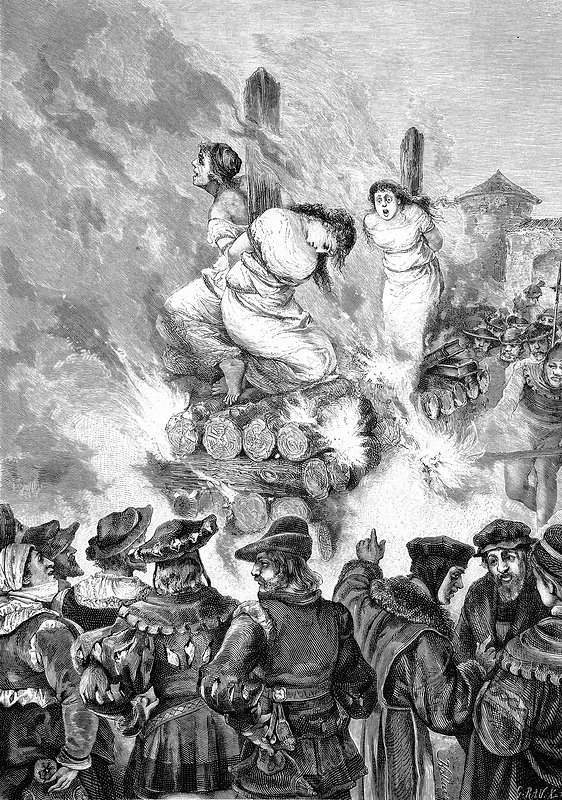
Halloween might have been turned into a pop holiday for cute kids’ costumes and going door-to-door for candy, but the spiritual substance of Halloween, if people would just stop and think about it is essentially devil worship, Satanic Ritual Abuse (SRA), Wicca, and Druidism. Even human sacrifice! Not to mention devil-glorifying horror films which bring demonic oppression and hauntings into people’s lives. If people want to give attention to fear in October, then use this time to preach hellfire and brimstone sermons, but not to glorify the devil. –J.B.
9 When you come into the land which the Lord your God is giving you, you shall not learn to follow the abominations of those nations. 10 There shall not be found among you anyone who makes his son or his daughter pass through the fire, or one who practices witchcraft, or a soothsayer, or one who interprets omens, or a sorcerer, 11 or one who conjures spells, or a medium, or a spiritist, or one who calls up the dead. 12 For all who do these things are an abomination to the Lord, and because of these abominations the Lord your God drives them out from before you. 13 You shall be blameless before the Lord your God. 14 For these nations which you will dispossess listened to soothsayers and diviners; but as for you, the Lord your God has not appointed such for you. –Deuteronomy 18:9-14 (NKJV)
Posted in Uncategorized
Leave a comment
Debunking Cessationism
Also see Miracles Are for Today! A Refutation of B. B. Warfield’s Cessationism (2019)
Also here in article format.
The Anti-Charismatic Bias of Reformed Christians
The original apostles of Jesus, also called “the Twelve” (Mark 9:35), are often assumed by most Reformed Christians, to be the last people on earth who ever experienced miraculous gifts of the Holy Spirit—not only in the Bible, but in all of church history. They believe this for several reasons, but I think it’s mainly because they have had no personal experience with miracles. And so, because they have come to make sense of their Christian lives without miracles, they don’t think any further thought needs to be invested in the subject. They have a personal relationship with God; they have repented from sin; and trust in the cross for their atonement and forgiveness. They believe in the Holy Spirit, doctrinally, and assume that it must be the Spirit that has leapt into their hearts and made them born again (John 3).
But they often lack any real experiential witness of the Spirit (Romans 8:16); nor are there burnings in their hearts (Luke 24:32), nor any baptisms in the Holy Spirit, where they feel God’s presence surround them during praise and worship, and overflow with joy unspeakable, praising God and speaking in tongues (Acts 2; 1 Cor. 14). With all the cares and concerns of life crowding in around them, and with all the natural things in life to care after, it seems that the majority of Christians in this camp, think it is unnecessary to get too concerned about applying Biblical statements like these to their lives:
These signs will accompany those who believe: In My name they will drive out demons; they will speak in new tongues; they will pick up snakes with their hands; and when they drink deadly poison, it will not hurt them at all; they will place their hands on sick people, and they will get well (Mark 16:17-18).
Eagerly desire the greater gifts…follow the way of love and eagerly desire spiritual gifts, especially the gift of prophecy…my brothers, be eager to prophesy, and do not forbid speaking in tongues (1 Corinthians 12:31; 14:1, 39).
Is anyone among you sick? Let him call for the elders of the church, and let them pray over him, anointing him with oil in the name of the Lord. And the prayer of faith will heal the sick, and the Lord will raise him up. And if he has committed sins, he will be forgiven. Confess your trespasses to one another, and pray for one another, that you may be healed. The effective, fervent prayer of a righteous man avails much (James 5:14-16, NKJV).
Read 1 Corinthians 14. The apostle Paul spends the entire chapter giving the charismatic church of Corinth directions on how to facilitate prophesying and speaking in tongues during a Sunday church service! If I didn’t know any better, I might have thought the apostle Paul was an Assemblies of God preacher when I read 14:4, 5, and 18:
He who speaks in a tongue edifies himself…I wish you all spoke with tongues…I thank my God I speak with tongues more than you all!
Verses like these really bother Reformed Christians. Since they place a high priority on Bible study, as evangelicals they understand hermeneutical principles. After reading a passage of the Bible in its proper context, they then proceed down a three step process, knowingly or not: revelation, interpretation, and application. As they read the Bible with a prayerful and obedient spirit, they get revelation; they begin to understand what God is speaking to them through the Word; then they proceed to interpretation, which is the rational digging and researching about the deeper, more practical meaning of the Word; then, after they believe they have a solid understanding of the passage they read, they move on to application, and begin applying the commands of Scripture to their lives, and attempt to live by the Bible in whichever way they think is right. This discipline is central to evangelical Christianity and living by faith in Jesus.

But Reformed Christians don’t speak in tongues; and often stubbornly refuse to speak in tongues. It’s either too weird for them, or they have never heard of the concept, or they have heard that Pentecostals and charismatics speak in tongues, but they are skeptical about their claims—either because they see too many scandals among Word of Faith televangelists, or because the tongues are often not of a known, verifiable foreign language (xenoglossy), like in Acts 2, or because the Westminster Confession seems to imply that tongue speaking (which is equivalent to prophecy when interpreted, 1 Cor. 14:5) as well as visions, dreams, and other prophetic experiences have passed away, because they believe all divine revelation has now been compacted into the Bible alone. In chapter 1, part 1 it says:
It pleased the Lord, at sundry times, and in divers manners, to reveal Himself, and to declare that His will unto His Church; and afterwards for the better preserving and propagating of the truth, and for the more sure establishment and comfort of the Church against the corruption of the flesh, and the malice of Satan and of the world, to commit the same wholly unto writing; which makes the Holy Scripture to be most necessary; those former ways of God’s revealing His will unto His people being now ceased.
This is from the opening statement of the Westminster Confession, and was penned by Calvinistic Puritans in 1646. The substance of the statement is based on their interpretation and application of Hebrews 1:1-2: “God, who at various times and in various ways spoke in time past to the fathers by the prophets, has in these last days spoken to us by His Son.” However, a plain reading of the text suggests a both/and scenario: that just as in the Old Testament times, God spoke to the prophets by dreams and visions and angels (Num. 12:6), so also in the New Testament times, God has spoken to us (as Christian prophets) through Jesus, His Son. And now through faith in Jesus, we receive dreams and visions, and words of knowledge, from the Holy Spirit (Acts 2:17).
I believe these Puritans misunderstood Hebrews 1:1-2, because they saw it as an either/or. They looked at the text as somehow meaning that the Old Testament prophets received revelation by dreams and visions and voices—but now Christians just receive revelation by studying the words of Jesus as written in the four gospels of Matthew, Mark, Luke, and John. Sure, we should pay attention to what Jesus said in the Bible in the first century; those words carry a special authority concerning our salvation, and many other things; but let’s not forget that the risen Jesus has been speaking by the Holy Spirit to saints all throughout church history;[1] and I believe, as a charismatic, that He continues to do so today. Jesus said, “I am with you always, to the very end of the age” (Matthew 28:20). If He promises His spiritual presence to be with us for all of the Church Age, until the end of the world, then to me that means He will likely speak to us by His Spirit, illuminating us, glorifying the Gospel and the Bible, encouraging, warning, comforting, and guiding us in the very specifics of our lives. Thankfully, at the same time the Puritans were writing the cessationist[2] statement above, charismatic activity was still pretty strong with some of the Covenanters in Scotland.
The Charismatic Conversions
of Augustine, Calvin, and Luther
The Puritans did not come up with cessationism from out of nowhere. Threads of the idea had appeared with earlier Christian thinkers during times of spiritual decline. Augustine once said around 409 A.D.:
In the earliest times, the Holy Ghost fell upon them that believed: and they spoke with tongues, which they had not learned, as the Spirit gave them utterance (Acts 2:4). These were signs adapted to the time. For there behooved to be that betokening of the Holy Spirit in all tongues, to show that the Gospel of God was to run through all tongues over the whole earth. That thing was done for a betokening, and it passed away.[3]
But after about 20 years (427 A.D.), experience had taught him that miraculous gifts were for today; and he spent chapters 8-10 in book 22 of The City of God sharing about miraculous healing testimonies that occurred in his own church. Augustine lived about 50 to 60 years after St. Antony and the Desert Fathers in Egypt, so it is possible that he was far removed from this charismatic movement. St. Patrick’s ministry in Ireland, which was very prophetic and charismatic, began just a couple of years after Augustine died.
The second historical testimony that cessationists rely on is a statement made by John Calvin in 1536:
Those miraculous powers and manifest operations, which were distributed by the laying on of hands, have ceased. They were only for a time.[4]
However, despite the fact that he wrote this, curious Christians will find in John Howie’s The Scots Worthies, evidence that John Knox and the Covenanters in Scotland were seeing visions and accurately prophesying the deaths of their persecutors over and over again. This charismatic movement was in another country than Calvin lived in, and the supernatural occurrences experienced by them happened about 10 to 20 years after Calvin wrote his cessationist comment in 1536. What’s more, is that Calvin himself, like Augustine, apparently had a charismatic conversion later on in his life. On December 19, 1562 Calvin seemed to have gone into a trance and heard supernatural sounds of war drums while he laid on his sickbed. He thought a war was happening; and so, he and his friends prayed about it in the morning. A few days later, word came to Calvin from a messenger that a great battle was fought between the Guisians and the Protestants outside of Paris.[5]

The third historical testimony is Martin Luther. What greater authority, aside from the Word, than the Reformer himself? So they think. In the year 1538, Luther said:
In the early church the Holy Spirit was sent forth in visible form. He descended upon Christ in the form of a dove (Matt. 3:16), and in the likeness of fire upon the apostles and other believers (Acts 2:3). This visible outpouring of the Holy Spirit was necessary to the establishment of the early church, as were also the miracles that accompanied the gift of the Holy Ghost. Paul explained the purpose of these miraculous gifts of the Spirit in 1 Corinthians 14:22, “Tongues are for a sign, not to them that believe, but to them that believe not.” Once the church had been established and properly advertised by these miracles, the visible appearance of the Holy Ghost ceased.[6]
Luther totally changed his mind! Notice the line in “A Mighty Fortress Is Our God” when he says, “The Spirit and the gifts are ours through Him who with us sideth.” When the evidence is set beside Calvin, it makes Luther look like a John Wimber in the 1500s. The page numbers below in parentheses correspond to Thomas Boys’ The Suppressed Evidence.
1. Prophecy. Luther, in 1522, wrote to a friend named Lincke, and appears to have foreseen a war, either by a dream or vision. He said, “I seem to myself to see Germany swimming with blood…I certainly am of the opinion that I speak these things in the Spirit” (cp. of a strong persuasion, 1 Cor. 7:40). Three years later, this was fulfilled by the German Peasants’ War (182-183). On another occasion, Luther writes to a friend that one of his enemies, named Emser, had sinned a sin to the death, and that he would pray against him; soon after this, Emser died with convulsions, after going to a “splendid entertainment” with some rich and important person (186). Luther prophesied that a Franciscan monk movement would happen in many areas where the Reformation took place; and that people would go back to Catholicism and abandon the Gospel (189). Luther said, “It will be idolatry and the work of the devil.” He prophesied several times that this would happen in Germany after he would die; he also seems to have prophesied about the violence that Lutheran children would go through after they were fully grown. This is a possible prophecy of the Thirty Years’ War (1618-1648) (191).
2. Healing. Once when Luther came down with a deadly illness, a group of people prayed for his healing, after all medical means proved useless. Luther said, “They prayed so hard for me to God, that the tears of many people proved successful on my behalf…God has already wrought a miracle on me this night, and does so still, through the intercession of good people” (193). Evidently Luther believed in practicing James 5:14-16. He appears to have suffered from migraine headaches; and on one occasion he thought he would die, because the pain in his head was so great. All medical means were used again, to no use. But his friend Pomeranus continued in “persevering intercession” for Luther’s healing, and he got better (195). On two occasions, Luther’s friend Friedrich Myconius (Mecum) was on his deathbed. On each occasion, he wrote a farewell letter to Luther, expecting to die. Luther wrote him back in friendly protest, and prophesied that he must die first, and then Mecum. Luther prayed for his recovery; and both times he was healed and continued to live, that is, of course, until one month after Luther died (196-199).
Melanchthon was probably Luther’s best friend. He was on his deathbed, and his eyes were gazing off into space, and he could hardly breathe. When Luther saw him like this, he got angry at the devil, and began to pray fervently to God for his healing, looking out the window. Then, he grabbed his hand and said, “‘Be of good courage Philip, thou shalt not die. Though God wanteth not reason to slay thee, yet He willeth not the death of a sinner, but that he may be converted and live. He takes pleasure in life, and not in death. Inasmuch as God has called and taken back to His favour the greatest sinners that ever lived on earth, namely, Adam and Eve, much less, Philip, will He cast off thee, or suffer thee to perish in thy sin and sorrow. Wherefore give not place to the spirit of grief, nor become the slayer of thyself; but trust in the Lord, who is able to kill, and to make alive.’ While he thus utters these things, Philip begins as it were to revive and to breathe, and, gradually recovering his strength, is at last restored to health.” Melanchthon later wrote, “I should have been a dead man, had I not been recalled from death itself by the coming of Luther.” Melanchthon had apparently fallen into some grievous sin, for which Luther thought he had become so sick, and later wrote, “I fetched back Philip out of Hell” (202).
3. Deliverance. When praying, Luther saw an open vision of a demon (177). No visual description is given, but if Schongauer’s German woodcut of “The Temptation of St. Anthony” is in any way accurate, we may assume that he saw something like a hideous monster with warped, beastly features; and was most likely a spirit of fear (2 Tim. 1:7). It is also clear from Roland Bainton’s Here I Stand, that demons harassed Luther in Wartbug Castle. Seckendorf’s Historia Lutheranismi (1688)—written by a friend of Luther’s great-grandson (189)—gives two accounts of demon-possessed young women who Luther helped with prayer in the name of Jesus.
Sola Scriptura and the Authority of the Twelve Apostles
There seem to be two main ideas in the minds of Reformed cessationist preachers when it comes to the subject of miraculous gifts:
1. Sola Scriptura, or the Reformation doctrine that the Bible alone is the only authority in all matters of faith and practice, and that all other authorities, or doctrines, must be subordinated or corrected by the Bible. To be more specific, it is the Lutheran view that the Bible alone is divinely authoritative, unquestioningly inspired by the Holy Spirit, and calls for unswerving faith and obedience to its commands; it also implies the sufficiency of Scripture to teach the way of salvation from Hell, the Christian life, and the way to Heaven. This sufficiency of Scripture means the Bible is perfect in every way, and hence not deficient: and so, no new revelations or traditions or papal pronouncements or modern theological developments, can in any way enhance our understanding of God’s will.[7]
2. Miraculous Gifts Were Only Given to the Twelve Apostles to Prove Their Unique Authority to Write Scripture. That is, at least in the minds of some of the more hardline cessationist theologians:–one finds this idea that the only reason why miraculous gifts appear among the apostles, is because these gifts were God’s way of proving to mankind that the Twelve were given a special authority from God to write the Scriptures that would become the New Testament.

Lest I be accused of setting up a straw man argument, or misrepresenting my opponents, I invite the reader to examine the views of B. B. Warfield,[8] John MacArthur,[9] Samuel Waldron,[10] and any other books by cessationists. Every one of them will have their own thoughts on things; but to be sure, I believe you will find the two ideas of “sola Scriptura” and “miracles were only for the twelve apostles” as two common themes that seem to undergird all of their other arguments.
In response to the first concern, sola Scriptura: I can agree with 90% of it as a charismatic Christian. Of course I believe the Bible is inspired by God (2 Tim. 3:16); it’s uniquely authoritative as the Word of God, and as such requires unquestioning faith and obedience to its commands. There is no doubt in my mind that the epistle to the Romans as well as many other portions of the Bible, are entirely sufficient to show the way of salvation from Hell and to train a Christian in righteousness. But where I think the Reformed or Lutheran view of this subject falls short, is when it removes any need for new revelations from the Holy Spirit in specific areas of the Christian life, areas where the Bible may be silent or unclear at first glance.
While I will admit the law of the Lord is perfect, and that it converts the soul (Psalm 19:7), I believe it is naïve to assume the Bible is perfectly understood by all people, of all ages, of all classes, and backgrounds, and that no new theological developments or research can enhance our understanding of the Bible as it is plainly written. I own that the revelation of the Bible is perfect and righteous in every way—morally, theologically—but when it comes to personal interpretation and application of what the Bible says—I say, a grounded conservative evangelical charismatic Christian, I think has the upper hand if he remains sensitive to new revelations (that is, from God to himself, which he might write down in a journal, but not even think of adding to Scripture itself), dreams, visions, and illuminations from the Holy Spirit regarding various teachings of the Bible, which he might have been otherwise foggy about. It is the Lutheran “sufficiency of Scripture” that I have a problem with, especially if it implies the cessation of miraculous gifts like prophecy, dreams, visions, and the voice of God. For this reason, I am more comfortable with the doctrine of prima Scriptura—that adhered to by Catholics, Anglicans, Covenanters, Methodists, and Pentecostals—the view that the Bible is the primary authority in all matters of faith and conduct, but that our understanding of it, our interpretation and application of it, can be enhanced by church tradition (historical theologians like church fathers), reason, ordinary Christian experience, and even supernatural experiences that may come from miraculous gifts.
But the problem that cessationists have with prima Scriptura is that all of those other things—theologians, reason, experiences—are subject to imperfections and errors (although, strangely enough, Reformed Christianity is filled with theologians and books written by them). True, these secondary authorities are subject to error (and I’ll admit that for myself before anyone else gets to it first); but I would reply that in my mind, the Bible still remains the primary authority. And so if I am more diligent in my study of the Bible than in my study of all these other things, my spiritual discernment will get sharper and sharper to distinguish good from evil (Hebrews 5:14). But in the course of Bible study, if things become unclear, I think it is necessary to turn to theologians, reason, and personal experiences to fill in the gaps in my understanding. And this even opens the door to dreams, visions, and all supernatural experiences associated with prophecy.
Problem is, cessationists are perfectionists. They want total perfection—if not in sanctification—then at least in a knowledge of God’s truth. The Bible is that perfection. But for some, John Calvin’s Institutes of the Christian Religion or the Westminster Confession or the 1689 Baptist Confession is the perfection they seek. This theological perfectionism becomes a weapon of attack when they see charismatics attempting to share prophecies from dreams, visions, or words of knowledge—and the details of the prophecies do not occur exactly as understood or uttered. They are keen to point to Deuteronomy 18:20, 22:
A prophet who presumes to speak in My name anything I have not commanded, or a prophet who speaks in the name of other gods, is to be put to death…If what a prophet proclaims in the name of the Lord does not take place or come true, that is a message the Lord has not spoken. That prophet has spoken presumptuously, so do not be alarmed.
Speaking in the name of other gods should be the furthest thing from any discussion on miraculous gifts. But I have surprisingly seen even this brought up in arguments between conservative evangelicals, conservative Pentecostals, and conservative Bible-believing charismatics—and this is just immature. In such a case, they all believe in the God of the Bible; they just have different views about some things. It’s nothing else than immature mud-slinging to accuse charismatics of speaking in the name of a god other than the Holy Trinity. However, experiential cults like the Mormons, which have produced their own “Scripture-level” revelations like The Book of Mormon, are definitely to be rebuked and resisted with evangelical fervor…and gospel grace. And since the Mormons are polytheistic, they do speak in the name of other gods. In Old Testament times, their founder Joseph Smith would have been stoned to death for his false prophetic heresies. As evangelical Christians, we should do our part to preach repentance, faith in the cross, and New Testament obedience to all people—including the Mormons.
When it comes to prophetic accuracy, the Reformed preachers feel that they have always got the winning argument against charismatic prophets. All they have to do is find one mistake, and immediately they can be labeled a false prophet according to Deuteronomy 18:22. But it’s not that simple. Why? 1 Corinthians 14 is why. This is often overlooked by them (or ignored). The apostle Paul wrote 1 Corinthians 14 to provide guidance for how to facilitate tongues and prophecy during a Sunday church service. In this chapter, he says the following in 14:26, 29-32:
When you come together, each of you has a hymn, or a word of instruction, a revelation, a tongue or an interpretation. Everything must be done so that the church may be built up…Two or three prophets should speak, and the others should weigh carefully what is said. And if a revelation comes to someone who is sitting down, the first speaker should stop. For you can all prophesy in turn so that everyone may be instructed and encouraged. The spirits of prophets are subject to the control of prophets. For God is not a God of disorder but of peace—as in all the congregations of the Lord’s people.
“Two or three prophets should speak, and the others should weigh carefully what is said” (1 Cor. 14:29). This represents the New Testament attitude toward the gift of prophecy. Weighing carefully what is said, judging what is prophesied in a church service; and if necessary, providing negative feedback, with grace and love. It is totally okay to reject prophecies uttered in a church service. The gift of prophecy is a tricky thing to feel out sometimes: it doesn’t always come with absolute certainty: “we know in part and we prophesy in part…now we see but a poor reflection as in a mirror” (1 Cor. 13:9, 12). I believe Paul is here referring to seeing partial, poor reflections of messages from Jesus through dream interpretation or symbolic visions, slow and hard to be understood;[11] or by impressions from the Holy Spirit, and how sometimes these are hard to distinguish from human emotions; or how internal voices from the Holy Spirit might be hard to separate from human thoughts. But sometimes such experiences can be very clear; and that is why prophesying is a valuable thing.
“If what a prophet proclaims in the name of the Lord does not take place or come true, that is a message the Lord has not spoken. That prophet has spoken presumptuously, so do not be alarmed” (Deut. 18:22). I agree. Charismatic prophets can speak their own mind, thinking it was a word of knowledge, or the discerning of spirits; and all along, it was just their own opinion they formed by themselves—but it might have come up while they were in a prayer meeting, and then they thought it was a word from the Lord. This kind of stuff happens all the time in charismatic churches; but that’s no reason to stone people to death. That kind of Old Testament strictness was superseded by the grace of the gospel, and expressed in 1 Corinthians 14:29: “Two or three prophets should speak, and the others should weigh carefully what is said.” Cessationists like John MacArthur may have a problem with this, saying that charismatics just prophesy conditional, unbinding, imperfect things, with cloudy uncertainty, prophecies that are “up for grabs” and do not carry with them any weight of authority. True, there is an “up for grabs” element with 1 Corinthians 14 prophecy, but hopefully mature prophets will prophesy good things that will be grabbed by church members who will be built up, warned, and comforted by truly supernatural prophecies from God! (1 Cor. 14:3).
Cessationists often wonder why only charismatics seem to hear God’s voice; and they usually ask this in a questioning and cynical way. The answer is quite simple: charismatics are the only Christians willing to have faith for prophecy today; and God converts non-charismatics into charismatics through supernatural experiences. So it ends up being that all the people hearing God’s voice today are charismatics, or become them; and are definitely not cessationists. Are you eager to prophesy? You should be (1 Cor. 14:1). Cessationists don’t hear God’s voice, because they don’t or won’t ask for it (James 4:2). And yet, they will accuse charismatics for spiritual pride and arrogance, because they seem to think they are better than cessationists because they get to experience dreams and visions from Christ, while everyone else just has to use the Bible. But this anger and frustration is not justifiable. It is because of their unbelief in miraculous gifts; and a stubborn idolatry of the Westminster Confession, or some Puritan writer, or something that keeps Reformed cessationists at the Bible-only level of spirituality:–if they would just trust God for new revelations from the Holy Spirit (not adding to nor taking away from Scripture, Rev. 22:18-19), then they too would have these mystical experiences.
Cessationists also quote Jude 1:3: “Contend earnestly for the faith which was once for all delivered to the saints.” They think this means modern-day charismatic prophecies go against the idea of the once-for-all revelation of the Bible. But this is not so, except in the case of anti-Biblical cults. The epistle of Jude was written around 65 A.D., but the completed New Testament canon was not adopted until 393 A.D. Jude is talking about the Gospel, not the completed Bible. The context of Jude shows us that he was writing against antinomian teachers who were infecting the church with cheap grace ideas. Bible-believing charismatic prophets only practice prophecy in the framework of 1 Corinthians 14; they are not going to introduce anti-Biblical revelations. They too accept the once-for-all Biblical faith of the saints; it’s just that, unlike cessationists (who only believe what is written in the Bible), charismatics are eager for additional revelations from the Holy Spirit to build up, warn, and comfort in times of trouble or confusion or spiritual low points.[12]
Cessationists ask, “What’s the point of prophecy today? Why isn’t the Bible good enough for charismatics?” The reason is that “he who prophesies speaks edification and exhortation and comfort to men” (1 Cor. 14:3, NKJV). The Holy Spirit can supernaturally speak to specific situations that only the Holy Spirit knows in the most intimate details of people’s lives: through the word of knowledge or wisdom or discerning of spirits. Sometimes the Holy Spirit can use the Bible to speak to specific circumstances; but in other cases, an additional word from the gift of prophecy is necessary. 1 Corinthians 14:24-25:
If an unbeliever or an inquirer comes in while everyone is prophesying, they are convicted of sin and are brought under judgment by all, as the secrets of their hearts are laid bare. So they will fall down and worship God, exclaiming, “God is really among you!”
The closing of the canon of Scripture was very important. All evangelical Christians will admit that: as do Pentecostals and charismatics. The sixty-six books of the Bible are the authoritative rule for Christian faith and life. It took some time to get to this point though. For centuries since Augustine’s Council of Hippo (393 A.D.), the Catholic Bible included the Apocrypha; by the time of the 16th century Reformation, some of our Protestant Bibles still had the Apocrypha in it. It wasn’t until the Westminster Confession in 1646 that the Apocrypha was finally excluded from the canon of the Protestant Bible, in chapter 1, part 3:
The books commonly called Apocrypha, not being of divine inspiration, are no part of the canon of the Scripture, and therefore are of no authority in the Church of God, nor to be any otherwise approved, or made use of, than other human writings.
Only the most extreme cults preach an open canon (e.g., the Mormons). To say the canon is open, would be along the same lines as saying the Apocrypha is equally inspired by God and is just as authoritative as the rest of the Bible. Some cessationists, like Samuel Waldron, insist that if charismatics are claiming new revelations from the Holy Spirit in dreams, visions, and words of knowledge—then it necessitates an open canon for them. In other words, if charismatics believe God still supernaturally speaks today, then they must also believe that their revelations could be added to the Holy Bible! This is ludicrous. Charismatics Michael Brown and Matt Slick both debated Waldron on this point[13] and emphatically denied that any such notion is held by charismatics today. Assemblies of God, the world’s largest Pentecostal denomination, denies the notion plainly:
We therefore understand the Bible to be the very Word of God in that God Himself revealed His will and purposes to chosen writers (Amos 3:8) who faithfully and precisely recorded what had been revealed to them for eventual and providential inclusion in our canon of sixty-six books…the Scriptures are not simply one authority among others; they are the final authority.[14]

The Association of Vineyard Churches, founded by John Wimber, is the largest charismatic denomination, and makes the following statement:
The Bible is a collection of 66 books…The Old Testament books were written between 1400 B.C. and 430 B.C. These books were compiled into a collection called the “canon” about 300 years before the birth of Christ. The New Testament was written between 40 A.D. and 90 A.D. The early church recognized these writings as “Scripture” but they were not collected into an official canon until the 4th century.[15]
Most Pentecostals and charismatics today would identify entirely with these statements about the canon of Scripture by the Assemblies of God and the Vineyard. In no way is there any room for adding to the Bible or an open canon, as Waldron so emphatically asserts. Yes, Pentecostals and charismatics believe in miraculous gifts; yes, they believe that supernatural prophecies, dreams, visions, and words of knowledge are for today. In 1 Corinthians 14 and Acts 19:6-7, Christians are referred to as prophesying under the influence of the Holy Spirit, but no such idea is even remotely suggested about their prophecies being recorded into books, added to the New Testament Scriptures, or canonized. The purpose these prophecies served were personal, private, localized, and not meant to be shared with or binding on the entire body of Christ in all ages.
The same could be said of Paul’s vision in 2 Corinthians 12:1-4, where he briefly mentioned an out-of-body vision of Heaven, but refuses to go into any more detail about it. That is because the details of that vision were just meant for him; and were not meant to be part of the canon of Scripture. This is the level of prophecy that Pentecostals and charismatics will allow for today (they will either just remember or journal their revelations for personal inspiration or guidance); and all of these new revelations, often of a private or localized nature for a small church, are always received as subservient to the judgment of the canon of Scripture, which they understand to be the sixty-six books of the Bible (Isa. 8:20). The mystical theologians of the Catholic Church, which have had no problem with miraculous gifts, called these “private revelations,”[16] as opposed to the “universal revelation” of the Bible.
To Waldron, the cessation of apostles is central to his conclusion that there are no more prophets or healers or miracle workers in the church today. This is based on his interpretation of Ephesians 4:11-13 (something I don’t find very convincing). But towards the end of his debate with Matt Slick, he admitted that John Knox and Charles Spurgeon accurately prophesied the future and gave words of knowledge! But because neither of them claimed the title of “prophet,” these supernatural gifts were of no consequence! The tremendous inconsistency of his argument was revealed, by the fact that he seemed to be straining out a gnat and swallowing a camel (Matt. 23:24), over the subject of Biblical canonicity and authority and apostolicity, and forcing his conclusion that miraculous gifts have to be tied up with all of these things; and that therefore, miraculous gifts have ceased because the canon is closed and the twelve apostles are dead. Yet, he ignores or downplays the miraculous gifts that have occurred among Protestant reformers and revivalists, even when confronted with it (and even after acknowledging it)!
The closing of the Biblical canon is something I can admit 100% along with Waldron. But the cessation of apostles is still an open question for me. I think there could have been some post-Biblical apostles in church history and maybe even some in the recent past. The original apostles of Christ, also known as “the Twelve,” were a special group of missionaries that were eyewitnesses of the entire earthly ministry of Jesus, from the time He was baptized by John the Baptist, until the time He ascended into Heaven (Acts 1:21-22). During a prayer meeting among the eleven apostles without Judas Iscariot, they cast lots, and Matthias was chosen to take Judas’ place (1:26). These twelve were the following apostles (1:13):
These twelve men carried with them a special sense of spiritual authority, because they had been with Jesus physically the entire time of His earthly ministry. They had all seen His resurrection and ascension into Heaven. The faith and the revelation they carried with them had a special touch of God on it, much more so than normal Christians. According to Foxe’s Book of Martyrs, all of them, except for John, suffered martyrdom for their faith in Christ, so convinced they were of His deity and Gospel.

Cessationists claim that only the Twelve received miraculous gifts of the Holy Spirit. Although there are variations of this opinion among cessationists, this seems to be a very popular idea among them. In 1918, B. B. Warfield said the miraculous gifts were
distinctly for the authentication of the Apostles. They were part of the credentials of the Apostles as the authoritative agents of God in founding the church. Their function thus confined them to distinctively the Apostolic Church, and they necessarily passed away with it.[17]
They like to point to the fact that the church was “built on the foundation of the apostles and prophets” (Eph. 2:20), as if this meant miraculous gifts were only intended for the Old Testament prophets and the Twelve, in order that the founding of the Christian Church might be possible. But the context of Ephesians 2 suggests nothing about miraculous gifts in point of reference to the founding of the church. The chapter is speaking about salvation, the Gospel, and how both Jews and Gentiles can be considered members of the body of Christ. The miraculous gifts are not in the chapter; much less anything about them only being temporary for the founding of the early church! Reformed theologians should know better than to use such poor hermeneutics, quoting a verse like this out of context, just to prove a cessationist idea. Warfield, however, in the context of the quote from above, provides absolutely NO BIBLICAL PROOF TEXTS to support his assertions! And that is simply because Warfield’s idea is wrong.
The Bible provides plenty of examples of Christians experiencing miraculous gifts:—people who were not in the list of the original twelve apostles. This totally contradicts Warfield’s idea that the miraculous gifts “were part of the credentials of the Apostles as the authoritative agents of God in founding the church”; and that the miraculous gifts must have “passed away” with the deaths of the Twelve. NEVER does Jesus or anyone in the Bible claim that the ultimate purpose of miraculous gifts is only to prove someone’s ministry. However, they can be used as a credential, as when Paul—an apostle who was appointed by the Spirit of Jesus, and was not one of the Twelve—said the following: “I persevered in demonstrating among you the marks of a true apostle, including signs, wonders and miracles” (2 Cor. 12:12). Or even when Philip questioned Jesus’ deity, and He replied, “Believe me when I say that I am in the Father and the Father is in Me; or at least believe on the evidence of the miracles themselves” (John 14:11). But ministry authentication is not the main (or the only) reason for miraculous gifts.
The main Biblical reasons for prophecy are these:
The main Biblical reasons for miracles are these:
I can find no justification for why these reasons behind the miraculous gifts of 1 Corinthians 12:8-10 and ch. 14 should have passed away. It is obvious that right now in the 21st century, as in all past centuries, that unbelievers need some convincing; and that Christians need revival, and a strengthening of their faith; and that there are times when they need encouraging, warning, and comforting.
In the Bible, there are plenty of non-apostles using miraculous gifts:
Why were all of these non-apostles prophesying, performing miracles, signs, wonders, healings, and exorcisms? These people were not the twelve apostles. These are extra disciples; and some of them were even anonymous. Why is this? I can tell you why. Warfield’s idea is wrong! Miraculous gifts were not given merely for the authentication of the twelve apostles. These gifts were given to authenticate the Gospel of Jesus Christ (Mark 16:20); and they were (and still are) given to believing charismatic Christians straight from the Holy Spirit, for the purpose of convincing unbelievers and strengthening the faith of Christians. Even if the Twelve never existed, the Holy Spirit has and always will exist, and will give out miraculous gifts, just as He determines (1 Cor. 12:11).
Acts 2:17: “In the last days, God says, I will pour out My Spirit on all people. Your sons and daughters will prophesy, your young men will see visions, your old men will dream dreams.” This can’t only mean the first century (or the second century). The text clearly says prophecy through dreams and visions—supernatural experiences—will continue until THE LAST DAYS. All reliable theologians acknowledge the entire Church Age to count as the last days of world history: a period of time which will end when Jesus returns to set up His earthly kingdom. I can find no conclusion from this text other than the continuation of miraculous gifts until the return of Christ. We have this expressed again in 1 Corinthians 1:7: “You do not lack any spiritual gift as you eagerly wait for our Lord Jesus Christ to be revealed.” It is then, and only then, that prophecies will cease, speaking in tongues will be stilled, and words of knowledge will pass away (1 Cor. 13:8). To teach the cessation of miraculous gifts for right now is equivalent to saying Jesus has already come back; and Paul emphatically warned against this in 2 Thessalonians 2:1-2:
Concerning the coming of our Lord Jesus Christ and our being gathered to Him, we ask you, brothers, not to become easily unsettled or alarmed by some prophecy, report or letter supposed to have come from us, saying that the day of the Lord has already come.
So where does that lead us as we think about miraculous gifts in the third, fourth, fifth, sixth, and seventh centuries? What about the eighth, ninth, tenth, eleventh, twelfth, thirteenth, and fourteenth centuries? Were there miraculous gifts in the fifteenth, sixteenth, and seventeenth centuries? Have we ignored, downplayed, or explained away with too much skepticism any miraculous gifts that may have occurred in the lives of Protestant saints? What about the biographies of saints in the eighteenth, nineteenth, and even twentieth centuries? What about the twenty-first century? What about RIGHT NOW?
A man named Jacobus de Voragine compiled a large book in 1260 called The Golden Legend. It became a bestseller as reading books became more popular in Europe. It compiled “lives” of Catholic saints from the first century all the way up to the twelfth century; and there is a strong emphasis on miraculous gifts in these mini-biographies. Unfortunately, from a Protestant viewpoint, there are many instances of praying to the dead, to Mary, and extreme medieval asceticism. But I still think it might be a good example of charismatic hagiography; and useful for the study of miraculous gifts; and how they can operate in a Christian’s life. Over time, however, although the Legend was read for devotion at first, it eventually came to popularize the use of the word “legend” as a pejorative word for folklore or myth. The word “legend” used to just mean a “reading,” but over time, due to skepticism and unbelief, Jacobus’ Legend came to mean just that to many: a collection of Catholic legends that are just unreliable, outrageous, and unbelievable. Warfield expresses this attitude. But Jacobus didn’t think that way about it; he saw himself as simply doing what Luke did when he wrote the book of Acts: recalling stories of saints and their experiences with miraculous gifts. If people have a problem believing in these miracle stories, it’s their fault, not the author’s fault, and not the stories’ fault. These were meant to be TESTIMONIES of SAINTS; and not just Catholic myths meant to entertain children.
Jacobus told the stories of many saints: many of which contained no miracle stories, just experiences about living a holy life. Those he mentions with notable miraculous gifts, however, were St. Anthony (d. 356), St. Patrick (d. 492), St. Benedict (d. 543), and St. Francis of Assisi (d. 1226). In addition to Jacobus’ Legend, there were also individual biographies written about these saints, which go into greater detail about the miraculous gifts they experienced. A trend developed to call these by the “life of”:–Athanasius’ The Life of Antony, Muirchu’s The Life of Saint Patrick, Gregory the Great’s Life and Miracles of St. Benedict (many of which repeat the Biblical miracles of Elisha and Jesus), and Bonaventure’s Life of St. Francis (which is jam-packed with stories of miraculous gifts). Catholic hagiography continued after the 1200s, but it seemed to become more skeptical of miraculous accounts; and emphasized the ethical lessons of the saints, as in Alban Butler’s Lives of the Saints (1759).
It has long been a tradition among Protestant charismatic theologians to look to theological teaching literature from the early church fathers, or some other men of God in church history, in order to find evidence for miraculous gifts in the past (for example, Thomas Boys’ The Suppressed Evidence and Ronald Kydd’s Charismatic Gifts in the Early Church); and I’m all for this, but I think one of the weak points in this approach is that there is not enough information communicated about how exactly the miraculous gifts have operated through people’s lives in the past. I believe the narrative literature of hagiographies, or the lives of the saints, is where we will find the strongest evidence for continuationism (or the continuation of miraculous gifts throughout church history).
This approach is, in effect, picking up where the book of Acts left off, and continues to trace the historical flow of miraculous gifts, as they have traveled throughout various countries, and through the centuries. John Howie’s The Scots Worthies is the closest thing I know of that resembles a Protestant Reformation Golden Legend: it covers John Knox and the Covenanters; The Journal of George Fox (8 vols.) will likely have many examples of miraculous gifts in the 1600s, as will his Book of Miracles; The Journal of John Wesley has many miraculous gifts recounted in it (for a distilled version, see Daniel Jennings’ The Supernatural Occurrences of John Wesley); and for the 1800s, see also The Supernatural Occurrences of Charles G. Finney; for the 1900s, see Frank Bartleman’s Azusa Street and Stanley Frodsham’s Smith Wigglesworth: Apostle of Faith.
I am personally of the opinion (not that I would bind this on the consciences of all Christians) that apostles and prophets—holy saints with miraculous gifts—have indeed continued throughout church history. I don’t mean this in the institutional sense as some churches understand the phrase “apostolic succession,” but only in a spiritual, mystical, moral, and functional sense, in the lives of certain saints. Ephesians 4:11: “It was he who gave some to be apostles, some to be prophets, some to be evangelists, and some to be pastors and teachers.” Evangelicals have no problem with having pastors and teachers, and even evangelists in their churches; but apostles and prophets have been out of the question. This is wrapped up in the cessationist idea that miraculous gifts ceased with the deaths of the twelve apostles and prophets of the first century church. But I can find nowhere in the context of Ephesians 4 that suggests the ministries of apostles and prophets ceased in the early church, or that they were only meant to be temporary, transitional ministries: there is no explicit statement, much less two or three other Biblical witnesses, that confirm this idea (Deut. 19:15). Most evangelical theologians will say that you need at least two or three Scriptures saying the same thing in order to establish a doctrine, because Scripture interprets Scripture; and yet, there is NOT ONE BIBLE VERSE that implies the apostolic and prophetic ministries were supposed to cease in the first century.
So what does this mean? For some churches, such as the Assemblies of God, it means that their missionaries are apostles.[19] For me, it could mean an apostle is a missionary, but it would more accurately mean that an apostle is “one sent” directly and prophetically by Jesus, who lives in a manner similar to the apostle Paul.[20] I believe the apostle Paul is a perfect example of what I am arguing for here. This doesn’t mean I believe like some of the flaky Pentecostal churches do, where they go overboard with prosperity theology, or an authoritarian “spiritual authority” and “covering” power trip, or they declare themselves to be an elite class of end-times saints (Joel’s Army), and use grandiose titles like “Rev. Dr. Apostle Prophet Bob Smith.” Jesus was against titles; and such ministry titles are Pharisaical, silly, and arrogant (Matt. 23:8). I think that sounds more like the false apostles who masquerade as ministers of righteousness (2 Cor. 11:13-15). But Paul was considered a true apostle; and PAUL WAS NOT ONE OF THE TWELVE APOSTLES. To me, this proves the apostolic ministry continued outside the circle of the Twelve. The characteristics of an apostle like Paul would seem to be the following:
1. Galatians 1. An apostle is directly sent by Jesus, through a vision, dream, or other such prophetic experience (1:1, 12). He has received a revelation about the Gospel of lordship salvation (1:4); and he does not receive his preaching ordination from men, but only directly from God (1:17-20).
2. 1 Corinthians 4. An apostle suffers so much that he feels he has been given the death penalty; and made a spectacle of suffering to both men and angels (4:9). They are made to look like fools for Christ, because of their walk of faith, and desire to be guided by the Holy Spirit in their decisions (4:10). They are hated; they suffer hunger, thirst, poor clothing, beatings, and homelessness (4:10-11); they do manual labor; they are made fun of and are persecuted (4:12); and their reputations are defamed by slanderous lies (4:13).
3. 1 Corinthians 9. An apostle has seen Jesus at least once in a vision or dream (9:1). He may not be viewed as an apostle by all Christians, but he will be to those who have been blessed by his influence and ministry (9:2). He can be married (9:5); and can quit work and live off of ministry donations (9:6-11); but he also realizes that living 100% from ministry donations is likely going to hinder people from receiving the Gospel (9:12): but not in all cases (9:13-14). The overall sense that apostles feel is that preaching the Gospel should be free of charge (9:15-18), because there is more reward in that; and its considered an abuse to charge money for preaching the Gospel. Apostles are interracial in their ministry scope (9:20-23); and they make quality friendships with the poor (“the weak”) so they can be saved (9:22). They understand conditional security, so they discipline their lives, and embrace their sufferings as from God (9:27).
4. 2 Corinthians 12:12. They exhibit all of “the marks of a true apostle, including signs, wonders and miracles.”
In Catholicism, there has always been an openness to call some of the Catholic saints “apostles,” such as St. Patrick, who is called “the Apostle of Ireland.”
In Reformed Christianity, there is only one kind of apostolic ministry: that which belonged to the original Twelve.
In Pentecostalism, the use of the word “apostle” seems to have carried over from the Catholic use. In fact, the Azusa Street Revival of 1906-1909, was pastored by William J. Seymour at the Apostolic Faith Gospel Mission. Some of the early Pentecostals (and some groups today) still call themselves by the name “Apostolic.” The reason is they are trying to pattern their lives off of the book of Acts; and they can see the link between apostles and miracles.
However, the level of inspiration, authority, and miraculous power of modern-day apostles, or apostles in church history, such as Catholic saints and Protestant revivalists:–appears to have been much weaker than we see in the Twelve. Or is that wrong? Perhaps it depends on which saints you are referring to. I’ve read the lives of saints Columba, Benedict, and Francis of Assisi—and I have to say, it appears they experienced an equal or even surpassing amount of miraculous gifts than the twelve apostles. Reformed Christians, like Warfield, dismiss these hagiographies as superstitious and blasphemous Catholic legends. But the examples of holiness that permeate these stories makes it too hard for me to dismiss their miraculous elements.
Where I would draw the line between the twelve apostles and the Catholic saints is on the point of AUTHORITY. In some cases, it seems their divine inspiration and miracle working were equal in power or “anointing,” as Pentecostals say. But on the level of authority, I have to side with the twelve apostles alone, because they were with Jesus during His earthly ministry (Acts 1:21-22); and in the case of the apostle Paul, he was at least approved of by the twelve apostles later on, even if reluctantly (Acts 9:26-30). This was the rationale for all the men of God in past ages for why the canon of Scripture was compiled the way it was: all of the New Testament writings had to be written by someone who was in some way connected with the original twelve apostles. (And personally, I think Paul wrote Hebrews.) 2 Timothy 3:16: “All Scripture is God-breathed and is useful for teaching, rebuking, correcting and training in righteousness.” That’s an authority that no Catholic or Protestant saint can claim on me, no matter how anointed with miraculous gifts. I don’t care how holy, miraculous, or inspiring the life of a saint is to read: their hagiographies are not Scripture. Only the Bible is authoritative enough to be Scripture. Lives of saints, as stories, may have the touch of God on them, the influence of the Holy Spirit; but nothing is on the level of 2 Timothy 3:16 except for the sixty-six books of the Holy Bible.
So, in saying that I believe miraculous gifts (and even apostles, in a less authoritative sense) have existed throughout church history—I am in no way contradicting the absolute authority of the Bible. I refuse to accept any charismatic book under the name of “Scripture.”
The “Seek Not, Forbid Not” View:
A Watered-Down Pentecostalism

The Christian and Missionary Alliance (CMA) is the traditional proponent of this view; a modern proponent would be Calvary Chapel. This is the “almost charismatic” attitude toward miraculous gifts; or the “open but cautious” view. And it basically takes a complacent or dispassionate view towards miraculous gifts. It is well aware of the abuses of miraculous gifts among various Pentecostal evangelists and seeks to distance itself from such abuses, using words like “charismania”; in the days of John Wesley, the words “enthusiasm” and “fanatic” were used to describe people who were too charismatic; so, this spirit is nothing new. But a preoccupation with such abuses is not sufficient. Paul corrects the abuse of miraculous gifts in 1 Corinthians 13, and makes it easy enough to understand: use these gifts with LOVE. Then he spends the entire chapter of 1 Corinthians 14 giving detailed information about how to facilitate and evaluate prophecy and tongues in church services.
THE FEAR OF MIRACULOUS GIFTS is unlikely to actually enable these gifts a prominent place in your life for guidance, encouragement, and comfort (1 Cor. 14:3). Jesus says “fear not” several times in the Bible (Matt. 14:27). If we ask our Father for bread, He will not give us a stone (Matt. 7:9). We will not receive counterfeit gifts from Satan so long as we are living and believing in lordship salvation. And if Satan and his minions try to give us dreams and visions (which many of them do already), we should have the wisdom to say, “That’s not of God,” especially if we continue to read our Bibles.
1 Corinthians 14:5: “I would like every one of you to speak in tongues.”
1 Corinthians 14:18: “I thank God that I speak in tongues more than all of you.”
1 Corinthians 14:4: “He who speaks in a tongue edifies himself.”
1 Corinthians 12:31: “Eagerly desire the greater gifts.”
1 Corinthians 14:1: “Eagerly desire gifts of the Spirit, especially prophecy.”
1 Corinthians 14:39: “Be eager to prophesy.”
There is no way around these Scriptures! Some are COMMANDMENTS; they have to be obeyed, whether you like them or not! This is not an Assemblies of God thing, nor a Vineyard thing, nor a denominational thing; this is THE BIBLE. You may say, “But so many people speak in tongues; and have no love and holiness,” but I say, “Well, why don’t you be the one to do it!” Some quote, “Do all speak with tongues?” (1 Cor. 12:30), as if this meant, “Oh, speaking in tongues is optional; I don’t have to speak in tongues.” No, that’s not what it means, because Paul says in 14:5, “I would like every one of you to speak in tongues.” The truth is 12:30 is referring to Christians who don’t speak in tongues, because they don’t want to speak in tongues. But it’s a commandment; it’s an apostolic preference, a desire that the apostle Paul expressed! DO IT! “Oh, well, speaking in tongues is just not for me.” Really? Not your style? Too uncivilized for you? Paul didn’t think so. Cast this devil of unbelief out of you! Refuse to put on airs of pride and respectability; let yourself go and pray in the Spirit (1 Cor. 14:15). He who humbles himself will be exalted in the Spirit (Matt. 23:12). Do you imagine Jesus as a respectable American church man? What about when Jesus confronted the Pharisees by yelling at them in public (Matt. 23); or when He spit and put mud on a blind man’s eyes to heal him? (John 9:6). Respectability…give me a break! Jesus was totally radical: and we should feel free to be that way too.
The Christian and Missionary Alliance says:
Speaking in tongues is a valid gift for today. However, in the public ministry setting, the gift of tongues must have someone to interpret for it to be profitable for strengthening the body. If anyone speaks in a tongue, two–or at the most three–should speak, one at a time, and someone must interpret. If there is no interpreter, the speaker should keep quiet in the church and speak to himself and to God (1 Cor. 14:27-28). This would indicate that if there is no interpreter present, tongues should be used in a personal prayer to God for which no interpretation is necessary. This, of course, is also of value to the individual believer’s edification and ultimately for the edification of the church and must not be considered a lesser gift…
Our expectancy should be that God will meet His people in a powerful way. However, it would be equally dangerous to demand a specific agenda or manifestation in that moment. Again, we should come to the Lord with great expectation, while seeking to free ourselves from human agendas or motives…Regardless of the gifts or manifestations a believer may experience, the fruit of the Holy Spirit, as described in Galatians 5:22-23 is the primary evidence of the Spirit-filled life…Rather than demanding a single gift or manifestation as the evidence of the filling of the Holy Spirit, we ought to gratefully embrace all the gifts, manifestations and fruit that the Lord desires to bring into our lives.[21]
This statement is technically Biblical and I can’t argue with it necessarily. But their choice of phraseology also shows their attitude about speaking in tongues in general: they don’t like it and it’s not their style. There would be opposition to charismatic praise and worship where people close their eyes, feel God’s presence, raise their hands, and speak in tongues as the Spirit gives utterance (Acts 2:4). I was part of a CMA church and I know; their attitude towards miraculous gifts is pretty dry and complacent, like the Reformed crowd; and one elder who had been in that church for 30 years was even stubbornly resistant to me about this, quoting J. Vernon McGee all the way. Don’t be misled by the CMA’s statement on spiritual gifts:–what they say with their lips, they do not generally seem to believe in their hearts, or eagerly welcome in their church practice. WE SHOULD BE PASSIONATE, EAGER, AND ON FIRE FOR THE MIRACULOUS GIFTS! But the CMA dawdles away in a clumsy reluctance and lukewarmness when it comes to this. Sure, there could be some exceptions: maybe a few charismatic CMA missionaries. But there is no way the CMA is as charismatic as the Vineyard is, or how the non-denominational charismatic churches are, which practice “prophetic ministry.”
The CMA has a theoretical view of miraculous gifts, but they do not have a pro-active attitude about eagerly developing these gifts in the lives of believers, which is tragic. This position has been called “seek not, forbid not,” a phrase coined by A. W. Tozer[22] in 1963: which means, “Sure, if you want to speak in tongues, go ahead, but just keep it to yourself. Sure, okay, you have dreams and visions, gee that’s nice…just don’t share them with the church…I mean theoretically that could happen, but last time I checked, you’re not one of the twelve apostles!” So there is a lot of doubt and skepticism; and no exercise of miraculous gifts in CMA church services: miraculous gifts are usually discouraged, explained away, and scoffed at. The CMA view of miraculous gifts exists pretty much only in their statement of faith; but you will not see very many miracles in their churches or in the personal lives of their church members. I’m afraid the same could be also said about Assemblies of God, which is a more tragic situation, because they have had Donald Gee, Harold Horton, and Smith Wigglesworth as teachers; and yet, where’s the power of God today in their churches? Let’s be different. Cessationism is a lie; but this “seek not, forbid not” attitude is skeptical, and ungodly, and un-Biblical. Let’s do what Paul said and “eagerly desire gifts of the Spirit, especially prophecy” (1 Cor. 14:1).
In a way I’m sorry if what I’ve said here about the CMA has come off too harshly, but I have no tolerance for a dispassionate approach to miraculous gifts; and what I find even more offensive is the idea of focusing on the fruit of the Spirit (Gal. 5:22-23) instead of the miraculous gifts (1 Cor. 12:8-10). THE HOLY SPIRIT ISN’T DIVIDED!
Jack Deere, a leading charismatic theologian today, said:
I frequently hear leaders say, “I am open to the gifts of the Spirit and to God doing healing miracles.” Often people say this as though they think there is something noble about being “open.” However, being open doesn’t count very much with God. A person who is simply open is still a person who does not yet believe…It is not being open that gets blessing from God, it is believing and pursuing what He promised…I am sure in most cases it is better than being hostile, but a state of openness is not going to cause us to advance in spiritual things. Paul did not tell us to be open to the spiritual gifts; he told us to pursue them diligently (1 Cor. 12:31; 14:1, 39).[23]
In the next five chapters, I am going to take the reader down a Biblical and theological path which will hopefully, if mixed with faith, lead to that same reader having experiences with prophecy, speaking in tongues, healing, casting out demons, and maybe even working nature miracles (1 Cor. 12:8-10). But none of these things, I can assure you, will be possible without taking the first step: a step of faith into the gift of prophecy. This means a willingness to admit the following:
Heavenly Father, I reject all cessationist ideas. I ask that You would speak to me by the Holy Spirit, in the name of Jesus, through visions and dreams: just like the prophets and apostles in the Bible. Help me to trust in the Bible and the Holy Spirit more than the Westminster Confession or any traditions. And help me to grow in revelation!
—–
[1] Jeff Doles’ Miracles and Manifestations of the Holy Spirit in the History of the Church; Ronald Kydd’s Charismatic Gifts in the Early Church.
[2] A “cessationist” is a Christian, usually of a Reformed persuasion, who believes in cessationism, or the cessation of the miraculous gifts. Although expressed in various ways, it usually means that with the death of the apostle John—the last of the Twelve—around the year 100 A.D., the miraculous gifts ceased, stopped, went extinct, or disappeared from the church forever, never to return again.
[3] Augustine, Homilies on the First Epistle of John, 6.10.
[4] John Calvin, Institutes of the Christian Religion, 4.19.6.
[5] Thomas Boys, The Suppressed Evidence: or, Proofs of the Miraculous Faith and Experience of the Church of Christ in All Ages (London: Hamilton, Adams, and Co., 1832), p. 125.
[6] Martin Luther, Commentary on St. Paul’s Epistle to the Galatians, 4.6.
[7] https://en.wikipedia.org/wiki/Sola_scriptura#Characteristics_in_
Lutheranism. Louis Berkhof, the Reformed theologian, does not define it this way. His view is that the Reformers saw Scripture as sufficient in its authority over the Christian life; and that no charismatic revelations could rightly claim an equal authority [Systematic Theology (Grand Rapids, MI: Eerdmans, 1996), p. 168]. However, it seems that the popular opinion among Reformed Christians today, takes an anti-charismatic view: that the doctrine of the sufficiency of Scripture implies that all the divine revelation that will ever be given has now been compacted into the Bible; and that there are no true charismatic revelations given by the Holy Spirit anymore. As we have already seen, this view was not shared by Martin Luther and John Calvin: at least not consistently for all of their lives. Wayne Grudem rightly observes: “The sufficiency of Scripture does not mean that God will not give additional specific directions to individual persons for them to obey (such as a calling to serve in a certain church, or a calling to the mission field, etc.)” [The Gift of Prophecy (Wheaton, IL: Crossway Books, 2000), p. 257].
[8] Counterfeit Miracles.
[9] Charismatic Chaos and Strange Fire.
[10] To Be Continued?: Are the Miraculous Gifts for Today?
[11] On 1 Corinthians 13:12, Adam Clarke said: “Possibly the true meaning of the words, through a glass darkly (KJV), may be found among the Jewish writers, who use a similar term to express nearly the same thing to which the apostle refers. A revelation of the will of God, in clear and express terms, is called by them aspecularia maira, a clear or lucid glass, or specular…used by the ancients for windows instead of glass. An obscure prophecy they termed…“a specular which is not clear.”…Numbers 12:6: If there be a prophet—I the Lord will make Myself known unto him in a vision, and I will speak unto him in a dream; Rab. Tanchum thus explains: “My Shechinah shall not be revealed to him…in a lucid specular, but only in a dream and a vision.”…From a great variety of examples produced by Schoettgen it appears that the rabbins make a great deal of difference between seeing through the lucid glass or specular, and seeing through the obscure one. The first is attributed only to Moses, who conversed with God face to face, i.e. through the lucid specular; and between the other prophets, who saw Him in dreams and visions, i.e. through the obscure specular. In these distinctions and sayings of the ancient Jews we must seek for that to which the apostle alludes.”
[12] Take, for example, David Wilkerson’s The Vision (1973). Many charismatics, myself included, believe that it accurately prophesies about many spiritual, moral, and economic calamities that have developed in America in the past 40 years. Knowing that God is in control despite all of these happenings is an encouraging element in this prophecy. But no charismatic would DARE to think of adding The Vision to the canon of Scripture!
[13] YouTube debates: “Have the New Testament Charismatic Gifts Ceased?” and “Does the Bible Teach That the Charismatic Gifts Are For Today?”
[14] Assemblies of God’s Position Paper: “The Inspiration, Inerrancy, and Authority of Scripture,” pp. 1, 6.
[15] “What Does the Vineyard Believe About the Bible?,” p. 2.
[16] http://www.newadvent.org/cathen/13005a.htm
[17] B. B. Warfield, Counterfeit Miracles (Edinburgh: The Banner of Truth Trust, 1972), p. 6.
[18] Jack Deere, Surprised by the Power of the Spirit (Grand Rapids, MI: Zondervan, 1993), ch. 9: “Why Does God Heal?”; ch. 10: “Why God Gives Miraculous Gifts”; Appendix A: “Other Reasons Why God Heals & Works Miracles”; Appendix B: “Did Miraculous Gifts Cease With the Apostles?” Note: I do not agree with Deere’s past association with “manifest sons of God” or “Joel’s Army” teachings, nor his endorsements of the ministries of Paul Cain and Bob Jones.
[19] Assemblies of God’s Position Paper: “Apostles and Prophets,” p. 11.
[20] The Greek word apostolos means “one sent,” with a message, or with orders from a higher authority (Strong’s Gk. #652).
[21] https://www.cmalliance.org/about/beliefs/perspectives/spiritual-gifts
[22] Vinson Synan, The Holiness-Pentecostal Tradition (Grand Rapids, MI: Eerdmans, 1997), p. 147.
[23] Jack Deere, Surprised by the Power of the Spirit, pp. 154-155.
Posted in Uncategorized
Leave a comment
Hell as Endless Punishment – Denny Burk
Originally from here.
Definition
Hell is a place of eternal, conscious torment for everyone who does not trust in Jesus Christ. Hell involves final separation from God’s mercy and from God’s people, unending experience of divine judgment, and just retribution for sin.
Summary
Jesus himself speaks more about hell than any other figure in scripture. Jesus’s teaching relies on Old Testament depictions of final judgment (Isa. 66:22–24; Jer. 7:32–8:3). The Bible describes hell as a place of eternal conscious torment. Eternal conscious torment has been the majority position of the Christian church throughout its 2,000-year history. In the modern era, other views have emerged among Protestants as rivals to the church’s traditional teaching. These alternatives include annihilationism and universalism. Nevertheless, the Bible teaches that Hell involves final separation from God’s mercy and from God’s people, unending experience of divine judgment, and just retribution for sin. By definition, these three characteristics of Hell rule out the annihilationist position (which denies that the torments of hell are everlasting), the universalist position (which holds that all people will eventually be saved), and the notion of purgatory (which views the flames of final judgment as a potential gateway to eternal life).
The person who talks most about hell in Scripture is none other than Jesus himself. Indeed, except for James 3:6, the only person even to use the word hell in scripture is Jesus.
“Whoever shall say, ‘You fool,’ shall be guilty enough to go into the hell of fire” (Matt. 5:22).
“It is better for you that one of the parts of your body perish, than for your whole body to be thrown into hell” (Matt. 5:29, 30).
“Do not fear those who kill the body but are unable to kill the soul; but rather fear Him who is able to destroy both soul and body in hell” (Matt. 10:28).
“It is better for you to enter life with one eye, than having two eyes, to be cast into the hell of fire” (Matt. 18:9).
“Woe to you, scribes and Pharisees, hypocrites, because you travel about on sea and land to make one proselyte; and when he becomes one, you make him twice as much a son of hell as yourselves” (Matt. 23:15).
“You serpents, you brood of vipers, how shall you escape the sentence of hell?” (Matt. 23:33).
“If your hand causes you to stumble, cut it off; it is better for you to enter life crippled, than having your two hands, to go into hell, into the unquenchable fire” (Mark 9:43).
“If your foot causes you to stumble, cut it off; it is better for you to enter life lame, than having your two feet, to be cast into hell” (Mark 9:45).
“If your eye causes you to stumble, cast it out; it is better for you to enter the kingdom of God with one eye, than having two eyes, to be cast into hell, where their worm does not die, and the fire is not quenched” (Mark 9:47–48).
“I say to you, My friends, do not be afraid of those who kill the body, and after that have no more that they can do. But I will warn you whom to fear: fear the One who after He has killed has authority to cast into hell; yes, I tell you, fear Him!” (Luke 12:4–5).
The only other place where the term hell appears in the Bible is James 3:6, “and the tongue is a fire, the very world of iniquity; the tongue is set among our members as that which defiles the entire body, and sets on fire the course of our life, and is set on fire by hell.”
Hell in Scripture
The term rendered as “hell” (sometimes transliterated as Gehenna) is the Greek term geenna, which derives from the Hebrew gê hinnōm, which means “Valley of Hinnom.” Contrary to a popular and long-running misunderstanding, there is no evidence that the Valley of Hinnom was ever used as a garbage dump. Among first century Jews, Hinnom was best known as the site of child sacrifices to the idol Molech during the era of the kings (2 Kgs. 16:3; 21:6) and where God’s judgment would eventually fall on his enemies. Child sacrifice so provoked the Lord to anger that Jeremiah prophesied God would destroy these idolaters in the Valley of Hinnom and would leave their corpses to rot. There would be so many corpses that there would be no room to bury them all and that the valley would be renamed “Valley of Slaughter” (Jer. 7:31-34, NIV).
This valley’s association with fire and judgment is the background for the term’s appearance in the Gospels, where Jesus refers to Gehenna as the place of final judgment (Jeremias). Twice in Matthew’s Gospel, Jesus calls it the “hell of fire” (Matt. 5:22, 18:9). In Mark’s Gospel also, Jesus describes hell as a place where the worm never dies (Mark 9:48a) and the fire is never quenched (Mark 9:43, 48b). When Jesus speaks of the undying worm and unquenchable fire, he alludes directly to the prophecy in the final chapter of Isaiah, which says:
“For just as the new heavens and the new earth
Which I make will endure before Me,” declares the Lord,
“So your offspring and your name will endure.
“And it shall be from new moon to new moon
And from sabbath to sabbath,
All mankind will come to bow down before Me,” says the Lord.
“Then they will go forth and look
On the corpses of the men
Who have transgressed against Me.
For their worm will not die
And their fire will not be quenched;
And they will be an abhorrence to all mankind.”
Verse 22 identifies the “new heavens and the new earth” as the context for the latter statement about judgment, indicating that Isaiah is looking far beyond the immediate events of his own day to the eschatological renewal of heaven and earth (see Block in Hell Under Fire). God promises to create a “new heavens and new earth” after the last judgment (Isa. 65:17). This new place will be a domain in which there is no more weeping (Isa. 65:19), no more untimely death (Isa. 65:20), no more want (Isa. 65:21–22), no more bloody conflict or evil (Isa. 65:25). It is a place of God’s presence and comfort for all of God’s people. “All nations and languages” will eventually see God’s glory and declare it (Isa. 66:18–19 NIV).
But the wicked will not share in the joy of this new creation. In fact, the worshipers inhabiting the new heavens and the new earth will be able to see that the lot of those who “rebelled” against God is very different from their own. As the worshipers leave the temple, they see the corpses of the Lord’s enemies strewn about what is most likely the Valley of Hinnom (cf. Jer. 7:32–8:3). Hinnom is the very place where Ahaz and Manasseh burned human sacrifices to the false god Molech (2 Kgs. 16:3; 21:6), and it would explain why this place became associated with fire. These enemies will be separated from the joys of the “new heavens and the new earth” and will instead undergo the judgment of fire and worm (Isa. 66:24). The worm pictures the disgrace of decaying bodies left exposed after their defeat. Isaiah commentator Gary Smith suggests that the image may be growing out of the scene in Isaiah 37:36, where “the decomposing carcasses of the 185,000 Assyrian troops that were left to rot in the fields around Jerusalem when God defeated the army of Sennacherib.” Isaiah elsewhere invokes fire as an image of God’s holy presence (e.g., Isa. 33:14), and the fire may appear here as a just recompense for those who caused innocents to pass through the fire of Molech. In any case, both the worm and the fire are vivid images of the horror that is to come for the damned.
Jesus’s statements about hell are directly drawing on Isaiah’s eschatological vision of the final judgment. Jesus has named the place of final punishment “Hell” (i.e., Gehenna/Valley of Hinnom) after the imagery in Isaiah 66:22–24 and Jeremiah 7:31–34. Like the Valley of Hinnom, hell is to be a place of torment, fire, worm, and death. John the Baptist also accesses the language of Isaiah 66:24 to describe the final judgment of the damned as “unquenchable fire” (Matt. 3:12; Luke 3:17). In the Old Testament, God’s fiery presence has a binary effect. It sanctifies and guides his chosen people (e.g., Exod. 3:2, 13:21, 24:16-17; Deut. 4:12; Isa. 6:6-7), but it punishes and destroys unrepentant sinners (e.g., Lev. 10:2; Num. 11:1, 16:35). Just the Old Testament depicts God’s presence and wrath as fire (Isaiah 33:14), so also the New Testament uses fire to describe God’s hot wrath at the final judgment in a place called hell.
The Nature of Hell as Final Judgment
For most church history across every branch of Christianity, Christians have understood the Bible’s teaching about final judgment and Jesus’s teaching about hell to describe a place of endless conscious torment. This teaching, however, has become the subject of a great deal of controversy in the modern era in the West. John Stott has perhaps summed up for all time the visceral reaction many people have to the idea of hell as eternal conscious torment. He writes, “I find the concept intolerable and do not understand how people can live with it without either cauterizing their feelings or cracking under the strain” (see Evangelical Essentials). This line of thinking has led many people to question how eternal conscious torment can be reconciled with the ways of a just and loving God.
Some oppose the traditional view on exegetical grounds. Others express objections that are more theological in nature than exegetical. Herman Bavinck says, “The grounds on which people argue against the eternity of hellish punishment always remain the same.” Of the five reasons he lists, the first three are based less on specific Scripture than they are on human estimations of the way God ought to behave: (1) Eternal punishment contradicts the goodness, love, and compassion of God and makes him a tyrant; (2) Eternal punishment contradicts the justice of God because it is in no way proportionate to the sin in question; and (3) Eternal punishment that is purely punitive and not remedial has no apparent value. Indeed, it is such questions that Augustine dealt with extensively in his defense of eternal conscious punishment over 1,500 years ago (see Book XXI in City of God). Such objections persist today. What kind of a God would preside over a place of eternal conscious torment? Can the loving God of the Bible possibly be responsible for punishing the unrepentant in this way?
A range of alternative explanations has emerged in light of these considerations.
Annihilationism (sometimes called “conditional immortality”) holds that hell is a place of punishment for the impenitent. The damned must atone for their own sins by suffering in hell, but eventually hell destroys them such that they cease to exist. An eternal hell would be disproportionate with God’s justice, therefore those in hell will eventually depart from existence.
Universalism holds that eventually all people will be saved from punishment. Christian universalists hold that while there may be punishment after death for the impenitent, there will be chances to believe and be saved after death. In the end, God will reconcile all things with himself, and an eternal hell is irreconcilable with a loving God. Thus, eventually everyone will be saved, and hell itself will be no more.
Purgatory has traditionally been understood as a Roman Catholic doctrine, but the doctrine has recently found support among some Protestant theologians (e.g., Jerry Walls). Purgatory is not technically a doctrine of hell but of post-mortem sanctification. Those who hold to purgatory still believe in a heaven and a hell. Nevertheless, some sinners who are on their way to heaven who must pass through sanctifying “flames” before entering heaven. All those in purgatory eventually make it to heaven.
Eternal Conscious Torment
The traditional Christian account of hell says that it is a place of eternal conscious torment for the unrepentant. The Bible teaches that this final state of the damned has at least three characteristics: final separation, unending experience, and just retribution.
Final separation occurs at the last judgment and consists in the irrevocable separation of the wicked from the righteous and from the presence of God’s mercy. Jesus himself teaches that the final judgment will involve an irrevocable separation between the “sheep” and the “goats” (Matt. 25:31–46). The apostle Paul says that those who experience “eternal destruction” will do so “away from the presence of the Lord and from the glory of his might” (2 Thess. 1:9). There will be no post-mortem opportunities to be reconciled to God in order to bridge this separation (Heb. 9:27).
Unending experience indicates that the punishments of hell will be consciously experienced forever and will not abate with the annihilation or eventual salvation of the damned. In Isaiah 66:24, the devouring worm “will not die” and the consuming fire “will not be quenched.” The bodily degradation of the wicked never ends but partakes of the same longevity as the new heavens and the new earth (cf. Isa. 66:22).
Jesus himself says that the “goats” are “cursed” and are forced into “eternal fire” and “eternal punishment” (Matt. 25:41, 46). When God “curses” someone, it means that he has called down harm or misfortune upon them. The nature of the misfortune is summed up in the phrases “eternal fire” and “eternal punishment.” The term translated as “eternal” is the Greek word aiōnios, which is an adjective that means “pertaining to an age.” In this context, the age in view is the age to come, and that age is without end. Thus the fire refers to the painful experience that must be endured for time “without end.”
Likewise, the “punishment” is unending (aiōnios) as well. Annihilationists argue that the punishment is eternal only in the sense of an ongoing fire of judgment. The fire keeps burning, but the ones tossed into it are ultimately destroyed. It only keeps going as more people are put into it. But this misses the point of the double resurrection alluded to earlier in Matthew 18:8–9. The bodies that are cast into the fire have properties that make them fit for an eternal destiny. Thus the punishment is in fact everlasting for every individual that enters the fire.
Regarding 2 Thessalonians 1:9, Annihilationists deny that conscious torment is unending and argue that “destruction” means that the damned will at some point cease to exist. Thus “eternal destruction” means only that their annihilation will be permanent. Their suffering will eventually come to an end. But this is a misunderstanding of Paul’s language. “Destruction” (oletheros) does not mean “cease to exist.” If I were to say that “My car was destroyed in a crash last week,” no one understands that to mean that the car ceases to exist. They understand it to mean that the car was completely ruined and lost to me as a result of the accident. That is the sense in which the Greek term oletheros is used here. Indeed, Paul is the only New Testament author to use this term, and in none of its other uses does it mean “cease to exist” (cf. 1 Cor. 5:5; 1 Thess. 5:3; 1 Tim. 6:9). Its primary sense is something more along the lines of ruin or loss, not annihilation. It refers to what Gordon Fee calls “the ultimate desolation” and the “absolute loss of . . . glory.” So “eternal destruction” refers to everlasting ruin or loss, not annihilation.
Just retribution indicates that the terrors of the damned are a recompense for evil, not a means of redemption or renewal. It is a punitive judgment intended to magnify the justice of God. Consider, for example, Jesus’ words in Matthew 25:46, “And these will go away into eternal punishment, but the righteous into eternal life.” The word translated as “punishment” (kolasis) appears only twice in the New Testament (Matt. 25:46; 1 Jn. 4:18).
Some have questioned the traditional gloss “punishment” in favor of “correction.” In this way, Jesus’ words could be fit into a universalist’s paradigm where hell becomes a temporary place of correction until the sinner becomes rehabilitated and fit for heaven. This argument is completely undermined by the fact that kolasis never means “correction” or “pruning” anywhere else in the New Testament or related literature. The term is used one other time in the New Testament, in 1 John 4:18 where it clearly means punishment. Also, the verb form kolazō appears twice in the New Testament (Acts 4:21 and 2 Pet. 2:9). Both of these uses refer to punishment as well. The standard lexicon of New Testament Greek does not list “correction” or “pruning” as possible meanings (BDAG). Rather, the semantic range is limited to either divine or human punishment. It defines kolasis in Matthew 25:46 as “transcendent retribution.” This meaning is in line with its use in intertestamental literature, where it often refers to the penalty imposed for wrongdoing (2 Macc. 4:38; 3 Macc. 1:3; 7:10; 4 Macc. 8:9), but never to “correction.”
Another reason we know that it does not mean “correction” is that “eternal punishment” in verse 46 is the same place as “eternal fire which has been prepared for the devil and his angels” in verse 41. Interpreters tend to agree that hell is a permanent place of punishment for demonic creatures. Indeed Revelation 20:10 confirms that the devil and his minions will be cast into the lake of fire and “tormented day and night forever and ever.” It is not a place of correction for them. If unbelievers are cast into the same place as the demons, that suggests that the duration is the same for both groups. There are no grounds in this text for saying that hell is “corrective” for the one and not for the other. If it is retributive for demonic creatures, then it is also for those unbelievers who share their fate in the judgment. For these reasons, we can be confident that kolasis is a punishment for sin that is unending. It is retributive in nature with no notion of rehabilitation or restoration in view.
These three characteristics of hell and of the final state emerge from Scripture. By definition, these three characteristics rule out the annihilationist position (which denies that the torments of hell are everlasting), the universalist position (which holds that all people will eventually be saved), and the notion of purgatory (which views the flames of final judgment as a potential gateway to eternal life).
Further Reading
Peterson, Robert. Hell on Trial: The Case for Eternal Punishment. Phillipsburg, N.J.: P & R, 1995.
Herman Bavinck, Reformed Dogmatics, ed. John Bolt, trans. John Vriend, vol. 4, Holy Spirit, Church, and New Creation (Grand Rapids: Baker, 2008).
Burk, Denny. “Eternal Conscious Torment.” In Four Views on Hell, edited by Preston Sprinkle, 2nd ed., 17–43. Counterpoints. Grand Rapids: Zondervan, 2016.
Edward Fudge and Robert Peterson, Two Views of Hell: A Biblical & Theological Dialogue, Spectrum Multiview Books (Downers Grove, IL: IVP Academic, 2000).
Joachim Jeremias, “γέεννα,” in Theological Dictionary of the New Testament, ed. Gerhard Kittel, trans. Geoffrey W. Bromiley, vol. 1 (Grand Rapids: Eerdmans, 1964), 657–58.
Christopher Morgan and Robert Peterson, eds. Hell Under Fire: Modern Scholarship Reinvents Eternal Punishment. Grand Rapids: Zondervan, 2004.
Posted in Uncategorized
Leave a comment
KFC’s Colonel Sanders Publicly Repents of Cussing Habit–Gets Born Again At An AG Church In 1968
One day in 1965, a stranger approached Sanders on the street and invited him to evangelistic services with the McDuff Brothers at Evangel Tabernacle Assembly of God in Louisville, Kentucky. Sanders visited the church and asked the pastor, Waymon Rodgers, whether God could give him an assurance that he would go to heaven, and whether God could deliver him from his habit of cursing. Rodgers responded affirmatively on both counts and led Sanders in a prayer to accept Christ. Sanders became a faithful member of Evangel Tabernacle.
Sanders frequently testified of his Christian conversion. In a 1979 interview on the PTL Club, Sanders noted that God both saved him and took away his desire to swear. Various Assemblies of God publications also featured Sanders’ testimony. In 1968, Revivaltime radio personalities C. M. Ward and Lee Shultz interviewed Sanders, which resulted in the publication of a small Revivaltime booklet, Colonel Sanders Begins a New Life. –“This Week In AG History (May 12, 1968)”
Posted in Uncategorized
Leave a comment
Supernatural Theology 140: The False Teaching About Positive Confessions and Decrees
They said, “We have no more than five loaves and two fish.”…Then He took the five loaves and the two fish, and looking up to heaven, He blessed and broke them, and gave them to the disciples to set before the multitude. So they all ate and were filled, and twelve baskets of the leftover fragments were taken up by them. –Luke 9:13, 16-17 (NKJV)
Saying things like “we decree,” “we speak,” and “we loose” are not Biblical forms of prayer. It assumes the little gods concept of innate psi power. It is like a charismatic form of casting spells. Although it is Biblical to pray healing prayers under the form of a command, such as saying “be healed” with the laying on of hands, all of that assumes the external power of the Holy Spirit has been imparted at some point, and is merely being transmitted by impartation. I believe God answers prayers when faith is mixed in with them; and so even if positive confession prayer forms are mixed into Pentecostal and charismatic prayers, even if they are grammatically and theologically off base, if FAITH for a divine intervention or an answer to prayer is present, I believe that God still answers the faith of such prayers. But if we want to be Bible Christians it would be better to pray in a more Biblical way: and that is to address God the Father personally and fervently ask for his divine intervention in Jesus’ name (see Matthew 6:9-13; James 5:13-18). –J.B.
41 And Elijah said to Ahab, “Go, eat and drink, for there is the sound of a heavy rain.” 42 So Ahab went off to eat and drink, but Elijah climbed to the top of Carmel, bent down to the ground and put his face between his knees. 43 “Go and look toward the sea,” he told his servant. And he went up and looked. “There is nothing there,” he said. Seven times Elijah said, “Go back.” 44 The seventh time the servant reported, “A cloud as small as a man’s hand is rising from the sea.” So Elijah said, “Go and tell Ahab, ‘Hitch up your chariot and go down before the rain stops you.’” 45 Meanwhile, the sky grew black with clouds, the wind rose, a heavy rain started falling and Ahab rode off to Jezreel. 46 The power of the Lord came on Elijah and, tucking his cloak into his belt, he ran ahead of Ahab all the way to Jezreel. –1 Kings 18:41-46
—
Assemblies of God Position Paper, “The Believer and Positive Confession.”
D. R. McConnell, A Different Gospel (Hendrickson Publishers, 1995).
Hank Hanegraaff, Christianity in Crisis (Thomas Nelson, 2009).
Posted in Uncategorized
Leave a comment
They Say Transvestites Can Read to Kids, But Not Bible Believers – Paul Washer
Posted in Uncategorized
Leave a comment
The Eternity of Hell’s Torments – Jonathan Edwards
Beams of fire sweep through my head
Thrusts of pain increasingly engaged
Sensory receptors succumb
And now I know all the agony
My crimson liquid so frantically spilled
The ruby fluid of life unleashed
Ripples ascend to the surface of my eyes
Their red pens drawing at random, at will
A myriad pains begotten in their wake
The bastard spawn of a mutinous self
The regurgitation of my micro nemesis
Salivating red at the prospect of my ruin, my doom
Malfunction
The means for its ascent
–Meshuggah, “Bleed”–
Originally from here.
—
“These shall go away into everlasting punishment.” — Matthew 25:46
Subject: The misery of the wicked in hell will be absolutely eternal.
In this chapter we have the most particular description of the day of judgment, of any in the whole Bible. Christ here declares that when he shall hereafter sit on the throne of his glory, the righteous and the wicked shall be set before him, and separated one from the other, as a shepherd divides his sheep from the goats. Then we have an account how both will be judged according to their works: how the good works of the one and the evil works of the other will be rehearsed, and how the sentence shall be pronounced accordingly. We are told what the sentence will be on each, and then we have an account of the execution of the sentence on both. In the words of the text is the account of the execution of the sentence on the wicked or the ungodly, concerning which, it is to my purpose to observe two things.
I. The duration of the punishment on which they are here said to enter: it is called everlasting punishment.
II. The time of their entrance on this everlasting punishment, viz. after the day of judgment, when all these things that are of a temporary continuance shall have come to an end and even those of them that are most lasting — the frame of the world itself, the earth which is said to abide forever, the ancient mountains and everlasting hills, [and] the sun, moon, and stars. When the heavens shall have waxed old like a garment and as a vesture shall be changed, then shall be the time when the wicked shall enter on their punishment.
Doctrine. — The misery of the wicked in hell will be absolutely eternal.
There are two opinions which I mean to oppose in this doctrine. One is that the eternal death with which wicked men are threatened in Scripture, signifies no more than eternal annihilation: that God will punish their wickedness by eternally abolishing their being.
The other opinion which I mean to oppose is that though the punishment of the wicked shall consist in sensible misery, yet it shall not be absolutely eternal, but only of a very long continuance.
Therefore, to establish the doctrine in opposition to these different opinions, I shall undertake to show,
I. That it is not contrary to the divine perfections to inflict on wicked men a punishment that is absolutely eternal.
II. That the eternal death which God threatens is not annihilation, but an abiding sensible punishment or misery.
III. That this misery will not only continue for a very long time, but will be absolutely without end.
IV. That various good ends will be obtained by the eternal punishment of the wicked.
I. I am to show that it is not contrary to the divine perfections to inflict on wicked men a punishment that is absolutely eternal.
This is the sum of the objections usually made against this doctrine: that it is inconsistent with the justice, and especially with the mercy, of God. And some say [that] if it be strictly just, yet how can we suppose that a merciful God can bear eternally to torment his creatures.
First, I shall briefly show that it is not inconsistent with the justice of God to inflict an eternal punishment. To evince this, I shall use only one argument, viz. that sin is heinous enough to deserve such a punishment, and such a punishment is no more than proportionable to the evil or demerit of sin. If the evil of sin be infinite, as the punishment is, then it is manifest that the punishment is no more than proportionable to the sin punished, and is no more than sin deserves. And if the obligation to love, honor, and obey God be infinite, then sin which is the violation of this obligation, is a violation of infinite obligation, and so is an infinite evil. Again, if God be infinitely worthy of love, honor, and obedience, then our obligation to love, and honor, and obey him is infinitely great. — So that God being infinitely glorious, or infinitely worthy of our love, honor, and obedience, our obligation to love, honor, and obey him (and so to avoid all sin) is infinitely great. Again, our obligation to love, honor, and obey God being infinitely great, sin is the violation of infinite obligation, and so is an infinite evil. Once more, sin being an infinite evil, deserves an infinite punishment. An infinite punishment is no more than it deserves. Therefore such punishment is just, which was the thing to be proved. There is no evading the force of this reasoning, but by denying that God, the sovereign of the universe, is infinitely glorious, which I presume none of my hearers will venture to do.
Second, I am to show that it is not inconsistent with the mercy of God, to inflict an eternal punishment on wicked men. It is an unreasonable and unscriptural notion of the mercy of God, that he is merciful in such a sense that he cannot bear that penal justice should be executed. This is to conceive of the mercy of God as a passion to which his nature is so subject that God is liable to be moved, and affected, and overcome by seeing a creature in misery, so that he cannot bear to see justice executed: which is a most unworthy and absurd notion of the mercy of God, and would, if true, argue great weakness. — It would be a great defect, and not a perfection, in the sovereign and supreme Judge of the world, to be merciful in such a sense that he could not bear to have penal justice executed. It is a very unscriptural notion of the mercy of God. The Scriptures everywhere represent the mercy of God as free and sovereign, and not that the exercises of it are necessary, so that God cannot bear justice should take place. The Scriptures abundantly speak of it as the glory of the divine attribute of mercy, that it is free and sovereign in its exercises, and not that God cannot but deliver sinners from misery. This is a mean and most unworthy idea of the divine mercy.
It is most absurd also as it is contrary to plain fact. For if there be any meaning in the objection, this is supposed in it, that all misery of the creature, whether just or unjust, is in itself contrary to the nature of God. For if his mercy be of such a nature that a very great degree of misery, though just, is contrary to his nature, then it is only to add to the mercy. And then a less degree of misery is contrary to his nature (again to add further to it), and a still less degree of misery is contrary to his nature. And so the mercy of God being infinite, all misery must be contrary to his nature, which we see to be contrary to fact. For we see that God in his providence, does indeed inflict very great calamities on mankind even in this life.
However strong such kind of objections against the eternal misery of the wicked, may seem to the carnal, senseless hearts of men, as though it were against God’s justice and mercy, yet their seeming strength arises from a want of sense of the infinite evil, odiousness, and provocation there is in sin. Hence it seems to us not suitable that any poor creature should be the subject of such misery, because we have no sense of anything abominable and provoking in any creature answerable to it. If we had, then this infinite calamity would not seem unsuitable. For one thing would but appear answerable and proportionable to another, and so the mind would rest in it as fit and suitable, and no more than what is proper to be ordered by the just, holy, and good Governor of the world.
That this is so, we may be convinced by this consideration, viz. that when we hear or read of some horrid instances of cruelty, it may be to some poor innocent child or some holy martyr — and their cruel persecutors, having no regard to their shrieks and cries, only sported themselves with their misery, and would not vouchsafe even to put an end to their lives — we have a sense of the evil of them, and they make a deep impression on our minds. Hence it seems just, every way fit and suitable, that God should inflict a very terrible punishment on persons who have perpetrated such wickedness. It seems no way disagreeable to any perfection of the Judge of the world. We can think of it without being at all shocked. The reason is that we have a sense of the evil of their conduct, and a sense of the proportion there is between the evil or demerit and the punishment.
Just so, if we saw a proportion between the evil of sin and eternal punishment, i.e. if we saw something in wicked men that should appear as hateful to us, as eternal misery appears dreadful (something that should as much stir up indignation and detestation, as eternal misery does terror), all objections against this doctrine would vanish at once. Though now it seem incredible, [and] though when we hear of such a degree and duration of torments as are held forth in this doctrine and think what eternity is, it is ready to seem impossible that such torments should be inflicted on poor feeble creatures by a Creator of infinite mercy. Yet this arises principally from these two causes: 1. It is so contrary to the depraved inclinations of mankind, that they hate to believe it and cannot bear it should be true. 2. They see not the suitableness of eternal punishment to the evil of sin. They see not that it is no more than proportionable to the demerit of sin.
Having thus shown that the eternal punishment of the wicked is not inconsistent with the divine perfections, I shall now proceed to show that it is so far from being inconsistent with the divine perfections, that those perfections evidently require it; i.e. they require that sin should have so great a punishment, either in the person who has committed it, or in a surety. And therefore with respect to those who believe not in a surety, and have no interest in him, the divine perfections require that this punishment should be inflicted on them.
This appears as it is not only not unsuitable that sin should be thus punished, but it is positively suitable, decent, and proper. — If this be made to appear, that it is positively suitable that sin should be thus punished, then it will follow that the perfections of God require it. For certainly the perfections of God require what is proper to be done. The perfection and excellency of God require that to take place which is perfect, excellent, and proper in its own nature. But that sin should be punished eternally is such a thing, which appears by the following considerations.
1. It is suitable that God should infinitely hate sin, and be an infinite enemy to it. Sin, as I have before shown, is an infinite evil, and therefore is infinitely odious and detestable. It is proper that God should hate every evil, and hate it according to its odious and detestable nature. And sin being infinitely evil and odious, it is proper that God should hate it infinitely.
2. If infinite hatred of sin be suitable to the divine character, then the expressions of such hatred are also suitable to this character. Because that which is suitable to be, is suitable to be expressed. That which is lovely in itself, is lovely when it appears. If it be suitable that God should be an infinite enemy to sin, or that he should hate it infinitely, then it is suitable that he should act as such an enemy. If it be suitable that he should hate and have enmity against sin, then it is suitable for him to express that hatred and enmity in that to which hatred and enmity by its own nature tends. But certainly hatred in its own nature tends to opposition, and to set itself against that which is hated, and to procure its evil and not its good, and that in proportion to the hatred. Great hatred naturally tends to the great evil, and infinite hatred to the infinite evil, of its object.
Whence it follows that if it be suitable that there should be infinite hatred of sin in God, as I have shown it is, it is suitable that he should execute an infinite punishment on it. And so the perfections of God require that he should punish sin with an infinite, or which is the same thing with an eternal, punishment.
Thus we see not only the great objection against this doctrine answered, but the truth of the doctrine established by reason. I now proceed further to establish it by considering the remaining particulars under the doctrine.
II. That eternal death or punishment which God threatens to the wicked, is not annihilation, but an abiding sensible punishment or misery. — The truth of this proposition will appear by the following particulars.
First, the Scripture everywhere represents the punishment of the wicked, as implying very extreme pains and sufferings. But a state of annihilation is no state of suffering at all. Persons annihilated have no sense or feeling of pain or pleasure, and much less do they feel that punishment which carries in it an extreme pain or suffering. They no more suffer to eternity than they did suffer from eternity.
Second, it is agreeable both to Scripture and reason to suppose that the wicked shall be punished in such a manner that they shall be sensible of the punishment they are under: that they should be sensible that now God has executed and fulfilled what he threatened, what they disregarded and would not believe. They should know themselves that justice takes place upon them, that God vindicates that majesty which they despised, [and] that God is not so despicable a being as they thought him to be. They should be sensible for what they are punished, while they are under the threatened punishment. It is reasonable that they should be sensible of their own guilt, and should remember their former opportunities and obligations, and should see their own folly and God’s justice. — If the punishment threatened be eternal annihilation, they will never know that it is inflicted. They will never know that God is just in their punishment, or that they have their deserts. And how is this agreeable to the Scriptures, in which God threatens, that he will repay the wicked to his face, Deut. 7:10. And to that in Job 21:19, 20, “God rewardeth him, and he shall know it; his eyes shall see his destruction, and he shall drink of the wrath of the Almighty.” And to that in Ezek. 22:21, 22, “Yea, I will gather you, and blow upon you in the fire of my wrath, and ye shall be melted in the midst thereof. As silver is melted in the midst of the furnace, so shall ye be melted in the midst thereof; and ye shall know that I the Lord have poured out my fury upon you.” — And how is it agreeable to that expression so often annexed to the threatenings of God’s wrath against wicked men, And ye shall know that I am the Lord?
Third, the Scripture teaches that the wicked will suffer different degrees of torment, according to the different aggravations of their sins. Mat. 5:22, “Whosoever is angry with his brother without a cause, shall be in danger of the judgment: and whosoever shall say to his brother, Raca, shall be in danger of the council: but whosoever shall say, Thou fool, shall be in danger of hell-fire.” Here Christ teaches us that the torments of wicked men will be different in different persons, according to the different degrees of their guilt. — It shall be more tolerable for Sodom and Gomorrah, for Tyre and Sidon, than for the cities where most of Christ’s mighty works were wrought. — Again, our Lord assures us that he that knows his Lord’s will, and prepares not himself, nor does according to his will, shall be beaten with many stripes. But he that knows not, and commits things worthy of stripes, shall be beaten with few stripes. — These several passages of Scripture infallibly prove that there will be different degrees of punishment in hell, which is utterly inconsistent with the supposition that the punishment consists in annihilation, in which there can be no degrees.
Fourth, the Scriptures are very express and abundant in this matter: that the eternal punishment of the wicked will consist in sensible misery and torment, and not in annihilation. — What is said of Judas is worthy to be observed here, “It had been good for that man if he had not been born;” Mat. 26:24. — This seems plainly to teach us, that the punishment of the wicked is such that their existence, upon the whole, is worse than non-existence. But if their punishment consists merely in annihilation, this is not true. — The wicked, in their punishment, are said to weep, and wail, and gnash their teeth; which implies not only real existence, but life, knowledge, and activity, and that they are in a very sensible and exquisite manner affected with their punishment, Isa. 33:14. Sinners in the state of their punishment are represented to dwell with everlasting burnings. But if they are only turned into nothing, where is the foundation for this representation? It is absurd to say that sinners will dwell with annihilation, for there is no dwelling in the case. It is also absurd to call annihilation a burning, which implies a state of existence, sensibility, and extreme pain: whereas in annihilation there is neither.
It is said that they shall be cast into a lake of fire and brimstone. How can this expression with any propriety be understood to mean a state of annihilation? Yea, they are expressly said to have no rest day nor night, but to be tormented with fire and brimstone forever and ever, Rev. 20:10. But annihilation is a state of rest, a state in which not the least torment can possibly be suffered. The rich man in hell lifted up his eyes being in torment, and saw Abraham afar off, and Lazarus in his bosom, and entered into a particular conversation with Abraham: all which proves that he was not annihilated.
The spirits of ungodly men before the resurrection are not in a state of annihilation, but in a state of misery. They are spirits in prison, as the apostle says of them that were drowned in the flood, 1 Pet. 3:19. — And this appears very plainly from the instance of the rich man before mentioned, if we consider him as representing the wicked in their separate state between death and the resurrection. But if the wicked even then are in a state of torment, much more will they be, when they shall come to suffer that which is the proper punishment of their sins.
Annihilation is not so great a calamity but that some men have undoubtedly chosen it, rather than a state of suffering even in this life. This was the case of Job, a good man. But if a good man in this world may suffer that which is worse than annihilation, doubtless the proper punishment of the wicked, in which God means to manifest his peculiar abhorrence of their wickedness, will be a calamity vastly greater still, and therefore cannot be annihilation. That must be a very mean contemptible testimony of God’s wrath towards those who have rebelled against his crown and dignity — broken his laws, and despised both his vengeance and his grace — which is not so great a calamity as some of his true children have suffered in life.
The eternal punishment of the wicked is said to be the second death, as Rev. 20:14, and 21:8. It is doubtless called the second death in reference to the death of the body, and as the death of the body is ordinarily attended with great pain and distress, so the like, or something vastly greater, is implied in calling the eternal punishment of the wicked the second death. And there would be no propriety in calling it so, if it consisted merely in annihilation. And this second death wicked men will suffer, for it cannot be called the second death with respect to any other than men. It cannot be called so with respect to devils, as they die no temporal death, which is the first death. In Rev. 2:11, it is said, “He that overcometh, shall not be hurt of the second death;” implying that all who do not overcome their lusts, but live in sin, shall suffer the second death.
Again, wicked men will suffer the same kind of death with the devils; as in verse 41 of the context, “Depart, ye cursed, into everlasting fire, prepared for the devil and his angels.” Now the punishment of the devil is not annihilation, but torment. He therefore trembles for fear of it. not for fear of being annihilated — he would be glad of that. Where he is afraid of is torment, as appears by Luke 8:28, where he cries out and beseeches Christ that he would not torment him before the time. And it is said, Rev. 20:10, “The devil that deceived them was cast into the lake of fire and brimstone, where the beast and the false prophet are, and shall be tormented day and night, for ever and ever.”
It is strange how men will go directly against so plain and full revelations of Scripture, as to suppose notwithstanding all these things, that the eternal punishment threatened against the wicked signifies no more than annihilation.
III. As the future punishment of the wicked consists in sensible misery, so it shall not only continue for a very long time, but shall be absolutely without end.
Of those who have held that the torments of hell are not absolutely eternal, there have been two sorts. Some suppose that in the threatenings of everlasting punishment, the terms used do not necessarily import a proper eternity, but only a very long duration. Others suppose that if they do import a proper eternity, yet we cannot necessarily conclude thence, that God will fulfill his threatenings. — Therefore I shall,
First, show that the threatenings of eternal punishment do very plainly and fully import a proper, absolute eternity, and not merely a long duration. — This appears,
1. Because when the Scripture speaks of the wicked being sentenced to their punishment at the time when all temporal things are come to an end, it then speaks of it as everlasting, as in the text, and elsewhere. It is true that the term forever is not always in Scripture used to signify eternity. Sometimes it means “as long as a man lives.” In this sense it is said that the Hebrew servant, who chose to abide with his master, should have his ear bored and should serve his master forever. Sometimes it means “during the continuance of the state and church of the Jews.” In this sense, several laws, which were peculiar to that church and were to continue in force no longer than that church should last, are called statutes forever. See Exod. 27:21, 28:43, etc. Sometimes it means as long as the world stands. So in Eccl. 1:4, “One generation passeth away, and another generation cometh, but the earth abideth for ever.”
And this last is the longest temporal duration that such a term is ever used to signify. For the duration of the world is the longest of things temporal, as its beginning was the earliest. Therefore when the Scripture speaks of things as being before the foundation of the world, it means that they existed before the beginning of time. So those things which continue after the end of the world, are eternal things. When heaven and earth are shaken and removed, those things that remain will be what cannot be shaken, but will remain forever, Heb. 12:26-27.
But the punishment of the wicked will not only remain after the end of the world, but is called everlasting, as in the text, “These shall go away into everlasting punishment.” So in 2 Thess. 1:9-10, “Who shall be punished with everlasting destruction from the presence of the Lord, and from the glory of his power; when he shall come to be glorified in his saints,” etc. — Now, what can be meant by a thing being everlasting, after all temporal things are come to an end, but that it is absolutely without end!
2. Such expressions are used to set forth the duration of the punishment of the wicked, as are never used in the scriptures of the New Testament to signify anything but a proper eternity. It is said, not only that the punishment shall be forever, but for ever and ever. Rev. 14:11, “The smoke of their torment ascendeth up for ever and ever.” Rev. 20:10, “Shall be tormented day and night, for ever and ever.” Doubtless the New Testament has some expression to signify a proper eternity, of which it has so often occasion to speak. But it has no higher expression than this: if this do not signify an absolute eternity, there is none that does.
3. The Scripture uses the same way of speaking to set forth the eternity of punishment and the eternity of happiness, yea, the eternity of God himself. Mat. 25:46, “These shall go away into everlasting punishment: but the righteous into life eternal.” The words everlasting and eternal, in the original, are the very same. Rev. 22:5, “And they (the saints) shall reign for ever and ever.” And the Scripture has no higher expression to signify the eternity of God himself, than that of his being for ever and ever, as Rev. 4:9, “To him who sat on the throne, who liveth for ever and ever;” and in the 10th verse, and in Rev. 5:14; 10:6, and 15:7.
Again, the Scripture expresses God’s eternity by this: that it shall be forever, after the world is come to an end, Psa. 102:26-27, “They shall perish, but thou shalt endure: yea, all of them shall wax old like a garment; as a vesture shalt thou change them, and they shall be changed. But thou art the same, and thy years shall have no end.”
4. The Scripture says that wicked men shall not be delivered till they have paid the uttermost farthing of their debt, Mat. 5:26. The last mite, Luke 12:59, i.e. the utmost that is deserved, and all mercy is excluded by this expression. But we have shown that they deserve an infinite, an endless punishment.
5. The Scripture says absolutely that their punishment shall not have an end, Mark 9:44, “Where their worm dieth not, and the fire is not quenched.” Now it will not do to say that the meaning is [that] their worm shall live a great while, or that it shall be a great while before their fire is quenched. If ever the time comes that their worm shall die, if ever there shall be a quenching of the fire at all, then it is not true that their worm dieth not and that the fire is not quenched. For if there be a dying of the worm and a quenching of the fire, let it be at what time it will, nearer or further off, it is equally contrary to such a negation — it dieth not, it is not quenched.
Second, there are others who allow that the expression of the threatenings do denote a proper eternity. But then, they say, it does not certainly follow that the punishment will really be eternal, because God may threaten, and yet not fulfill his threatenings. Though they allow that the threatenings are positive and peremptory, without any reserve, yet they say [that] God is not obliged to fulfill absolute positive threatenings, as he is absolute promises. Because in promises a right is conveyed that the creature to whom the promises are made will claim. But there is no danger of the creature’s claiming any right by a threatening. Therefore I am now to show that what God has positively declared in this matter, does indeed make it certain that it shall be as he has declared. To this end, I shall mention two things:
1. It is evidently contrary to the divine truth, positively to declare anything to be real, whether past, present, or to come, which God at the same time knows is not so. Absolutely threatening that anything shall be, is the same as absolutely declaring that it is to be. For any to suppose that God absolutely declares that anything will be, which be at the same time knows will not be, is blasphemy, if there be any such thing as blasphemy.
Indeed, it is very true that there is no obligation on God, arising from the claim of the creature, as there is in promises. They seem to reckon the wrong way, who suppose the necessity of the execution of the threatening to arise from a proper obligation on God to the creature to execute consequent on his threatening. For indeed the certainty of the execution arises the other way, viz. on the obligation there was on the omniscient God, in threatening, to conform his threatening to what he knew would be future in execution. Though, strictly speaking, God is not properly obliged to the creature to execute because he has threatened, yet he was obliged not absolutely to threaten, if at the same time he knew that he should not or would not fulfill, because this would not have been consistent with his truth. So that from the truth of God there is an inviolable connection between positive threatenings and execution. They who suppose that God positively declared that he would do contrary to what he knew would come to pass, do therein suppose, that he absolutely threatened contrary to what he knew to be truth. And how anyone can speak contrary to what he knows to be truth, in declaring, promising, or threatening, or any other way, consistently with inviolable truth, is inconceivable.
Threatenings are significations of something, and if they are made consistently with truth, they are true significations, or significations of truth, that which shall be. If absolute threatenings are significations of anything, they are significations of the futurity of the things threatened. But if the futurity of the things threatened be not true and real, then how can the threatening be a true signification? And if God, in them, speaks contrary to what he knows, and contrary to what he intends, how he can speak true is inconceivable.
Absolute threatenings are a kind of predictions. And though God is not properly obliged by any claim of ours to fulfill predictions, unless they are of the nature of promises, yet it certainly would be contrary to truth, to predict that such a thing would come to pass, which he knew at the same time would not come to pass. Threatenings are declarations of something future, and they must be declarations of future truth, if they are true declarations. Its being future alters not the case any more than if it were present. It is equally contrary to truth, to declare contrary to what at the same time is known to be truth, whether it be of things past, present, or to come: for all are alike to God.
Beside, we have often declarations in Scripture of the future eternal punishment of the wicked, in the proper form of predictions, and not in the form of threatenings. So in the text, “These shall go away into everlasting punishment.” So in those frequent assertions of eternal punishment in the Revelation, some of which I have already quoted. The Revelation is a prophecy, and is so called in the book itself. So are those declarations of eternal punishment. — The like declarations we have also in many other places of Scripture.
2. The doctrine of those who teach that it is not certain that God will fulfill those absolute threatenings, is blasphemous another way, and that is, as God, according to their supposition, was obliged to make use of a fallacy to govern the world. They own that it is needful that men should apprehend themselves liable to an eternal punishment, that they might thereby be restrained from sin, and that God has threatened such a punishment, for the very end that they might believe themselves exposed to it. But what an unworthy opinion does this convey of God and his government, of his infinite majesty, and wisdom, and all-sufficiency! — Beside, they suppose that though God has made use of such a fallacy, yet it is not such an one but that they have detected him in it. Though God intended men should believe it to be certain that sinners are liable to an eternal punishment, yet they suppose that they have been so cunning as to find out that it is not certain. And so that God had not laid his design so deep, but that such cunning men as they can discern the cheat and defeat the design, because they have found out that there is no necessary connection between the threatening of eternal punishment, and the execution of that threatening.
Considering these things, is it not greatly to be wondered at, that Archbishop Tillotson, who has made so great a figure among the new-fashioned divines, should advance such an opinion as this?
Before I conclude this head, it may be proper for me to answer an objection or two that may arise in the minds of some.
Objection 1. It may be here said [that] we have instances wherein God has not fulfilled his threatenings: as his threatening to Adam, and in him to mankind, that they should surely die, if they should eat the forbidden fruit. I answer, it is not true that God did not fulfill that threatening. He fulfilled it and will fulfill it in every jot and tittle. When God said, “Thou shalt surely die,” if we respect spiritual death, it was fulfilled in Adam’s person in the day that he ate. For immediately his image, his holy spirit and original righteousness, which was the highest and best life of our first parents, were lost, and they were immediately in a doleful state of spiritual death.
If we respect temporal death, that was also fulfilled. He brought death upon himself and all his posterity, and he virtually suffered that death on that very day on which he ate. His body was brought into a corruptible, mortal, and dying condition, and so it continued till it was dissolved. If we look at all that death which was comprehended in the threatening, it was, properly speaking, fulfilled in Christ. When God said to Adam, “If thou eatest, thou shalt die,” he spoke not only to him, and of him personally, but the words respected mankind, Adam and his race, and doubtless were so understood by him. His offspring were to be looked upon as sinning in him, and so should die with him. The words do as justly allow of an imputation of death as of sin. They are as well consistent with dying in a surety, as with sinning in one. Therefore, the threatening is fulfilled in the death of Christ, the surety.
Objection 2. Another objection may arise from God’s threatening to Nineveh. He threatened, that in forty days Nineveh should be destroyed, which yet he did not fulfill. — I answer, that threatening could justly be looked upon no otherwise than as conditional. It was of the nature of a warning, and not of an absolute denunciation. Why was Jonah sent to the Ninevites, but to give them warning, that they might have opportunity to repent, reform, and avert the approaching destruction? God had no other design or end in sending the prophet to them, but that they might be warned and tried by him, as God warned the Israelites, Judah and Jerusalem, before their destruction. Therefore the prophets, together with their prophecies of approaching destruction, joined earnest exhortations to repent and reform, that it might be averted.
No more could justly be understood to be certainly threatened, than that Nineveh should be destroyed in forty days, continuing as it was. For it was for their wickedness that that destruction was threatened, and so the Ninevites took it. Therefore, when the cause was removed, the effect ceased. It was contrary to God’s known manner, to threaten punishment and destruction for sin in this world absolutely, so that it should come upon the persons threatened unavoidably, let them repent and reform and do what they would; Jer. 18:7, 8, “At what instant I shall speak concerning a nation, and concerning a kingdom, to pluck up, and to pull down, and to destroy it; if that nation against whom I have pronounced turn from their evil, I will repent of the evil that I thought to do unto them.” So that all threatenings of this nature had a condition implied in them, according to the known and declared manner of God’s dealing. And the Ninevites did not take it as an absolute sentence of denunciation: if they had, they would have despaired of any benefit by fasting and reformation.
But the threatenings of eternal wrath are positive and absolute. There is nothing in the Word of God from which we can gather any condition. The only opportunity of escaping is in this world. This is the only state of trial, wherein we have any offers of mercy, or place for repentance.
IV. I shall mention several good and important ends, which will be obtained by the eternal punishment of the wicked.
First, hereby God vindicates his injured majesty. Wherein sinners cast contempt upon it, and trample it in the dust, God vindicates and honors it and makes it appear, as it is indeed infinite, by showing that it is infinitely dreadful to condemn or offend it.
Second, God glorifies his justice. — The glory of God is the greatest good. It is that which is the chief end of the creation. It is of greater importance than anything else. But this one way wherein God will glorify himself, as in the eternal destruction of ungodly men, he will glorify his justice. Therein he will appear as a just governor of the world. The vindictive justice of God will appear strict, exact, awful, and terrible, and therefore glorious.
Third, God hereby indirectly glorifies his grace on the vessels of mercy. — The saints in heaven will behold the torments of the damned: “the smoke of their torment ascendeth up for ever and ever.” Isa. 66:24, “And they shall go forth and look upon the carcasses of the men that have trangressed against me: for their worm shall not die, neither shall their fire be quenched, and they shall be an abhorring unto all flesh.” And in Rev. 14:10 it is said, that they shall be tormented in the presence of the holy angels, and in the presence of the Lamb. So they will be tormented in the presence also of the glorified saints.
Hereby the saints will be made the more sensible how great their salvation is. When they shall see how great the misery is from which God has saved them, and how great a difference he has made between their state and the state of others, who were by nature (and perhaps for a time by practice) no more sinful and ill-deserving than any, it will give them a greater sense of the wonderfulness of God’s grace to them. Every time they look upon the damned, it will excite in them a lively and admiring sense of the grace of God, in making them so to differ. This the apostle informs us is one end of the damnation of ungodly men; Rom. 9:22-23, “What if God willing to show his wrath, and to make his power known, endured with much long-suffering the vessels of wrath fitted to destruction: and that he might make known the riches of his glory on the vessels of mercy, which he had afore prepared unto glory?” The view of the misery of the damned will double the ardor of the love and gratitude of the saints in heaven.
Fourth, the sight of hell torments will exalt the happiness of the saints forever. It will not only make them more sensible of the greatness and freeness of the grace of God in their happiness, but it will really make their happiness the greater, as it will make them more sensible of their own happiness. It will give them a more lively relish of it: it will make them prize it more. When they see others, who were of the same nature and born under the same circumstances, plunged in such misery, and they so distinguished, O it will make them sensible how happy they are. A sense of the opposite misery, in all cases, greatly increases the relish of any joy or pleasure.
The sight of the wonderful power, the great and dreadful majesty, and awful justice and holiness of God, manifested in the eternal punishment of ungodly men, will make them prize his favor and love vastly the more. And they will be so much the more happy in the enjoyment of it.
APPLICATION
I. From what has been said, we may learn the folly and madness of the greater part of mankind, in that for the sake of present momentary gratification, they run the venture of enduring all these eternal torments. They prefer a small pleasure, or a little wealth, or a little earthly honor and greatness, which can last but for a moment, to an escape from this punishment. If it be true that the torments of hell are eternal, what will it profit a man if he gain the whole world and lose his own soul, or what shall a man give in exchange for his soul? What is there in this world, which is not a trifle and lighter than vanity, in comparison with these eternal things?
How mad are men, who so often hear of these things and pretend to believe them; who can live but a little while (a few years); who do not even expect to live here longer than others of their species ordinarily do; and who yet are careless about what becomes of themselves in another world, where there is no change and no end! How mad are they, when they hear that if they go on in sin, they shall be eternally miserable — that they are not moved by it, but hear it with as much carelessness and coldness as if they were no way concerned in the matter — when they know not but that it may be their case, that they may be suffering these torments before a week is at an end!
How can men be so careless of such a matter as their own eternal and desperate destruction and torment! What a strange stupor and senselessness possesses the hearts of men! How common a thing is it to see men, who are told from Sabbath to Sabbath of eternal misery, and who are as mortal as other men, so careless about it that they seem not to be at all restrained by it from whatever their souls lust after! It is not half so much their care to escape eternal misery, as it is to get money and land, and to be considerable in the world, and to gratify their sense. Their thoughts are much more exercised about these things, and much more of their care and concern is about them. Eternal misery, though they lie every day exposed to it, is a thing neglected, it is but now and then thought of, and then with a great deal of stupidity, and not with concern enough to stir them up to do anything considerable in order to escape it. They are not sensible that it is worth their while to take any considerable pains in order to it. And if they do take pains for a little while, they soon leave off, and something else takes up their thoughts and concern.
Thus you see it among young and old. Multitudes of youth lead a careless life, taking little care about their salvation. So you may see it among persons of middle age, and with many advanced in years, and when they certainly draw near to the grave. — Yet these same persons will seem to acknowledge that the greater part of men go to hell and suffer eternal misery, and this through carelessness about it. However, they will do the same. How strange is it that men can enjoy themselves and be at rest, when they are thus hanging over eternal burnings: at the same time, having no lease of their lives and not knowing how soon the thread by which they hang will break. Nor indeed do they pretend to know. And if it breaks, they are gone: they are lost forever, and there is no remedy! Yet they trouble not themselves much about it, nor will they hearken to those who cry to them, and entreat them to take care for themselves, and labor to get out of that dangerous condition. They are not willing to take so much pains. They choose not to be diverted from amusing themselves with toys and vanities. Thus, well might the wise man say, Ecc. 9:3, “The heart of the sons of men is full of evil. Madness is in their heart while they live; and after that they go to the dead.” — How much wiser are those few, who make it their main business to lay a foundation for eternity, to secure their salvation!
II. I shall improve this subject in a use of exhortation to sinners, to take care to escape these eternal torments. If they be eternal, one would think that would be enough to awaken your concern, and excite your diligence. If the punishment be eternal, it is infinite, as we said before. And therefore no other evil, no death, no temporary torment that ever you heard of, or that you can imagine, is anything in comparison with it, but is as much less and less considerable, not only as a grain of sand is less than the whole universe, but as it is less than the boundless space which encompasses the universe. — Therefore here,
First, be entreated to consider attentively how great and awful a thing eternity is. Although you cannot comprehend it the more by considering, yet you may be made more sensible that it is not a thing to be disregarded. — Do but consider what it is to suffer extreme torment forever and ever: to suffer it day and night from one year to another, from one age to another, and from one thousand ages to another (and so adding age to age, and thousands to thousands), in pain, in wailing and lamenting, groaning and shrieking, and gnashing your teeth — with your souls full of dreadful grief and amazement, [and] with your bodies and every member full of racking torture; without any possibility of getting ease; without any possibility of moving God to pity by your cries; without any possibility of hiding yourselves from him; without any possibility of diverting your thoughts from your pain; without any possibility of obtaining any manner of mitigation, or help, or change for the better.
Second, do but consider how dreadful despair will be in such torment. How dismal will it be, when you are under these racking torments, to know assuredly that you never, never shall be delivered from them. To have no hope: when you shall wish that you might be turned into nothing, but shall have no hope of it; when you shall wish that you might be turned into a toad or a serpent, but shall have no hope of it; when you would rejoice if you might but have any relief; after you shall have endured these torments millions of ages, but shall have no hope of it. After you shall have worn out the age of the sun, moon, and stars, in your dolorous groans and lamentations, without rest day and night, or one minute’s ease, yet you shall have no hope of ever being delivered. After you shall have worn a thousand more such ages, you shall have no hope, but shall know that you are not one whit nearer to the end of your torments. But that still there are the same groans, the same shrieks, the same doleful cries, incessantly to be made by you, and that the smoke of your torment shall still ascend up forever and ever. Your souls, which shall have been agitated with the wrath of God all this while, will still exist to bear more wrath. Your bodies, which shall have been burning all this while in these glowing flames, shall not have been consumed, but will remain to roast through eternity, which will not have been at all shortened by what shall have been past.
You may by considering make yourselves more sensible than you ordinarily are. But it is a little you can conceive of what it is to have no hope in such torments. How sinking would it be to you, to endure such pain as you have felt in this world, without any hopes, and to know that you never should be delivered from it, nor have one minute’s rest! You can now scarcely conceive how doleful that would be. How much more to endure the vast weight of the wrath of God without hope! The more the damned in hell think of the eternity of their torments, the more amazing will it appear to them. And alas, they will not be able to keep it out of their minds! Their tortures will not divert them from it, but will fix their attention to it. O how dreadful will eternity appear to them after they shall have been thinking on it for ages together, and shall have so long an experience of their torments! The damned in hell will have two infinites perpetually to amaze them, and swallow them up: one is an infinite God, whose wrath they will bear, and in whom they will behold their perfect and irreconcilable enemy. The other is the infinite duration of their torment.
If it were possible for the damned in hell to have a comprehensive knowledge of eternity, their sorrow and grief would be infinite in degree. The comprehensive view of so much sorrow, which they must endure, would cause infinite grief for the present. Though they will not have a comprehensive knowledge of it, yet they will doubtless have a vastly more lively and strong apprehension of it than we can have in this world. Their torments will give them an impression of it. — A man in his present state, without any enlargement of his capacity, would have a vastly more lively impression of eternity than he has, if he were only under some pretty sharp pain in some member of his body, and were at the same time assured that he must endure that pain forever. His pain would give him a greater sense of eternity than other men have. How much more will those excruciating torments, which the damned will suffer, have this effect!
Besides, their capacity will probably be enlarged, their understandings will be quicker and stronger in a future state, and God can give them as great a sense and as strong an impression of eternity, as he pleases, to increase their grief and torment. — O be entreated, ye that are in a Christless state and are going on in a way to hell, that are daily exposed to damnation, to consider these things. If you do not, it will surely be but a little while before you will experience them, and then you will know how dreadful it is to despair in hell. And it may be before this year, or this month, or this week, is at an end: before another Sabbath, or ever you shall have opportunity to hear another sermon. Third, that you may effectually escape these dreadful and awful torments. Be entreated to flee and embrace him who came into the world for the very end of saving sinners from these torments, who has paid the whole debt due to the divine law, and exhausted eternal in temporal sufferings. What great encouragement is it to those of you who are sensible that you are exposed to eternal punishment, that there is a Savior provided, who is able and who freely offers to save you from that punishment, and that in a way which is perfectly consistent with the glory of God: yea, which is more to the glory of God than it would be if you should suffer the eternal punishment of hell. For if you should suffer that punishment you would never pay the whole of the debt. Those who are sent to hell never will have paid the whole of the debt which they owe to God, nor indeed a part which bears any proportion to the whole. They never will have paid a part which bears so great a proportion to the whole, as one mite to ten thousand talents. Justice therefore never can be actually satisfied in your damnation. But it is actually satisfied in Christ. Therefore he is accepted of the Father, and therefore all who believe are accepted and justified in him. Therefore believe in him, come to him, commit your souls to him to be saved by him. In him you shall be safe from the eternal torments of hell. Nor is that all: but through him you shall inherit inconceivable blessedness and glory, which will be of equal duration with the torments of hell. For, as at the last day the wicked shall go away into everlasting punishment, so shall the righteous, or those who trust in Christ, go into life eternal.
Posted in Uncategorized
Leave a comment
Supernatural Theology 130: Review of Dr. Jack Deere’s “Why I Am Still Surprised by the Voice of God” (Part 2)
If there be a prophet among you, I the Lord will make myself known unto him in a vision, and will speak unto him in a dream. –Numbers 12:6 (KJV)
God speaketh once, yea twice, yet man perceiveth it not. In a dream, in a vision of the night, when deep sleep falleth upon men, in slumberings upon the bed. –Job 33:14-15 (KJV)
It shall come to pass in the last days, saith God, I will pour out of my Spirit upon all flesh: and your sons and your daughters shall prophesy, and your young men shall see visions, and your old men shall dream dreams. –Acts 2:17 (KJV)
I was not disobedient unto the heavenly vision. –Acts 26:19 (KJV)
—
YouTube said I couldn’t keep the film clips because they broke copyright. So here’s the movies I was referring to:
Jeremiah. Lux Vid, 1998.
St. Patrick: The Irish Legend. Fox Family, 2000.
A Diary of Revival. Vision Video, 2008.
A Man Called Peter. 20th Century Fox, 1955. A movie about the pastor that Dr. Deere refers to at 35:00.
Posted in Uncategorized
Leave a comment
 WesleyGospel Ministries