Be afflicted, and mourn, and weep:
let your laughter be turned to mourning,
and your joy to heaviness.
–James 4:9 (KJV)–
Grieving, Praying, and Weeping Over Adultery and False Christianity – Philip Anthony Mitchell
Posted in Uncategorized
Leave a comment
Pastors Who Roundly Criticize Charles Finney Are Probably Evil
Because thou art lukewarm, and neither cold nor hot,
I will spue thee out of my mouth.
–Revelation 3:16 (KJV)–
Woe unto them that call evil good, and good evil;
that put darkness for light, and light for darkness.
–Isaiah 5:20 (KJV)–
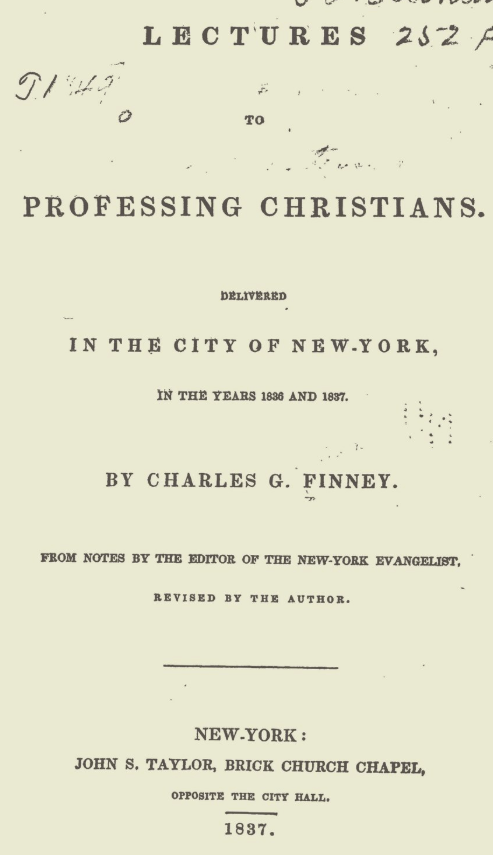

Charles G. Finney won some 250,000 souls in a few short years, most of them in New York state and in nearby areas. Within certain limited areas the profound effect of the Finney revivals was more intense, more revolutionary than even the Moody revivals. And how did Charles G. Finney preach? Did he preach upon the love of God? Not often! Did he preach on grace? He believed in grace, but law comes before grace in the Bible, and so it came in Finney’s preaching. Did he give tender invitations? Perhaps, toward the close of each campaign, certainly not in the first part of the services. In school houses and small churches, usually, he preached. And the revival fires spread like a prairie conflagration before the wind!
How did Finney preach? He tells us again and again in his autobiography. For example, note this passage:
That night I determined that I would cry aloud against the sins of the people and bring to bear the very fires of Hell as a final consequence of their rebellion. For almost two hours I literally flailed the evildoers who sat before me. I called God to witness that the judgment was not far off for them. Concluding, I gave a few moments to the mercy of God but I did that in a stern manner. I was determined that the people should for once stand face to face with the fact of sin and Hell. That night the meeting broke and I think I never experienced such a divine demonstration.
Oh, may God give us preachers who will preach like Charles G. Finney against sin! Finney preached against cursing, against drunkenness, against covetousness, against pride. He named sins. He preached on Sodom and Gomorrah. He preached on Hell and judgment. He preached on the death of the wicked. He preached on the justice and wrath of God. Men fell unconscious in their seats, or became utterly helpless as they sobbed and prayed, and would not leave the building. The conviction was so terrible in many services that Finney could preach no longer. (After he had already preached perhaps an hour and twenty minutes or two hours on sin!) Finney’s revivals must be traced to a deep consciousness of sin brought about by the preaching of the Word of God on the sin matter by a Spirit-filled preacher. Certainly God used the Gospel of grace, but it does not take people long to be taught salvation by faith when they are deeply convicted of their sins.
–Dr. John R. Rice, Why Preach Against Sin? (Sword of the Lord Publishers, 1985), pp. 23-24. Dr. Rice was a fundamental Baptist evangelist, a colleague of Bob Jones Sr. and Jr.,
and a mentor of the young Billy Graham.–
Posted in Uncategorized
Leave a comment
Dreams and Visions Leading to Conversion – Archibald Alexander
Archibald Alexander, Thoughts on Religious Experience,
ch. VII: “Considerations on Dreams, Visions, Etc.”
—


Posted in Uncategorized
Leave a comment
A Reformed Charismatic Approach to Personal Revelation – Tim Conway
Posted in Uncategorized
Leave a comment
Be Ye Angry And Sin Not – Leonard Ravenhill

Originally from here.
If you attend church at all, you will undoubtedly hear a thousand sermons on “Be filled with the Spirit” (Eph. 5:18) for every one sermon you hear preached on “Be ye angry, and sin not” (Eph. 4:26). This is a command! It is not a defense for a bad temper. It is not an excuse for an explosion of bitterness from your bruised ego for personal rejection. I am talking here of Holy Anger. God gets angry. “The anger of the Lord was kindled against Moses” (Exodus 4:14), “God is angry with the wicked every day” (Psalm 7:11). (If you must have a bumper sticker, try this last statement for a while – but be sure that you increase your insurance before you do so.)
The blessed preacher St. Paul walked down Main Street Athens, the intellectual capital of the world of his day. Acts 17:16 says in the sleepy Elizabethan English of the King James version, “His spirit was stirred in him, when he saw the city wholly given to idolatry.” The Amplified says it this way, “Now while Paul was awaiting them at Athens, his spirit was grieved and roused to anger as he saw that the city was full of idols.” Such anger needs to come back to us today. I admit right here that I am downright angry. I am angry that Christ is wounded in the house of His friends.
Here Is An Example
Our home is less than 100 miles from Dallas – the “Athens” of the theologians. Therefore we are vulnerable to the students who come from the seminaries there, distressed, disgusted, and despondent over the low state of spirituality in their particular classes. A professor in one such seminary tells the preacher – boys, “Remember that preaching is now a profession, and not to be viewed or represented by a sweating evangelist in a sawdust-carpeted tent. Now the preacher has status like a doctor or a seasoned lawyer.” Be gone such idiocy! Preaching is not a profession – it is a passion! Paul sets the standard, “Woe unto me if I preach not the Gospel!” I am angry that these professors want the world’s smile on our holy calling. But no man called to the ministry needs a status symbol. He is, by the very nature of his calling, in the highest calling.
I am further angered by a statement by Bruce Cook – the former advertising agent for Coca Cola, who engineered the “I Found It” campaign. Here is his horrible comment, and it angers me: “Back in Jerusalem when the Church started, God performed a miracle there on the Day of Pentecost. They didn’t have the benefit of buttons and media, so God had to do a little supernatural work there. But today, with our technology, we have available to us the opportunity to create the same kind of interest in a secular society.”2 This wretched interpretation makes me bristle. So buttons and modern media are as likely to start a Heaven-Born Holy Ghost Revival as was the Upper Room invasion from heaven? What is this but “Christian humanism”? WE are capable of producing the same thing as the Blessed Holy Spirit?
Homosexual “Christians”
I am angry when I read a letter from my friend and neighbor David Wilkerson announcing this near unbelievable perversion.
“Homosexuals now claim more than 50,000 members in their ‘all homosexual’ churches. The Metropolitan Community Church is one of many homosexual denominations springing up across the nation. I sent an observer to one of their annual ‘Holy Ghost’ conventions in Dallas, Texas. What unbelievable blasphemy!
“Each delegate, as they registered, was given a packet which included, among other things, two ‘boy’ magazines of all nude men and a list of all the gay bars in Dallas – so that delegates could leave the evening service, go to their selected bar, and connect with a lover for the night. And those delegates call themselves ‘ministers.’ How they did sing! They praised the Lord with enthusiasm; but their evangelist corrupted the Gospel beyond comprehension. He said, ‘Sure, Paul condemned men who changed the natural use and burned one toward another. But that’s not us. We didn’t change anything. We were born this way. So, come out of your closets. Be filled with the Holy Ghost, and enjoy your homosexuality!'”3
My anger over this is intensified when I read that the cutback in federal spending will cause some old folks to miss meals. Yet the same federal folks on the 5th of May, 1981, gave the Metropolitan Community (homosexual) Church $380,000 of our tax money to operate four resettlement centers for Cuban refugee homosexuals.4 (Just let the true Church of Jesus try to get the government to give us a dime to rescue men from an eternal hell!)
Clean Up America?
I am angry also when I hear preachers crying with great emotion, “Help me clean up America,” when they dare not try to clean up the Church – riddled as it is with carnality and sensuality. I am angry and grieved when preachers weep over the TV that their income is decreasing, though I’ve never seen them weep on TV over the millions of lost souls they address every week. The God on TV is an inoffensive, undemanding God, wanting to give but requiring nothing in exchange. There is no need to take up your cross and follow Him.
The “Mush God”
Nicholas Van Hoffman has a penetrating column on the “Mush God” of today. Read it friend, read it twice and maybe you will weep as he speaks of the gross representation of the Holy Deity. Here is Van Hoffman:
“The Mush God has been known to appear to millionaires on golf courses. He appears to politicians at ribbon-cutting ceremonies and to clergymen speaking the invocation on national TV at either Democratic or Republican conventions. The Mush God’s presence is felt during Brotherhood Week and when Rotarians come together. He is the lifeless deity President Carter was referring to when suggesting peace might come to the Middle East because the Egyptian president and Israeli prime minister both worshipped the Great Mushy One.
“The Mush God has no theology to speak of being a Cream of Wheat divinity. The Mush God has no particular credo, no tenets of faith, nothing that would make it difficult for believer and non-believer alike to lower one’s head when the temporary chairman tells us the Reverend, Rabbi, Father, Mufti, or So-and-So will lead us in an innocuous, harmless prayer, for this god of public occasions is not a jealous god. You can even invoke him to start a hookers’ convention and he/she or it won’t be offended.
“God of the Rotary, God of the Optimists Club, Protector of the Buddy System, the Mush God is the Lord of secular ritual, of the necessary but hypocritical forms and formalities that hush the divisive and the derisive. The Mush God is a serviceable god whose laws are not chiseled on tablets but written on sand, open to amendment, qualification, and erasure. This is a god that will compromise with you, make allowances and declare all wars holy, all peaces hallowed.”5
More Anger
My Holy Anger and burning indignation is fueled by articles like this from the pen of a “Wiseman” from the East – the Bhagwan Shree Ragneesh, writing from the Meditation Center that bears his name.6
“SEX – never repress it. Never be against it – rather, go deep into it with great clarity, with great love. Go like an explorer. Search all the nooks and corners of your sexuality and you will be surprised and enriched and benefited. Knowing your sexuality, one day you will stumble upon your spirituality [or get V.D.-LR] then you will become free. The future will have a totally different vision of sex. It will be more fun, more joy, more friendship, more a play than a serious affair, as it has been in the past. [The “serious affair” mentioned here must mean marriage-LR] Sex is just the beginning, not the end. But if you miss the beginning, you will miss the end also.”
What logic and what warning! Why not miss the end which is torment here and hereafter? I wonder what folks who have tried this teacher’s methods think about it. Does he have “revival crusades” with living, bright-faced “witnesses” telling of their rapturous emancipation from the “bondage of purity and a good conscience”?
Save Whose Children?
I am not angered that the Moral Majority boys campaign against abortion. I am angry when the same men who say, “Save OUR children” bellow “Build more and bigger bombers.” That’s right! Blast the children in other nations into eternity, or limbless misery as they lay crippled from “OUR” bombers! This does not jell.
I am angry that the pulpiteers can roar from their pulpits against political injustices, yet whisper about the wrong doings in their own fellowship – also that sin is called by other names. God has no mild views of sin, so let’s get back to biblical language. The soothsayers in the world are dangerous, but the “smooth-sayers” in the pulpit are equally dangerous. We now call iniquity, infirmity. Wickedness is just weakness. Adultery and fornication, just “having an affair.” Lust is called love. Sodomy is now being “GAY.” The Harlot is not called a Whore anymore, she is inoffensively named a “Call Girl.” These are not terms for every sermon, but they have some kind of intimidation and disgrace attached to them, which makes the preachers afraid to use them (and sinners afraid to hear them). But the Bible uses them!
I am angry when I hear preachers saying, “We had our best concert ever last week when the ‘ZYX Singers’ came to our church. The main auditorium was jammed with extra seats and we had to run extensions into the church hall for the overflow!” Yet, that same popular, prosperous church can comfortably seat its prayer meeting in just about the smallest room in the facility. What a slap in the face for a prayer-answering God! What a public declaration that the offering from the concert patrons is more important than prayer!
I am angry with people who withhold their own money from the Lord, but then turn His House into a Flea Market to raise church funds. And believe me, I am stirred, sick, and angry when I try to realize that 90% of Gospel preaching is to only 10% of the world’s population.
Mormons Get “More Men”
“Newsweek” for April 27, 1981, states:
“This year the Mormons will field more missionaries – about 30,000 in all – than any other church in the United States… their single purposeis to labor 16 hours a day,6 days a week, spreading the Gospel according to the Church of Jesus Christ of Latter-Day Saints. [Now notice the discipline attached to this effort.] The discipline imposed on Mormon missionaries is as unique as their message: no movies, television, or popular music; no phone calls to parents or girlfriends; no dates – and no going anywhere alone. Under this quasi-military regimen the L.D.S. missionaries have carried the faith across the U.S. into six continents.”
I am angry at this false zeal, disturbed and deeply troubled that we have to make so many Christian Youth Camps a miniature Olympics to entice kids to so-called Bible study. Dare we try to get kids away from TV, sports, etc., for a week of solid concentration on eternal things? It seems more correct with the emphasis on sports and church programs, and church leagues of bowling, baseball, etc., that we should be singing: “Onward Christian Sportsmen – forget about the war – look at all the prizes – you’re contending for!”7
I am angry when I think that the government will subsidize a science effort to find out where man came from, but will not give a dime to tell men where they are going. God! baptize us with a Holy Anger that will set us on a course of hell disturbing, heaven-enriching intercession!
All these sad events I have mentioned would be taken care of by a heaven-born, sin-convicting visitation of the Spirit.
I am angry at the devil’s monopoly of this age.
I am angry that the Church sleeps on.
I am angry that the Church, in many (and maybe most) cases, is an entertainment center. Lord have mercy! “Wilt Thou not revive us again, that Thy people may rejoice in Thee?”(Psalm 85:6)
1) Scripture quotation from The Amplified Bible © 1965 Zondervan Publishing House.
2) From “The Total Image”, 1980, by Virginia Owens, Eerdmans Publishing Company.
3) “The Coming Purge”, David Wilkerson Crusade.
4) “Your Newsletter”, First Church Of God, Fort Smith, AR.
5) From “Sources And Resources.”
6) “Time Magazine”, July 20, 1981.
7) Sung to the tune of “Onward Christian Soldiers.”
Posted in Uncategorized
Leave a comment
Confusing Statements On Justification By Faith? – Tim Conway
Posted in Uncategorized
Leave a comment
Three Jokes Forbidden In the Bible: Sexual, Blasphemous, and Insulting
Neither filthiness, nor foolish talking, nor jesting.
–Ephesians 5:4 (KJV)–
—
When your stars are baked
And your rivers fly
Do you ever believe you were stuck out in the, sky
When your castle breaks
And your feet are dry
Do you ever believe you were stuck out in the, sky
Do you believe, when you’re high
That your life is tried
Don’t you ever get stuck in the sky
Don’t you ever get stuck in the sky
Don’t ever get stuck in the sky, when you’re high
When your moon is fake
And your mermaids cry
Do you ever believe you were stuck out in the, sky
When your tunnel fades
And your guide is shy
Do you ever believe you were stuck out in the, sky
Do you believe, when you’re high
That your life is tried
Don’t you ever get stuck in the sky
Don’t you ever get stuck in the sky
Don’t ever get stuck in the sky, when you’re high
–System of a Down, “Peephole”–
Posted in Uncategorized
Leave a comment
Loving Righteousness And Hating Iniquity
This commission I have taken to my heart
To the world
(My heart)
In my heart
The curl is spent darkening through the day
But lasting for a thousand
And many more in reflections of You
More, many more
–Hopesfall, “In Reflection”–

—
17 This I say therefore, and testify in the Lord, that ye henceforth walk not as other Gentiles walk, in the vanity of their mind, 18 Having the understanding darkened, being alienated from the life of God through the ignorance that is in them, because of the blindness of their heart: 19 Who being past feeling have given themselves over unto lasciviousness,
to work all uncleanness with greediness.
–Ephesians 4:17-19 (KJV)–
Thou hast loved righteousness, and hated iniquity; therefore God, even thy God, hath anointed thee with the oil of gladness above thy fellows.
–Hebrews 1:9 (KJV)–
Seventy weeks are determined upon thy people and upon thy holy city, to finish the transgression, and to make an end of sins, and to make reconciliation for iniquity, and to bring in everlasting righteousness, and to seal up the vision and prophecy, and to anoint the most Holy.
–Daniel 9:24 (KJV)–

Posted in Uncategorized
Leave a comment