I will never forget the day that I broke the law and was caught red-handed by a police officer. I had to go to a photo processing place and couldn’t find it. I’d already been around the block once when I suddenly saw it. It was at the top of a one-way street, and it looked like I’d have to go around the block again to get to it. That is, unless I nipped across the top of the one-way street into their parking lot. So that’s what I did.
As I parked my car, I noticed that a police officer was parking his motorbike across the road. I remember thinking, “He’s not interested in me.” So I ran up the row of steps into the photo processing building. It was then that I noticed that I had grabbed the wrong set of negatives. I turned around to go back to my car, and that’s when I saw the officer leaning against my vehicle.
As I approached the car, he said, “May I see your driver’s license, please?” I sat on the driver’s seat and handed him my license. He looked at it and then said something that shocked me. He asked, “Have you any excuse for going the wrong way up a one-way street?”
The Scriptures say that the Law was given to stop every mouth—to leave us without justification and leave all of us guilty before God.
I didn’t think I had gone the wrong way up a one-way street. I had just nipped across the top (along the sidewalk a little) and into a parking lot. It was then that I realized that the law isn’t interested in the angle. I remember thinking, “Guilty, guilty, guilty.” I looked the officer in the eye and said, “No excuse whatsoever.”
He thought for a moment and said, “Well, there was no traffic coming.” With a sparkle in his eye, he added, “And I don’t think you’ll do it again.” He then closed my driver’s license, handed it back to me, turned around, and walked away. Phew!
That officer had within his authority the discretion to show me mercy or judgment. And it was what came out of my mouth that determined which one it would be. If I had said, “Officer, there are plenty of drivers worse than me,” then he would have seen that I wasn’t sorry, and he would have thrown the book at me. But when I said, “No excuse whatsoever,” it was evident that my sinful mouth was stopped. I had seen my guilt, couldn’t justify myself, and was genuinely sorry. That’s why he chose to show me mercy rather than judgment.
Look now at the purpose of God’s Law:
Now we know that whatever the law says, it says to those who are under the law, that every mouth may be stopped, and all the world may become guilty before God. (Romans 3:19)
The Scriptures say that the Law was given to stop every mouth—to leave us without justification and leave all of us guilty before God. That’s its purpose. Those who try and justify themselves when confronted with the Ten Commandments don’t see the seriousness of their sin and clearly are not sorry. And those whose mouths are stopped, those who have no excuse whatsoever, are ready for the mercy of the gospel.
38:40 – Chart that shows the connection between Branhamism, Derek Prince, John Wimber, and the Vineyard churches. Also shows that Paul Cain came straight out of the Branham cult called The Message, and into IHOP. So Cain deeply influenced Mike Bickle. This means he became the primary demonstrator and teacher on the word of knowledge gift. DR.JACKDEERE, the main charismatic theologian today, was deeply influenced by Cain, but later denounced him when he discovered Cain was a backslider. JOHNWIMBER also denounced Branhamite teachings at the end of his life. All the more reason for Pentecostals to get back to Assembly of God doctrine. DAVIDWILKERSON was an Assembly of God evangelist for most of his life and ministry, and by sharp contrast, had a preaching ministry marked by sharp Biblical discernment. Be that as it is, I still think that Wimber and Deere both discovered and taught uniquely useful things about miraculousgifts that shouldn’t be ignored.
But the primary heretical doctrines from Branhamism to be avoided, are the cultish fivefoldministry structure, positiveconfession, and the littlegods heresy. These doctrines are not only not from traditional evangelicalism, but have become all engrossing concepts taught in charismatic NAR churches. They’ve become such a big deal, and so idolatrous, that they tend to distract pastors from preaching the Gospel of Jesus Christ, and teaching biblical sanctification. They’ve become such idols in charismatic churches, that if you start to talk about sin, righteousness, and judgment, repentance, faith in the blood, eternal punishment, and sanctification, the typical charismatic NAR pastor will accuse you of having a demon of some type! Maybe a religious spirit, or legalism, or they’ll liken you to a Pharisee, or perhaps say you have an orphan spirit which can only be healed by viewing God only as a tender Father, but never as a holy and righteous Judge. All of this is simply proof that they are horribly brainwashed, false converts with false spiritual experiences, who have not come to love and appreciate theGospelmessage very much. –J.B.
This is an old Church of England chant on Psalm 130:1-7, which was modified over time, but was originally inspired by Henry Purcell’s “Out of the Deep Have I Called Unto Thee, O Lord” in De Profundis (1680). Buy this and many other recorded psalms here; perfect for prayer and contemplation.
1. Out of the deep have I called unto thee, O Lord: Lord, hear my voice.
2. O let Thine ears consider well: the voice of my complaint.
3. If thou, Lord, wilt be extreme to mark what is done amiss: O Lord, who may abide it?
4. For there is mercy with Thee: therefore shalt Thou be feared.
5. I look for the Lord; my soul doth wait for Him: in His Word is my trust.
6. My soul fleeth unto the Lord before the morning watch: I say, before the morning watch.
7. O Israel, trust in the Lord; for with the Lord there is mercy: and with Him is plenteous redemption.
8. And He shall redeem Israel: from all his sins.
9. Glory be to the Father, and to the Son: And to the Holy Ghost.
10. As it was in the beginning, is now, and ever shall be: World without end. Amen.
Consumed with memories that preceded today Given a chance to bereave life that’s slipping away Suffered through tragedy of my slow decay Deceptive tendencies dragged my soul away
All that I know, there was no God for me Force that shatters all, absence of mortality
Revive all my fears Revive wasted tears Revive void within Revive once again
Forsaken by destiny, forsaken by my own mind I must remove my skin to see belief in your eyes All that I know, there was no God for me Force that shatters all, absence of humanity
Revive all my fears Revive wasted tears Revive void within Revive once again
Reach for the sky Touch the sky Revive a hope For mankind
–Fear Factory, “Resurrection”–
—
The Spirit of the Lord had departed from Saul, and an evil spirit from the Lord tormented him. –1 Samuel 16:14 (NIV)–
She called, “Samson, the Philistines are upon you!” He awoke from his sleep and thought, “I’ll go out as before and shake myself free.” But he did not know that the Lord had left him. –Judges 16:20 (NIV)–
You always resist the Holy Spirit! –Acts 7:51 (NIV)–
Cast me not away from thy presence; and take not thy Holy Spirit fromme. –Psalm 51:11 (KJV)–
How shall we escape, if we neglect so great salvation? –Hebrews 2:3 (KJV)–
19 Holding on to faith and a good conscience, which some have rejected and so have suffered shipwreck with regard to the faith. 20 Among them are Hymenaeus and Alexander, whom I have handed over to Satan to be taught not to blaspheme. –1 Timothy 1:19-20 (NIV)–
20 If they have escaped the corruption of the world by knowing our Lord and Savior Jesus Christ and are again entangled in it and are overcome, they are worse off at the end than they were at the beginning. 21 It would have been better for them not to have known the way of righteousness, than to have known it and then to turn their backs on the sacred command that was passed on to them. 22 Of them the proverbs are true: “A dog returns to its vomit,” and, “A sow that is washed returns to her wallowing in the mud.” –2 Peter 2:20-22 (NIV)–
4 It is impossible for those who have once been enlightened, who have tasted the heavenly gift, who have shared in the Holy Spirit, 5 who have tasted the goodness of the Word of God and the powers of the coming age 6 and who have fallen away, to be brought back to repentance. To their loss they are crucifying the Son of God all over again and subjecting him to public disgrace. –Hebrews 6:4-6 (NIV)–
26 If we deliberately keep on sinning after we have received the knowledge of the truth, no sacrifice for sins is left, 27 but only a fearful expectation of judgment and of raging fire that will consume the enemies of God. 28 Anyone who rejected the law of Moses died without mercy on the testimony of two or three witnesses. 29 How much more severely do you think someone deserves to be punished who has trampled the Son of God underfoot, who has treated as an unholy thing the blood of the covenant that sanctified them, and who has insulted the Spirit of grace? –Hebrews 10:26-29 (NIV)–
—
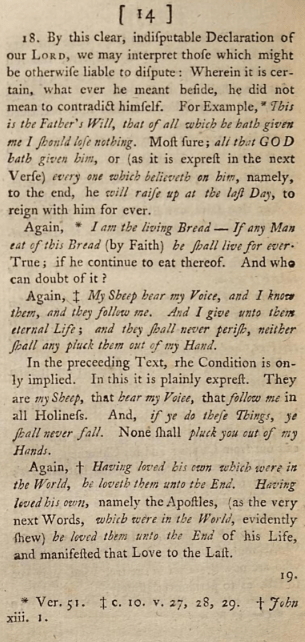
John Wesley, Serious Thoughts Upon the Perseverance of the Saints. Using the Bible, he maintains the view that true converts can lose the regenerating work of the Holy Spirit; and hence lose the saving, justifying, and sanctifying grace of the Spirit, by willingly consenting to temptation and consciously reversing repentance, rejecting the substitutionary atonement that they trusted in before–the most important aspect of apostasy, and by rebelling against God after previously walking with him (Hebrews 6:4-6; 10:26-29; 2 Peter 2:20-22; 1 Timothy 1:19). The true converts previously had a holy faith walk with God, a saving relationship with God, previously; but have now consciously walked away from Christianity completely, becoming apostates–these are not tempted, overcome, addicted, or backslidden but still fighting believers–but ex-evangelicals that are into complete and 100% total rejection of the born again lifestyle and faith they had before; and are now slidden so deep into atheism, agnosticism, or some false religion, that their hearts have become reprobate, hardened, blinded, past feeling, and unrepentant. “Prone to wander, Lord, I feel it, prone to leave the God I love,” as “Come Thou Fount” says. This is not the straw man argument view of being “Saved one minute, lost the next. Saved again, lost again,” as is often misunderstood by anxious people not properly taught the Wesleyan view of apostasy. It is seen as more of a total reversal of trust in God and a lifestyle that now has a permanently abiding nature of unbelief about it, often entered into by becoming close friends with non-Christians. The saving work of the Holy Spirit is not viewed as irresistible; a person can always resist the Spirit’s saving influence (Acts 7:51).
This is why the witness of the Spirit is so important in Wesleyan theology; because a genuine walk with God, will have experiences of God’s presence and voice to occasionally authenticate the reality of a true convert’s faith in the Gospel. It was in his sermon “The Witness of the Spirit, Part II,” where Wesley taught that Christians without experiences of the Holy Spirit, with no real faith confirming that they’re children of God (Rom. 8:16), are not true converts, but are simply deists who might have very well accepted a whole lot of Bible teachings in their heads. To Wesley, a true convert has a heart-faith in the Gospel strong enough to produce experiences of the Holy Spirit, which provide him with assurance of salvation. This is understood as the “strongest proof of Christianity,” a much stronger assurance than any Calvinistic arguments about a Father’s hand holding a sheep with a spiritual vice grip. Wesley: “This is farther explained by the parallel text, (Gal. 4:6,) “Because ye are sons, God hath sent forth the Spirit of his Son into your hearts, crying Abba, Father.” Is not this something immediate and direct, not the result of reflection or argumentation? Does not his Spirit cry, “Abba, Father,” in our hearts the moment it is given, antecedently to any reflection upon our sincerity; yea, to any reasoning whatsoever? And is not this the plain natural sense of the words, which strikes any one as soon as he hears them? All these texts then, in their most obvious meaning, describe a direct testimony of the Spirit” (“The Witness of the Spirit, II” 3.4).
Adam Clarke, Christian Theology, ch. 30: “Apostacy.” Wesley’s theological successor. Clarke: “You have many enemies; be continually on your guard; be always circumspect: 1. Be watchful against evil. 2. Watch for opportunities to do good. 3. Watch over each other in love. 4. Watch that none may draw you aside from the belief and unity of the Gospel. He that is self-confident is already half fallen. He who professes to believe that God will absolutely keep him from falling finally, and neglects watching unto prayer, is not in a safer state. He who lives by the moment, walks in the light, and maintains his communion with God, is in no danger of apostacy…The apostle shows here five degrees of apostacy: 1. Consenting to sin; being deceived by its solicitations. 2. Hardness of heart through giving way to sin. 3. Unbelief in consequence of this hardness, which leads them to call even the truth of the Gospel in question. 4. This unbelief causing them to speak evil of the Gospel, and the provision God has made for the salvation of their souls. 5. Apostacy itself, or falling off from the living God, and thus extinguishing all the light that was in them, and finally grieving the Spirit of God, so that he takes his flight, and leaves them to a seared conscience and reprobate mind. He who begins to give the least way to sin is in danger of final apostacy: the best remedy against this is, to get the evil heart removed; as one murderer in the house is more to be dreaded than ten without…How strange is it that there should be found any backslider! that one who once felt the power of Christ should ever turn aside! But it is still stranger that any one who has felt it, and given, in his life and conversation, full proof that he has felt it, should not only let it slip, but at last deny that he ever had it, and even ridicule a work of grace in the heart!
Such instances have appeared among men…“But he that lacketh these things:” he, whether Jew or Gentile, who professes to have faith in God, and has not added to that faith, fortitude, knowledge, temperance, patience, godliness, brotherly kindness, and universal love, “is blind,” his understanding is darkened, and cannot see afar off, shutting his eyes against the light, winking, not able to look truth in the face, nor to behold that God whom he once knew was reconciled to him; and thus it appears he is wilfully blind, “and hath forgotten that he was purged from his old sins”—has at last, through the non-improvement of the grace which he received from God, his faith ceasing to work by love, lost the evidence of things not seen: for, having grieved the Holy Spirit by not showing forth the virtues of Him who called him into his marvellous light, he has lost the testimony of his sonship; and then darkness and hardness having taken the place of light and filial confidence, he first calls all his former experience into doubt;—questions whether he has not put enthusiasm in the place of religion. By these means his darkness and hardness increase, his memory becomes indistinct and confused, till at length he forgets the work of God on his soul, next denies it, and at last asserts that the knowledge of salvation by the remission of sins is impossible, and that no man can be saved from sin (addiction) in this life. Indeed, some go so far as to deny the Lord that bought them; to renounce Jesus Christ as having made atonement for them; and finish their career of apostacy by utterly denying his godhead. Many cases of this kind have I known; and they are all the consequence of believers not continuing to be workers together with God, after they had experienced his pardoning love…Here (2 Peter 2:22) is a sad proof of the possibility of falling from grace, and from very high degrees of it too. These had escaped from the contagion that was in the world; they had had true repentance, and cast up “their sour-sweet morsel of sin;” they had been washed from all their filthiness, and this must have been through the blood of the Lamb; yet, after all, they went back, got entangled with their old sins, swallowed down their formerly rejected lusts, and rewallowed in the mire of corruption. It is no wonder that God should say, “The latter end is worse with them than the beginning:” reason and nature say, “It must be so;” and divine justice says, “It ought to be so;” and the person himself must confess that it is right that it should be so. But how dreadful is this state! How dangerous, when the person has abandoned himself to his old sins!
Yet it is not said that it is impossible for him to return to his Maker; though his case be deplorable, it is not utterly hopeless; the leper may yet be made clean, and the dead may be raised. Reader, is thy backsliding a grief and burden to thee? Then thou art not far from the kingdom of God; believe on the Lord Jesus, and thou shalt be saved…The backslider’s soul, before influenced by the Spirit of God, dilated and expanded under its heavenly influences, becomes more capable of refinement in iniquity, as its powers are more capacious than formerly. Evil habits are formed and strengthened by relapses; and relapses are multiplied, and become more incurable, through new habits…A soul cut off from the flock of God is in an awful state! His outward defence is departed from him; and being no longer accountable to any for his conduct, he generally plunges into unprecedented depths of iniquity, and the last state of that man becomes worse than the first…In a state of probation every thing may change. While we are in life we may stand or fall. Our standing in the faith depends on our union with God; and that depends on our watching unto prayer, and continuing to possess that faith that worketh by love. The highest saint under heaven can stand no longer than he depends upon God, and continues in the obedience of faith. He that ceases to do so will fall into sin, and get a darkened understanding and a hardened heart; and he may continue in this state till God come to take away his soul. Therefore, let him who most assuredly standeth take heed lest he fall, not only partially, but finally.”
Charles Finney, “The Loss When a Soul Is Lost.” Using the Bible, he presents Wesley’s view in another way, a sermon based on Mark 8:36: “What shall it profit a man, if he shall gain the whole world, and lose his own soul?” Finney: “This danger is exceedingly great, because men have only to neglect the soul and it is surely lost. It does not require attention and labor. You can lose your soul without the least possible effort made specially for this purpose. You need not go about to commit sin in order to ensure the ruin of your soul hopelessly and forever. You need only neglect its salvation and it is surely lost. You need only be as negligent as you have been heretofore. It is only necessary that you slide along in the same thoughtless, reckless manner as in your past days and the end will be “sudden destruction and that without remedy.” As says the apostle; —“How shall we escape if we neglect so great salvation?” There is none other name under heaven given among man whereby ye can be saved. And there is no salvation through this name but by a living faith which works by love and makes the heart pure from sin.”
—
Dr. French Arrington, Christian Doctrine, vol. 2 (Pathway Press, 1993), pp. 183-192.
—. Unconditional Eternal Security: Myth or Truth? (Pathway Press, 2005).
Dr. Thomas C. Oden, John Wesley’s Scriptural Christianity (Zondervan, 1992), p. 341.




 WesleyGospel Ministries