18 “Listen then to what the parable of the sower means: 19 When anyone hears the message about the kingdom and does not understand it, the evil one comes and snatches away what was sown in their heart. This is the seed sown along the path. 20 The seed falling on rocky ground refers to someone who hears the word and at once receives it with joy. 21 But since they have no root, they last only a short time. When trouble or persecution comes because of the word, they quickly fall away. 22 The seed falling among the thorns refers to someone who hears the word, but the worries of this life and the deceitfulness of wealth choke the word, making it unfruitful. 23 But the seed falling on good soil refers to someone who hears the word and understands it. This is the one who produces a crop, yielding a hundred, sixty or thirty times what was sown.” –Jesus in Matthew 13:18-23 (NIV)–
Holding on to faith and a good conscience, which some have rejected and so have suffered shipwreck with regard to the faith. –Apostle Paul in 1 Timothy 1:19 (NIV)–
4 It is impossible for those who have once been enlightened, who have tasted the heavenly gift, who have shared in the Holy Spirit, 5 who have tasted the goodness of the word of God and the powers of the coming age 6 and who have fallen away, to be brought back to repentance. To their loss they are crucifying the Son of God all over again and subjecting him to public disgrace. –Hebrews 6:4-6 (NIV)–
26 If we deliberately keep on sinning after we have received the knowledge of the truth, no sacrifice for sins is left, 27 but only a fearful expectation of judgment and of raging fire that will consume the enemies of God. 28 Anyone who rejected the law of Moses died without mercy on the testimony of two or three witnesses. 29 How much more severely do you think someone deserves to be punished who has trampled the Son of God underfoot, who has treated as an unholy thing the blood of the covenant that sanctified them, and who has insulted the Spirit of grace? 30 For we know him who said, “It is mine to avenge; I will repay,” and again, “The Lord will judge his people.” –Hebrews 10:26-30 (NIV)–
—
Dr. French Arrington, Christian Doctrine: A Pentecostal Perspective, vol. 2 (Pathway Press, 1993), p. 184.
Cut deep The wound is open Infection sets in Will this be my last Or does the cut get deeper I can’t feel I can’t feel Walking with unopened eyes
Drowning is evidence Drowning is evidence Fading is slowly taking root
Hand of the dead laid in stone Shape shift to convince Drowning is evidence that fading is slowly taking root Can’t feel for the wound inside Taking root Can’t feel for the wound inside
Lies that brought me here fade away Misplaced this cure Misplaced this heart
Can’t feel for the wound inside Can’t feel for the wound inside
Merciless in full form A sacrilege conceived in robed black Impossible to rip apart from it Listen close, hear it calling for you
It moves through you There’s no turning back
Concentrate Face to face with what turns The unsettling fascination opaque Sick beast spread poison You are consumed
Run, hide, cry Nothing will help you this time Soon trapped by rot and vine “Nowhere to go, you are mine” A truth resonates as you fall in endless spiral
Incompetent in disbelief Reality is frozen
Feel the jaws Clench and now Slowly you bend
–Loathe, “Gored”–
—
Your cheatin’ heart will make you weep You’ll cry and cry and try to sleep But sleep won’t come the whole night through Your cheatin’ heart will tell on you
When tears come down like falling rain You’ll toss around and call my name You’ll walk the floor the way I do Your cheatin’ heart will tell on you
Your cheatin’ heart will pine someday And crave the love you threw away The time will come when you’ll be blue Your cheatin’ heart will tell on you
–Hank Williams, “Your Cheatin’ Heart”–
—
If a man know not how to rule his own house, how shall he take care of the church of God? –1 Timothy 3:5 (KJV)–
Marriage is honourable in all, and the bed undefiled: but whoremongers and ADULTERERS GOD WILL JUDGE. –Hebrews 13:4 (KJV)–
If thy right eye offend thee, PLUCK IT OUT, and cast it from thee: for it is profitable for thee that one of thy members should perish, and not that thy whole body should be CAST INTO HELL. –Matthew 5:29 (KJV)–
Know ye not that the unrighteous shall not inherit the kingdom of God? Be not deceived: neither fornicators, nor idolaters, NOR ADULTERERS, nor effeminate, nor abusers of themselves with mankind, nor thieves, nor covetous, nor drunkards, nor revilers, nor extortioners, SHALL INHERIT THE KINGDOM OF GOD. –1 Corinthians 6:9-10 (KJV)–
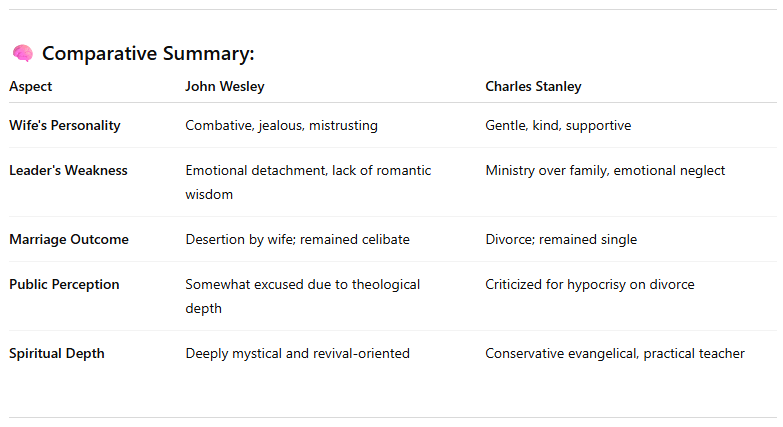
It is a well known fact that John Wesley’s wife, Mary Wesley, also deserted him for a similar reason. Wesley went off on extensive travels as an itinerant evangelist, leaving his wife at home. He also wrote ministry letters to Methodist women who asked him theological questions. Mary interpreted these ministry letters as love letters; and she became jealous. He continued to do this even though he saw it bothered his wife. A similar but different situation as Charles Stanley’s, but not the same. In Stanley’s case, it appears that he clearly prioritized his ministry above his marriage. In Wesley’s case, it appears that he simply had an antagonistic and jealous wife, who didn’t want to understand what he was trying to do. It also appears that he just had very little romantic sense, leaving her at home for long stretches instead of bringing along “a wife, as well as other apostles, and as the brethren of the Lord, and Cephas” (1 Corinthians 9:5). The spiritual and theological depth that Wesley’s ministry had was exponentially greater than Stanley’s ministry; and so its easier for me to give him a pass, as he clearly loved God in a very deep way. But when it came to romance, I think it would be right to say that Wesley was somewhat of a holy fool, who lacked the necessary sensitivity to have a healthy marriage: something he probably learned from watching his own parents. It also seems that Mary Wesley was a self-centered and unspiritual woman, who was prone to pull him into debates, which might explain why he didn’t take her on trips with him. She would have gotten him all worked up in the flesh, so he wouldn’t be able to read, pray, and seek God.
In Stanley’s case, its hard to see anything other than just easy believism, carnality, and ambition that blinded him from loving his wife enough. But I don’t intend to portray Wesley as completely blameless. He wasn’t. After dealing with an unsubmissive, insulting, and argumentative wife for about seven years, he eventually gave into a temptation of what we’d today call emotional adultery, writing the following words in a letter to a thirty three year old Methodist lady named Sarah Ryan in 1758: “The conversing with you, either by speaking or writing, is an unspeakable blessing to me.” This was the straw that broke the camel’s back. Mary deserted her husband after she found that letter in his coat pocket. It happens all the time these days by text on pastors’ not-so-smartphones. On the other hand, maybe it wasn’t emotional adultery at all. Seeing the context, Wesley as well as other Methodist leaders, had been counseling Ms. Ryan as she had been going through a process of “deliverance” for lack of a better word, and reorienting her life after coming from a very abusive background. Wesley was also twenty years older than Ms. Ryan, so its likely that his interactions with her were very brief, shallow, and only of a spiritual nature, intended to provide light to a very darkened mind. It would probably be wrong to say that he “knew” her in any close way. And if that’s the case, as it probably is, since Wesley remained celibate his whole life after Mary left him–that Mary was just a hothead, and was prone to overreact to his pastoral letters that were aimed at women with spiritual problems. Anna Stanley, on the other hand, had a reputation for being a kind woman that served the Lord enthusiastically; and yet, Charles neglected her for the sake of the ministry. –J.B.
—
Westminster Confession of Faith, 24.5-6. Adultery or fornication committed after a contract, being detected before marriage, giveth just occasion to the innocent party to dissolve that contract. In the case of adultery after marriage, it is lawful for the innocent party to sue out a divorce: and, after the divorce, to marry another, as if the offending party were dead…Although the corruption of man be such as is apt to study arguments unduly to put asunder those whom God hath joined together in marriage: yet, nothing but adultery, or such willful desertion as can no way be remedied by the church, or civil magistrate, is cause sufficient of dissolving the bond of marriage: wherein, a public and orderly course of proceeding is to be observed; and the persons concerned in it not left to their own wills, and discretion, in their own case (Matt. 1:18-20; 5:31-32; 19:6-9; Rom. 7:2-3; 1 Cor. 7:15; Deut. 24:1-4).
Gayle White, “Stanley’s Wife Halts Divorce Plans,” Christianity Today, April 29, 1996. Anna Stanley said: “Long ago…Charles, in effect, abandoned our marriage. He chose his priorities, and I have not been one of them.”
Dan Corner, The Gospel According to Charles Stanley (Evangelical Outreach, 1995).
Thomas R. Edgar, “Divorce and Remarriage for Adultery or Desertion,” Divorce and Remarriage: Four Christian Views (InterVarsity Press, 1990).
Dr. John R. Rice, Divorce: The Wreck of Marriage (Sword of the Lord, 1946).



 WesleyGospel Ministries