
-
-

-
LATEST POSTS
- MORMONISM DETOX
- LGBT-Minded Democrats Can’t Even Define What a Woman Is! – Ken Ham
- Today’s Political Podcasters: Do These Guys Even Read Books About Political Science?! – Mark Levin
- Wisconsin Public School Teachers Take to the Streets with Marxist-Islamist Demonstrations–They Call Off School and Invite Students to Protest With Them – Fox News
- Hasan Piker: An Influential Nutcase Marxist-Islamist and a Poisonous Reprobate In the World of Podcasting – Mark Levin
RECENT VIEWS
- Old Testament Visions of Hell
- Biblical Arguments Against Eternal Security - John Wesley and Charles Finney
- R. C. Sproul Was a False Teacher That Rejected the Biblical Hell
- MORMONISM DETOX
- Wesleyans and Calvinists: The Two Main Doctrinal Differences
- Review of Dr. Wayne Grudem’s “The Gift of Prophecy”
- Review of Bill Jackson’s “The Quest for the Radical Middle: A History of the Vineyard”
- If You Just Read Four Verses Before -- God Just Got Done Throwing Every Non-Believer In Hell! - Bryce Crawford
- Tour of Paul Washer’s Library
- The Link Between Elijah and John the Baptist - T. Austin-Sparks
MONTHLY ARCHIVES
- May 2026 (5)
- April 2026 (139)
- March 2026 (142)
- February 2026 (150)
- January 2026 (242)
- December 2025 (259)
- November 2025 (286)
- October 2025 (188)
- September 2025 (145)
- August 2025 (122)
- July 2025 (118)
- June 2025 (88)
- May 2025 (122)
- April 2025 (182)
- March 2025 (185)
- February 2025 (132)
- January 2025 (159)
- December 2024 (103)
- November 2024 (139)
- October 2024 (135)
- September 2024 (79)
- August 2024 (81)
- July 2024 (105)
- June 2024 (95)
- May 2024 (58)
- April 2024 (55)
- March 2024 (34)
- February 2024 (97)
- January 2024 (61)
- December 2023 (6)
- November 2023 (36)
- October 2023 (24)
- September 2023 (18)
- August 2023 (13)
- July 2023 (11)
- June 2023 (16)
- May 2023 (22)
- April 2023 (14)
- March 2023 (6)
- February 2023 (6)
- January 2023 (11)
- December 2022 (14)
- November 2022 (15)
- October 2022 (10)
- September 2022 (1)
- August 2022 (3)
- July 2022 (2)
- June 2022 (1)
- May 2022 (3)
- April 2022 (7)
- March 2022 (6)
- February 2022 (2)
- January 2022 (4)
- December 2021 (7)
- November 2021 (5)
- September 2021 (1)
- August 2021 (1)
- July 2021 (3)
- June 2021 (1)
- May 2021 (2)
- March 2021 (3)
- February 2021 (2)
- January 2021 (1)
- December 2020 (1)
- October 2020 (1)
- November 2019 (1)
- October 2019 (2)
- September 2019 (1)
- August 2019 (1)
- July 2019 (7)
- June 2019 (4)
- May 2019 (4)
- April 2019 (18)
- March 2019 (7)
- February 2019 (4)
- January 2019 (6)
- December 2018 (3)
- November 2018 (2)
- October 2018 (4)
- September 2018 (5)
- August 2018 (3)
- July 2018 (2)
- June 2018 (1)
- May 2018 (3)
- April 2018 (8)
- January 2018 (2)
- December 2017 (5)
- November 2017 (1)
- October 2017 (8)
- September 2017 (4)
- August 2017 (6)
- July 2017 (6)
- June 2017 (6)
- May 2017 (10)
- April 2017 (20)
- March 2017 (15)
- February 2017 (10)
- January 2017 (10)
- December 2016 (8)
- November 2016 (10)
- October 2016 (23)
- September 2016 (15)
- August 2016 (5)
- July 2016 (9)
- June 2016 (3)
- May 2016 (7)
- April 2016 (4)
- March 2016 (11)
- February 2016 (3)
- January 2016 (10)
- December 2015 (8)
- November 2015 (9)
- October 2015 (10)
- September 2015 (5)
- August 2015 (15)
- July 2015 (9)
- June 2015 (2)
- May 2015 (6)
- April 2015 (38)
- March 2015 (28)
- February 2015 (28)
- January 2015 (28)
- December 2014 (19)
- November 2014 (15)
- October 2014 (5)
- September 2014 (9)
- August 2014 (17)
- July 2014 (30)
- June 2014 (16)
- May 2014 (17)
- April 2014 (18)
- March 2014 (6)
- February 2014 (8)
- January 2014 (8)
- December 2013 (2)
- November 2013 (2)
- October 2013 (3)
- September 2013 (2)
- August 2013 (2)
- July 2013 (1)
- June 2013 (2)
- May 2013 (7)
- April 2013 (9)
- March 2013 (6)
- February 2013 (3)
- January 2013 (6)
- December 2012 (2)
- November 2012 (2)
- October 2012 (4)
- September 2012 (6)
- August 2012 (4)
- July 2012 (7)
- June 2012 (1)
- May 2012 (3)
- April 2012 (5)
- March 2012 (2)
- February 2012 (3)
- January 2012 (1)
- December 2011 (5)
- November 2011 (4)
- October 2011 (11)
- September 2011 (2)
- August 2011 (3)
- July 2011 (2)
- June 2011 (4)
- May 2011 (4)
- April 2011 (4)
- March 2011 (6)
- February 2011 (4)
- January 2011 (1)
- December 2010 (7)
- November 2010 (5)
- October 2010 (9)
- September 2010 (3)
-
Penal Substitutionary Atonement As the Satisfaction of God’s Wrath At Our Sins – Dr. Charles Hodge
Originally from here.
Taken from Charles Hodge’s Systematic Theology, vol. 2, p. 507.
The Fifty-third Chapter of Isaiah.
It is not however only in the typical services of the old economy that this great doctrine was set forth in the Hebrew Scriptures. In the fifty-third chapter of Isaiah this doctrine is presented with a clearness and copiousness which have extorted assent from the most unwilling minds. The prophet in that chapter not only foretells that the Messiah was to be a man of sorrows; not only that He was to suffer the greatest indignities and be put to a violent death; not only that these sufferings were endured for the benefit of others; but that they were truly vicarious, i.e., that He suffered, in our stead, the penalty which we had incurred, in order to our deliverance. This is done not only in those forms of expression which most naturally admit of this interpretation, but in others which can, consistently with usage and the analogy of Scripture, be understood in no other way. To the former class belong such expressions as the following, “He hath borne our griefs, and carried our sorrows.” Our griefs and our sorrows are the griefs and sorrows which we deserved. These Christ bore in the sense of enduring, for He carried them as a burden. “He was wounded for our transgressions, he was bruised for our iniquities.” “With his stripes we are healed.” “For the transgression of my people was he stricken.” These phrases might be used of the sufferings of a patriot for his country, of a philanthropist for his fellow-men, or of a friend for those dear to him. That they however are most naturally understood of vicarious suffering, can hardly be denied, And that they were intended by the Spirit of God to be so understood, is plain by their being intermingled with expressions which admit of no other interpretation. To this class belong the following clauses: First, “the chastisement (or punishment) of our peace was upon him.” That is, the punishment by which our peace was secured. Of this clause Delitzsch, one of the very first of living Hebraists, says,431 “Der Begriff der pœna vicaria kann hebräisch gar nicht schärfer ausgedrückt werden als in jenen Worten.” “The idea of vicarious punishment cannot be more precisely expressed in Hebrew than by those words.” Secondly, it is said, “The Lord hath laid on him (caused to fall, or, cast on him) the iniquity of us all.” We have already seen that this is the language used in the Old Testament to express the transfer of the guilt of the offender to the victim slain in his stead. They have a definite Scriptural meaning, which cannot be denied in this case without doing open violence to admitted rules of interpretation. “If,” says Dr. J. Addison Alexander,432 “vicarious suffering can be described in words, it is so described in these two verses;” i.e., the verses in which this clause occurs. Thirdly, it is said of the Messiah that He made, or was to make “his soul an offering for sin.” The Hebrew word is אָשָּׁם, guilt, debt; and then an offering which bears guilt and expiates it. It is the common word in the Levitical law for “trespass offering.” Michaelis in his marginal annotations, remarks on this word (Isaiah liii. 10), “Delictum significat, ut notet etiam sacrificium, cui delictum imputatum est. Vide passim, inprimis Lev. iv. 3; v. 6, 7, 16; vii. 1, etc., etc. . . . . Recte etiam Raschi ad h. 1. ‘Ascham,’ inquit, ‘significat satisfactionem, seu lytron, quod quis alteri exsolvit, in quem deliquit, Gallice, Amande, i.e. mulcta.’” The literal meaning of the words, therefore, is, His soul was made a satisfaction for sin. Fourthly, it is said, “My righteous servant shall justify many; for he shall bear their iniquities.” “He was numbered with the transgressors, and he bare the sin of many.” It has already been shown that to “bear sin” never means to sanctify, to effect a moral change by removing the power and pollution of sin, but uniformly, in the sacrificial language of the Bible, to bear the guilt or penalty for sin.
Passages of the Hew Testament in which the Work of Christ is set forth as Sacrifice.
In Romans iii. 25, it is said, He was set forth as “a propitiation through faith in his blood.” The word here used is ἱλαστήριον, the neuter form of the adjective ἱλαστήριος (“propitiatory, expiatory”) used substantively. It therefore means, as Robinson and other lexicographers define it, and as the great body of interpreters explain it, “an expiatory sacrifice.” The meaning of the word is determined by the context and confirmed by parallel passages. The design of setting forth Christ as a ἱλαστήριον was precisely that which an expiatory sacrifice was intended to accomplish, namely, to satisfy justice, that God might be just in the forgiveness of sin. And the δικαιοσυνη of God manifested in the sacrifice of Christ, was not his benevolence, but that form of justice which demands the punishment of sin. “It is a fundamental idea of Scripture,” says Delitzsch, “that sin is expiated (יְכֻפַּר) by punishment, as murder by the death of the murderer.”433 Again, “Where there is shedding of blood and of life, there is violent death, and where a violent death is (judicially) inflicted, there there is manifestation of vindicatory justice, der strafenden Gerechtigkeit.”434 In like manner, in Romans viii. 3, the Apostle says, God sent his Son as a sin offering (περὶ ἁμαρτίας, which in Hellenistic Greek means an offering for sin, Hebrews x. 6), and thereby condemned sin in the flesh, that is, in the flesh or person of Christ. And thus it is that we are justified, or the righteousness of the law is fulfilled in us. The same Apostle, in Galatians i. 4, says that Christ “gave himself for our sins.” That is, He gave Himself unto death as a sacrifice for our sins that He might effect our redemption. Such is the plain meaning of this passage, if understood according to the established usage of the Scripture. “The idea of satisfaction,” says Meyer, on this passage, “lies not in the force of the preposition [ὑπέρ] but in the nature of the transaction, in dem ganzen Sachverhältniss.” In Ephesians v. 2, it is said Christ gave “himself for us, an offering and a sacrifice to God for a sweet-smelling savour.” His offering was a sacrifice (θυσίαν). His blood was shed as an expiation. The question, says Meyer, whether Christ is here represented as a sin offering, “is decided not so much by ὑπὲρ ἡμῶν as by the constant New Testament, and specially the Pauline, conception of the death of Christ as a ἱλαστήριον.” Hebrews ix. 14, is especially important and decisive. The Apostle, in the context, contrasts the sacrifices of the law with that of Christ. If the former, consisting of the blood of irrational animals, nothing but the principle of animal life, could avail to effect external or ceremonial purification, how much more shall the blood of Christ, who was possessed of an eternal spirit, or divine nature, and offered Himself without spot unto God, avail to the purification of the conscience, i.e., effect the real expiation of sin. The purification spoken of in both members of this comparison, is purification from guilt, and not spiritual renovation. The Old Testament sacrifices were expiatory and not reformatory, and so was the sacrifice of Christ. The certain result and ultimate design in both cases was reconciliation to the favour and fellowship of God; but the necessary preliminary condition of such reconciliation was the expiation of guilt. Again, toward the end of the same chapter, the Apostle says that Christ was not called upon to “offer himself often, . . . for then must he often have suffered since the foundation of the world: but now once in the end of the world hath he appeared to put away sin by the sacrifice of himself.” The offering which He made was Himself. Its design and effect were to put away sin; i.e., to put away sin as was done by expiatory sacrifices. This is confirmed by what follows. Christ came the first time “to bear the sins of many;” He is to come the second time “without sin,” without that burden which, on his first advent, He had voluntarily assumed. He was then burdened with our sins in the sense in which the ancient sacrifices bore the sins of the people. He bore their guilt; that is, he assumed the responsibility of making satisfaction for them to the justice of God. When He comes the second time, it will not be as a sin offering, but to consummate the salvation of his people. The parallel passage to this is found in 2 Corinthians v. 21: “He hath made him to be sin for us who knew no sin,” The design of the Apostle is to explain how it is that God is reconciled unto the world, not imputing unto men their trespasses. He is free thus to pardon and treat as righteous those who in themselves are unrighteous, because for us and in our stead He who was without sin was treated as a sinner. The sense in which Christ was treated as a sinner is, says Meyer, in loco “in dem er nämlich die Todesstrafe erlitt, in that he suffered the punishment of death.” Here again the idea of the pœna vicaria is clearly expressed.
In Hebrews x. 10, we are said to be “sanctified through the offering of the body of Jesus Christ once for all.” The word ἁγιάζειν, here rendered sanctify, means to cleanse. Sin is, in Scripture, always regarded as a defilement in both its aspects of guilt and moral turpitude. As guilt, it is cleansed by blood, by sacrificial expiation, as defilement, by the renewing of the Holy Ghost. Which kind of purification is intended is determined in each case by the context. If the purification is effected by sacrifice, by the blood or death of Christ, then the removal of guilt is intended. Hence, all the passages in which we are said to be saved, or reconciled unto God, or purified, or sanctified by the blood or death of Christ, must be regarded as so many assertions that He was an expiatory sacrifice for sin. In this passage the meaning of the Apostle cannot be mistaken. He is again contrasting the sacrifices of the Old Testament with that of Christ. They were ineffectual, the latter was of sovereign efficacy. “Sacrifice and offering thou wouldest not, but a body hast thou prepared me. Lo, I come to do thy will.” By which will, i.e., by the execution of this purpose of sending his incarnate Son, we are cleansed by the one offering up of his body. The ancient sacrifices, he says (verse 11), had to be constantly repeated. “But this man, after he had offered one sacrifice for sins, forever sat down on the right hand of God.” “For by one offering he hath perfected forever (τετελείωκεν, brought to the end contemplated by a sacrifice) them that are sanctified,” i.e., cleansed from guilt. That sacrificial cleansing is here intended is plain, for the effect of it is pardon. “Their sins and iniquities will I remember no more. Now where remission of these is, there is no more offering for sin.” And in verse 26, we are taught that for those who reject the sacrifice of Christ there remains “no more sacrifice for sins; but a certain fearful looking for of judgment.” It was pardon, therefore, founded upon the expiation of sin, that was secured by the sacrifice of Christ. And this is declared to be the only possible means by which our guilt can be removed, or the justice of God satisfied. It is to be always borne in mind, however, that the end of expiation is reconciliation with God, and that reconciliation with God involves or secures conformity to his image and intimate fellowship with Him. The ultimate design of the work of Christ is, therefore, declared to be to “bring us to God;” to “purify unto himself a peculiar people zealous of good works.” The removal of guilt by expiation is, however, constantly set forth as the absolutely essential preliminary to this inward subjective reconciliation with God. This is a necessity, as the Scriptures teach, arising out of the nature of God as a holy and just Being.
What Paul teaches so abundantly of the sacrificial death of Christ is taught by the Apostle John (First Epistle, ii. 2). Jesus Christ “is the propitiation for our sins; and not for ours only, but also for the sins of the whole world.” The word here used is ἱλασμός, propitiation, expiation; from “ἱλάσκομαι, to reconcile one’s self to any one by expiation, to appease, to propitiate.” And in chapter iv. 10, it is said, “Herein is love, not that we loved God, but that he loved us, and sent his Son to be the propitiation for our sins.” The inconsistency between love, and expiation or satisfaction for sin, which modern writers so much insist upon, was not perceived by men who spoke as they were moved by the Holy Ghost. In chapter i. 7, this same Apostle says, “The blood of Jesus Christ his Son cleanseth us from all sin.” To cleanse, καθαρίζειν, καθαίρειν, καθαρισμόν ποιεῖν, ἁγιάζειν, λούειν (Revelation i. 5) are established sacrificial terms to express the removal of the guilt of sin by expiation.
The above are only a part of the passages in which our blessed Lord is, in the New Testament, set forth as a sin offering, in the Scriptural sense of that term. What is thus taught is taught by other forms of expression which imply the expiatory character of his death, or his priestly function of making satisfaction for sin. Thus in Hebrews ix. 28, it is said, “Christ was once offered to bear the sins of many.” This is a quotation from Isaiah liii. 12, where the same word is used in the Septuagint that the Apostle here employs. The meaning of the Scriptural phrase “to bear sin” has already been sufficiently discussed. Robinson, who will not be suspected of theological bias, defines, in his “Greek Lexicon,” the word in question (ἀναφέρω) in the formula ἀνενεγκεῖν τὰς ἁμαρτίας ἡμῶν, “to bear up our sins, to take upon oneself and bear our sins, i.e., to bear the penalty of sin, to make expiation for sin.” This is the sense in which the sacrifices of old were said to bear the sins of the people, and in which it was said that one man, in God’s dealings with his theocratic people, should not bear the sins of another. Delitzsch, on Hebrews ix. 28, says,435 “This assumption of the sufferings which the sins of men had caused, into fellowship with whom He had entered, this bearing as a substitute the punishment of sins not his own, this expiatory suffering for the sins of others, is precisely what ἀνενεγκεῖν ἀμαρτίας πολλῶν in this passage means, and is the sense intended in the Italic and Vulgate versions; ‘ad multorum exhaurienda peccata.’” He quotes with approbation the comment of Seb. Schmidt: “Quia mors in hominibus pœna est, Christus oblatus est moriendo, ut morte sua portaret omnium hominum peccata h. e. omnes peccatorum pœnas exæquaret satisfaciendo.”436
Nearly the same language is used by the Apostle Peter (First Epistle, ii. 24). “Who his own self bare our sins in his own body on the tree.” Whether ἀναφέρω here means sufferre, to bear or endure, or sursum ferre, to carry up, the sense is the same. Only the figure is altered. Christ bore the guilt of our sins. This is the burden which He sustained; or which He carried up with Him when He ascended the cross. In the parallel passage in Isaiah liii. 11, evidently in the Apostle’s mind, the words are in the Septuagint, τὰς ἁμαρτίας αὐτῶν αὐτὸς ἀνοίσει, where in Hebrew יִסְבֹּל is used, which appears decisive in favour of the rendering in our version, He “bare our sins,” as סָבַל always means to bear as a burden. As to the doctrinal meaning of this passage commentators of almost all classes agree. Wahl, in his “Lexicon,” on the word ἀναφέρω referring to this place, makes it mean “peccatorum pœnam et reatum ultro in se suscipit.” Bretschneider (Rationalist) thus defines the word, “attollo et mihi impono, i.e., impositum mihi porto, tropice de pœnis: pœnam susceptam luo; Heb. ix. 28. . . . . Vide etiam Num. xiv. 33, ἀνοίσουσι τήν πορνείαν ὑμῶν, pœna vestræ perfidiæ illis persolvenda est.” Wegscheider, the chief of the systematic theologians among the Rationalists,437 referring to this passage, 1 Peter ii. 24, says that almost all the New Testament writers regard the death of Christ “tanquam [mortem] expiatoriam, eandemque vicariam, velut pœnam peccatorum hominum omnium ab ipso susceptam, etc.” Calvin does not go beyond these Rationalists; his comment is, “Sicuti sub lege peccator, ut reatu solveretur, victimam substituebat suo loco: ita Christus maledictionem peccatis nostris debitam in se suscepit, ut ea coram Deo expiaret. Hoc beneficium sophistæ in suis scholis, quantum possunt, obscurant.”
Another form of expression used by the sacred writers clearly teaches the expiatory character of Christ’s work. Under the old economy, the great function of the high priest was to make expiation for sin, and thereby restore the people to the favour of God, and secure for them the blessings of the covenant under which they lived. All this was typical of Christ and of his work. He came to save his people from their sins, to restore them to the favour of God, and to secure for them the enjoyment of the blessings of the new and better covenant of which He is the mediator. He, therefore, assumed our nature in order that He might die, and by death effect our reconciliation with God. For as He did not undertake the redemption of angels, but the redemption of man, it was the nature of man that He assumed. He was made in all things like unto his brethren, that He might be a merciful and faithful high priest in things pertaining to God, εἰς τὸ ἱλάσκεσθαι τάς ἁμαρτίας τοῦ λαοῦ, to make expiation for the sins of the people. The word ἱλάσκομαι (or ἐξιλάσκομαι) is the technical word in Hellenistic Greek to express the idea of expiation. In common Greek, the word means propitium reddere, and in the passive form it is used in this sense in the Septuagint as in Psalm lxxix. 9. But in the middle and deponent form followed by the word sins in the accusative, it always expresses the act by which that in sin is removed which hinders God from being propitious. This is the precise idea of expiation. Hence the word is so constantly rendered in the Vulgate by expiare, and is in Greek the rendering of כַּפֵּר. Hence Christ as He who renders God propitious to us is called the ἱλασμὸς περὶ τῶν ἁμαρτιῶν ἡμῶν in 1 John ii. 2, and ἱλαστήριον in Romans iii. 25.
Still another form in which the doctrine of expiation is taught is found in those passages which refer our reconciliation to God to the death of Christ. The Greek word used to express this idea in Romans v. 10; 2 Corinthians v. 18, 19, 20, is καταλλάσσειν, to exchange, or to change the relation of one person to another, from enmity to friendship. In Ephesians ii. 16; Colossians i. 20, 21, the word used is ἀποκαταλλάττειν, only an intensive form, to reconcile fully. When two parties are at enmity a reconciliation may be effected by a change in either or in both. When, therefore, it is said that we are reconciled to God, it only means that peace is restored between Him and us. Whether this is effected by our enmity towards Him being removed, or by his justice in regard to us being satisfied, or whether both ideas are in any case included, depends on the context where the word occurs, and on the analogy of Scripture. In the chief passage, Romans v. 10, the obvious meaning is that the reconciliation is effected by God’s justice being satisfied, so that He can be favourable to us in consistency with his own nature. This is plain, —
1. Because the means by which the reconciliation is effected is “the death of his Son.” The design of sacrificial death is expiation. It would be to do violence to all Scriptural usage to make the proximate design and effect of a sacrifice the removal of the sinner’s enmity to God.
2. “Being reconciled by the death of his Son,” in verse 10, is parallel to the clause “being justified by his blood” in verse 9. The one is exchanged for the other, as different forms of expressing the same idea. But justification is not sanctification. It does not express a subjective change in the sinner. And, therefore, the reconciliation here spoken of cannot express any such change.
3. Those reconciled are declared to be ἐχθροί, in the passive sense of the word, “those who are the objects of God’s just displeasure.” They are guilty. Justice demands their punishment. The death of Christ, as satisfying justice, reconciles God to us; effects peace, so that we can be received into favour.
4. What is here taught is explained by all those passages which teach the method by which the reconciliation of God and man is effected, namely, by the expiation of sin. Meyer, on this passage, says, “κατηλλάγημεν and καταλλαγέντες must of necessity be understood passively: ausgesöhnt mit Gott, atoned for in the sight of God, so that he no longer is hostile to us; he has said aside his anger, and we are made partakers of his grace and favour.” The same doctrine is taught in Ephesians ii. 16. “That he might reconcile both unto God in one body by the cross.” Here again the reconciliation of God with man is effected by the cross or death of Christ, which, removing the necessity for the punishment of sinners, renders it possible for God to manifest towards them his love. The change is not in man, but, humanly speaking, in God; a change from the purpose to punish to a purpose to pardon and save. There is, so to speak, a reconciliation of God’s justice and of his love effected by Christ’s bearing the penalty in our stead. In 2 Corinthians v. 18, it is said, God “hath reconciled us to himself by Jesus Christ, and hath given to us the ministry of reconciliation.” This does not mean that God changed our heart, and made us love Him, and appointed the Apostle to announce that fact. It can only mean that through Christ, through what He did and suffered for us, peace is restored between God and man, who is able and willing to be gracious. This is the gospel which Paul was commissioned to announce, namely, as follows in the next verse, God is bringing about peace; He was in Christ effecting this peace, and now is ready to forgive sin, i.e., not to impute unto men their trespasses; and therefore the Apostle urges his readers to embrace this offer of mercy, to be reconciled unto God; i.e., to accept his overture of reconciliation. For it has a sure foundation. It rests on the substitution and vicarious death of Christ. He was made sin for us, that we might be made the righteousness of God in Him. It is impossible, therefore, that the reconciliation of which the Apostles speak as effected by the cross or death of Christ, should, in its primary and main aspect, be a subjective change in us from enmity to the love of God. It is such a reconciliation as makes God our friend; a reconciliation which enables Him to pardon and save sinners, and which they are called upon most gratefully to embrace.
It is clearly, therefore, the doctrine of the New Testament, that Jesus Christ our Lord saves his people by acting for them the part of a priest. For this office He had all the requisite qualifications; He was thereto duly appointed, and He performed all its functions. He was an expiatory sacrifice for the sins of men. He is not only repeatedly declared to be a sin offering in the Old Testament sense of that term; but He is said to have borne our sins; to have made expiation for the sins of the people; and to have reconciled us, who were the just objects of the divine wrath, to God by his death, by his cross, by the sacrifice of Himself. These representations are so frequent; they are so formally stated, so illustrated, and so applied, as to render them characteristic. They constitute the essential element of the Scriptural doctrine concerning the method of salvation.
Christ our Redeemer.
There is a third class of passages equally numerous and equally important. Christ is not only set forth as a Priest and as a sacrifice, but also as a Redeemer, and his work as a Redemption. Redemption is deliverance from evil by the payment of a ransom. This idea is expressed by the words ἀπολύτρωσις, from λύτρον, and the verbs λυτρός, ἀγοράζω (to purchase), and ἐξαγοράζω (to buy from, or deliver out of the possession or power of any one by purchase). The price or ransom paid for our redemption is always said to be Christ himself, his blood, his death. As the evils consequent on our apostasy from God are manifold, Christ’s work as a Redeemer is presented in manifold relations in the word of God.
Redemption from the Penalty of the Law.
1. The first and most obvious consequence of sin, is subjection to the penalty of the law. The wages of sin is death. Every sin of necessity subjects the sinner to the wrath and curse of God. The first step, therefore, in the salvation of sinners, is their redemption from that curse. Until this is done they are of necessity separated from God. But alienation from Him of necessity involves both misery and subjection to the power of sin. So long as men are under the curse, they are cut off from the only source of holiness and life. Such is the doctrine taught throughout the Bible, and elaborately in Romans, chapters vi. and vii. In effecting the salvation of his people, Christ “redeemed them from the curse of the law,” not by a mere act of sovereignty, or power; not by moral influence restoring them to virtue, but by being “made a curse for them.” No language can be plainer than this. The curse is the penalty of the law. We were subject to that penalty. Christ has redeemed us from that subjection by being made a curse for us. (Galatians iii. 13.) That the infinitely exalted and holy Son of God should be “accursed” (ἐπικατάρατος), is so awful an idea, that the Apostle justifies the use of such language by quoting the declaration of Scripture, “Cursed is every one that hangeth on a tree.” Suffering, and especially the suffering of death, judicially inflicted on account of sin, is penal. Those who thus suffer bear the curse or penalty of the law. The sufferings of Christ, and especially his death upon the cross, were neither calamities, nor chastisements designed for his own good, nor symbolical or didactic exhibitions, designed to illustrate and enforce truth, and exert a moral influence on others; these are all subordinate and collateral ends. Nor were they the mere natural consequences of his becoming a man and subjecting Himself to the common lot of humanity. They were divine inflictions. It pleased the Lord to bruise Him. He was smitten of God and afflicted. These sufferings were declared to be on account of sin, not his own, but ours. He bore our sins. The chastisement of our peace was on Him. And they were designed as an expiation, or for the satisfaction of justice. They had, therefore, all the elements of punishment, and consequently it was in a strict and proper sense that He was made a curse for us. All this is included in what the Apostle teaches in this passage (Gal. iii. 13), and its immediate context.
Redemption from the Law.
2. Nearly allied to this mode of representation are those passages in which Christ is said to have delivered us from the law. Redemption from bondage to the law includes not only deliverance from its penalty, but also from the obligation to satisfy its demands. This is the fundamental idea of Paul’s doctrine of justification. The law demands, and from the nature of God, must demand perfect obedience. It says, Do this and live; and, “Cursed is every one that continueth not in all things which are written in the book of the law to do them.” No man since the fall is able to fulfil these demands, yet He must fulfil them or perish. The only possible method, according to the Scriptures, by which men can be saved, is that they should be delivered from this obligation of perfect obedience. This, the Apostle teaches, has been effected by Christ. He was “made under the law to redeem them that were under the law.” (Gal. iv. 4, 5.) Therefore, in Romans vi. 14, he says to believers, “Ye are not under the law, but under grace.” And this redemption from the law in Romans vii. 4, is said to be “by the body of Christ.” Hence we are justified not by our own obedience, but “by the obedience” of Christ. (Rom. v. 18, 19.) Redemption in this case is not mere deliverance, but a true redemption, i. e., a deliverance effected by satisfying all the just claims which are against us. The Apostle says, in Galatians iv. 5, that we are thus redeemed from the law, in order “that we might receive the adoption of sons”; that is, be introduced into the state and relation of sons to God. Subjection to the law, in our case, was a state of bondage. Those under the law are, therefore, called slaves, δουλοί. From this state of bondage they are redeemed, and introduced into the liberty of the sons of God. This redemption includes freedom from a slavish spirit, which is supplanted by a spirit of adoption, filling the heart with reverence, love, and confidence in God as our reconciled Father.
Redemption from the Power of Sin.
3. As deliverance from the curse of the law secures restoration to the favour of God, and as the love of God is the life of the soul, and restores us to his image, therefore in redeeming us from the curse of the law, Christ redeems us also from the power of sin. “Whosoever committeth sin,” saith our Lord, “is the servant (the slave) of sin.” This is a bondage from which no man can deliver himself. To effect this deliverance was the great object of the mission of Christ. He gave Himself that He might purify unto Himself a peculiar people zealous of good works. He died, the just for the unjust, that He might bring us unto God. He loved the Church and gave Himself for it, that He might present it unto Himself a glorious Church, without spot or wrinkle or any such thing. This deliverance from sin is a true redemption. A deliverance effected by a ransom, or satisfaction to justice, was the necessary condition of restoration to the favour of God; and restoration to his favour was the necessary condition of holiness. Therefore, it is said, Galatians i. 8, Christ “gave Himself for our sins, that He might deliver us (ἐξέληται) from this present evil world.” Titus ii. 14, “Who gave himself for us that he might redeem us from all iniquity.” 1 Peter i. 18, 19, “Ye were not redeemed with corruptible things, as silver and gold, from your vain conversation received by tradition from your fathers, but with the precious blood of Christ, as of a lamb without blemish and without spot.” Deliverance by sacrifice was deliverance by ransom. Therefore, here as elsewhere, the two modes of statement are combined. Thus our Lord in Matthew xx. 28, Mark x. 45, says, “The Son of Man came . . . . to give his life a ransom for many (ἀντὶ, not merely ὑπὲρ, πολλῶν).” The idea of substitution cannot be more definitely expressed. In these passages our deliverance is said to be effected by a ransom. In Matthew xxvi. 28, our Lord says that his blood was “shed for many for the remission of sins.” Here his death is presented in the light of a sacrifice. The two modes of deliverance are therefore identical. A ransom was a satisfaction to justice, and a sacrifice is a satisfaction to justice.
Redemption from the Power of Satan.
4. The Scriptures teach that Christ redeems us from the power of Satan. Satan is said to be the prince and god of this world. His kingdom is the kingdom of darkness, in which all men, since Adam, are born, and in which they remain, until translated into the kingdom of God’s dear Son. They are his subjects “taken captive by him at his will.” (2 Tim. ii. 26.) The first promise was that the seed of the woman should bruise the serpent’s head. Christ came to destroy the works of the devil; to cast him down from his place of usurped power, to deliver those who are subject to his dominion. (2 Cor. iv. 4; Col. ii. 16.) The fact of this redemption of his people from the power of Satan, and the mode of its accomplishment, are clearly stated in Hebrews ii. 15. The eternal Son of God, who in the first chapter of that epistle, is proved to be God, the object of the worship of angels, the creator of heaven and earth, eternal and immutable, in verse 14 of the second chapter, is said to have become man, in order “that through death He might destroy him that had the power of death, and deliver them who through fear of death were all their lifetime subject to bondage.” It is here taught, (1.) That men are in a state of bondage through fear of the wrath of God on account of sin. (2.) That in this state they are in subjection to Satan who has the power of death over them; i.e., the ability and opportunity of inflicting on them the sufferings due to them as sinners. (3.) That from this state of bondage and of subjection to the power of Satan, they are delivered by the death of Christ. His death, by satisfying the justice of God, frees them from the penalty of the law; and freedom from the curse of the law involves freedom from the power of Satan to inflict its penalty. “The strength of sin is the law.” (1 Cor. xv. 56.) What satisfies the law deprives sin of the power to subject us to the wrath of God. And thus redemption from the law, is redemption from the curse, and consequently redemption from the power of Satan. This Scriptural representation took such hold of the imagination of many of the early fathers, that they dwelt upon it, almost to the exclusion of other and more important aspects of the work of Christ. They dallied with it and wrought it out into many fanciful theories. These theories have passed away; the Scriptural truth which underlay them, remains. Christ is our Redeemer from the power of Satan, as well as from the curse of the law, and from the dominion of sin. And if a Redeemer, the deliverance which He effected was by means of a ransom. Hence He is often said to have purchased his people. They are his because He bought them. “Know ye not that . . . . ye are not your own?” says the Apostle, “For ye are bought with a price.” (1 Cor. vi. 20.) God, in Acts xx. 28, is said to have purchased the Church “with his own blood.” “Ye were redeemed (delivered by purchase) . . . . with the precious blood of Christ.” (1 Pet. i. 18, 19.) “Thou art worthy . . . . for thou has purchased us (ἡγόρασας) for God by thy blood.” (Rev. v. 9.)
Final Redemption from all Evil.
5. Christ redeems us not only from the curse of the law, from the law itself as a covenant of works, from the power of sin, and from the dominion of Satan, but also from all evil. This evil is the consequence of the curse of the law, and being redeemed from that we are delivered from all evil. Hence the word redemption is often used for the sum of all the benefits of Christ’s work, or for the consummation of the great scheme of salvation. Thus our Lord says, Luke xxi. 28, that when the Son of Man shall appear in his glory, then his disciples may be sure that their “redemption draweth nigh.” They are sealed unto the day of redemption. (Eph. i. 14.) Christ has “obtained eternal redemption.” (Heb. ix. 12.) Believers are represented as waiting for their redemption. (Rom. viii. 23.)
It is therefore the plain doctrine of Scripture that, as before said, Christ saves us neither by the mere exercise of power, nor by his doctrine, nor by his example, nor by the moral influence which He exerted, nor by any subjective influence on his people, whether natural or mystical, but as a satisfaction to divine justice, as an expiation for sin and as a ransom from the curse and authority of the law, thus reconciling us to God, by making it consistent with his perfections to exercise mercy toward sinners, and then renewing them after his own image, and finally exalting them to all the dignity, excellence, and blessedness of the sons of God.
Posted in Uncategorized
Leave a comment
Teaching As Doctrines the Commandments of Men
In vain do they worship me,
teaching as doctrines the commandments of men.
–Mark 7:7 (ESV)–
God is a Spirit: and they that worship him
must worship him in spirit and in truth.
–John 4:24 (KJV)–
—

C. S. LEWIS’ UNIVERSALISM, SYNCRETISM, AND PAGANISM
There are people who do not accept the full Christian doctrine about Christ but who are so strongly attracted by Him that they are His in a much deeper sense than they themselves understand. There are people in other religions who are being led by God’s secret influence to concentrate on those parts of their religion which are in agreement with Christianity, and who thus belong to Christ without knowing it. For example, a Buddhist of good will may be led to concentrate more and more on the Buddhist teaching about mercy and to leave in the background (though he might still say he believed) the Buddhist teaching on certain other points.
–C. S. Lewis, Mere Christianity, p. 178–
God said in the Bible that “we were ‘gods’ and He is going to make good His words. If we let Him–for we can prevent Him, if we choose–He will make the feeblest and filthiest of us into a god or goddess, a dazzling, radiant, immortal creature, pulsating all through with such energy and joy and wisdom and love as we cannot now imagine.”
–C. S. Lewis, Words to Live By, p. 218–
I have therefore no difficulty in accepting, say, the view of those scholars who tell us that the account of Creation in Genesis is derived from earlier Semitic stories which were Pagan and mythical.
–C. S. Lewis, Reflections on the Psalms, p. 110–
I believe, Christ…fulfills both Paganism and Judaism.
–C. S. Lewis, Reflections on the Psalms, p. 129–
I have the deepest respect even for Pagan myths,
still more for myths in the Holy Scripture.
–C. S. Lewis, The Problem of Pain, p. 66–
No one ever attempted to show in what sense Christianity fulfilled Paganism or Paganism prefigured Christianity…In the midst of a thousand such religions stood our own, the thousand and first, labeled True. But on what grounds could I believe in this exception? It obviously was in some general sense the same kind of thing as all the rest. Why was it so differently treated? Need I, at any rate, continue to treat it differently? I was very anxious not to.
–C. S. Lewis, Surprised by Joy, p. 62–
The question was no longer to find the one simply true religion among a thousand religions simply false. It was rather, ‘Where has religion reached its true maturity? Where, if anywhere, have the hints of all Paganism been fulfilled?’…the intellect and the conscience, as well as the orgy and the ritual, must be our guide. There could be no question of going back to primitive, untheologized and unmoralized, Paganism. The God whom I had at last acknowledged was one, and was righteous. Paganism had been only the childhood of religion, or only a prophetic dream. Where was the thing full grown?…There were really only two answers possible: either in Hinduism or in Christianity.
–C. S. Lewis, Surprised by Joy, p. 235–
Religions of the Earth-Mother have hitherto been spiritually inferior to those of the Sky-father, but, perhaps, it is now time to readmit some of their elements. I shouldn’t believe it very strongly, but some sort of case could be made out.
–C. S. Lewis, quoted by Mark Freshwater, C. S. Lewis and the Truth of Myth, p. 14–
C. S. LEWIS’ HIGHER CRITICISM OF THE BIBLE
The Book of Job appears to me unhistorical…unconnected with all history or even legend…the author quite obviously writes as a story-teller not as a chronicler.
–C. S. Lewis, Reflections on the Psalms, p. 110–
C. S. LEWIS’ DARWINISM
Man is “an animal; but an animal called to be, or raised to be, or (if you like) doomed to be, something more than an animal. On the ordinary biological view (what difficulties I have about evolution are not religious) one of the primates is changed so that he becomes man; but he remains still a primate and an animal.”
–C. S. Lewis, Reflections on the Psalms, p. 115–
For long centuries God perfected the animal form
which was to become the
vehicle of humanity and the image of Himself.
–C. S. Lewis, The Problem of Pain, p. 72–
C. S. LEWIS’ PURGATORY
I hope that when the tooth of life is drawn and I am coming round, a voice will say, ‘Rinse your mouth out with this’ This will be purgatory.’
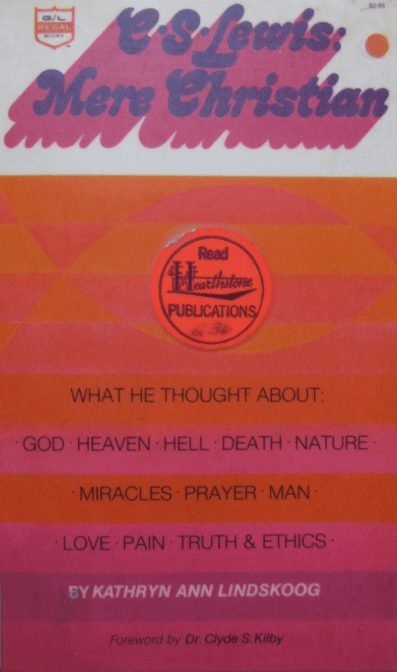
–C. S. Lewis, quoted by Kathryn Lindskoog, C. S. Lewis: Mere Christian, p. 105–
C. S. LEWIS’ DEPRAVITY AND PERVERSION
I cannot give pederasty anything like a first place among the evils of the Coll. There is much hypocrisy on this theme. People commonly talk as if every other evil were more tolerable than this. But why? Because those of us who do not share the vice feel for it a certain nausea, as we do, say, for necrophily? I think that of very little relevance to moral judgment.
–C. S. Lewis, Surprised by Joy, p. 109–
—
Paul Kerry, ed. The Ring and the Cross (Fairleigh Dickinson, 2011). About LOTR.
Kathryn Ann Lindskoog, C. S. Lewis: Mere Christian (Regal Books, 1973).
David Cloud, C. S. Lewis and Evangelicals Today (Way of Life Literature, 2000).
C. S. Lewis, ed. George Macdonald: An Anthology (Macmillan, 1947).
Discovery Institute, “C. S. Lewis: Not On Our Side Exposed As a Heretic and Occultist.”
North American Anglican, “The Salvation Theology of C. S. Lewis.” “It is not possible to ignore the urgency and necessity of George MacDonald and his universalist ideas in the development of C. S. Lewis’ theology. While it did not force Lewis into a total belief in universalism, it is certainly the case that it broadened Lewis’ theology of salvation, to the point that it differs considerably from orthodox, traditional beliefs within both Protestantism and the Roman Catholic Church. It is likely, as can be seen in The Great Divorce, that Lewis leaves open the possibility of universal salvation, limited only by our own innate ability to deny God, even in death. This results in a reality that renders the possibility of universalism unlikely, even within Lewis’ expansive theology of salvation. We must again acknowledge his fairly unorthodox belief that other religions contain truth that points back to God. This is a very large leap of faith on Lewis’ part because it flies in the face of many accepted and traditional beliefs within the universal church. Again, however, in choosing to argue for this possibility, Lewis is ultimately arguing for the supreme sovereignty of God to act in any way God deems fit. Lewis does not outright reject the idea of universalism. Instead, Lewis makes provides explicit and detailed examples that together show salvation, while not being universal, is much broader, merciful and understanding than the church has often taught.”

Dr. John R. Rice, What Is Wrong With the Movies? (Sword of the Lord, 1938). VidAngel, Clearplay, and TCM–the next best thing to completely smashing your TV.
—. The Double Curse of Booze (Sword of the Lord, 1960).
—. Tobacco: Is Its Use Sin? (Sword of the Lord, 2000).
Jeff Amsbaugh, Pay-Per-View…Cost of Pornography (Sword of the Lord, 2008).
Posted in Uncategorized
Leave a comment
Kim Clement’s Esther Prophecy Probably Fulfilled By TPUSA
He that prophesieth speaketh unto men
to edification, and exhortation, and comfort.
–1 Corinthians 14:3 (KJV)–
—
Charisma, “Prophecy: Will a Modern-Day ‘Esther’ Rise In America?”
Christy Johnston, The Esther Mantle (Destiny Image, 2024), ch. 5.
Kim Clement, Secrets of the Prophetic (Destiny Image, 2005). AUDIO BOOK.
—. Call Me Crazy, But I’m Hearing God (Destiny Image, 2007). AUDIO BOOK.
Posted in Uncategorized
Leave a comment
Let Not the Rich Man Glory In His Riches
Let not the wise man glory in his wisdom,
neither let the mighty man glory in his might,
let not the rich man glory in his riches.
–Jeremiah 9:23 (KJV)–
When I experienced a small level of success with my home-based business in 2020-2023, and was writing Biblical Economics, I felt right proud of myself. But because I didn’t have people to hold me accountable, I became greatly inflated with a sense of arrogance, and was quite sure about my money-making ideas. Poverty alleviation, or learning the methods of it, had been on my heart since about high school. Even before I was born again around the year 2000, I was always bothered by the sight of homeless people. Why are they like that? How can I help them? And so, I came to hold respect for ministries like the Salvation Army and the Catholic counterpart of it, the St. Vincent de Paul Society. The reasons are various, but one of the reasons I didn’t pursue a STEM career was the secular humanism, materialism, and anti-supernatural attitudes associated with it. I knew that STEM could produce $80,000 a year and land me in a fine suburb: I knew this before I went off to college. I could have transferred to the NC State engineering program and really got off to a solid money-making career at the age of 23, with $80k to $100k in mechanical engineering. But I didn’t like math; and as I hinted, there’s several reasons why I chose to walk away from that and pursue theology, even if it meant not serving in a certain lukewarm Pentecostal denomination. There was a Scriptural deficit in my life by the time I entered college; and I had to make up for it. I wanted to make the most of my time there by catching up on the Bible and absolute truth about God and the world; and so I spent a lot of time in the college library, not just for homework, but for personal, spiritual, and theological development. I graduated in 2008 and worked minimum wage jobs for about ten years.
Then my attitude changed and I finally hit something close to the $80k mark in 2022. Not only that, but I had done so from my own bedroom. I was just so excited about it! I had to tell the world! So I started the Biblical Economics Podcast, initially for me, just to keep track of my thinking process, so I would retain what I learned. But in the process of doing this, I BECAME OVERLY SURE OF MYSELF. So sure in fact, that I never took the time to get a business website built; nor did I take the time to learn about paid advertising. My tiny little moment of success had blinded my eyes through pride, kind of like staring into the sun, or going out to look at a bunch of white concrete on a summer day. I couldn’t see clearly, there was too much glare, and I didn’t have the sunglasses of humility on. There was more light than my eyes could take in. I had become so sure, so confident of what I had learned and accomplished, that I couldn’t see this massive blind spot. Then it happened…March 2023. The COVID crisis was over; and people were leaving remote work in droves, as most businesses went back to normal, requiring their employees to go back to the old office model so they could be closely supervised by Big Brother. My reliance on GMass, a cold emailing program, was over as well. Gmail had just created an A.I. program that made cold emailing impossible, as it would shut down your G-Suite account in a matter of days! Goodbye leads, prospects, interviews, and 1099 clients. Goodbye home-based business. I’m going back to work under a boss again in a W-2 job.
Business success is deceitful; as Jesus said it, there’s a deceitfulness to riches (Mark 4:19). They can be here today trumpeting your success with over $10,000 in your savings account, and then through an unexpected marketing conundrum, lead to the equivalent of a stock dropping after a rally. Crash! Kaboom! Business, success, independence, Field of Dreams…OVER AND DEAD. You’re going back to work pal, just like everybody else. “Pride goeth before destruction, and an haughty spirit before a fall” (Proverbs 16:18). That’s not to say we can’t learn lessons from going through an experience of financial success and subsequent financial failure. We can! But with Christ, we’ll also have to learn about pride, humility, faith, and the providence of God. “The way of fools seems right to them, but the wise listen to advice” (Proverbs 12:15). That’s what I should’ve done in 2022. It could have saved me three years of financial suffering. But I was too distracted by the pride of my little success, as Richard Baxter said so long ago: “The foolish heart of man is apt to swell upon the accession of so poor a matter as wealth: and men think they are got above their neighbours, and more honour and obeysance is their due, if they be but richer.”
Why is self-denial in general so little practised at present among the Methodists?…The Methodists grow more and more self-indulgent, because they grow rich…And it is an observation which admits of few exceptions, that nine in ten of these decreased in grace, in the same proportion as they increased in wealth. Indeed, according to the natural tendency of riches, we cannot expect it to be otherwise. But how astonishing a thing is this! How can we understand it? Does it not seem (and yet this cannot be) that Christianity, true scriptural Christianity, has a tendency, in process of time, to undermine and destroy itself? For wherever true Christianity spreads, it must cause diligence and frugality, which, in the natural course of things, must beget riches. And riches naturally beget pride, love of the world, and every temper that is destructive of Christianity. Now, if there be no way to prevent this, Christianity is inconsistent with itself, and, of consequence, cannot stand, cannot continue long among any people; since, wherever it generally prevails, it saps its own foundation. But is there no way to prevent this? To continue Christianity among a people? Allowing that diligence and frugality must produce riches, is there no means to hinder riches from destroying the religion of those that possess them? I can see only one possible way; find out another who can. Do you gain all you can, and save all you can? Then you must, in the nature of things, grow rich. Then if you have any desire to escape the damnation of hell, give all you can; otherwise I can have no more hope of your salvation, than of that of Judas Iscariot.
–JOHN WESLEY, “CAUSES OF THE INEFFICACY OF CHRISTIANITY” 1.16-18–

Posted in Uncategorized
Leave a comment
Secular Humanist Republicanism vs Gospel Government
Let every person be subject to the governing authorities. For there is no authority except from God, and those that exist have been instituted by God.
–Romans 13:1 (ESV)–
I urge that supplications, prayers, intercessions, and thanksgivings be made for all people, for kings and all who are in high positions, that we may lead a peaceful and quiet life, godly and dignified in every way.
–1 Timothy 2:1-2 (ESV)–
Be submissive to rulers and authorities,
to be obedient, to be ready for every good work.
–Titus 3:1 (ESV)–
—
Wikipedia, “Republicanism in the United States.”
American Reformer, “The Vanity of Christless Conservatism.” “God has, moreover, given you by his son Jesus Christ—who is far superior to Moses—a complete revelation of His will and a perfect system of true religion plainly delivered in the sacred writings. It will, therefore, be your wisdom in the eyes of the nations, and your true interest and happiness, to conform your practice in the strictest manner to the excellent principles of your government, adhere faithfully to the doctrines and commands of the gospel, and practice every public and private virtue.”
Institute for Faith and Culture, “Warning: The Devastating Trajectory of Christ-less Conservatism.” “The landscape of American politics and international politics alike is marked by an unsettling trend towards a Christ-less conservatism, where faith has been relegated to the periphery of political discourse. In this alarming shift, self-proclaimed conservatives parade their ideological banners devoid of genuine spiritual grounding, choosing to overlook the sacred teachings that once illuminated their paths. The dangers inherent in this trajectory cannot be underestimated, for to sever the ties between faith and conservatism is to lose the very essence of authenticity. Ridding conservatism of the “permanent things”–i.e., morality, liberty, family–leaves conservatism devoid of its value. It becomes an empty shell.”
Richard Weiss, The American Myth of Success (University of Illinois Press, 1988), p. 42. “The pilgrims, when they landed from the Mayflower–a weary and comfortless group–had little to rely upon but God and their own severe virtues; those virtues which adorn freedom, no less than they become Christianity; which give life, vigor, and endurance to a republic. The first was Industry, without which it was impossible to render their conditions tolerable; in its train followed Frugality, the exercise of which, at all times desirable, was rendered imperious by circumstances; Perseverance, essential to the success of all human efforts…On these virtues, next to Heaven, as on a foundation of rock, did they depend as the chief supports of their independence and prosperity.”
Ron Carlson, “Freemasonry and the Masonic Lodge.” “THE REASON WHY NO YOUNG LADIES CAN BECOME MASONS, IS THE BECAUSE THE GOD OF FREEMASONRY IS THE MALE SEX ORGAN” (46:08).
Jeff Farnham, The Octopus of Humanism (Sword of the Lord, 2009).
Dr. John R. Rice, The Unequal Yoke (Sword of the Lord, 1946).
—. Lodges Examined by the Bible (Sword of the Lord, 1943).
Perry Miller, The New England Mind: From Colony to Province (Harvard, 1953).


Posted in Uncategorized
Leave a comment
The Biblical Case Against Evolution
In the beginning
God created the heaven and the earth
That’s what the Word of God says
On the very first page
But then I went to school
And the science teacher taught me
That the world was formed by itself
Over millions of years
And so the animals began to come about
From different kinds of animals that came before
And starfish turned into dogs and cats
Hedgehogs and monkeys turned into people
The teacher showed us a painting all about it
And that means that it’s the truth
Because dinosaur fossils were found in the ground
That means the world is billions of years old
I was told not to believe in God
And the Bible’s just a fairy tale
That the paintings in my science class were true
And that people are just really smart monkeys
The paintings in my biology book
The pictures in my geology book
The verses in Genesis chapter 1
Some people said to just mix ’em all together
–“Millions of Bones and Years”–
—
God said, “Let the land produce living creatures according to their kinds: the livestock, the creatures that move along the ground, and the wild animals, each according to its kind.” And it was so. God made the wild animals according to their kinds, the livestock according to their kinds, and all the creatures that move along the ground according to their kinds. And God saw that it was good. Then God said, “Let us make mankind in our image, in our likeness, so that they may rule over the fish in the sea and the birds in the sky, over the livestock and all the wild animals, and over all the creatures that move along the ground.”
–Genesis 1:24-26 (NIV)–
Casting down imaginations,
and every high thing that exalteth itself
against the knowledge of God.
–2 Corinthians 10:5 (KJV)–
Keep that which is committed to thy trust, avoiding profane and vain babblings, and oppositions of science falsely so called: which some professing have erred concerning the faith.
–1 Timothy 6:20-21 (KJV)–
The fool says in his heart,
“There is no God.”
They are corrupt, their deeds are vile;
there is no one who does good.
–Psalm 14:1 (NIV)–
18 The wrath of God is being revealed from heaven against all the godlessness and wickedness of people, who suppress the truth by their wickedness, 19 since what may be known about God is plain to them, because God has made it plain to them. 20 For since the creation of the world God’s invisible qualities—his eternal power and divine nature—have been clearly seen, being understood from what has been made, so that people are without excuse. 21 For although they knew God, they neither glorified him as God nor gave thanks to him, but their thinking became futile and their foolish hearts were darkened. 22 Although they claimed to be wise, they became fools 23 and exchanged the glory of the immortal God for images made to look like a mortal human being and birds and animals and reptiles.
–Romans 1:18-23 (NIV)–
I use that trust to effectively brainwash them…our teaching methods are primarily those of propaganda. We appeal–without demonstration–to evidence that supports our position. We only introduce arguments and evidence that supports the currently accepted theories and omit or gloss over any evidence to the contrary.
–Dr. Mark Singham, Physics Professor–
—
Dr. Henry Morris, “The Scientific Case Against Evolution.”
Dr. John R. Rice, Evolution or the Bible–Which? (Sword of the Lord, 1963).
The Bible: In the Beginning (20th Century Fox, 1966).
Wikipedia, “Qurna.” Local folklore holds that Qurna, Iraq is the specific location where the Garden of Eden used to exist in Genesis 2:10, 14.
The Encyclopaedia Britannica, 12th ed. (London, 1922), p. 563. “Qurna, the legendary site of the Garden of Eden.”
Iraq: A Tourist’s Guide (State Organization for Tourism, 1975), p. 47. “Al-Qurna, where the Tigris joins the Euphrates. It is the legendary spot of the Garden of Eden.” Smartraveller: “We continue to advise: Do not travel to Iraq, including the Kurdistan Region of Iraq, due to the volatile security situation and the threat of terrorism, armed conflict, kidnapping and violent crime.”
Posted in Uncategorized
Leave a comment
Evangelism Training Video for Turning Point USA – Ray Comfort
THIS IS SO, SO STRONG.
–J.B.–
Posted in Uncategorized
Leave a comment
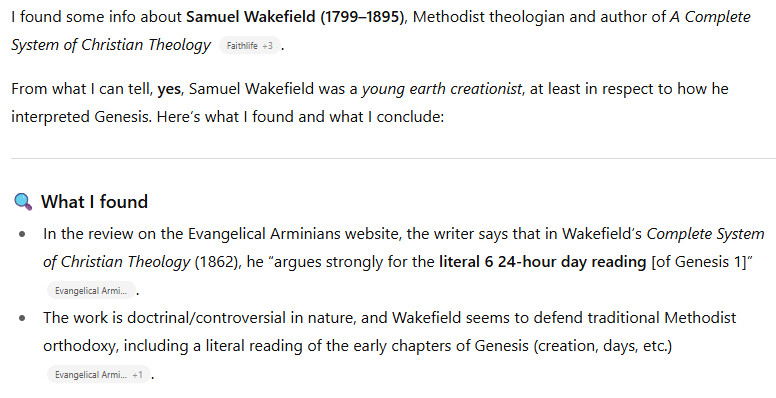
Wesleyan Theologians That Believed In Young Earth Creation – According to ChatGPT
May there not have been eternal protoplasms and life-cells, out of which, during the past eternity, ascidians may have been evolved, and then by successive evolutions and transmutations, natural selection with “the survival of the fittest” and the destruction of the rest, all other animals, including the anthropoids and anthrops, may have been produced? Well, no; there would have been no such thing, and it is absurd to broach an hypothesis so irrational and baseless. Such a genesis would involve a power and skill which bespeak a personal agent and a designing mind—and that is what we call God. This absurd hypothesis not only finds no warrant, but flat contradiction, in Scripture.
–Dr. Thomas O. Summers–

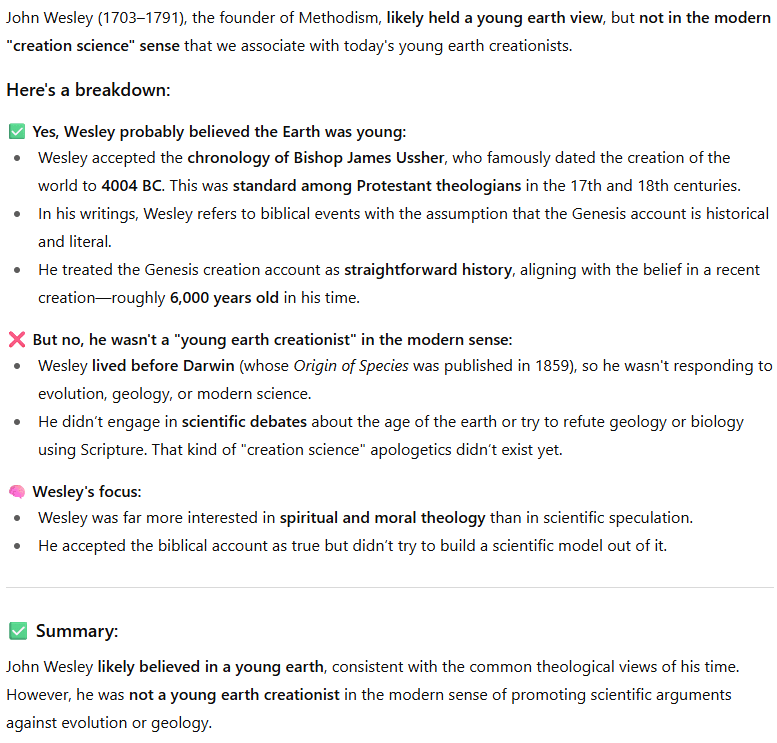


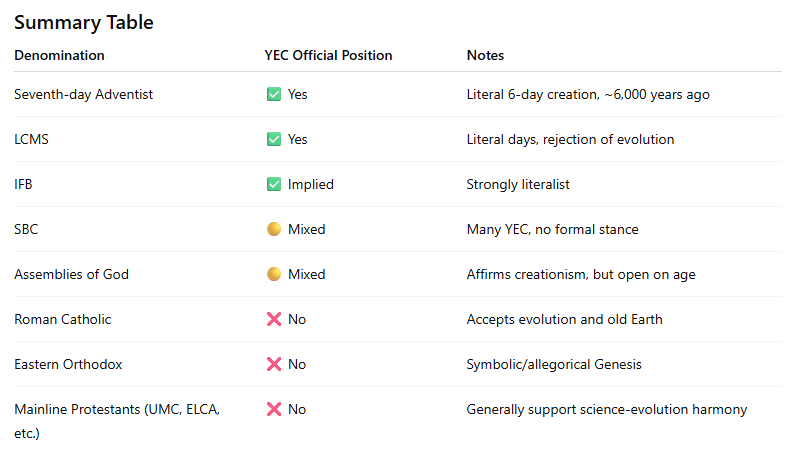
WESLEYAN THEOLOGIANS THAT AFFIRMED YOUNG EARTH CREATION OR BISHOP USSHER’S TIMELINE FROM ANNALS OF THE WORLD. THESE TEACHERS CAN BE TAKEN MORE SERIOUSLY AS INTERPRETERS OF GOD’S WORD, BECAUSE THEY ELEVATED THE DOGMA OF BIBLICAL REVELATION ABOVE MODERNIST IDEAS LIKE EVOLUTION. I SPOKE TO THE PRESIDENT OF THE SOUTHERN METHODIST CHURCH’S BIBLE COLLEGE. HE TOLD ME THAT THEIR DENOMINATION IS THE ONLY WESLEYAN DENOMINATION THAT TAKES A FIRM STANCE ON YOUNG EARTH CREATION. ACCORDING TO HIM, ALL OF THE WESLEYAN-HOLINESS AND PENTECOSTAL DENOMINATIONS, ARE CONFUSED AND AMBIGUOUS ABOUT THEISTIC EVOLUTION. ALTHOUGH HE HINTED THAT CHURCH OF GOD (CLEVELAND) MIGHT HAVE MORE YOUNG EARTH PEOPLE WITHIN IT. HE ALSO HINTED THAT THE INTERNATIONAL FELLOWSHIP OF BIBLE CHURCHES IS FIRMLY YOUNG EARTH…
JOHN WESLEY
JOHN FLETCHER
ADAM CLARKE
CHARLES FINNEY
RICHARD WATSON*
THOMAS NEELY RALSTON*
THOMAS O. SUMMERS*
SAMUEL WAKEFIELD*
A. B. SIMPSON
A. W. TOZER
VIC REASONER
FRENCH ARRINGTON
THE SOUTHERN METHODIST CHURCH
INTERNATIONAL FELLOWSHIP OF BIBLE CHURCHES
CHURCH OF GOD (CLEVELAND, TN)
WESLEYAN THEOLOGIANS THAT REJECTED YOUNG EARTH CREATION; AND AS A RESULT, CANNOT BE TAKEN VERY SERIOUSLY AS THEOLOGIANS, BECAUSE THEY DID NOT REGARD THE BIBLE TO BE THE ABSOLUTE AND SUPREME AUTHORITY ON MATTERS OF CHRISTIAN DOCTRINE. THEY ALLOWED UNPROVEN SCIENCE THEORIES LIKE EVOLUTION TO BE ELEVATED ABOVE THE BIBLE…
WILLIAM BURT POPE
THOMAS C. ODEN
MILDRED BANGS WYNKOOP
H. RAY DUNNING
RANDY MADDOX
H. ORTON WILEY
JOHN MILEY
AMOS BINNEY
BEN WITHERINGTON III
HOWARD SNYDER
CLARK PINNOCK
THOMAS JAY OORD
DUKE DIVINITY SCHOOL
—
*John Tigert, “The Methodist Doctrine of the Atonement,” The Methodist Quarterly Review (New York, 1884), p. 299. This article persuaded me that Thomas Summers’ Systematic Theology (1888) and Richard Watson’s Theological Institutes (1823), in that order, might have been the most thorough and orthodox of the 19th century Methodist theologians. However, Summers was pro-slavery and so I’d have decide against his teaching because of his poor judgment about such a glaring and obvious moral question; and would naturally favor WATSON because his British M.E.C. theology is probably more like Wesley’s and Clarke’s, in keeping with the young earth creation and anti-slavery stances. Samuel Wakefield’s A Complete System of Christian Theology (1862) was also M.E.C., anti-slavery, and taught young earth creation just like Watson did. Although Summers is thorough, I’d rather spend my energy on the Methodist theologian who had the good sense to fight against slavery during the Civil War era: WAKEFIELD. I’d also avoid Thomas Ralston’s Elements of Divinity (1847), because although its a thorough treatment of Wesleyan soteriology, like Summers, it was also a pro-slavery M.E.C. South theology book. But if I were forced to choose between Wakefield and Watson, I would choose Wakefield because he is very clear in his teaching on young earth creation and sides with Archbishop “Usher,” although he misspelled his name. Watson was ambiguous about the matter because he came before Darwin. –J.B.
Posted in Uncategorized
Leave a comment
 WesleyGospel Ministries