
-
-

-
LATEST POSTS
- The Vice Destroying Power of the True Gospel
- Measures for Catholic and Protestant Unity
- Interview With Chicago Bulls Player Jaden Ivey About Him Speaking Out Against Pride Month – Pinpoint Podcast
- He Reads the Bible Daily But Doesn’t Know If He’ll Be In Heaven – Ray Comfort
- The Boxing Gloves, the Suitcase, and the Truth: A Jeremiah Johnson Plagiarism Story – Dr. Ron Cantor
RECENT VIEWS
- Jeremiah Johnson Is a False Prophet and a Lowlife!!
- Biblical Arguments Against Eternal Security - John Wesley and Charles Finney
- Is Bethel Church a Cult?
- Directions About Sports and Recreations - Richard Baxter
- Jeremiah Johnson's Prophetic Plagiarism: More Evidence - Minor Prophets
- Run for Your Life from Prosperity Preachers! - Pastor Carter Conlon
- Review of John Wesley’s “The Use of Money” (1760)
- Bible Believers Refute Universalist Views Held By John Crowder
- Leonard Ravenhill: A Man on Fire for God
- The History of the Emerging Church Movement - Elliott Nesch
MONTHLY ARCHIVES
- April 2026 (12)
- March 2026 (142)
- February 2026 (151)
- January 2026 (242)
- December 2025 (266)
- November 2025 (293)
- October 2025 (190)
- September 2025 (145)
- August 2025 (122)
- July 2025 (119)
- June 2025 (89)
- May 2025 (122)
- April 2025 (183)
- March 2025 (185)
- February 2025 (132)
- January 2025 (159)
- December 2024 (103)
- November 2024 (139)
- October 2024 (135)
- September 2024 (79)
- August 2024 (81)
- July 2024 (105)
- June 2024 (95)
- May 2024 (58)
- April 2024 (55)
- March 2024 (34)
- February 2024 (97)
- January 2024 (61)
- December 2023 (6)
- November 2023 (36)
- October 2023 (24)
- September 2023 (18)
- August 2023 (13)
- July 2023 (11)
- June 2023 (16)
- May 2023 (22)
- April 2023 (14)
- March 2023 (6)
- February 2023 (6)
- January 2023 (11)
- December 2022 (14)
- November 2022 (15)
- October 2022 (10)
- September 2022 (1)
- August 2022 (3)
- July 2022 (2)
- June 2022 (1)
- May 2022 (3)
- April 2022 (7)
- March 2022 (6)
- February 2022 (2)
- January 2022 (4)
- December 2021 (7)
- November 2021 (5)
- September 2021 (1)
- August 2021 (1)
- July 2021 (3)
- June 2021 (1)
- May 2021 (2)
- March 2021 (3)
- February 2021 (2)
- January 2021 (1)
- December 2020 (1)
- October 2020 (1)
- November 2019 (1)
- October 2019 (2)
- September 2019 (1)
- August 2019 (1)
- July 2019 (7)
- June 2019 (4)
- May 2019 (4)
- April 2019 (18)
- March 2019 (7)
- February 2019 (4)
- January 2019 (6)
- December 2018 (3)
- November 2018 (2)
- October 2018 (4)
- September 2018 (5)
- August 2018 (3)
- July 2018 (2)
- June 2018 (1)
- May 2018 (3)
- April 2018 (8)
- January 2018 (2)
- December 2017 (5)
- November 2017 (1)
- October 2017 (8)
- September 2017 (4)
- August 2017 (6)
- July 2017 (6)
- June 2017 (6)
- May 2017 (10)
- April 2017 (20)
- March 2017 (15)
- February 2017 (10)
- January 2017 (10)
- December 2016 (8)
- November 2016 (10)
- October 2016 (23)
- September 2016 (15)
- August 2016 (5)
- July 2016 (9)
- June 2016 (3)
- May 2016 (7)
- April 2016 (4)
- March 2016 (11)
- February 2016 (3)
- January 2016 (10)
- December 2015 (8)
- November 2015 (9)
- October 2015 (10)
- September 2015 (5)
- August 2015 (15)
- July 2015 (9)
- June 2015 (2)
- May 2015 (6)
- April 2015 (38)
- March 2015 (28)
- February 2015 (28)
- January 2015 (28)
- December 2014 (19)
- November 2014 (15)
- October 2014 (5)
- September 2014 (9)
- August 2014 (17)
- July 2014 (30)
- June 2014 (16)
- May 2014 (17)
- April 2014 (18)
- March 2014 (6)
- February 2014 (8)
- January 2014 (8)
- December 2013 (2)
- November 2013 (2)
- October 2013 (3)
- September 2013 (2)
- August 2013 (2)
- July 2013 (1)
- June 2013 (2)
- May 2013 (7)
- April 2013 (9)
- March 2013 (6)
- February 2013 (3)
- January 2013 (6)
- December 2012 (2)
- November 2012 (2)
- October 2012 (4)
- September 2012 (6)
- August 2012 (4)
- July 2012 (7)
- June 2012 (1)
- May 2012 (3)
- April 2012 (5)
- March 2012 (2)
- February 2012 (3)
- January 2012 (1)
- December 2011 (5)
- November 2011 (4)
- October 2011 (11)
- September 2011 (2)
- August 2011 (3)
- July 2011 (2)
- June 2011 (4)
- May 2011 (4)
- April 2011 (4)
- March 2011 (6)
- February 2011 (4)
- January 2011 (1)
- December 2010 (7)
- November 2010 (5)
- October 2010 (9)
- September 2010 (3)
-
Charlie Kirk’s Eerily Prophetic Words In His Last Interview – Living Waters
Posted in Uncategorized
Leave a comment
Divorce Prone Pastors: Let’s Not Repeat Charles Stanley’s Marriage
You’ll break
Merciless in full form
A sacrilege conceived in robed black
Impossible to rip apart from it
Listen close, hear it calling for you
It moves through you
There’s no turning back
Concentrate
Face to face with what turns
The unsettling fascination opaque
Sick beast spread poison
You are consumed
Run, hide, cry
Nothing will help you this time
Soon trapped by rot and vine
“Nowhere to go, you are mine”
A truth resonates as you fall in endless spiral
Incompetent in disbelief
Reality is frozen
Feel the jaws
Clench and now
Slowly you bend
–Loathe, “Gored”–
—
Your cheatin’ heart will make you weep
You’ll cry and cry and try to sleep
But sleep won’t come the whole night through
Your cheatin’ heart will tell on you
When tears come down like falling rain
You’ll toss around and call my name
You’ll walk the floor the way I do
Your cheatin’ heart will tell on you
Your cheatin’ heart will pine someday
And crave the love you threw away
The time will come when you’ll be blue
Your cheatin’ heart will tell on you
–Hank Williams, “Your Cheatin’ Heart”–
—
If a man know not how to rule his own house,
how shall he take care of the church of God?
–1 Timothy 3:5 (KJV)–
Marriage is honourable in all, and the bed undefiled:
but whoremongers and ADULTERERS GOD WILL JUDGE.
–Hebrews 13:4 (KJV)–
If thy right eye offend thee, PLUCK IT OUT, and cast it from thee: for it is profitable for thee that one of thy members should perish, and not that thy whole body should be CAST INTO HELL.
–Matthew 5:29 (KJV)–
Know ye not that the unrighteous shall not inherit the kingdom of God? Be not deceived: neither fornicators, nor idolaters, NOR ADULTERERS, nor effeminate, nor abusers of themselves with mankind, nor thieves, nor covetous, nor drunkards, nor revilers, nor extortioners, SHALL INHERIT THE KINGDOM OF GOD.
–1 Corinthians 6:9-10 (KJV)–

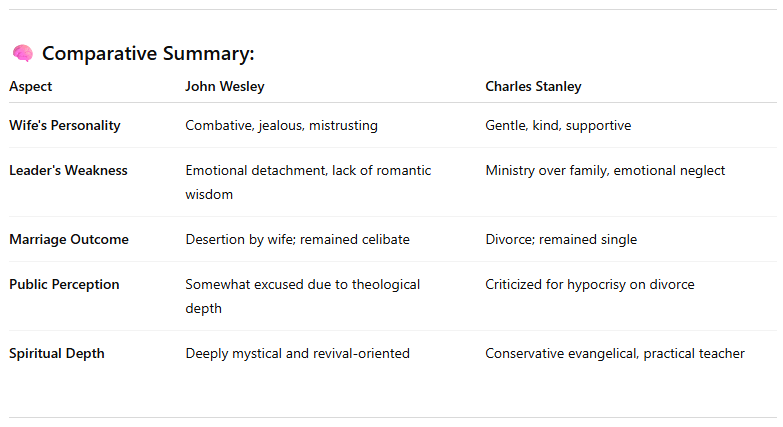
It is a well known fact that John Wesley’s wife, Mary Wesley, also deserted him for a similar reason. Wesley went off on extensive travels as an itinerant evangelist, leaving his wife at home. He also wrote ministry letters to Methodist women who asked him theological questions. Mary interpreted these ministry letters as love letters; and she became jealous. He continued to do this even though he saw it bothered his wife. A similar but different situation as Charles Stanley’s, but not the same. In Stanley’s case, it appears that he clearly prioritized his ministry above his marriage. In Wesley’s case, it appears that he simply had an antagonistic and jealous wife, who didn’t want to understand what he was trying to do. It also appears that he just had very little romantic sense, leaving her at home for long stretches instead of bringing along “a wife, as well as other apostles, and as the brethren of the Lord, and Cephas” (1 Corinthians 9:5). The spiritual and theological depth that Wesley’s ministry had was exponentially greater than Stanley’s ministry; and so its easier for me to give him a pass, as he clearly loved God in a very deep way. But when it came to romance, I think it would be right to say that Wesley was somewhat of a holy fool, who lacked the necessary sensitivity to have a healthy marriage: something he probably learned from watching his own parents. It also seems that Mary Wesley was a self-centered and unspiritual woman, who was prone to pull him into debates, which might explain why he didn’t take her on trips with him. She would have gotten him all worked up in the flesh, so he wouldn’t be able to read, pray, and seek God.
In Stanley’s case, its hard to see anything other than just easy believism, carnality, and ambition that blinded him from loving his wife enough. But I don’t intend to portray Wesley as completely blameless. He wasn’t. After dealing with an unsubmissive, insulting, and argumentative wife for about seven years, he eventually gave into a temptation of what we’d today call emotional adultery, writing the following words in a letter to a thirty three year old Methodist lady named Sarah Ryan in 1758: “The conversing with you, either by speaking or writing, is an unspeakable blessing to me.” This was the straw that broke the camel’s back. Mary deserted her husband after she found that letter in his coat pocket. It happens all the time these days by text on pastors’ not-so-smartphones. On the other hand, maybe it wasn’t emotional adultery at all. Seeing the context, Wesley as well as other Methodist leaders, had been counseling Ms. Ryan as she had been going through a process of “deliverance” for lack of a better word, and reorienting her life after coming from a very abusive background. Wesley was also twenty years older than Ms. Ryan, so its likely that his interactions with her were very brief, shallow, and only of a spiritual nature, intended to provide light to a very darkened mind. It would probably be wrong to say that he “knew” her in any close way. And if that’s the case, as it probably is, since Wesley remained celibate his whole life after Mary left him–that Mary was just a hothead, and was prone to overreact to his pastoral letters that were aimed at women with spiritual problems. Anna Stanley, on the other hand, had a reputation for being a kind woman that served the Lord enthusiastically; and yet, Charles neglected her for the sake of the ministry. –J.B.
—
Westminster Confession of Faith, 24.5-6. Adultery or fornication committed after a contract, being detected before marriage, giveth just occasion to the innocent party to dissolve that contract. In the case of adultery after marriage, it is lawful for the innocent party to sue out a divorce: and, after the divorce, to marry another, as if the offending party were dead…Although the corruption of man be such as is apt to study arguments unduly to put asunder those whom God hath joined together in marriage: yet, nothing but adultery, or such willful desertion as can no way be remedied by the church, or civil magistrate, is cause sufficient of dissolving the bond of marriage: wherein, a public and orderly course of proceeding is to be observed; and the persons concerned in it not left to their own wills, and discretion, in their own case (Matt. 1:18-20; 5:31-32; 19:6-9; Rom. 7:2-3; 1 Cor. 7:15; Deut. 24:1-4).
Gayle White, “Stanley’s Wife Halts Divorce Plans,” Christianity Today, April 29, 1996. Anna Stanley said: “Long ago…Charles, in effect, abandoned our marriage. He chose his priorities, and I have not been one of them.”
Dan Corner, The Gospel According to Charles Stanley (Evangelical Outreach, 1995).
Thomas R. Edgar, “Divorce and Remarriage for Adultery or Desertion,” Divorce and Remarriage: Four Christian Views (InterVarsity Press, 1990).
Dr. John R. Rice, Divorce: The Wreck of Marriage (Sword of the Lord, 1946).
Posted in Uncategorized
1 Comment
The Masonic Lodge Is a Witchcraft Cult Veiled As a Men’s Club – Jeremiah Films
Posted in Uncategorized
Leave a comment
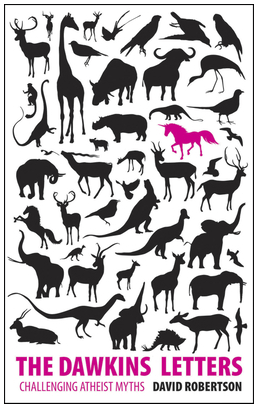
Richard Dawkins’ “The God Delusion” Rebuked By Reformed Pastor David Robertson
Posted in Uncategorized
Leave a comment
Indecent Dress Feeds Adultery – Maze Jackson
David arose from off his bed, and walked upon the roof of the king’s house: and FROM THE ROOF HE SAW A WOMAN WASHING HERSELF; and the woman was very beautiful to look upon.
–2 Samuel 11:2 (KJV)–
Posted in Uncategorized
Leave a comment
Watch Atheists React to the Top 10 Reasons to Trust the Bible – Living Waters
Posted in Uncategorized
Leave a comment
Bertrand Russell’s Atheism Refuted By Dr. Greg Bahnsen
Trapped behind my state of mind
I took your words and now I’m blind
And everything you’ve given just kills me
Your words swarm through my soul like locusts
Eating away at any glimpse of focus
Their eyes flaming red like pain
Filling the void once righteous and bloodstained
But words can’t kill the light inside me
That tears me from the hate that binds me
I feel it crawling up my spine
But I’ll cut it off before it reaches the bloodline
You’ll never fade me out, you’ll never turn me off
You’ll never reach the end, you’ll never hear enough
You’re half-grasp can’t exterminate my stand
You can’t rule with a broken upper hand
A fragment of what’s been left behind
Trapped behind my state of mind
I took your words and now I’m blind
And everything you’ve given just kills me
Trapped behind my state of mind
I took your words and now I’m blind
And everything you’ve given just kills me
Your face brings out the hate that rots me
The face of everyday that haunts me
I can’t pull away my blank stare
A thousand times should prove I don’t care
But hands can’t steal the light that makes me
Or bring me to the fate that breaks me
I feel it crawling up my spine
But I’ll cut it off before it reaches the bloodline
You’ll never fade me out, you’ll never turn me off
You’ll never reach the end, you’ll never hear enough
You’re the half-grasp can’t exterminate my stand
You can’t rule with a broken upper hand
A fragment of what’s been left behind
Trapped behind my state of mind
I took your words and now I’m blind
And everything you’ve given just kills me
Trapped behind my state of mind
A fragment of what’s been left behind
I took your words and now I’m blind
And everything you give just kills me
Kills me!
Kills me!
Kills me!
Kills me!
–Demon Hunter, “A Broken Upper Hand”–
—
Today, if you hear his voice,
do not harden your hearts as in the rebellion.
–Hebrews 3:15 (ESV)–
You stiff-necked people, uncircumcised in heart and ears,
you always resist the Holy Spirit. As your fathers did, so do you.
–Acts 7:51 (ESV)–
18 For the wrath of God is revealed from heaven against all ungodliness and unrighteousness of men, who by their unrighteousness suppress the truth. 19 For what can be known about God is plain to them, because God has shown it to them. 20 For his invisible attributes, namely, his eternal power and divine nature, have been clearly perceived, ever since the creation of the world, in the things that have been made. So they are without excuse. 21 For although they knew God, they did not honor him as God or give thanks to him, but they became futile in their thinking, and their foolish hearts were darkened. 22 Claiming to be wise, they became fools, 23 and exchanged the glory of the immortal God for images resembling mortal man and birds and animals and creeping things. 24 Therefore God gave them up in the lusts of their hearts to impurity, to the dishonoring of their bodies among themselves, 25 because they exchanged the truth about God for a lie and worshiped and served the creature rather than the Creator, who is blessed forever! Amen.
–Romans 1:18-25 (ESV)–
The fool says in his heart, “There is no God.”
They are corrupt, they do abominable deeds;
there is none who does good.
–Psalm 14:1 (ESV)–
18 They are darkened in their understanding, alienated from the life of God because of the ignorance that is in them, due to their hardness of heart. 19 They have become callous and have given themselves up to sensuality, greedy to practice every kind of impurity.
–Ephesians 4:18-19 (ESV)–
The natural person does not accept the things of the Spirit of God, for they are folly to him, and he is not able to understand them because they are spiritually discerned.
–1 Corinthians 2:14 (ESV)–
—
ANCIENT EXTRA-BIBLICAL REFERENCES TO
JESUS AS A REAL HISTORICAL FIGURE
Because the four gospels have miracle stories in them, atheists often say that this puts them in the category of folktales, fairy tales, myths, and legends; and so they are historically unreliable, for no other reason, than that they contain stories about miracles. Then atheists, bursting with laughter at all of these absurdities, with a lens of historical naturalism, will conclusively assert that all four gospels are untruthful, unhistorical, and finally question whether Jesus existed at all. But God in his wisdom saw fit to provide us with at least three testimonies from the ancient world–OUTSIDE OF THE BIBLE–testimonies from non-Christians that Jesus Christ was in fact a real person that lived in first century Palestine. If the “Testimonium Flavianum” was not altered by Christians, as some say it was, then it would mean that Josephus was in the process of becoming a Christian when he wrote that part of Antiquities. But make no mistake: both PLINY and TACITUS were pagan Romans and definitely not Christians: and they still referred to Christ as a historical figure who was crucified by Pilate and produced a following of Christians that worshiped him. Atheists are WRONG! Jesus was a real person that was identified by the secular Roman world at the time. Even up to 83 years after his death and resurrection. –J.B.
Now there was about this time Jesus, a wise man, if it be lawful to call him a man; for he was a doer of wonderful works, a teacher of such men as receive the truth with pleasure. He drew over to him both many of the Jews and many of the Gentiles. He was the Christ. And when Pilate, at the suggestion of the principal men amongst us, had condemned him to the cross, those that loved him at the first did not forsake him; for he appeared to them alive again the third day; as the divine prophets had foretold these and ten thousand other wonderful things concerning him. And the tribe of Christians, so named from him, are not extinct at this day.
–Josephus, Antiquities of the Jews 18.3.3–
–“The Testimonium Flavianum”–
(94 A.D.)
They were accustomed to meet on a fixed day before dawn
and sing responsively a hymn to Christ as to a god.
–Pliny, Letters 10.96-97–
(110 A.D.)
Christus, from whom the name had its origin,
suffered the extreme penalty during the reign of Tiberius
at the hands of one of our procurators, Pontius Pilatus.
–Tacitus, Annals 15.44–
(116 A.D.)

Originally published in 1927, this might be one of the most evil books of all time. The very title communicates apostasy and intellectual atheism. Evil on the level of Machiavelli’s Prince, Hitler’s Mein Kampf, Marx’s Communist Manifesto, and LaVey’s Satanic Bible. Without question, its the most anti-Christian atheist book that’s ever been written. It influenced Richard Dawkins and a host of other atheists. I’ve been aware of it since 2006 or so, but I never tried to refute it, because I thought it was outside of my ability. Some Christian apologists believe this article by Dr. Bahnsen is one of the strongest rebuttals of this perverse, wicked book. Its in Always Ready: Directions for Defending the Faith (Covenant Media Press, 1996), p. 153. –J.B.
—
Originally from here.
An excellent opportunity to practice our defense of the Christian faith is provided by one of the most noteworthy British philosophers of the twentieth century: Bertrand Russell. Russell has offered us a clear and pointed example of an intellectual challenge to the truthfulness of the Christian faith by writing an article which specifically aimed to show that Christianity should not be believed. The title of his famous essay was “Why I Am Not a Christian.”1 Bertrand Russell (1872-1970) studied mathematics and philosophy at Cambridge University and began his teaching career there. He wrote respected works as a philosopher (about Leibniz, about the philosophy of mathematics and set theory, about the metaphysics of mind and matter, about epistemological problems) and was influential on twentieth-century developments in the philosophy of language. He also wrote extensively in a more popular vein on literature, education and politics. Controversy surrounded him. He was dismissed by Trinity College for pacifist activities in 1916; he was jailed in 1961 in connection with a campaign for nuclear disarmament. His views on sexual morality contributed to the annulment of his appointment to teach at the City University of New York in 1940. Yet Russell was highly regarded as a scholar. In 1944 he returned to teach at Cambridge, and in 1950 he became a recipient of the Nobel Prize for Literature.
For all his stature as a philosopher, Russell cannot be said to have been sure of himself and consistent in his views regarding reality or knowledge. In his early years he adopted the Hegelian idealism taught by F. H. Bradley. Influenced by G. E. Moore, he changed to a Platonic theory of ideas. Challenged by Ludwig Wittgenstein that mathematics consists merely of tautologies, he turned to metaphysical and linguistic atomism. He adopted the extreme realism of Alexius Meinong, only later to turn toward logical constructionism instead. Then following the lead of William James, Russell abandoned mind-matter dualism for the theory of neutral monism. Eventually Russell propounded materialism with fervor, even though his dissatisfaction with his earlier logical atomism left him without an alternative metaphysical account of the object of our empirical experiences. Struggling with philosophical problems not unlike those which stymied David Hume, Russell conceded in his later years that the quest for certainty is a failure.
This brief history of Russell’s philosophical evolution is rehearsed so that the reader may correctly appraise the strength and authority of the intellectual platform from which Russell would presume to criticize the Christian faith. Russell’s brilliance is not in doubt; he was a talented and intelligent man. But to what avail? In criticizing Christians for their views of ultimate reality, of how we know what we know, and of how we should live our lives, did Bertrand Russell have a defensible alternative from which to launch his attacks? Not at all. He could not give an account of reality and knowing which—on the grounds of, and according to the criteria of, his own autonomous reasoning—was cogent, reasonable and sure. He could not say with certainty what was true about reality and knowledge, but nevertheless he was firmly convinced that Christianity was false! Russell was firing an unloaded gun.
Bertrand Russell made no secret of the fact that he intellectually and personally disdained religion in general, and Christianity in particular. In the preface to the book of his critical essays on the subject of religion he wrote: “I am as firmly convinced that religions do harm as I am that they are untrue.”3 He repeatedly charges in one way or another that a free man who exercises his reasoning ability cannot submit to religious dogma. He argued that religion was a hindrance to the advance of civilization, that it cannot cure our troubles, and that we do not survive death.
We are treated to a defiant expression of metaphysical materialism—perhaps Russell’s most notorious essay for a popular reading audience—in the article (first published in 1903) entitled “A Free Man’s Worship.” He there concluded: “Brief and powerless is man’s life; on him and all his race the slow, sure doom falls pitiless and dark. Blind to good and evil, reckless of destruction, omnipotent matter rolls on its relentless way.” In the face of this nihilism and ethical subjectivism, Russell nevertheless called men to the invigoration of the free man’s worship: “to worship at the shrine that his own hands have built; undismayed by the empire of chance…”3
Hopefully the brazen contradiction in Russell’s philosophy of life is already apparent to the reader. He asserts that our ideals and values are not objective and supported by the nature of reality, indeed that they are fleeting and doomed to destruction. On the other hand, quite contrary to this, Russell encourages us to assert our autonomous values in the face of a valueless universe—to act as though they really amounted to something worthwhile, were rational, and not merely the result of chance. But after all, what sense could Russell hope to make of an immaterial value (an ideal) in the face of an “omnipotent matter” which is blind to values? Russell only succeeded in shooting himself in the foot.
The essay “Why I Am Not a Christian” is the text of a lecture which Russell delivered to the National Secular Society in London on March 6, 1927. It is only fair to recognize, as Russell commented, that constraints of time prevented him from going into great detail or saying as much as he might like about the matters which he raises in the lecture. Nevertheless, he says quite enough with which to find fault.
In broad terms, Russell argued that he could not be a Christian because:
(1) The Roman Catholic Church is mistaken to say that the existence of God can be proved by unaided reason;
(2) Serious defects in the character and teaching of Jesus show that he was not the best and wisest of men, but actually morally inferior to Buddha and Socrates;
(3) People accept religion on emotional grounds, particularly on the foundation of fear, which is “not worthy of self-respecting human beings”; and
(4) The Christian religion “has been and still is the principal enemy of moral progress in the world.”
What is outstanding about this litany of complaints against Christianity is Russell’s arbitrariness and inconsistency. The second reason offered above presupposes some absolute standard of moral wisdom by which somebody could grade Jesus as either inferior or superior to others. Likewise, the third reason presupposes a fixed criterion for what is, and what is not, “worthy” of self-respecting human beings. Then again, the complaint expressed in the fourth reason would not make any sense unless it is objectively wrong to be an enemy of “moral progress”; indeed, the very notion of moral “progress” itself assumes an established benchmark for morality by which to assess progress.
Now, if Russell had been reasoning and speaking in terms of the Christian worldview, his attempt to assess moral wisdom, human worthiness, and moral progress—as well as to adversely judge shortcomings in these matters—would be understandable and expected. Christians have a universal, objective and absolute standard of morality in the revealed Word of God. But obviously Russell did not mean to be speaking as though he adopted Christian premises and perspectives! On what basis, then, could Russell issue his moral evaluations and judgments? In terms of what view of reality and knowledge did he assume that there was anything like an objective criterion of morality by which to find Christ, Christians, and the church lacking?
Russell was embarrassingly arbitrary in this regard. He just took it for granted, as an unargued philosophical bias, that there was a moral standard to apply, and that he could presume to be the spokesman and judge who applies it. One could easily counter Russell by simply saying that he had arbitrarily chosen the wrong standard of morality. To be fair, Russell’s opponents must be granted just as much arbitrariness in choosing a moral standard, and they may then select one different from his own. And there goes his argument down in defeat.
By assuming the prerogative to pass moral judgment, Russell evidenced that his own presuppositions fail to comport with each other. In offering a condemning value-judgment against Christianity, Russell engaged in behavior which betrayed his professed beliefs elsewhere. In his lecture Russell professed that this was a chance world which shows no evidence of design, and where “laws” are nothing more than statistical averages describing what has happened. He professed that the physical world may have always existed, and that human life and intelligence came about in the way explained by Darwin (evolutionary natural selection). Our values and hopes are what “our intelligence can create.” The fact remains that, according to “the ordinary laws of science, you have to suppose that human life…on this planet will die out in due course.”
This is simply to say that human values are subjective, fleeting, and self-created. In short, they are relative. Holding to this kind of view of moral values, Russell was utterly inconsistent in acting as though he could assume an altogether different kind of view of values, declaring an absolute moral evaluation of Christ or Christians. One aspect of Russell’s network of beliefs rendered another aspect of his set of beliefs unintelligible.
The same kind of inner tension within Russell’s beliefs is evident above in what he had to say about the “laws” of science. On the one hand such laws are merely descriptions of what has happened in the past, says Russell. On the other hand, Russell spoke of the laws of science as providing a basis for projecting what will happen in the future, namely the decay of the solar system. This kind of dialectical dance between conflicting views of scientific law (to speak epistemologically) or between conflicting views of the nature of the physical cosmos (to speak metaphysically) is characteristic of unbelieving thought. Such thinking is not in harmony with itself and is thus irrational.
In the first reason given by Russell for why he was not a Christian, he alluded to the dogma of the Roman Catholic Church that “the existence of God can be proved by the unaided reason.”4 He then turns to some of the more popular arguments advanced for the existence of God which are (supposedly) based upon this “unaided reason” and easily finds them wanting. It goes without saying, of course, that Russell thought that he was defeating these arguments of unaided reason by means of his own (superior) unaided reason. Russell did not disagree with Rome that man can prove things with his “natural reason” (apart from the supernatural work of grace). Indeed, at the end of his lecture he called his hearers to “a fearless outlook and a free intelligence.” Russell simply disagreed that unaided reason takes one to God. In different ways, and with different final conclusions, both the Roman church and Russell encouraged men to exercise their reasoning ability autonomously—apart from the foundation and restraints of divine revelation.
The Christian apologist should not fail to expose this commitment to “unaided reason” for the unargued philosophical bias that it is. Throughout his lecture Russell simply takes it for granted that autonomous reason enables man to know things. He speaks freely of his “knowledge of what atoms actually do,” of what “science can teach us,” and of “certain quite definite fallacies” committed in Christian arguments, etc. But this simply will not do. As the philosopher, Russell here gave himself a free ride; he hypocritically failed to be as self-critical in his reasoning as he beseeched others to be with themselves.
The nagging problem which Russell simply did not face is that, on the basis of autonomous reasoning, man cannot give an adequate and rational account of the knowledge we gain through science and logic. Scientific procedure assumes that the natural world operates in a uniform fashion, in which case our observational knowledge of past cases provides a basis for predicting what will happen in future cases. However, autonomous reason has no basis whatsoever for believing that the natural world will operate in a uniform fashion. Russell himself (at times) asserted that this is a chance universe. He could never reconcile this view of nature being random with his view that nature is uniform (so that “science” can teach us).
So it is with a knowledge and use of the laws of logic (in terms of which Russell definitely insisted that fallacies be avoided). The laws of logic are not physical objects in the natural world; they are not observed by man’s senses. Moreover, the laws of logic are universal and unchanging—or else they reduce to relativistic preferences for thinking, rather than prescriptive requirements. However, Russell’s autonomous reasoning could not explain or justify these characteristics of logical laws. An individual’s unaided reason is limited in the scope of its use and experiences, in which case it cannot pronounce on what is universally true (descriptively). On the other hand, an individual’s unaided reason is in no position to dictate (prescriptively) universal laws of thought or to assure us that these stipulations for the mind will somehow prove applicable to the world of thought or matter outside the individual’s mind.5
Russell’s worldview, even apart from its internal tensions, could not provide a foundation for the intelligibility of science or logic. His “unaided” reason could not account for the knowledge which men readily gain in God’s universe, a universe sovereignly controlled (so that it is uniform) and interpreted in light of the Creator’s revealed mind (so that there are immaterial laws of thought which are universal).
We must note, finally, that Russell’s case against being a Christian is subject to criticism for its reliance upon prejudicial conjecture and logical fallacies. That being the case, he cannot be thought to have established his conclusions or given good reason for his rejection of Christianity.
One stands in amazement, for instance, that the same Russell who could lavish ridicule upon past Christians for their ignorance and lack of scholarship, could come out and say something as uneducated and inaccurate as this: “Historically it is quite doubtful whether Christ ever existed at all, and if He did we do not know anything about Him.” Even forgetting secular references to Christ in the ancient world, Russell’s remark simply ignores the documents of the New Testament as early and authentic witnesses to the historical person of Jesus. Given the relatively early dates of these documents and the relatively large number of them, if Russell “doubted” the existence of Jesus Christ, he must have either applied a conspicuous double standard in his historical reasoning, or been an agnostic about virtually the whole of ancient history. Either way, we are given an insight into the prejudicial nature of Russell’s thinking when it came to consideration of the Christian religion.
Perhaps the most obvious logical fallacy evident in Russell’s lecture comes out in the way he readily shifts from an evaluation of Christian beliefs to a criticism of Christian believers. And he should have known better. At the very beginning of his lecture, Russell said, “I do not mean by a Christian any person who tries to live decently and according to his lights. I think that you must have a certain amount of definite belief before you have a right to call yourself a Christian.” That is, the object of Russell’s criticism should be, by his own testimony, not the lifestyle of individuals but the doctrinal claims which are essential to Christianity as a system of thought. The opening of his lecture focuses upon his dissatisfaction with those beliefs (God’s existence, immortality, Christ as the best of men).
Nevertheless, toward the end of his lecture, Russell’s discussion turns in the direction of fallaciously arguing against the personal defects of Christians (enforcing narrow rules contrary to human happiness) and the supposed psychological genesis of their beliefs (in emotion and fear). That is, he indulges in the fallacy of arguing ad hominem. Even if what Russell had to say in these matters was fair-minded and accurate (it is not), the fact would remain that Russell has descended to the level of arguing against a truth-claim on the basis of his personal dislike and psychologizing of those who personally profess that claim. In other settings, Russell the philosopher would have been the first to criticize a student for pulling such a thing. It is nothing less than a shameful logical fallacy.
Notice briefly other defects in Russell’s line of thinking here. He presumed to know the motivation of a person in becoming a Christian—even though Russell’s epistemology gave him no warrant for thinking he could discern such things (especially easily and at a distance). Moreover, he presumed to know the motivation of a whole class of people (including those who lived long ago), based on a very, very small sampling from his own present experience. These are little more than hasty and unfounded generalizations, telling us (if anything) only about the state of Russell’s mind and feelings in his obvious, emotional antipathy to Christians.
But then this leaves us face to face with a final, devastating fallacy in Russell’s case against Christianity—the use of double standards (and implicit special pleading) in his reasoning. Russell wished to fault Christians for the emotional factor in their faith-commitment, and yet Russell himself evidenced a similarly emotional factor in his own personal anti-Christian commitment. Indeed, Russell openly appealed to emotional feelings of courage, pride, freedom and self-worth as a basis for his audience to refrain from being Christians!
Similarly, Russell tried to take Christians to task for their “wickedness” (as though there could be any such thing within Russell’s worldview)—for their cruelty, wars, inquisitions, etc. Russell did not pause for even a moment, however, to reflect on the far-surpassing cruelty and violence of non-Christians throughout history. Genghis Khan, Vlad the Impaler, Marquis de Sade and a whole cast of other butchers were not known in history for their Christian professions, after all! This is all conveniently swept under the carpet in Russell’s hypocritical disdain for the moral errors of the Christian church.
Russell’s essay “Why I Am Not a Christian” reveals to us that even the intellectually elite of this world are refuted by their own errors in opposing the truth of the Christian faith. There is no credibility to a challenge to Christianity which evidences prejudicial conjecture, logical fallacies, unargued philosophical bias, behavior which betrays professed beliefs, and presuppositions which do not comport with each other. Why wasn’t Russell a Christian? Given his weak effort at criticism, one would have to conclude that it was not for intellectual reasons.
—
NOTES
1 The article is found in Bertrand Russell, Why I Am Not a Christian, And Other Essays on Religion and Related Subjects, ed. Paul Edwards (New York: Simon and Schuster, Clarion, 1957), pp. 3-23.
2 Ibid., p. vi.
3 Ibid., pp. 115-16.
4 In his lecture Russell displays a curious and capricious shifting around for the standard which defines the content of “Christian” beliefs. Here he arbitrarily assumes that what the Roman magisterium says is the standard of Christian faith. Yet in the paragraph immediately preceding, Russell claimed that the doctrine of Hell was not essential to Christian belief because the Privy Council of the English Parliament had so decreed (over the dissent of the Archbishops of Canterbury and York). Elsewhere Russell departs from this criterion of Christianity and excoriates the teaching of Jesus, based upon the Bible, that the unrepentant face everlasting damnation. Russell had no interest in being consistent or fair in dealing with Christianity as his opponent. When convenient he defined the faith according to the Bible, but when it was more convenient for his polemical purposes he shifted to defining the faith according to the English Parliament or the Roman Catholic Church.
5 Those familiar with Russell’s detailed (and noteworthy, seminal) work in philosophy would point out that, despite his brilliance, Russell’s “unaided reason” could never resolve certain semantic and logical paradoxes which arise in his account of logic, mathematics and language. His most reverent followers concede that Russell’s theories are subject to criticism.
—
Jeff Farnham, The Octopus of Humanism (Sword of the Lord, 2009).
Josh McDowell, The New Evidence That Demands a Verdict (Thomas Nelson, 1999).
John Frame, “Presuppositional Apologetics,” Five Views… (Zondervan, 2000).
Dr. John R. Rice, Evolution or the Bible–Which? (Sword of the Lord, 1963).
Dr. Greg Bahnsen, Always Ready: Directions for Defending the Faith (Covenant, 1996).
Dr. Jack Deere, Why I Am Still Surprised by the Power of the Spirit (Zondervan, 2020).
Dr. Archibald Alexander, Thoughts on Religious Experience (Banner of Truth, 2020).
Posted in Uncategorized
Leave a comment
 WesleyGospel Ministries