
I don’t believe that it’s right to say a lordship view of eternal security is a false teaching. It’s a different point of view on the keeping power of the Holy Spirit than the Wesleyan holds to. The lordship Calvinist believes in holy living, obedience to the Bible, and heartfelt repentance. So does the Wesleyan. Both the John MacArthurs and the A. W. Tozers–the former can be linked with Reformed theology; the latter with Wesleyanism and holiness churches. However, the main point that they differ on is the extent of regeneration and its relation to the free will of the true convert. Wesleyans believe that the Holy Spirit can fly out of the heart of a true convert if he decides to backslide and let apostasy run full circle: which is the result of people choosing to shift their trust away from Jesus and instead walking their own way: Wesleyans call this conditional security (1 Samuel 16:14; Judges 16:20; 24:15; 1 Timothy 1:19-20; 2 Timothy 4:10; John 6:66). Calvinists believe that this simply can’t happen; and the reason why this is so, is very complicated hermeneutically; and has to do with many Bible verses that they view that way. Then there’s another class of believers in eternal security: these are the dispensationalists like Zane Hodges, who run the teaching of “once saved, always saved” into antinomian territory. This view says that salvation through faith in Jesus is so free that Christians don’t really need to read, study, or apply any Biblical principles to their lives; and tends to view those who believe in obedience to the Bible as legalists and modern Pharisees. This teaching is often linked with Dallas Theological Seminary; and would be the descendant of a strain of American antinomianism that goes back to the time of Anne Hutchinson. Such a belief is wicked and damnable; and rejected by both Wesleyans and lordship Calvinists. –J.B.
John Wesley, Serious Thoughts Upon the Perseverance of the Saints. Using the Bible, he maintains the view that true converts can lose the regenerating work of the Holy Spirit; and hence lose the saving, justifying, and sanctifying grace of the Spirit, by willingly consenting to temptation and consciously reversing repentance, rejecting the substitutionary atonement that they trusted in before–the most important aspect of apostasy, and by rebelling against God after previously walking with him (Hebrews 6:4-6; 10:26-29; 2 Peter 2:20-22; 1 Timothy 1:19). The true converts previously had a holy faith walk with God, a saving relationship with God, previously; but have now consciously walked away from Christianity completely, becoming apostates–these are not tempted, overcome, addicted, or backslidden but still fighting believers–but ex-evangelicals that are into complete and 100% total rejection of the born again lifestyle and faith they had before; and are now slidden so deep into atheism, agnosticism, or some false religion, that their hearts have become reprobate, hardened, blinded, past feeling, and unrepentant. “Prone to wander, Lord, I feel it, prone to leave the God I love,” as “Come Thou Fount” says. This is not the straw man argument view of being “Saved one minute, lost the next. Saved again, lost again,” as is often misunderstood by anxious people not properly taught the Wesleyan view of apostasy. It is seen as more of a total reversal of trust in God and a lifestyle that now has a permanently abiding nature of unbelief about it, often entered into by becoming close friends with non-Christians. The saving work of the Holy Spirit is not viewed as irresistible; a person can always resist the Spirit’s saving influence (Acts 7:51).
This is why the witness of the Spirit is so important in Wesleyan theology; because a genuine walk with God, will have experiences of God’s presence and voice to occasionally authenticate the reality of a true convert’s faith in the Gospel. It was in his sermon “The Witness of the Spirit, Part II,” where Wesley taught that Christians without experiences of the Holy Spirit, with no real faith confirming that they’re children of God (Rom. 8:16), are not true converts, but are simply deists who might have very well accepted a whole lot of Bible teachings in their heads. To Wesley, a true convert has a heart-faith in the Gospel strong enough to produce experiences of the Holy Spirit, which provide him with assurance of salvation. This is understood as the “strongest proof of Christianity,” a much stronger assurance than any Calvinistic arguments about a Father’s hand holding a sheep with a spiritual vice grip. Wesley: “This is farther explained by the parallel text, (Gal. 4:6,) “Because ye are sons, God hath sent forth the Spirit of his Son into your hearts, crying Abba, Father.” Is not this something immediate and direct, not the result of reflection or argumentation? Does not his Spirit cry, “Abba, Father,” in our hearts the moment it is given, antecedently to any reflection upon our sincerity; yea, to any reasoning whatsoever? And is not this the plain natural sense of the words, which strikes any one as soon as he hears them? All these texts then, in their most obvious meaning, describe a direct testimony of the Spirit” (“The Witness of the Spirit, II” 3.4).
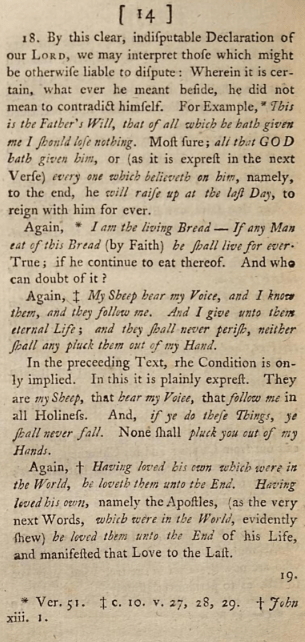
Randolph Foster, Objections to Calvinism As It Is, ch. 6: “Perseverance.” Presents Wesley’s view.
Adam Clarke, Christian Theology, ch. 30: “Apostacy.” Wesley’s theological successor. Clarke: “You have many enemies; be continually on your guard; be always circumspect: 1. Be watchful against evil. 2. Watch for opportunities to do good. 3. Watch over each other in love. 4. Watch that none may draw you aside from the belief and unity of the Gospel. He that is self-confident is already half fallen. He who professes to believe that God will absolutely keep him from falling finally, and neglects watching unto prayer, is not in a safer state. He who lives by the moment, walks in the light, and maintains his communion with God, is in no danger of apostacy…The apostle shows here five degrees of apostacy: 1. Consenting to sin; being deceived by its solicitations. 2. Hardness of heart through giving way to sin. 3. Unbelief in consequence of this hardness, which leads them to call even the truth of the Gospel in question. 4. This unbelief causing them to speak evil of the Gospel, and the provision God has made for the salvation of their souls. 5. Apostacy itself, or falling off from the living God, and thus extinguishing all the light that was in them, and finally grieving the Spirit of God, so that he takes his flight, and leaves them to a seared conscience and reprobate mind. He who begins to give the least way to sin is in danger of final apostacy: the best remedy against this is, to get the evil heart removed; as one murderer in the house is more to be dreaded than ten without…How strange is it that there should be found any backslider! that one who once felt the power of Christ should ever turn aside! But it is still stranger that any one who has felt it, and given, in his life and conversation, full proof that he has felt it, should not only let it slip, but at last deny that he ever had it, and even ridicule a work of grace in the heart! Such instances have appeared among men…“But he that lacketh these things:” he, whether Jew or Gentile, who professes to have faith in God, and has not added to that faith, fortitude, knowledge, temperance, patience, godliness, brotherly kindness, and universal love, “is blind,” his understanding is darkened, and cannot see afar off, shutting his eyes against the light, winking, not able to look truth in the face, nor to behold that God whom he once knew was reconciled to him; and thus it appears he is wilfully blind, “and hath forgotten that he was purged from his old sins”—has at last, through the non-improvement of the grace which he received from God, his faith ceasing to work by love, lost the evidence of things not seen: for, having grieved the Holy Spirit by not showing forth the virtues of Him who called him into his marvellous light, he has lost the testimony of his sonship; and then darkness and hardness having taken the place of light and filial confidence, he first calls all his former experience into doubt;—questions whether he has not put enthusiasm in the place of religion. By these means his darkness and hardness increase, his memory becomes indistinct and confused, till at length he forgets the work of God on his soul, next denies it, and at last asserts that the knowledge of salvation by the remission of sins is impossible, and that no man can be saved from sin (addiction) in this life. Indeed, some go so far as to deny the Lord that bought them; to renounce Jesus Christ as having made atonement for them; and finish their career of apostacy by utterly denying his godhead. Many cases of this kind have I known; and they are all the consequence of believers not continuing to be workers together with God, after they had experienced his pardoning love…Here (2 Peter 2:22) is a sad proof of the possibility of falling from grace, and from very high degrees of it too. These had escaped from the contagion that was in the world; they had had true repentance, and cast up “their sour-sweet morsel of sin;” they had been washed from all their filthiness, and this must have been through the blood of the Lamb; yet, after all, they went back, got entangled with their old sins, swallowed down their formerly rejected lusts, and rewallowed in the mire of corruption. It is no wonder that God should say, “The latter end is worse with them than the beginning:” reason and nature say, “It must be so;” and divine justice says, “It ought to be so;” and the person himself must confess that it is right that it should be so. But how dreadful is this state! How dangerous, when the person has abandoned himself to his old sins! Yet it is not said that it is impossible for him to return to his Maker; though his case be deplorable, it is not utterly hopeless; the leper may yet be made clean, and the dead may be raised. Reader, is thy backsliding a grief and burden to thee? Then thou art not far from the kingdom of God; believe on the Lord Jesus, and thou shalt be saved…The backslider’s soul, before influenced by the Spirit of God, dilated and expanded under its heavenly influences, becomes more capable of refinement in iniquity, as its powers are more capacious than formerly. Evil habits are formed and strengthened by relapses; and relapses are multiplied, and become more incurable, through new habits…A soul cut off from the flock of God is in an awful state! His outward defence is departed from him; and being no longer accountable to any for his conduct, he generally plunges into unprecedented depths of iniquity, and the last state of that man becomes worse than the first…In a state of probation every thing may change. While we are in life we may stand or fall. Our standing in the faith depends on our union with God; and that depends on our watching unto prayer, and continuing to possess that faith that worketh by love. The highest saint under heaven can stand no longer than he depends upon God, and continues in the obedience of faith. He that ceases to do so will fall into sin, and get a darkened understanding and a hardened heart; and he may continue in this state till God come to take away his soul. Therefore, let him who most assuredly standeth take heed lest he fall, not only partially, but finally.”
Charles Finney, “The Loss When a Soul Is Lost.” Using the Bible, he presents Wesley’s view in another way, a sermon based on Mark 8:36: “What shall it profit a man, if he shall gain the whole world, and lose his own soul?” Finney: “This danger is exceedingly great, because men have only to neglect the soul and it is surely lost. It does not require attention and labor. You can lose your soul without the least possible effort made specially for this purpose. You need not go about to commit sin in order to ensure the ruin of your soul hopelessly and forever. You need only neglect its salvation and it is surely lost. You need only be as negligent as you have been heretofore. It is only necessary that you slide along in the same thoughtless, reckless manner as in your past days and the end will be “sudden destruction and that without remedy.” As says the apostle; —“How shall we escape if we neglect so great salvation?” There is none other name under heaven given among man whereby ye can be saved. And there is no salvation through this name but by a living faith which works by love and makes the heart pure from sin.”
Living Waters, “The Importance of Eternal Security.” Using the Bible, they present the view that people who look like they lost their salvation were people who were never really true converts in the first place (1 John 2:19). But they don’t believe in the antinomian view of “once saved, always saved,” which implies that personal holiness is unnecessary. They believe that holy living is the mark of a true convert, but they don’t believe it’s possible to fall away from the faith once you’ve had a genuine Holy Spirit conversion experience.
J. Matthew Pinson, ed. Four Views on Eternal Security (Zondervan, 2002).
John Jefferson Davis, “The Perseverance of the Saints: A History of the Doctrine.”
—
What are the Bible-based churches that firmly represent the conditional security position? Ones that are not Purpose Driven? I don’t know for sure–maybe its the Southern Methodist Church, the Free Will Baptist Church, or the denominations in the InterChurch Holiness Convention (IHC): that is, the Bible Methodist Church, Central Yearly Meeting of Friends, Church of the Nazarene, God’s Missionary Church, the Bible Holiness Church, the Pilgrim Holiness Church, and other independent Wesleyan holiness churches. And just to be generous, maybe there’s even some really conservative Assembly of God and Church of God preachers out there who still preach against eternal security. –J.B.
“YOU’RE NOT GOIN’ ANYWHERE DUDE!”
–The Great Khali–
Thank God that Jesus ain’t like that.


 WesleyGospel Ministries