
DEAD BODIES EVERYWHERE!
DEAD BODIES EVERYWHERE!
DEAD BODIES EVERYWHERE!
DEAD BODIES EVERYWHERE!
–Korn, “Dead Bodies Everywhere”–*
And they shall go forth, and look upon the carcasses of the men that have transgressed against me: for their worm shall not die, neither shall their fire be quenched; and they shall be an abhorring unto all flesh.
–Isaiah 66:24 (KJV)–
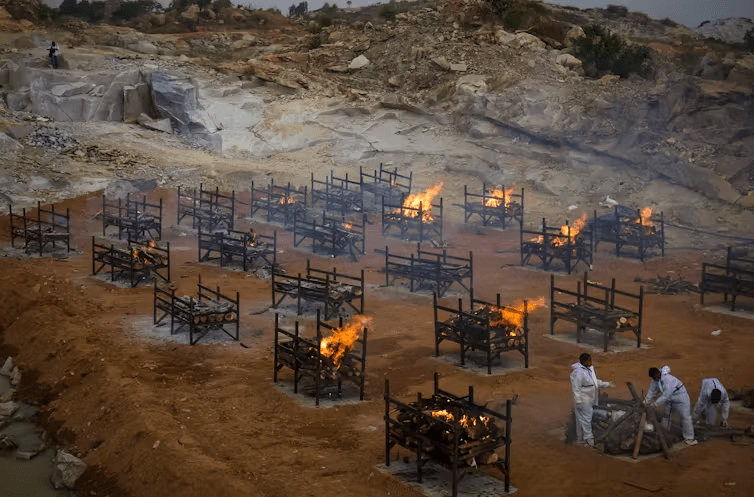
That their thankful sense of God’s distinguishing favour to them should be very much increased by the consideration of the fearful doom and destruction of those that persist and perish in their infidelity and impiety. Those that have been worshipping the Lord of hosts, and rejoicing before him in the goodness of his house, shall, in order to affect themselves the more with their own happiness, take a view of the misery of the wicked. Observe, (1.) Who they are whose misery is here described. They are men that have transgressed against God, not only broken his laws, but broken covenant with him, and thought themselves able to contend with him. It may be meant especially of the unbelieving Jews that rejected the gospel of Christ. (2.) What their misery is. It is here represented by the frightful spectacle of a field of battle, covered with the carcasses of the slain, that lie rotting above ground, full of worms crawling about them and feeding on them; and, if you go to burn them, they are so scattered, and it is such a noisome piece of work to get them together, that it would be endless, and the fire would never be quenched; so that they are an abhorring to all flesh, nobody cares to come near them. Now this is sometimes accomplished in temporal judgments, and perhaps never nearer the letter than in the destruction of Jerusalem and the Jewish nation by the Romans, in which destruction it is computed that above two millions, first and last, were cut off by the sword, besides what perished by famine and pestilence. It may refer likewise to the spiritual judgments that came upon the unbelieving Jews, which St. Paul looks upon, and shows us, Romans 11:8, c. They became dead in sins, twice dead. The church of the Jews was a carcass of a church all its members were putrid carcasses; their worm died not, their own consciences made them continually uneasy, and the fire of their rage against the gospel was not quenched, which was their punishment as well as their sin; and they became, more than ever any nation under the sun, an abhorring to all flesh. But our Saviour applies it to the everlasting misery and torment of impenitent sinners in the future state, where their worm dies not, and their fire is not quenched (Mark 9:44); for the soul, whose conscience is its constant tormentor, is immortal, and God, whose wrath is its constant terror, is eternal. (3.) What notice shall be taken of it. Those that worship God shall go forth and look upon them, to affect their own hearts with the love of their Redeemer, when they see what misery they are redeemed from. As it will aggravate the miseries of the damned to see others in the kingdom of heaven and themselves thrust out (Luke 13:28), so it will illustrate the joys and glories of the blessed to see what becomes of those that died in their transgression, and it will elevate their praises to think that they were themselves as brands plucked out of that burning. To the honour of that free grace which thus distinguished them let the redeemed of the Lord with all humility, and not without a holy trembling, sing their triumphant songs.
—MATTHEW HENRY’S COMMENTARY—
—
These words of the prophet are applied by our blessed Saviour, Mark 9:44, to express the everlasting punishment of the wicked in Gehenna, or in hell. Gehenna, or the valley of Hinnom, was very near to Jerusalem to the south-east: it was the place where the idolatrous Jews celebrated that horrible rite of making their children pass through the fire, that is, of burning them in sacrifice to Moloch. To put a stop to this abominable practice, Josiah defiled, or desecrated, the place, by filling it with human bones, 2 Kings 23:10; and probably it was the custom afterwards to throw out the carcasses of animals there, when it also became the common burying place for the poorer people of Jerusalem. Our Saviour expressed the state of the blessed by sensible images; such as paradise, Abraham’s bosom, or, which is the same thing, a place to recline next to Abraham at table in the kingdom of heaven. See Matthew 8:11…for we could not possibly have any conception of it but by analogy from worldly objects. In like manner he expressed the place of torment under the image of Gehenna; and the punishment of the wicked by the worm which there preyed on the carcasses, and the fire that consumed the wretched victims. Marking however, in the strongest manner, the difference between Gehenna and the invisible place of torment; namely, that in the former the suffering is transient:-the worm itself which preys upon the body, dies; and the fire which totally consumes it, is soon extinguished:-whereas in the figurative Gehenna the instruments of punishment shall be everlasting, and the suffering without end; “for there the worm dieth not, and the fire is not quenched.” These emblematical images, expressing heaven and hell, were in use among the Jews before our Saviour’s time; and in using them he complied with their notions. “Blessed is he that shall eat bread in the kingdom of God,” says the Jew to our Saviour, Luke 14:15. And in regard to Gehenna, the Chaldee paraphrase as I observed before on Isaiah 30:33, renders everlasting or continual burnings by “the Gehenna of everlasting fire.” And before his time the son of Sirach, Sirach 7:17, had said, “The vengeance of the ungodly is fire and worms.” So likewise the author of the book of Judith, Judith 16:17: “Wo to the nations rising up against my kindred: the Lord Almighty will take vengeance of them in the day of judgment, in putting fire and worms in their flesh;” manifestly referring to the same emblem.**
—ADAM CLARKE’S COMMENTARY—
—
* I would not generally recommend listening to this band in the sense of entirely approving of their albums 100% or wholesale. I’ve only extracted a part of this song to illustrate a point. This goes for several of the songs on my podcasts. Amos 8:10: “I will turn your feasts into mourning, and all your songs into lamentation.” Ecclesiastes 7:5: “It is better to hear the rebuke of the wise, than for a man to hear the song of fools.” –J.B.
** “Woe to the nations that rise up against my people! The Lord Almighty will take vengeance on them in the day of judgment; he will send fire and worms into their flesh; they shall weep in pain forever” (Judith 16:17, NRSV).
What God sees on earth, he repeats and amplifies in eternity.


 WesleyGospel Ministries