
Recalling the road, leading it away from right
As the dark had appeared as the light
Tricked to cross the line, dragged further in
Then trapped in a swirl of wicked lies
–Extol, “Undeceived”–
God is angry with the wicked every day. –Psalm 7:11 (KJV)
When he saw many of the Pharisees and Sadducees come to his baptism, he said unto them, O generation of vipers, who hath warned you to flee from the wrath to come? –Matthew 3:7 (KJV)
This implies that those groups didn’t preach on the wrath of God, judgment, or Hell. Among all the rabbis in Jerusalem, who among the Bible teachers has warned them about God’s wrath against sin, about Hell, and the Day of Judgment? Its a rhetorical question: the answer is nobody, which is why they’re going to hear about if they come out to the desert to see John the Baptist. The Pharisees and Sadducees were into easy-believism, no-lordship, or anti-repentance type of religion; and John meant that people like that are headed for a burning Hell (Matthew 3:8-12). –J.B.
“The alarm he gives them is, Who has warned you to flee from the wrath to come? This intimates that they were in danger of the wrath to come; and that their case was so nearly desperate, and their hearts so hardened in sin (the Pharisees by their parade of religion, and the Sadducees by their arguments against religion), that it was next to a miracle to effect anything hopeful among them. “What brings you hither? Who thought of seeing you here? What fright have you been put into, that you enquire after the kingdom of heaven?” Note, (1.) There is a wrath to come; besides present wrath, the vials of which are poured out now, there is future wrath, the stores of which are treasured up for hereafter. (2.) It is the great concern of every one of us to flee from this wrath. (3.) It is wonderful mercy that we are fairly warned to flee from this wrath; think–Who has warned us? God has warned us, who delights not in our ruin; he warns by the written word, by ministers, by conscience. (4.) These warnings sometime startle those who seemed to have been very much hardened in their security and good opinion of themselves.” —MATTHEW HENRY’S COMMENTARY
It is a righteous thing with God to repay with tribulation those who trouble you, and to give you who are troubled rest with us when the Lord Jesus is revealed from heaven with His mighty angels, in flaming fire taking vengeance on those who do not know God, and on those who do not obey the gospel of our Lord Jesus Christ. These shall be punished with everlasting destruction from the presence of the Lord and from the glory of His power. –2 Thessalonians 1:6-9 (NKJV)
They cried with a loud voice, saying, How long, O Lord, holy and true, dost thou not judge and avenge our blood on them that dwell on the earth? –Revelation 6:10 (KJV)
Then will I profess unto them, I never knew you: depart from me, ye that work iniquity. –Matthew 7:23 (KJV)
Depart from me, ye cursed, into everlasting fire, prepared for the devil and his angels. –Matthew 25:41 (KJV)
These shall go away into everlasting punishment. –Matthew 25:46 (KJV)
—
The Jesus Trip, “God Is Hell.”
Robert Peterson, Hell on Trial: The Case for Eternal Punishment (P&R, 1995), chs. 10-11.
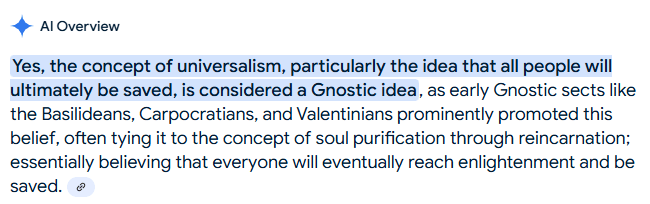
J. I. Packer in Hell Under Fire (Zondervan, 2004), ch. 8: “Universalism: Will Everyone Ultimately Be Saved?”
A. W. Pink, The Attributes of God (Baker Books, 2006), ch. 16: “The Wrath of God.”
Many turn away from a vision of God’s wrath as though they were called to look upon some blotch in the divine character, or some blot upon the divine government. But what says the Scriptures? As we turn to them we find that God has made no attempt to conceal the fact of His wrath. He is not ashamed to make it known that vengeance and fury belong to Him. His own challenge is, “See now that I, even I, am he, and there is no God with me: I kill, and I make alive: I wound, and I heal: neither is there any that can deliver out of my hand. For I lift up my hand to heaven, and say, I live for ever. If I whet my glittering sword, and mine hand take hold on judgment; I will render vengeance to mine enemies, and will reward them that hate me” (Deut. 32:39-41). A study of the concordance shows that there are more references in Scripture to the anger, fury, and wrath of God, than there are to His love and tenderness. Because God is holy, He hates all sin; because He hates all sin, His anger burns against the sinner (Ps. 7:11).
Our readiness or our reluctance to meditate upon the wrath of God becomes a sure test of how our hearts really are affected toward Him. If we do not truly rejoice in God, for what He is in Himself, and that because of all the perfections which are eternally resident in Him, then how dwelleth the love of God in us? Each of us needs to be most prayerfully on guard against devising an image of God in our thoughts which is patterned after our own evil inclinations. Of old, the Lord complained, “Thou thoughtest that I was altogether…as thyself” (Ps. 50:21). If we rejoice not “at the remembrance of his holiness” (Ps. 97:12), if we rejoice not to know that in a soon coming day God will make a glorious display of His wrath, by taking vengeance on all who now oppose Him, it is proof positive that our hearts are not in subjection to Him; that we are yet in our sins.
A word to preachers: Do we in our oral ministry preach on this solemn subject as much as we ought? The Old Testament prophets frequently told their hearers that their wicked lives provoked the Holy One of Israel, and that they were treasuring up to themselves wrath against the day of wrath. Conditions in the world are no better now than they were then! Nothing is so calculated to arouse the careless and cause carnal professors to search their hearts, as to enlarge upon the fact that “God is angry with the wicked every day” (Ps. 7:11).
The forerunner of Christ warned his hearers to “flee from the wrath to come” (Matthew 3:7). The Savior bade His auditors, “Fear him, which after he hath killed hath power to cast into hell; yea, I say unto you, Fear him” (Luke 12:5). Paul said, “Knowing therefore the terror of the Lord, we persuade men” (2 Cor. 5:11). Faithfulness demands that we speak as plainly about hell as about heaven.



 WesleyGospel Ministries