
What shall we say then? Shall we continue in sin, that grace may abound? God forbid. How shall we, that are dead to sin, live any longer therein? –Romans 6:1-2 (KJV)
If we say that we have no sin, we deceive ourselves, and the truth is not in us. If we confess our sins, he is faithful and just to forgive us our sins, and to cleanse us from all unrighteousness. –1 John 1:8-9 (KJV)
His own self bare our sins in his own body on the tree, that we, being dead to sins, should live unto righteousness. –1 Peter 2:24 (KJV)
The grace of God that bringeth salvation hath appeared to all men, teaching us that, denying ungodliness and worldly lusts, we should live soberly, righteously, and godly, in this present world. –Titus 2:11-12 (KJV)
How much more shall the blood of Christ, who through the eternal Spirit offered himself without spot to God, purge your conscience from dead works to serve the living God? –Hebrews 9:14 (KJV)
Holiness, without which no man shall see the Lord. –Hebrews 12:14 (KJV)
Ungodly men, turning the grace of our God into lasciviousness. –Jude 1:4 (KJV)
—
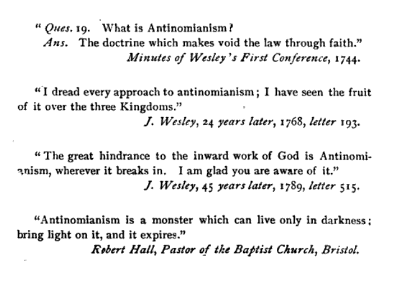
Mark Jones, Antinomianism: Reformed Theology’s Unwelcome Guest? P&R, 2013.
Daniel Steele, A Substitute for Holiness: Antinomianism Revived. Schmul, 1980.
Martin Luther, Commentary on Romans. Kregel Publications, 1982.
—, “Against the Antinomians,” Luther’s Works, vol. 47 (Fortress Press, 1971), pp. 99-118.


 WesleyGospel Ministries