
He was wounded for our transgressions, he was bruised for our iniquities: the chastisement of our peace was upon him. –Isaiah 53:5 (KJV)
Being now justified by his blood, we shall be saved from wrath through him. –Romans 5:9 (KJV)
His own self bare our sins in his own body on the tree, that we, being dead to sins, should live unto righteousness. –1 Peter 2:24 (KJV)
How much more shall the blood of Christ, who through the eternal Spirit offered himself without spot to God, purge your conscience from dead works to serve the living God? –Hebrews 9:14 (KJV)
—
Harald Lindstrom, Wesley and Sanctification, ch. 2.
Kenneth J. Collins, The Scripture Way of Salvation: The Heart of John Wesley’s Theology, p.
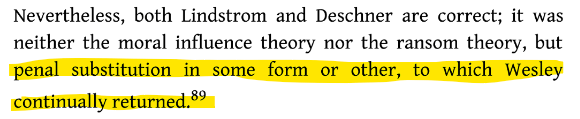
Charles Finney, Lectures on Systematic Theology, ch. 34: “Atonement.” “I shall here take it as established, that Christ was properly “God manifest in the flesh,” and proceed to cite a few out of the great multitude of passages, that attest the fact of his death, and also its vicarious nature; that is, that it was for us, and as a satisfaction to public justice for our sins, that his blood was shed…the atonement is the governmental substitution of the sufferings of Christ for the punishment of sinners. It is a covering of their sins by his sufferings…being now justified by his blood, we shall be saved from wrath through him…it was impossible that the atonement should not exert an amazing influence over moral beings…The atonement would present to creatures the highest possible motives to virtue. Example is the highest moral influence that can be exerted. If God, or any other being, would make others benevolent, he must manifest benevolence himself. If the benevolence manifested in the atonement does not subdue the selfishness of sinners, their case is hopeless.”
Got Questions, “What Are the Various Theories on the Atonement?”
—
HARALD LINDSTROM’S SUMMARY OF
JOHN WESLEY’S TEACHING ON THE ATONEMENT
In considering Wesley’s attitude to man we have already touched upon his view of salvation and the place in it of sanctification. We now pass on to a closer examination of his idea of salvation, in order, firstly, to determine the principles governing the relation between justification and sanctification, and, secondly, to bring out the importance attributed to sanctification. In this chapter, in clarifying the connection between justification and sanctification, we shall be concerned only with present justification. The question of the relation between sanctification and final justification, or final salvation, will be dealt with later on. The first step must be to scrutinize Wesley’s view of atonement. It is the natural starting point here, for both justification and sanctification are based on it.
Wesley never took up the Atonement for special consideration in any of his treatises or tracts. Nor is it the main theme in any of his sermons. His views on it will be found primarily in scattered remarks bearing on his exposition of sin, justification, and sanctification. Yet it was undoubtedly a pivotal and essential theme in both his preaching and his thought.1
Along with the new knowledge of justification in 1738, the Atonement, the rock on which justification is built, naturally comes to the fore. The controversy between Wesley and William Law, which was engendered by the doctrine of justification, also embraced the Atonement.
Law had seen religion as in the main synonymous with sanctification, which meant conformity to the life of Christ. It was man’s duty to bear the cross and follow Christ. Mortification constituted the essence of piety.2 Man had to die to the world and live a new life in the spirit of Christ.3 But although Christ is regarded as the cause of human sanctification, considerable emphasis is nevertheless laid on the necessity to exert oneself to the uttermost to achieve that holiness of life and heavenly wisdom in all one’s actions which is Law’s definition of Christianity.4 The struggle for sanctification is also regarded as a necessary condition of justification. Salvation, that is, depends upon the sincerity and completeness of man’s effort to attain it. Until he has striven to the last ounce of his strength he cannot win God’s favour.5
But sin and guilt too have their place in Law’s conception of man, and through them his attention is directed towards atonement. Man has perverted the nature with which God endowed him. He has fallen, and consequently has no right to feel proud.6 If we consider the Atonement, which was necessary that man might be liberated from the guilt of sin, the frightfulness of sin becomes manifest.7 Law sees the Incarnation and the suffering and death of Christ as essential to the re-establishment of man’s fellowship with God. “Nothing less,” he says, “has been required to take away the guilt of our sins, than the sufferings and death of the Son of God. Had He not taken our nature upon Him, our nature had been for ever separated from God, and incapable of ever appearing before Him.”8 Without the mediation of the Son of God and His intercession with the Father, man would not even have been in a position to pray for the forgiveness of his sins.9 Because of his sin, man is subject to punishment, and the only way in which he can obtain the favour of God is through the Atonement effected by Christ.10
Yet this line of thought does not lead to a Reformed adjustment of the relation between justification and sanctification. Christ’s work for mankind in the Atonement is not given significance enough to make such a step possible. The idea of atonement is modified in Law, as it was in practical mysticism in general, by the notion of man’s own mortification. Christ’s suffering on the cross is not regarded as a vicarious suffering for mankind. It is only a representational act in the name of mankind which has been credited to man in the sense that his union with Christ is accepted by God. Christ is a sacrifice to make the sacrifices of mankind acceptable to God.11 For Law Christ’s work of atonement does not constitute the only ground of deliverance from guilt and the favour of God: another factor is man’s own mortification. Man must practise self-denial and bear his cross if he is to benefit from Christ’s atonement. Law maintains that “all the sons of Adam are to go through a painful, sickly life, denying and mortifying their natural appetites, and crucifying the lusts of the flesh, in order to have a share in the atonement of our Saviour’s death.”12 The restoration of God’s favour demands not only “so great an Atonement of the Son of God” but also so great a “repentance of our own.”13
Wesley’s new insight into, and experience of, salvation by faith was made possible because he too acquired a new way of looking at the question of atonement.14 For him Christ’s work of atonement became the sole basis of justification and regeneration. Justifying faith became a faith in Christ’s work of atonement and His merits. Thus it was inevitable that Wesley should find himself compelled to settle matters with William Law, who had been his principal spiritual mentor for a number of years. He saw clearly that the main source of dissension between them was the Atonement. Wesley’s chief concern was now “a living faith in the blood of Christ.”15 Writing to Law in May, 1738, he expresses the fundamental difference between their views in the words: “‘He is our propitiation through faith in His blood.”16 It is true that the Atonement, as we have seen, had a place in Law’s theology, but it was not, as with Wesley, of such fundamental importance for justification that in this respect man’s own actions could be left entirely out of account. To Wesley, Law’s way of salvation now seemed a way of law, which he had tested but found quite impracticable. Of course Wesley undoubtedly exaggerates Law’s legalistic tendency. It had assumed excessive proportions for him precisely because of his earlier concentration on Law’s insistence on sanctification. This had meant that Wesley had put all the emphasis on man’s bearing of his own cross and mortification, while he had hardly paid any attention at all to what Law had to say about Christ’s work of atonement.17 Consequently Wesley now tends to underestimate the importance attributed to grace in Law’s conception of salvation. All the same, it is true that in Law the idea of Atonement is entirely subordinated to sanctification. Further, Wesley’s criticism cannot be said to involve any misrepresentation of Law’s principles, for in Law’s conception of man’s justification, grace is not fully freed from the trammels of the legalistic framework.
Wesley, then, came to regard Christ’s work of atonement as the sole ground of human justification. “The sole cause of our acceptance with God (or, that for the sake of which, on the account of which, we are accepted) is the righteousness and the death of Christ, who fulfilled God’s law, and died in our stead.”18 Justification cannot therefore be based on any righteousness in man himself: neither righteousness of outward acts nor righteousness of inward temper. Thus sanctification becomes not a cause, but an effect, of justification.19 Faith alone is regarded as the necessary condition for justification, a faith which does not embrace any form of human sanctity, but out of which inward and outward sanctity spring.20
The controversy with Law and the other mystics brings out clearly the importance that Wesley now ascribed to the Atonement. We have already hinted at its significance for the relation between justification and sanctification. The purport of the breach with the mystics can be summed up in the statement that he changed his mind about the way of salvation. But as to the goal of salvation, he remained in agreement with Law and practical mysticism. As we shall see later on, he continued to regard sanctification as the true aim and essence of religion.21 Yet the fact that Wesley’s way of salvation did not remain Law’s, was a natural consequence of the former’s deepened conception of Sin.22
Before attempting a definition of Wesley’s idea of atonement, we turn our attention to the view of it contained in the Thirty-nine Articles and the Homily of Salvation of the Church of England.
In the Thirty-nine Articles it will be found in a few sentences dealing with Christ’s work of atonement, which is particularly treated in three of the Articles. In connection with the Incarnation it is maintained that Christ, who was a true God and a true man, “truly suffered, was crucified, dead and buried, to reconcile his Father to us, and to be a sacrifice, not only for original guilt, but also for all actual sins of men.”23 The Roman Catholic doctrine of the sacrifices of Masses is rejected. The sacrifice of Christ, “once made, is that perfect redemption, propitiation, and satisfaction, for all the sins of the whole world, both original and actual; and there is none other satisfaction for sin, but that alone.”24 In the Article on justification, Christ’s merits are said to be the only basis of human justification: “We are accounted righteous before God, only for the merit of our Lord and Saviour Jesus Christ by Faith, and not for our own works or deservings: wherefore, that we are justified by Faith only is a most wholesome Doctrine, and very full of comfort, as more largely is expressed in the Homily of Justification.”25
Orthodox satisfaction would seem to be the dominant conception in the view of atonement reflected in these brief formulations.26 The legal order and the judicial system emerge as the governing principle. The work of Christ, by which God is atoned, is perceived as a satisfaction. By it God’s justice is satisfied. Yet it does not follow that the idea of grace is absent. In the Article on justification, where we are told that man is justified by the merit of Christ, the stress is laid on the justification of man solely “for the merit of our Lord and Saviour Jesus Christ by Faith” and not “for our own works and deservings.” Of the alternatives, the merit of Christ on the one hand and our own works on the other, the former is put first to accentuate the principle that justification takes place by grace alone. But while this theocentric view is seen in the attitude to grace, an anthropocentric tendency seems simultaneously to emerge in the notion of comfort for distressed man.27
The Homily of Salvation, which explains Article XI in the Thirty-nine Articles, shows still more clearly that this view of atonement is in alignment with the orthodox doctrine of satisfaction. Thus it agrees with the Latin idea of atonement, which, dating from Tertullian and Cyprian, is fully developed in Anselm, and in modified form continues in orthodox theology.28 The act of atonement is seen from the point of view of both grace and justice, but the latter seems to be the dominant principle. As all men have broken the law of God and thus their fellowship with Him, God justifies them instead through Christ. Thus no one can be justified by his own acts29; the justification of man occurs by the grace of God30. Implicit in, but partly independent of, this view of grace, a conception of justice also emerges. We see it in the way atonement is regarded as a form of satisfaction. The law broken by man must be fulfilled. This is done through Christ. God sent His only Son to fulfil the law for us and that by shedding His most precious blood He should provide God with that satisfaction or compensation for our sins which was necessary if God’s wrath against us was to be appeased.31 Since atonement is thus regarded as a form of satisfaction tendered to God, the work of Christ is seen as partly independent of God’s and operating as a separate factor, distinct from God’s, in redemption. In this way the free operation of God’s grace is interrupted. This is also seen when the act of atonement is regarded as sacrifice. Christ’s sacrifice, seen as meeting the just exactions of God, is regarded as the immediate — and from God’s grace partly independent — condition for the re-establishment of fellowship with God. Redemption is represented as a ransom paid by Christ to God.32
The relation between the functions of God and of Christ in redemption reflects two aspects of the Divine nature. By the redemption God is conceived to have “tempered his justice and mercy together.” In this way the human intelligence is provided with a satisfactory answer to the question as to how redemption can be given both freely and by payment of ransom.33 As a result of this adjustment the consequences of neither God’s justice nor His mercy have been fully exerted. Without mercy his justice would have sentenced us to the everlasting captivity of the devil; His mercy, on the other hand, would have freed us without the payment of a just ransom. Instead, “with his endless mercy,” God has “joined his most upright and equal justice,” delivering us from our captivity without recompense from us — we had no means of paying it — and ordaining a ransom through the precious blood of Christ. As well as paying this ransom, Christ has also wholly fulfilled the law for us.34 Thus justification is bound up with three related factors: From God, His mercy and grace; from Christ, Hissatisfaction of God’s justice by the ransom of His blood and His perfect fulfilment of the law; and from man: a true and living faith in the merits of Christ, a faith which is yet not his own work but God’s working in him. Through faith man relies on the promise of God’s mercy and the forgiveness of sins. Thus any idea of man achieving justification due to merits resulting from any action of his own is entirely eliminated. The mind is directed towards the merits of Christ instead of man’s own, and at the same time this brings the idea of God’s grace to the fore.35 But joined to this view of grace is that of justice: equally balanced, both God’s mercy and His justice are operative.
Here I have called particular attention to the feature specially characteristic of the orthodox doctrine of satisfaction. The main point was that the just claims of God had to be fulfilled and compensation paid. Even Christ’s vicarious suffering of punishment was regarded as satisfaction. It is true that the grace of God is also seen in the Atonement, but this grace is an integral part of the order of law. Thus, in the orthodox way, the Atonement expresses an unbroken legal order and a broken act of God.
In conformity with his general subscription to the Thirty-nine Articles and the homilies of the Anglican Church Wesley adopted in his abridgement without essential changes the three Articles that deal specifically with Atonement.36 Apart from his general solidarity with Anglicanism, his conception of sin, which was expounded in the previous chapter, would in itself lead us to expect his concurrence in the doctrine of the work of Christ as satisfaction and in the related idea of the merits of Christ. He did concur in this. It was through the sin of Adam, who was not only the father but also the representative of mankind, that all became subject to sin and punishment; similarly Christ, as the second Adam and representative of the human race, bore the sins of all. He suffered on behalf of all. His sacrifice was a full, perfect and sufficient satisfaction for the sins of the whole world.37 Christ bore our punishment.38 He paid the price for us.39 Consequently man has nothing to offer to God but the merits of Christ.40 Because of their inward and outward evil all that men deserve is the wrath of God and eternal damnation. Yet they can do nothing to assuage that wrath, atone for their sins, and escape the punishment they rightly deserve. They have no means of making satisfaction to the justice of God for their sins.41 Thus their only hope is the vicarious suffering of Christ.42
This train of thought, which is found in the first of Wesley’s sermons published after his experience in 1738, continues to be expressed; we see him considering the idea of the payment chargeable for the debt man owes to God. The man who has undergone first repentance and thus become aware of the punishment he merits, finds himself confronted by this problem of compensation and of his inability to discharge his debt: “But what shall he give in exchange for his soul, which is forfeited to the just vengeance of God? ‘Wherewithal shall he come before the Lord?’ How shall he pay Him that he oweth? Were he from this moment to perform the most perfect obedience to every command of God, this would make no amends for a single sin, for any one act of past disobedience; seeing he owes God all the service he is able to perform, from this moment to all eternity: could he pay this, it would make no manner of amends for what he ought to have done before. He sees himself therefore utterly helpless with regard to atoning for his past sins; utterly unable to make any amends to God, to pay any ransom for his own soul.”43Man’s only hope is therefore “to be washed in His blood, and renewed by His almighty Spirit, who himself ‘bare all our sins in His own body on the tree’!”44 In conformity with the Anglican Homily of Salvation, Wesley further maintains that “these things must go together in our justification; — upon God’s part, His great mercy and grace; upon Christ’s part, the satisfaction of God’s justice; and upon our part, true and lively faith in the merits of Jesus Christ.”45 In the court of Divine justice Christ acts as mediator between God and the sinner. In this way Divine justice is satisfied and man can obtain forgiveness through faith.46 With his active and passive righteousness Christ effects perfect atonement.47 The satisfaction thus given by Christ, Wesley thinks, is given by Him qua homo. It is as Man that Christ mediates between God and mankind.48 In his activity as High Priest Christ is also considered as a representative of mankind.49
This agreement in Wesley with certain essential features in the traditional orthodox view of atonement50 is again conspicuous in another controversy with Law, after the latter had come under the influence of Böhme’s mysticism. Law’s fundamentally mystical position led him to identify the Atonement with the regeneration of fallen man.51 Christ’s death did not constitute any satisfaction to God, but was only a means to the transformation of man and a demonstration of Christ’s superiority to the world, death, Hell, and the Devil.52 To Wesley as to Law the death of Christ was the only possible way by which the Almighty might overcome the evil in fallen mankind. But this was true only if Christ really atoned for our sins.53
To Wesley, therefore, it was important that Christ’s death should also have an objective import with relation to God. It had to have the meaning of an objective event establishing a new basis for human justification. Here as previously Wesley regarded Christ’s work of atonement as the payment of ransom or satisfaction. By analogy with the parable of the kingdom of Heaven as a king who would take account of his servants, the relation of fallen mankind to God is seen as that of debtor to creditor. Man cannot pay his debt. Nevertheless God has the right to insist on its discharge, and if this fails, to hand him over to the tormentors.54 Christ, however, was a ransom for us all and a sacrifice to God.55 His work acquired satisfactional and meritorious significance for all men.56
This difference between Law and Wesley in their attitude to atonement is naturally accompanied by divergence in their attitude to God. The former is a consequence of the latter. Whereas Law denies that wrath ever was or will be attributable to God, Wesley maintains that He is capable of wrath just as He is capable of justice.57 Law holds that wrath and pain are attributes of the created world only.58 God is goodness alone, and nothing but happiness can emanate from Him.59 Punishment cannot emanate from Him.60 His punitory justice is denied.61 In their respective conceptions of God, Law evinces a superficial monism and Wesley a more dualistic tendency. To Wesley God’s mercy is mixed with His justice.62 His wrath bears the same relation to His justice as His love to His mercy. In human terms the love and wrath of God are passions corresponding to the dispositions of mercy and justice. If, Wesley says, we deny that God is capable of wrath it would only be consistent to deny His justice also.63 From all eternity God was infinitely just and consequently His wrath had to manifest itself when man sinned.64 Thus there is in God punitory justice, and Adam’s sin must necessarily call forth His punishment.65
Differing thus from Law in this matter of God’s wrath66, Wesley also differs to some extent from Zinzendorf, to whom God’s wrath does not seem to have the same force and significance67. Consequently, Wesley gives more prominence than Zinzendorf to the objective side of the Atonement.68
Now as Wesley regarded Christ’s work of atonement as a form of satisfaction, it is chiefly a judicial view that finds expression in his conception of it. God’s justice must be satisfied, compensation must be paid. Christ is thought to have given this satisfaction qua homo and thus the Atonement is not regarded as a single continuous act of God. It is true that God takes the initiative in His grace, but in the act of atonement itself His grace is interrupted by His justice.
Grace, however, also has its place in Wesley’s idea of atonement. He dwells a great deal on the grace and love of God as reflected in His willingness to provide means of satisfaction.69 He emphasizes the love of God or Christ in the Atonement, although this love is not specifically defined.70 Just as in the Thirty-nine Articles and the Homily of Salvation, he considers the satisfaction and merits of Christ to express Divine grace. Salvation comes to man not because of his own works but through Christ alone.71 The issue is put thus: salvation on the grounds of what God did for us in Christ, or alternatively on the grounds of man’s own merits; and as the former is the true way the stress is laid on grace. A further point is that the sentence of damnation on all men was necessary in order that the inexhaustible wealth of Christ might be made manifest.72
Wesley is not unfamiliar with the concept of Christ’s work of atonement as an act of deliverance and conquest, although this is implicit rather than explicit and found chiefly in the earlier sermons. The Atonement is a step after which God no longer puts forth His wrath but instead appears as a loving father. When Wesley regards the devil as “the executioner of the wrath and righteous vengeance of God73,” the Atonement is seen as Christ’s victory over the devil. The association of the devil with God’s just sentence leads on to the idea that the victory over the devil both implies that God reconciles and is reconciled: at one and the same time He is both the subject and the object of atonement.74 In consonance with this Wesley writes of that perpetual and victorious Divine intervention against the powers of Evil that so greatly helps him who believes: “He feared not all the powers of darkness, whom God was daily bruising under his feet. Least of all was he afraid to die; nay, he desired to ‘depart, and to be with Christ’; (Phil. i. 23;) who, ‘through death, had destroyed him that had the power of death, even the devil; and delivered them who, through fear of death, were all their lifetime’, till then, ‘subject to bondage’. (Heb. ii. 15.)”75
Although in this way atonement can sometimes appear as an act of liberation, this is never more than ancillary to the main train of thought. The characteristic expression of the idea of atonement lies in satisfaction. Accordingly, Wesley links the Atonement with Christ’s office as High Priest, which as well as His vicarious work of atonement also comprises His intercession with the Father on man’s behalf. The victorious and liberating aspect of Christ’s work finds expression primarily in His office as King.76 A natural consequence of this partition of Christ’s offices is that the conception of satisfaction and the victor theme are thus distinguished; satisfaction standing first in the work of atonement, while the idea of victory and liberation is realized in Christ’s royal office. In this way the victory idea is associated not with Christ’s work for us but with His work in us; the restoration of the image of God in man. And thus the idea of victory is expressed not in the Atonement but in the New Birth and sanctification.
In the orthodox manner it is thus satisfaction that especially distinguishes Wesley’s attitude to atonement. But this does not mean that his idea of satisfaction is exactly identical with the orthodox conception of it, particularly as formulated in the classical period. Though Wesley can include both the active and the passive obedience of Christ in the work of atonement, the stress nevertheless lies on the latter. From the very beginning the thought of the death and suffering of Christ predominates77, and in a controversy with a contemporary representative of orthodoxy, James Hervey78, Wesley virtually confines satisfaction to comprise passive obedience. He contends that it was the passive obedience of Christ that laid the foundation of justification. True, he speaks also of the meritorious life of Christ, but always in connection with His atoning death. Christ’s fulfilment of the moral law, moreover, is not regarded as essential to our redemption. The satisfaction through the death of Christ is sufficient for our full forgiveness. Christ was a substitute only in suffering punishment, not in His fulfilling of the law.79 The fact that in essence satisfaction only implies His suffering and death is conditioned by the alternatives with which according to Wesley man was confronted. The choice was simple: to obey and fulfil the law or to die.80 But Christ died in obedience to the Father81, and His death alone gave full satisfaction for the sins of the world82.
As Wesley gives such prominence to the death of Christ and regards only His penal suffering as substitutional, it is clear that the judicial factor cannot be as important in His view of atonement as it was to the orthodox. If atonement also comprises a fulfilment of the law by proxy, as it did to Hervey, the legal concept must obviously be emphasized. Clearly the idea of the law fulfilled by Christ involved the restoration of a greater degree of equilibrium to the judicial order deranged by the Fall.
Parallel to this view of atonement is Wesley’s conception of justification. Here he had to diverge from the orthodox outlook, in which the imputation of Christ’s righteousness is involved in justification together with forgiveness and acceptance by God. To Wesley, justification implies the two latter factors only.83 It is true that he also speaks of the imputation of Christ’s righteousness to the believer, but this does not imply more than that by virtue of Christ’s righteousness man shall obtain forgiveness and acceptance.84 In this way Christ’s righteousness is regarded only as the meritorious cause or ground of human justification.85 Here Wesley was guided by a twofold motive: on the one hand he was eager to repudiate all thought of any righteousness or merit in man on the basis of which he might be justified86; on the other, he wanted to repudiate a tendency in man to rely on Christ’s righteousness imputed to him and to neglect the demand for inherent righteousness87.
Wesley’s rejection of the idea of a fulfilment of the law by proxy is an outcome of his struggle against antinomianism. He finds its very essence to lie in the idea that Christ has met the claims of the law on man’s behalf and that therefore he is not called upon to fulfil the moral law.88 Accordingly he disassociates the fulfilment of the law from atonement and justification and attaches it instead to sanctification. This explains why sanctification in the sense of fulfilment of the law occupies such an important place in his theology.
FOOTNOTES
1 Cf. the letter of 7 Febr. 1778, in which Wesley speaks of the centrality of the Atonement in Christianity: “Indeed, nothing in the Christian system is of greater consequence than the doctrine of Atonement. It is properly the distinguishing point between Deism and Christianity. ‘The scriptural scheme of morality’, said Lord Huntingdon, ‘is what every one must admire; but the doctrine of Atonement I cannot comprehend’. Here, then, we divide. Give up the Atonement, and the Deists are agreed with us.” The Letters of John Wesley, VI, p. 297 f.
2 LAW, Serious Call, p. 165. To understand the breach with Law in 1738, we must turn to this famous work of Law’s, published in 1728, which has had immense influence. See OVERTON, William Law. Nonjuror and Mystic, p. 109 ff.; INGE, Studies of English Mystics, p. 133 ff.; BRILIOTH, The Anglican Revival, p. 18 f.; MINKNER, Die Stufenfolge des mystischen Erlobnisses bei William Law, p. 11 f. Even after 1738 Wesley could speak appreciatively of this book. He says that it “will hardly be excelled, if it be equalled, in the English tongue, either for beauty of expression, or for justness and depth of thought.” Sermon On a Single Eye, dat. 1789, The Works of John Wesley, VII, p. 297. In his Serious Call Law describes the way to salvation of deistic religion, which attributes no importance to faith in this life. Law was deeply opposed to such an attitude and puts the emphasis on the need for sanctification. The book is mainly a practical religious appeal but as such it also expresses its author’s idea of Christianity. For a more detailed account of sanctification in Law and the relation between him and Wesley in this respect, see below, the fifth chapter.
3 Ib., p. 219.
4 “For as sure as Jesus Christ was wisdom and holiness, as sure as He came to make us like Himself, and to be baptized into His spirit, so sure is it, that none can be said to keep to their Christian profession, but they who, to the utmost of their power, live a wise and holy and heavenly life. This, and this alone, is Christianity; an universal holiness in every part of life, a heavenly wisdom in all our actions, not conforming to the spirit and temper of the world, but turning all worldly enjoyments into means of piety and devotion to God.” Ib., p. 112 f.
5 “The sum of this matter is this: from the abovementioned, and many other passages of Scripture (Phil. ii. 12, Matt. xxii. 14, Matt. vii. 14, Luke xiii. 24), it seems plain, that our salvation depends upon the sincerity and perfection of our endeavours to obtain it.
“Weak and imperfect men. shall, notwithstanding their frailties and defects, be received, as having pleased God, if they have done their utmost to please him.” Ib., p. 23.
6 Ib., p. 213.
7 Ib., p. 212.
8 Ib., p. 212.
9 Ib., p. 213.
10 See ib., p. 334.
11 Ib., p. 224: “To have a true idea of Christianity, we must not consider our Blessed Lord as suffering in our stead, but as our Representative, acting in our name, and with such particular merit, as to make our joining with Him acceptable into God.
“He suffered, and was a Sacrifice, to make our sufferings and sacrifice of ourselves fit to be received by God.” Cf. p. 335.
12 Ib., p. 334.
13 Ib., p. 335.
14 See Journal for 24 May 1738 and the days immediately before. The Journal of John Wesley, 1, p. 464 ff. Cf. also ib., for 22 April 1738, p. 454. It is true that as early as in the sermon on The Circumcision of the Heart, 1733, Wesley had expressed belief in Christ’s atonement, but the statement of personal conviction of atonement and forgiveness is a later addition. The Works of John Wesley, V, p. 205. See SUGDEN’S introduction to this sermon, The Standard Sermons of John Wesley, I, p. 265.
15 Letter to Law, 20 May 1738, The Letters of John Wesley, I, p. 241.
16 The two principles Law says he has been governed by, namely “‘Without Me ye can do nothing”‘ and “‘If any man will come after Me, let him take up his cross and follow Me’,” may, Wesley thinks, imply this third maxim on the Atonement, although it is not expressly stated. Ib., p. 241.
17 See Journal for this earlier period, The Journal of John Wesley, 1, passim.
18 In the criticism of the mystics in the preface to Hymns and Sacred Poems, 1739, The Poetical Works of John and Charles Wesley, 1, p. xx.
19 Ib., p. XIX f. Here Wesley objects to the mystics: “They speak largely and well against expecting to be accepted of God for our virtuous actions; and then teach, that we are to be accepted for our virtuous habits or tempers. Still the ground of our acceptance is placed in ourselves. The difference is only this: Common writers suppose we are to be justified for the sake of our outward righteousness. These suppose we are to be justified for the sake of our inward righteousness: whereas, in truth, we are no more justified for the sake of one than of the other. For neither our own inward nor outward righteousness is the ground of our justification. Holiness of heart, as well as holiness of life, is not the cause, but the affect of it.”
20 Ib., p. XX: “And even the condition of it is not (as they suppose) our holiness of heart or life: but our faith alone; faith contradistinguished from holiness as well as from good works. Other foundation therefore can no man lay, without being an adversary to Christ and His Gospel, than faith alone, faith, though necessarily producing both, yet not including either good works or holiness.” See also Journal for 13 Sept. 1739, The Journal of John Wesley, II, p. 275.
21 See the latter half of this chapter, where the place of sanctification in salvation is discussed, and particularly the fifth chapter.
22 Although, as we have seen, sin and guilt play their part in Law’s conception of man, he cannot, like Wesley, assert natural man’s total depravity, Thus, in Law, nature and grace are not necessarily incompatible; “the religion of the gospel” can be regarded as “only the refinement and exaltation of our best faculties.” LAW, Serious Call, p. 53.
23 The Book of Common Prayer, Articles of Religion, Art. II.
24 Ib., Art. XXXI.
25 The Book of Common Prayer, Art. XI.
26 In my exposition of the idea of atonement I have made use of the new perspective indicated by MANDEL in Christliche Versöhmungslebre, adumbrated by AULÉN in Christus Victor, and most fully expounded by LINDROTH in Försoningen.
The theory is that concentration on ‘objective’ or ‘subjective’ atonement has involved neglect of the ‘dualistic-dramatic’ view. The last is the ‘classic’ view. It means that atonement is seen as a continuous act of God Himself. The legal order is overruled. The relation of man to God is viewed in the light of grace. Christ functions as the representative of God in the act of atonement. The Atonement is regarded as the victorious outcome of a divine struggle, a work by which God in Christ defeats the evil powers of the world, sin, death, the devil, the law, and God’s wrath, thus reconciling the world to Himself. And since these evil powers are also regarded as subservient to God’s punitive will, God Himself is reconciled too. The essence of the view is that God reconciles and is at the same time reconciled. He is simultaneously both the object and the subject of atonement. Luther is said to have held this ‘classic’ view. Cf. LINDROTH’S earlier work Katolsk och evangelisk kristendomssyn, p. 165 f., 171 ff.; BRING, Dualismen hoe Luther, p. 67 ff. On the other hand VON ENGESTRÖM in Luthers trosbegrepp, p. 95 ff., disagrees and brings out Anselmian elements in Luther.
In contrast to this classic view, in which atonement is an uninterrupted work of God and an interruption of the legal order, the so-called objective view regards it as an interrupted work of God, the legal order remaining unbroken. The Atonement is thought to rest on God’s initiative, but this is interrupted in the actual work of atonement since here Christ is regarded as acting as the representative of man before God. Christ’s work is seen as a satisfaction made to God by Christ qua homo. This theory emerges in the orthodox doctrine of satisfaction. Some essential features of the orthodox view are found in Anselm, although unlike Anselm the orthodox theologians regard the suffering and punishment of Christ as a satisfaction and satisfaction as comprising both His active and His passive obedience. LINDROTH, who has subjected Anselm’s view of the Atonement to close scrutiny and shown how he differs from Melanchthon and Orthodoxy, maintains in particular that in Anselm as in the classic view the Atonement has cosmic significance, whereas in Orthodoxy it has a more individually legalistic and personal character (Försoningen, p. 147 f., 364).
27 Note the resemblance to Melanchthon. See LINDROTH, op. cit., p. 257 ff., 274 ff.; BRING, Förhållandet mellan tro och gärningar inom luthersk teologi, p. 71, 85, 97 f. Recently it has been shown that in important respects Melanchthon differs from Luther and begins the development towards Lutheran orthodoxy. Lindroth writes that “the orthodox outlook was determined by Melanchthon’s legalistic and anthropocentric modifications of Luther’s doctrine of atonement and justification.” Op. cit., p. 315. (Translated.) Melanchthon had exerted a direct historical influence on the formation of the Thirty-nine Articles, and it is natural that his view of atonement should assert itself here. For this influence, see Corp. Conf., Die Kirche von England, p. LXXXVI ff., XCVII.
28 AULÉN, Christus Victor, p. 54 f., 144 ff. LINDROTH, however, points out the great differences between Anselm’s view and that of Melanchthon and Lutheran orthodoxy. Op. cit., p. 361. Cf. above.
29 Corp. Conf., Die Kirche von England, p. 449.
30 Ib., p. 450.
31 Ib., p. 450.
32 Ib., p. 451.
33 Ib., p. 451. The rational element is evident. Cf. the idea of satisfaction in Anselm. See LINDROTH, op. cit., p. 359.
34 Ib., p. 451: “Objection. But here may man’s reason be astonished, receiving, after this fashion: If a ransom be paid for our redemption, then it is not given us freely. For a prisoner, that payeth his ransom, is not let go freely; for if he go freely, then he goeth without ransom: for what is it else to go freely, than to be set at liberty without payment of ransom?
Answer. This reason is satisfied by the great wisdom of God in this mystery of our redemption, who hath so tempered his justice and mercy together, that he would neither by his justice condemn us unto the everlasting captivity of the devil, and his prison of hell, remediless for ever without mercy, nor by his mercy deliver us clearly, without justice, or payment of a just ransom; but with his endless mercy he joined his most upright and equal justice. His great mercy he shewed unto us in delivering us from our former captivity, without requiring of any ransom to be paid, or amends to be made upon our parts, which thing by us had been impossible to be done. And whereas it lay not in us to do that, he provided a ransom for us, that was, the most precious body and blood of his own most dear and best beloved Son Jesus Christ, who, besides this ransom, fulfilled the law for us perfectly. And so the justice of God and his mercy did embrace together, and fulfilled the mystery of our redemption.”
35 Some sentences in the third, eighth, and tenth chapters of the Epistle to the Romans are annotated as follows: “In these foresaid places, the Apostle touches specially three things, which must go together in our justification. Upon God’s part, his great mercy and grace, upon Christ’s part, justice, that is, the satisfaction of God’s justice, or the price of our redemption, by the offering of his body, and shedding of his blood, with fulfilling of the law perfectly and throughly; and upon our part, true and lively faith in the merits of Jesus Christ, which yet is not ours, but by God’s working in us; so that in our justification is not only God’s mercy and grace, but also his justice, which the Apostle calleth the justice of God, and it consisteth in paying out ransom, and fulfilling of the law: and so the grace of God doth not shut out the justice of God in our justification, but only shutteth out the justice of man, that is to say, the justice of our works, as to the merits of deserving our justification.” Ib., p. 452. See also ib., p. 454.
36 See the articles II, IX, XX, Corp. Cord., Die Bischöfliche Methodistenkirche, pp. 10, 12, 15 f.
37 Justification by Faith, 1746, The Standard Sermons of John Wesley, I, p. 118 f. Cf. A Dialogue between an Antinomian and His Friend, 1745, The Works of John Wesley, X, p. 267: “Friend. — I behove, that, by that one offering, he made a full satisfaction for the sins of the whole world.” Cf. also A Second Dialogue between an Antinomian and His Friend, 1745, The Works of John Wesley, X, p. 277: “Friend. — I believe he made, by that one oblation of himself, once offered, a full, perfect, and sufficient sacrifice, oblation, and satisfaction for the sins of the whole world.”
38 Ib., p. 127.
39 The Righteousness of Faith, 1746, The Standard Sermons of John Wesley, I, p. 138 f.
40 Ib., p. 145 f.
41 On account of his “inward and outward wickedness” man is “guilty of everlasting death.” “It is just that the sentence should now take place. Dost thou see, dost thou feel this? Art thou thoroughly convinced that thou deservest God’s wrath, and everlasting damnation? …
“And what wilt thou do to appease the wrath of God, to atone for all thy sins, and to escape the punishment thou hast so justly deserved? Alas, thou canst do nothing; nothing that will in any wise make amends to God for one evil work, or word, or thought. If thou couldest now do all things well, if from this very hour till thy soul should return to God thou couldest perform perfect, uninterrupted obedience, even this would not atone for what is past. The not increasing thy debt would not discharge it. It would still remain as great as ever. Yea, the present and future obedience of all the men upon earth, and all the angels in heaven, would never make satisfaction to the justice of God for one single sin. How vain, then, was the thought of atoning for thy sins, by anything thou couldest do! It costeth far more to redeem one soul, than all mankind is able to pay. So that were there no other help for a guilty sinner, without doubt he must have perished everlastingly.” The Way to the Kingdom, 1746, The Standard Sermons of John Wesley, 1, p. 157 f.
42 Ib., p. 159.
43 The Sermon on the Mount: 1, 1748, The Standard Sermons of John Wesley, I, p. 324.
44 The Sermon on the Mount: 1, 1748, The Standard Sermons of John Wesley, 1, p. 327.
45 A Farther Appeal, 1745, The Works of John Wesley, VIII, p. 54. In his sermon on The Lord Our Righteousness, 1765, Wesley expresses agreement with the homilies of the Church of England: “And this is the doctrine which I have constantly believed and taught, for near eight-and-twenty years. This I published to all the world in the year 1738, and ten or twelve times since, in those words, and many others to the same effect, extracted from the Homilies of our Church: ‘These things must necessarily go together in our justification: upon God’s part, His great mercy and grace: upon Christ’s part, the satisfaction of God’s justice; and on our part, faith in the merits of Christ. So that the grace of God doth not shut out the righteousness of God in our justification, but only shutteth out the righteousness of man, as to deserving our justification.’ ‘That we are justified by faith alone, is spoken to take away clearly all merit of our works, and wholly to ascribe the merit and deserving of our justification to Christ only. Our justification comes freely of the mere mercy of God. For whereas all the world was not able to pay any part toward our ransom, it pleased Him, without any of our deserving, to prepare for us Christ’s body and blood, whereby our ransom might be paid, and His justice satisfied. Christ, therefore, is now the righteousness of all them that truly believe in Him., ” The Standard Sermons of John Wesley, II, p. 430 f.
46 See the explanation of Rom. iv. 5 in Notes, 1755.
47 “But His obedience implied more than all this: it implied not only doing, but suffering; suffering the whole will of God, from the time He came into the world, till ‘He bore our sins in His own body upon the tree’; yea, till having made a full atonement for them, ‘He bowed His head, and gave up the ghost.’ This is usually termed the passive righteousness of Christ; the former, His active righteousness. But as the active and passive righteousness of Christ were never, in fact, separated from each other, so we never need separate them at all, either in speaking or even in thinking. And it is with regard to both these conjointly, that Jesus is called ‘the Lord our Righteousness’.” The Lord our Righteousness, The Standard Sermons of John Wesley, II, p. 427 f.
48 “But I do not apprehend that the divine righteousness of Christ is immediately concerned in the present question. I believe few, if any, do now contend for the imputation of this righteousness to us. Whoever believes the doctrine of imputation, understands it chiefly, if not solely, of His human righteousness.
“The human righteousness of Christ belongs to Him in His human nature; as He is the ‘Mediator between God and man, the Man Christ Jesus’.” Ib., The Standard Sermons of John Wesley, II, p. 427. See further p. 427 f.
49 The Law Established through Faith: 11, 1750, The Standard Sermons of John Wesley, 11, p. 76.
50 Wesley is full of praise for the famous work An Exposition of the Creed by the orthodox bishop JOHN PEARSON (1612-1686). See especially Journal for 23 March 1749, The Journal of John Wesley, III, p. 391 and his letter of 13 May 1764, The Letters of John Wesley, IV, p. 243.
In Pearson’s work, the sixth and enlarged edition of which was published in 1692, atonement is presented in the form of satisfaction. Remission of sins “containeth in it a Reconciliation of an offended God, and a Satisfaction unto a just God; it containeth a Reconciliation, as without which God cannot be conceived to remit; it comprehendeth a Satisfaction, as without which God was resolved not to be reconciled.” Ib., p. 364. “If then we consider together, on our side the nature and obligation of sin, in Christ the satisfaction made, and reconciliation wrought, we shall easily perceive how God forgiveth sins, and in what Remission of them consisteth. Man being in all conditions under some Law of God, who both Sovereign power and dominion over him, and therefore owing absolute obedience to that Law, whensoever any way he transgresseth that Law, or deviateth from that Rule, he becomes thereby a sinner, and contracteth a guilt which is an obligation to endure a punishment proportionable to his offence; and God who is the Lawgiver and Sovereign, becoming now the party wronged and offender, hath a most just right to punish men as an offender. But Christ taking upon him the nature of man, and offering himself a sacrifice for sin, giveth that unto God for and instead of the eternal death of man, which is more valuable and acceptable to God than that death could be, and so maketh a sufficient compensation and full satisfaction for the sins of man; which God accepting, becometh reconciled unto us, and for the punishment which Christ endured, taketh off our obligation to eternal punishment.
“Thus man who violated by sinning the Law of God, and by that violation offended God, and was thereby obliged to undergo the punishment due unto the sin, and to be inflicted by the wrath of God, is, by the price of the most precious blood of Christ, given and accepted in full compensation and satisfaction for the punishment which was due, restored unto the favour of God, who being thus satisfied, and upon such satisfaction reconciled, is faithful and just to take off an obligation unto punishment from the sinner; and in this act of God consisteth the forgiveness of sins.” Ib., p. 366 f. See also p. 74, 216, 365 ff., 368, 370.
Even such a theologian as Archbishop John Tillotson, Pearson’s contemporary, can maintain the principle of satisfaction in his exposition of atonement. See TILLOTSON, The Works, Sermon XLVII, p. 560. Cf. HUNT, Religious Thought in England, 11, p. 101 f.
51 Letter to William Law, 6 Jan. 1756, The Letters of John Wesley, III, p. 351 f. Unlike the mystics whom Law considered authorities, Wesley determines to base his views on Scripture alone, especially St. Paul: “In matters of religion I regard no writers but the inspired. Tauler, Behmen, and an whole army of Mystic authors are with me nothing to St. Paul. In every point I appeal ‘to the law and the testimony’, and value no authority but this.” Ib., p. 332.
52 Ib., p. 353.
53 Ib., p. 353.
54 Ib., p. 352.
55 Ib., p. 354. Quot.
56 See ib., p. 357, 353 f. Quot.
57 Ib., p. 346.
58 Ib., p. 346 f.
59 Ib., p. 346.
60 Ib., p. 348 ff.
61 Ib., p. 350.
62 Ib., p. 349: “And yet we cannot say even as to them, ‘It is nothing but His love’, It is mercy mixed with justice.”
63 Ib., p. 346.
64 Ib., p. 346.
65 Ib., p. 349.
66 Cf. the letter of 7 Febr. 1778, The Letters of John Wesley, VI, p. 298: “But it is certain, had God never been angry, He could never have been reconciled. So that, in affirming this, Mr Law strikes at the very root of the Atonement, and finds a very short method of converting Deists. Although, therefore, I do not term God, as Mr Law supposes, ‘a wrathful Being’, which conveys a wrong idea; yet I firmly believe He was angry with all mankind, and that He was reconciled to them by the death of His Son. And I know He was angry with me till I believed in the Son of His love; and yet this is no impeachment to His mercy, that He is just as well as merciful.”
67 See BECKER, Zinzendorf im Verhältnis zu Philosophie und Kirchentum. seiner Zeit, p. 278 ff.; UTTENDÖRFER, Zinzendorfs religiöse Grundgedanken, p. 61. Cf. SPANGENBERG, Idea fidei fratrum, p. 149 ff.
68 For Zinzendorf’s view, see UTTENDÖRFER, op. cit., p. 62.
69 “It may be farther considered, that it was of mere grace, of free love, of undeserved mercy, that God hath vouchsafed to sinful man any way of reconciliation with Himself; that we were not cut away from His hand, and utterly blotted out of His remembrance. Therefore, whatever method He is pleased to appoint, of His tender mercy, of His unmerited goodness, whereby His enemies, who have so deeply revolted from Him, so long and obstinately rebelled against Him, may still find favour in His sight, it is doubtless our wisdom to accept it with all thankfulness.” The Righteousness of Faith, 1746, The Standard Sermons of John Wesley, I, p. 143.
70 Wesley often quoted the words in I. John: “We love God for he has first loved us.” For their bearing on the Atonement, see The Way to the Kingdom, 1746, The Standard Sermons of John Wesley, I, p. 160.
71 The sinful and guilty man has “nothing to plead, nothing to offer to God, but only the merits of His wellbeloved Son, ‘who loved thee and gave Himself for thee’! “The Righteousness of Faith, 1746, The Standard Sermons of John Wesley, I, p. 146. See also The Way to the Kingdom, 1746, The Standard Sermons of John Wesley, I, p. 157 ff. Cf. Minutes 1746, The Works of John Wesley, VIII, p. 286 f., where Wesley says that man can build on Christ only when he has lost his own righteousness. Cf. the issue in Luther and the Augsburg Confession, see LINDROTH, op. cit., p. 185.
72 “All that has been said, all that can be said, on these subjects, centres in this point: The fall of Adam produced the death of Christ … If God had prevented the fall of man, ‘the Word’ had never been ‘made flesh’, nor had we ever ‘seen his glory, the glory as of the only-begotten of the Father’… Unless ‘by one man judgment had come upon all men to condemnation’, neither angels nor men could ever have known ‘the unsearchable riches of Christ’.” The sermon on God’s Love to Fallen Man, 1788, The Works of John Wesley, VI, p. 239.
73 The Spirit of Bondage and of Adoption, 1746, The Standard Sermons of John Wesley, 1, p. 188.
74 Thus this view is in harmony with the so-called classic idea of atonement. See AULÉN, op. cit., p. 20 ff. Cf. above.
75 Scriptural Christianity, delivered in 1744, The Standard Sermons of John Wesley, I, p. 95. This idea of atonement as an unbroken, continuous work of God is closely related to the contention that justifying faith involves the belief that “God ‘was in Christ, reconciling the world unto himself.'” See A Farther Appeal, 1745, The Works of John Wesley, VIII, p. 48; Justification by Faith, 1746, The Standard Sermons of John Wesley, I, p. 125; The Sermon on the Mount: IX, 1748, The Standard Sermons of John Wesley, I, p. 498. Cf. Notes, 1755, U. Cor. v. 19. But that this idea does not prevent the view of Christ’s act of atonement as a work distinct from God’s, whereby this must chiefly be considered as a satisfaction given by Christ to God on behalf of men, is shown in The Law Established through Faith: 11, 1750, The Standard Sermons of John Wesley, 11, p. 76.
76 The Law Established through Faith: 11, 1750, The Standard Sermons of John Wesley, II, p. 76 f.
77 See The Almost Christian, delivered in 1741, The Standard Sermons of John Wesley, 1, p. 63; A Farther Appeal, 1, 1745, The Works of John Wesley, VIII, p. 48; Justification by Faith, 1746, The Standard Sermons of John Wesley, 1, p. 130; The Way to the Kingdom, 1746, The Standard Sermons of John Wesley, I, p. 160; The Sermon on the Mount: 1, 1748, The Standard Sermons of John Wesley 1, p. 328; The Sermon on the Mount: IX, 1748, The Standard Sermons of John Wesley, I, p. 508.
78 Letter to James Hervey, 15 Oct. 1756, The Letters of John Wesley, III, p. 371 ff.
79 Ib., The Letters of John Wesley, 111, p. 373. Wesley finds that the latter is not explicit in the Scriptures: ” ‘If He was a substitute as to penal sufferings, why not as to justifying obedience’? The former is expressly asserted in Scripture; the latter is not expressly asserted there.”
80 Ib., p. 377 f.: ” ‘By Christ’s sufferings alone the law was not satisfied’. Yes, it was; for it required only the alternative, Obey or die. It required no man to obey and die too. If any man had perfectly obeyed, He would not have died. ‘Where the Scripture ascribes the whole of our salvation to the death of Christ a part of His humiliation is put for the whole’. I cannot allow this without some proof. ‘He was obedient unto death’ is no proof at all, as it does not necessarily imply any more than that He died in obedience to the Father. In some texts there is a necessity of taking a part for the whole; but in these there is no such necessity.”
81 Ib., p. 377 f.
82 Ib., p. 379. But that Wesley can also expressly mention both Christ’s active and passive obedience as the object of faith and the foundation of salvation is seen in The Sermon on the Mount: XIII, 1750, The Standard Sermons of John Wesley, 11, p. 30. See also The Lord Our Righteousness, delivered in 1765, The Standard Sermons of John Wesley, 11, p. 427, 430, 432 ff. Yet that only Christ’s death had redemptory significance is again seen in Some Remarks on Mr. Hill’s “Review of All the Doctrines Taught by Mr. John Wesley,” 1772, The Works of John Wesley, X, p. 386. ” ‘I cannot prove, that it was requisite for Christ to fulfil the moral law in order to his purchasing redemption for us. By his sufferings alone the law was satisfied’. Undoubtedly it was. Therefore, although I believe Christ fulfilled God’s law, yet I do not affirm he did this to purchase redemption for us. This was done by his dying in our stead.”
83 Ib., p. 377.
84 The Lord our Righteousness, 1765, The Standard Sermons of John Wesley, 11, p. 430: “But in what sense is this righteousness imputed to believers? In this: all believers are forgiven and accepted, not for the sake of anything in them, or of anything that ever was, that is, or ever can be done by them, but wholly and solely for the sake of what Christ hath done and suffered for them.” Cf. Notes, 1755, Rom. iv. 9.
Wesley repudiates the notion that God should consider man just only because Christ is just: “Least of all does justification imply, that God is deceived in those whom He justifies; that He thinks them to be what, in fact, they are not; that He accounts them to be otherwise than they are. It does by no means imply, that God judges concerning us contrary to the real nature of things; that He esteems us better than we really are, or believes us righteous when we are unrighteous. Surely no. The judgement of the all-wise God is always according to truth. Neither can it ever consist with his unerring wisdom, to think that I am innocent, to judge that I am righteous or holy, because another is so. He can no more, in this manner, confound me with Christ than with David or Abraham.” Justification by Faith, 1746, The Standard Sermons of John Wesley, 1, p. 120.
85 Ib., p. 433 f. Cf. the declaration in Thoughts on the Imputed Righteousness of Christ, 1762, The Works of John Wesley, X, p. 313: “But is not Christ termed ‘our righteousness’? He is: ‘This is the name whereby he shall be called, The Lord our Righteousness’. (Jer. xxiii. 6.) And is not the plain, indisputable meaning of this scripture, He shall be what he is called, the sole Purchaser, the sole meritorious Cause, both of our justification and sanctification?” See also the letter to James Hervey of 15 Oct. 1756, The Letters of John Wesley, III, p. 375 f.: “‘There are but two methods whereby any can be justified — either by a perfect obedience to the law, or because Christ hath kept the law in our stead’. You should say, ‘Or by faith in Christ’. I then answer, This is true; and fallen man is justified, not by perfect obedience, but by faith. What Christ has done is the foundation of our justification, not the term or condition Of it.”
86 Ib., p. 432.
87 Ib., p. 438. He fears that “any should use the phrase, ‘The righteousness of Christ’, or ‘The righteousness of Christ is imputed to me’, as a cover for his unrighteousness. We have known this done a thousand times … And thus, thougha man be as far from the practise as from the tempers of a Christian; though he neither has the mind which was in Christ, nor in any respect walks as He walked; yet he has armour of proof against all conviction, in what he calls ‘the righteousness of Christ’.”
88 Letter to James Hervey, 15 Oct. 1756, The Letters of John Wesley, III, p. 386. Cf. LINDROTH’S Criticism of the legalistic theory fundamental in the orthodox view of atonement: “If Christ’s work of satisfaction is defined as an active obedience, it must be assumed that it is man who is called upon to fulfil the law. But if this is so, how is it possible, retaining the legalistic view fundamental in Orthodoxy, for another, forChrist, to fulfil this requirement vicariously? For, just as vicarious punishment means that man is absolved from punishment, so active and vicarious fulfilment of the law must mean that he is released from the obligation to obey it. Yet such a conclusion naturally Conflicts with the basic legalism of Orthodoxy. Such is the futility of defining Christ’s work of atonement as a vicarious obedientia activa.” (Translated.) Op. cit., p. 324.


 WesleyGospel Ministries