
 And after the fire there was a still, small voice.–1 Kings 19:12
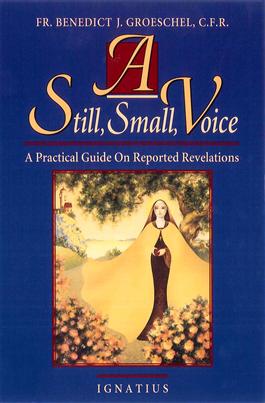
Benedict Groeschel’s A Still, Small Voice is probably the best Catholic book on spiritual gifts recently published (Ignatius Press, 1993). It follows in the tradition of what you may call Catholic “mystical theology,” although I was surprised not to find that phrase used; also, I was surprised to find the word “contemplation” used only once, and only in passing. No chapter was dedicated to the subject, but I suppose that is covered at length in his other book Listening at Prayer (taking the more popular phrase “listening prayer” for what used to simply be called contemplation or contemplative prayer; but “contemplation” occurs 9 times in that book). Groeschel admits to heavy reliance on Augustin Poulain’s The Graces of Interior Prayer and Thomas Dubay’s Fire Within, which is a systematic mystical theology based exclusively on the works of Saints Teresa of Avila and John of the Cross: the two most authoritative teachers on spiritual gifts in the Catholic Church.
I am a Pentecostal and not a Catholic, so I definitely see some things wrong with Groeschel’s views, such as Marianism, open-but-cautious and almost practical cessationism (John of the Cross’ influence), belief in Purgatory, and too much unwavering trust in church authorities over the private spiritual lives of seers. Also, the book could have had about 80% more Scriptural content; there was so little of it. Most of the book was based on Poulain and Dubay and Groeschel’s personal experiences as spiritual directors, which is fine, and great, and still very insightful. But very little came directly from the Bible, which was a turn off. Also he made a non-judgmental comment once (directed at hellfire visionaries), based on the popular skewing of Matthew 7:1, which doesn’t really fit the theme of his book, which is the judging of revelations. And on page 127 he makes a quasi-universalist remark about people in Hinduism or in pagan religions trying to seek God with the light they have, outside of the gospel. I had a real problem with that. He doesn’t say that people outside of Christianity can be saved from Hell, though. He merely sees some as misguided and searching for God.
CHAPTERS 1-2 left me with the impression that holy living is more important and more valuable than seeking for visions, dreams, and supernatural experiences from God. I agree. But unlike Groeschel, who takes his counsel as a Catholic from John of the Cross, he ends up with a bit of practical or experiential cessationism, and concludes that if you hear spiritual voices, then you should “pay no heed to them” (p. 121)—which in my view would basically result in DISOBEYING GOD’S VOICE and undermining the entire reason why God wants to impart spiritual gifts to the church (1 Corinthians 14)! To his credit though, he still allows for visions in the Christian life, but believes it is the Catholic clergy’s job to approve the visions. As a non-denominational Pentecostal, I’m personally more comfortable with allowing the Bible, creeds like the Thirty-Nine Articles and the 1689 Baptist Confession, and the Gospel of Jesus Christ to be the authoritative objective standards of judgment for visions in my personal spiritual life. And of course, if I find myself in a season of life where God has placed reliable, godly, spiritual, prophecy-experienced pastors over me—then they too would be channels for checking my subjective spiritual experiences to be in line with the will of God. The weakness I find with Groeschel’s view is that he would have all Christians to disbelieve their visions unless a Catholic clergyman approved; he makes no mention about the moral lives of the said clergy, he just says that its good enough that they are clergy. But I say, if you appeal to clergy only because they are church authorities, and you don’t also appeal to them on moral and mystical grounds as saints, or men of God experienced with the Holy Spirit, then you would not be appealing to the appropriate authority, if you were to ask them to help you judge and evaluate your spiritual experiences. What use is it for an eagle to ask a pig to evaluate his vision? And what good is it for a saint to ask a Pharisee if he would like to judge his revelations? But seek out Elijah and the sons of the prophets; and there you will find stability.
I think John Wesley’s theology of the Christian life and his use of John Lacy’s The General Delusion of Christians in his understanding of spiritual gifts, is much safer and more Biblical, and more in keeping with the Spirit of Pentecostalism, than the views I see in Groeschel’s book. Wesley was not perfect; but at least in his views we see a Biblical Christian who avoids the errors of Calvinism, antinomianism, cessationism, and universalism on the Protestant side; and on the Catholic side, avoids the errors of Marianism and the like, which unfortunately plays a very prominent role in this book. Rather than visions of Jesus taking priority, in this book visions of the “Virgin Mary” at Lourdes are mentioned way more. Something I think is mostly demonic—except in the case of St. Catherine of Siena, who said she once had a vision of Mary; and when visited by her, told Catherine that she was not sinless as the Catholic Church teaches (pp. 59, 67-68).
CHAPTERS 3-4 underscore a message that he repeats many times again: true revelations from God can be misinterpreted and misapplied by godly seers. And this in turn can make it look like to others that they are false prophets or have prophesied a falsehood; when in reality, they might have just misunderstood some mysterious aspect of a vision, which is usually symbolic, and veiled to some degree. “We know in part, and we prophesy in part” (1 Cor. 13:9). Setting dates of future events is admittedly a common error that spiritually gifted Christians fall into. Take note that even when Jesus foretold the future, I don’t think He ever set any specific dates about when things would happen. He didn’t even know the day or hour of His return; how much more fallible men such as us. I’d say it’s safe to say that while the Bible, the perfect law of the Lord (Ps. 19:7), can be totally trusted in faith—visions and dreams can only be partially trusted in faith. And that is because “we prophesy in part” or we partially have assurance of what God is speaking by the Holy Spirit. We need to test the spirits and judge our revelations with Scripture (1 John 4:1; Isa. 8:20), creeds, humility, patience, common sense; and understanding that prophets are men of like passions (James 5:17), and are subject to making mistakes at understanding their own visions, no differently than any of us might sometimes misplace our keys, or accidentally run a red light. (Observe how much misunderstanding Christians have with the book of Revelation.) Taking action on private revelations needs to be taken slowly and carefully. It’s not unbelief to delay taking personal action on a vision; its patient caution seeking assurance and true faith for an issue the Holy Spirit might be bringing to your attention. You want to make double-sure it’s really God, before you start to step out in faith, and take action on an experience you think is a revelation from God. And even if you arrive at a persuasion that you have received a private revelation from Jesus, the Holy Spirit, a saint, or an angel, with Poulain I have to agree that you can only arrive at a level of probability with personal visions or voices—never with absolute certainty like you can with the Bible. At best you can say, “I’m 90% sure; or this revelation is probably from God—and I am willing enough to take a leap of faith to see if God is leading me in this direction.” Why just probability? Why not total certainty? Because we “know in part, and we prophesy in part” (1 Cor. 13:9). Not even prophets have perfect knowledge and perfect faith—their revelations consist of partial, limited insights; and even when they do have an experience they think is a revelation, it will soon fade away (1 Cor. 13:8). But the word of the Lord endures forever (the Bible) (1 Peter 1:25). Some people reject revelations, because the revelations are holy, and the people are carnal, and don’t want to change their ways; others reject revelations because of their heretical content or because they were received during a period of schizophrenia; but hesitation to accept a revelation from God is not the same thing as rejection—it’s just being patient and cautious about discerning the will of the Holy Spirit.
CHAPTERS 5-6 elaborate the view put forth in the prior chapters: that prophets are fallible and can misinterpret their dreams and visions; even the apostle Peter misinterpreted the meaning of the visions of Moses and Elijah and the Transfiguration: “As He was praying, the appearance of His face changed, and His clothes became as bright as a flash of lightning. Two men, Moses and Elijah, appeared in glorious splendor, talking with Jesus. They spoke about His departure, which He was about to bring to fulfillment at Jerusalem. Peter and his companions were very sleepy, but when they became fully awake, they saw His glory and the two men standing with Him. As the men were leaving Jesus, Peter said to Him, “Master, it is good for us to be here. Let us put up three shelters–one for you, one for Moses and one for Elijah.” (He did not know what he was saying.)” (Luke 9:29-33). Often visions have Biblical symbolism in them; and it would do good to get an understanding of this sort of language of the Spirit; see Ira Milligan’s Understanding the Dreams You Dream. Because of the element of human error in misunderstanding the visions you can experience, the Catholic Church has different categories in which to place spiritual experiences: 1. Authentic revelations are those that the clergy approve of. 2. Questionable revelations are those that the clergy are uncertain about. 3. False revelations are those that come from schizophrenia or “false mystics” such as the Quietists (however, as a Wesleyan, I find myself becoming gradually more accepting of Madame Guyon, Francois Fenelon, and Michael Molinos–because all were highly esteemed by Wesley. Molinos even wrote a book called The Spiritual Guide: Which Disentangles the Soul, and by the Inward Way, Leads it to the Fruition of Perfect Contemplation, and of the Rich Treasure of Internal Peace). Note: perfect contemplation is something Wesley took seriously; and yet, I respectfully would like to disagree with Robert Tuttle, who in Mysticism in the Wesleyan Tradition, asserts that Wesley “was unimpressed by Molinos’ emphasis on the highest form of contemplation or mystical silence” (p. 137)–but where is the evidence of his being unimpressed? And why would Wesley put the whole book, without reservation, in his Christian Library for Methodists to read? I think it is unlikely that Wesley disapproved of contemplative prayer; he also includes Isaac Ambrose’s Looking Unto Jesus in his favored collection; again a contemplative book. What the Catholic Church considers “false revelation” might actually be true revelation in the evangelical sense; so watch out for such opinions. 4. Fake revelations are those that arise from the occult, demons, or flat out charlatans trying to deceive gullible people.
CHAPTERS 7-9 continue with the theme that prophets can misinterpret their visions; and because of this, charismatic Christians should walk a fine line of faith between healthy skepticism on the one side and reckless gullibility on the other. True seers are highlighted as worthy of attention who have founded “religions”; and as a Pentecostal, I’m inclined to point to John Wesley (Methodism), William J. Seymour (Pentecostalism), and John Wimber (the Vineyard churches). Personal revelations should be judged by the Bible of course, but because it is subject to such a wide variety of interpretations, even heretical ones, I would add that the theologies widely accepted in the Protestant Reformation are an objective standard to help guide Protestant seers. And this not a thing of theory; John Fletcher, known as “the Methodist mystic,” was once “prostrate in prayer” when “he received a vision of Christ bleeding on the cross” (Mysticism in the Wesleyan Tradition, p. 138). Groeschel has trouble accepting the visions of Hell that seers report; and also visions of apostasy in the church; he sees this as subversive to church authority. I say, if God gives you a vision that carnal men are going to reject, then keep it to yourself (Acts 3:7); and only say it to people if commanded; in doing so, you may save yourself a lot of trouble. In this vein, I feel a kindred spirit with David Wilkerson‘s The Vision (1973) and his inclusion as a prophet in the charismatic Protestant book on spiritual gifts: John and Paula Sandford’s The Elijah Task (1977). In chapter 8 Groeschel offers several cautions: because prophets can be attacked or tempted by demons, it follows that they should be on guard against pride from having received revelations (2 Cor. 12:7); prophetic merchandising or “the doctrine of Balaam” (Revelation 2:14; cp. 2 Peter 2:14; Jude 11); be wary of hateful Pharisees (corrupt church leaders) who reject all revelations immediately without serious investigation; and be careful to walk in love and avoid getting into a rude attitude, while your heart is agitated at the sight of so much sin in the world and the church (1 Cor. 13).
CHAPTERS 10-11 have additional cautions (some of which go too far): he says with John of the Cross that you should “pay no heed” to spiritual voices (p. 121)! Absurd! As mentioned in the beginning of this article, a view such this would definitely contradict the practice of prophecy in the church mentioned in 1 Corinthians 14. A sort of dry, practical cessationism is settled on; and sadly, this is the approach I see in the Christian & Missionary Alliance. They have a view of spiritual gifts “in theory,” but not in practice or experience: a view of “expectation without agenda,” as they call it; a similar stance is taken by Calvary Chapel; an “open-but-cautious” view of spiritual gifts, so-called, that ends up with so much skepticism that practical cessationism results, except, in the case of Groeschel that seeking to feel God’s presence is acceptable (ch 11): a thing hardly threatening to church authorities, because it rarely conveys a message other than that God loves them and is comforting them. Spiritual gifts are in their church doctrine. Regarding the Alliance on the gifts, it is rather tragic, because when A. B. Simpson was alive, it was much more spiritually gifted (see Paul King’s Genuine Gold). Personally my favorite Pentecostal/Charismatic denominations are the Assemblies of God and Vineyard churches; but I prefer Wilkersonian, non-denominational Pentecostalism above all. But to get back to my point: Groeschel, with the Catholic Church, takes about the same view of spiritual gifts as the Alliance does; its acceptable in doctrine, but when it comes to experience, it is considered wiser to “pay no heed” to spiritual experiences! I couldn’t disagree more! Wesley rightly said concerning spiritual gifts: “The danger was to regard extraordinary circumstances too much,–such as outcries, convulsions, visions, trances, as if these were essential to the inward work, so that it could not go on without them. Perhaps the danger is, to regard them too little; to condemn them altogether; to imagine they had nothing of God in them, and were a hindrance to His work” (Robert Southey’s The Life of Wesley, p. 242). Praise God for Methodism and Pentecostalism! Groeschel rightly cautions against antinomian Pentecostalism which points to visions, voices, and miracles—but ignores holy living (Matthew 7). I say keep Wesleyan theology in the scope; and this won’t be a problem, but remove Wesley and his friends from the picture, and its likely you will be led down such a road of Pentecostal subjectivity, that you can get pulled into the prosperity movement, or some of these ministries racked with televangelism scandals.
A Glossary of Terms at the end of the book is very interesting, which says inner voices are the most popular; audible voices are rare; impressions or directly received thoughts from the Holy Spirit are unreliable and most common; open visions are rare and transparent and ghostly; inner visions, with the eyes closed, are popular; and such phenomena in the life of prayer as feeling the presence of the Holy Spirit, angels, and demons are common.
Books on Spiritual Gifts Stirred Up From This Study
Red – Catholic
Blue – Wesleyan
Green – Vineyard
Orange – Charismatic/Other
1. Benedict Groeschel’s A Still, Small Voice
2. —–. Listening at Prayer
3. Augustin Poulain’s The Graces of Interior Prayer (Routledge and Kegan Paul, 1950)
4. Thomas Dubay’s Fire Within
5. John Lacy’s The General Delusion of Christians (The Spirit of Prophecy Defended)*
6. Michael Molinos’ The Spiritual Guide
7. Robert Tuttle’s Mysticism in the Wesleyan Tradition
8. Tom Schwanda’s Soul Recreation (on Isaac Ambrose)
9. Daniel Jennings’ The Supernatural Occurrences of John Wesley
10. Wayne Grudem’s The Gift of Prophecy
11. John Wimber’s Power Evangelism
12. —–. Power Healing
13. Ira Milligan’s Understanding the Dreams You Dream
14. John and Paula Sandford’s The Elijah Task
15. Paul King’s Genuine Gold
—–
* Some important reservations to be had about John Lacy’s The General Delusion:
Taken from M. AIKIN’s MEMOIRS OF RELIGIOUS IMPOSTORS…
- Revelations of “the universal destination of heaven” (9)—universalism?
- Samuel Keimer’s A Brand Snatched from the Burning—ex-French Prophet turned Quaker:
- “that diabolical spirit which operated upon them” (18)
- “pernicious delusion of Satan” (19)
- John Lacy, John Cavalier, John Potter—prophets (20, 35)
- Physical manifestations—scandalous as usual (c. August 1707) / The Toronto Blessing
- Flattering prophecies? (22)
- Repentance prophecies (23)
- Drinking wine (26)
- A young girl falsely prophesies that she will die (26)—misinterpreted revelation?
- Lacy falsely prophesied a resurrection (27)—again, misinterpretation of rev? | a long possibly theatrical display [“much like players upon a stage,” 39] of God chastising the prophets for their lack of faith and weakness in prayer, followed with a prophecy that the day shall come when they will raise Dr. Emes from the dead, even though he was buried in the ground
- “Be still, and know that I am God.” (31)
- Ecstatic prophecy (31ff)
- Tongues and interpretation (34)
- Holy kiss mandatory? (36)
- “fully given up to Satan, to believe lies” (38)
- “soothed up in my sins, by the flattering voice of the Devil” (38)—antinomianism? / cheap grace?
- Eating rotten apples (40)
- Men commanded to leave their jobs: the “doctrine of levelling” that rich men must abandon all wealth and become poor in order to be saved from Hell—but JOHN LACY was opposed to it (41, 50)
- Prepper/survivalist storage (41)
- Love-feasts – house churches (43)
- “love-meetings commanded by the spirit, which were abominable” (43)
- John Potter was very manipulative; and was like a brainwashing cult leader (45)
- They prophesied Queen Anne Stuart (low-cut shirts, d. 1714) would join the French Prophets (45)
- Prophets placing young women on their knees (45)
- Potter falsely prophesied fire and brimstone from Heaven would fall on the city of London (45)
- Potter falsely prophesied a judge would explode with blood (46)
- Lacy: “much like a clown on the stage” (47)
- Pretend healing of a blind man (47)
- DUETERONOMY 18:22: Presumptuous prophecies of the future, not from the Spirit.
- Vision of a man with his head split in half—this man, his name was Whitrow [CHARLATAN], he beat his wife with a horsewhip for committing adultery—he was a dissenter from the French Prophets (50)
- JOHN LACY had “done an extraordinary miracle,” even his critic admits (51)—it seems that although many of the others were questionable or delusional (especially John Potter)—Lacy, far from perfect, appears to have been more reasonable and guided by the Spirit; wheras the others were immature, or demonic, or vain. This is very similar to the KANSAS CITY PROPHETS—which was again a conglomerate of the good, the bad, and the ugly.
- “MANY FAILURES OF PREDICTIONS” (55)
- “I WILL ESTABLISH THEE IN MY HOUSE TO BE A PROPHET UNTO MY PEOPLE; I WILL GIVE THEE A GREAT AND GLORIOUS MINISTRY” (57)—DELUSION OF GRANDEUR; FLATTERY, NOT A CALL OF GOD….HOW MANY TIMES HAS THIS HAPPENED TO ME? FLATTERING PROMISES.
- JOHN POTTER—DEFINITELY A FALSE PROPHET—FALLSELY AND HARSHLY PROPHSIESD A MAN WOULD BE HEALED, AND ORDERED A WOMAN TO PRAY…THE MAN DIED THOUGH (58)
- One prophet grabbed a woman’s hair; and dragged her around (60)
- Men and women acting in a skit; and then wallowing on the ground together (61)
- The spirit inspired the prophet to tumble down the stairs, almost killing himself (61)
- Lunatic behavior; intimidation (61-2)
- Prophets stomping on top of each other as signs (62)
- Beating and punching a woman violently in the spirit (cp. Bentley, [Wigglesworth?]) (62)
- THE PRETENDER—A CULT LEADER/DISSENTER WHO ATTACKED KING GEORGE (65)
- John Lacy supposedly commanded by God to desert his wife, marry Elizabeth Gray, and start a family (66)—prophesied they would have a miracle-working son; but they actually had a daughter…just like Todd Bentley; other prophets followed Lacy’s example (68)
- “True-saying faith consisted in an implicit belief in, and strict obedience to, whatsoever that spirit commanded, without consulting our reason, or having regard to the commands of God as revealed in Scripture. The inference I draw in my mind from this doctrine was, that sin was no other than a breach of the commands of God, the great Law-giver, and therefore all acts ceased to be sins, though contrary to former revelation, and become duties whenever God commanded them” (67-68)—SIN NOT DEFINED AS “TRANSGRESSION OF THE LAW”—RATHER, DEFINED BY THE VOICE OF “THE SPIRIT”
- “The French had love-meetings commanded, where they would meet, kiss, and tickle one another, chucking one another under the chin, laughing and crying out, ‘He, he, he, he, he, he!’ and using many postures, which I shall not here mention” (69)
- “John Potter would sometimes (though but seldom) have warnings at private houses for our encouragement, still soothing us up with smooth things” (74)—c. 1713
- John Lacy’s The General Delusion (1713, published by Samuel Keimer, the author of this article!)
- It is possible Wesley did not know The General Delusion was written by a French Prophet, since they are never mentioned by name in that book; and because he preached against that group (The Spirit of Prophecy Defended, p. xviii, note 6).


 WesleyGospel Ministries